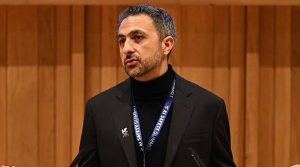
Mustafa Suleyman is one of the most influential entrepreneurs and business leaders in the modern artificial intelligence industry. Best known as a co-founder of DeepMind, the pioneering AI company later acquired by Google, Suleyman has played a significant role in the development and commercialization of advanced AI technologies. Today, he serves as Executive Vice President and CEO of Microsoft AI, where he is focused on developing frontier AI models and shaping Microsoft’s long-term artificial intelligence strategy.
His career is unusual because it spans entrepreneurship, AI research, technology policy, and product development. At DeepMind, Suleyman helped build one of the world’s most important AI companies alongside Demis Hassabis and Shane Legg. After leaving DeepMind, he co-founded Inflection AI, a company focused on developing personal AI systems, before joining Microsoft in 2024 with several members of his Inflection team.
At Microsoft, his responsibilities have continued to evolve alongside the rapid development of generative AI. In March 2026, Microsoft announced a restructuring in which Suleyman would concentrate his efforts on the company’s ambitious superintelligence and frontier-model efforts, while continuing to participate in the broader Copilot leadership structure.
CHECK: Gracy Chen Biography: Bitget CEO Career, Education, Achievements & Web3 Leadership
This Mustafa Suleyman biography explores his early life and education, the founding of DeepMind, his career at Google DeepMind and Inflection AI, his move to Microsoft, his leadership of Microsoft AI, major achievements, and his influence on the future of artificial intelligence.
Quick Facts
| Category | Details |
|---|---|
| Full Name | Mustafa Suleyman CBE |
| Date of Birth | August 1984 |
| Age | 42 (as of 2026) |
| Birthplace | London, England |
| Nationality | British |
| Profession | AI entrepreneur, CEO of Microsoft AI |
| Known For | Co-founder of DeepMind and Inflection AI; CEO of Microsoft AI; author of The Coming Wave |
| Education | Queen Elizabeth’s School, Barnet; University of Oxford (dropped out) |
| Notable Roles | Head of Applied AI at DeepMind; CEO of Inflection AI |
Mustafa Suleyman Biography
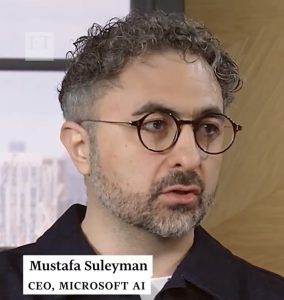
Mustafa Suleyman is one of the defining figures in modern artificial intelligence. As co-founder of DeepMind, the London research lab acquired by Google in 2014, and later co-founder of Inflection AI, he has shaped both the scientific and commercial trajectory of the field. Since March 2024 he has served as CEO of Microsoft AI, the division responsible for consumer-facing products such as Copilot while also driving the company’s push toward frontier models and what he terms “humanist superintelligence.”
Readers searching for Suleyman typically want to understand how a working-class Londoner who left Oxford without a degree became central to three of the most consequential AI organizations of the past fifteen years, what his book The Coming Wave argues, and how he frames the opportunities and risks of increasingly powerful systems. His career blends technical ambition with a long-standing interest in ethics, policy, and social impact—an unusual combination that continues to influence debates about the future of AI.
Mustafa Suleyman Early Life and Background
Mustafa Suleyman was born in August 1984 in London. His father, originally from Syria, worked as a taxi driver; his mother, English, was an NHS nurse. He grew up with two younger brothers in a modest home off Caledonian Road in the London Borough of Islington. The family was working-class, and education was not always the highest priority at home. Suleyman has recalled that his mother sometimes suggested he leave school at 16 to learn a trade such as carpentry or electrical work.
He attended Thornhill Primary School in Islington and later won a place at Queen Elizabeth’s School, Barnet, a selective boys’ grammar school. There he developed an early interest in big questions about society and technology. Through a school friend he met Demis Hassabis, whose younger brother was Suleyman’s best friend; the two teenagers often discussed how technology might improve the world.
When Suleyman was about 16 his parents separated. He and one of his younger brothers lived independently for a period. He has described the experience with the resilience typical of adolescence: precocious, overconfident, and largely unafraid. Those years reinforced a sense of self-reliance that would later surface in his entrepreneurial choices.
Mustafa Suleyman Education
Suleyman enrolled at Mansfield College, University of Oxford, to study philosophy and theology (some accounts also reference elements of PPE). He left after roughly a year, at age 19, without completing the degree. He has explained the decision as a preference for practical action over theoretical study. “I wanted to change the world and get stuff done,” he has said in interviews.
The timing coincided with the aftermath of the September 11 attacks. Suleyman, who has described himself as a strong atheist at the time, helped establish the Muslim Youth Helpline, a non-judgmental telephone counselling service aimed at young British Muslims facing identity struggles, family tensions, and community pressures. The organisation grew into one of the UK’s larger mental-health support services for that community. The experience of listening, facilitating, and building an organisation from scratch proved formative.
Mustafa Suleyman Career
After the helpline, Suleyman worked as a policy officer on human rights for Ken Livingstone, then Mayor of London. He later co-founded Reos Partners, a consultancy that applied conflict-resolution and systems-thinking methods to complex social problems for clients including the United Nations, governments, and NGOs. Around 2009 he became involved in the Copenhagen climate negotiations, an experience that left him sceptical of the capacity of traditional institutions to solve large-scale global challenges.
In 2010 Suleyman co-founded DeepMind Technologies in London with Demis Hassabis and Shane Legg. He took the role of Chief Product Officer and later Head of Applied AI. The company’s explicit ambition was to solve intelligence and use it to address hard scientific and societal problems. DeepMind quickly attracted attention for breakthroughs in reinforcement learning and game-playing systems, most famously AlphaGo’s victory over the world champion Go player.
Google acquired DeepMind in 2014 for a reported sum in the region of £400–650 million, then one of its largest European deals. Suleyman stayed on and led the integration of DeepMind’s technology across Google products. Applied work included medical imaging systems that could detect eye diseases from OCT scans and assist in breast-cancer screening from mammograms, as well as energy-optimisation systems for Google’s data centres. He also helped establish DeepMind Ethics & Society, an early effort to examine the broader implications of advanced AI.
In 2019 Suleyman took a leave of absence amid internal complaints about management style; he has publicly acknowledged shortcomings and expressed regret. He later moved into a vice-president role focused on AI product management and policy at Google before leaving the company in 2022.
That same year he co-founded Inflection AI with Reid Hoffman (LinkedIn co-founder) and researcher Karén Simonyan. As CEO he steered the company toward generative AI systems designed for natural, emotionally intelligent conversation. Inflection’s flagship product, Pi, was positioned as a personal AI companion rather than a pure productivity tool. The startup raised substantial funding and trained competitive large models before Microsoft hired Suleyman, Simonyan, and a significant portion of the Inflection team in March 2024.
At Microsoft, Suleyman was appointed Executive Vice President and CEO of the newly created Microsoft AI division, reporting directly to CEO Satya Nadella. The unit oversees consumer AI experiences including Copilot, Bing, and Edge. In subsequent years he has emphasised building frontier foundation models in-house, reducing reliance on external partners, and pursuing what he calls “humanist superintelligence”—advanced capabilities deliberately designed to remain controllable and to serve human needs. In late 2025 he announced the formation of the MAI Superintelligence Team focused on practical applications in areas such as healthcare, energy, and digital companions while rejecting pure race-to-AGI narratives.
Mustafa Suleyman Major Achievements and Contributions
Suleyman’s most enduring technical contribution is the co-founding and early product leadership of DeepMind, which helped shift AI from a largely academic pursuit into a high-stakes industrial and scientific enterprise. The Google acquisition validated the commercial value of cutting-edge research while giving the lab resources to pursue ambitious goals.
At Inflection he demonstrated that consumer-facing generative AI could prioritise emotional intelligence and long-term relationship-building with users. At Microsoft he has continued that emphasis while scaling the infrastructure and organisational capacity required for frontier models.
Beyond products, Suleyman has consistently raised questions of governance, safety, and social impact. His 2023 book The Coming Wave (written with Michael Bhaskar) examines the dual nature of powerful technologies—AI and synthetic biology in particular—and argues for containment strategies that allow beneficial uses while limiting catastrophic risks. Bill Gates publicly called it his favourite book about AI. Suleyman serves on the board of The Economist and is a Senior Fellow at the Belfer Center for Science and International Affairs at Harvard Kennedy School. In 2019 he was appointed Commander of the Order of the British Empire (CBE) for services to the UK technology industry.
Mustafa Suleyman Technology and Artificial Intelligence Focus
Suleyman’s entire professional identity is rooted in artificial intelligence. From the founding of DeepMind through Inflection’s conversational systems to Microsoft’s consumer and frontier-model efforts, he has operated at the intersection of research, product, and policy. He has publicly discussed the rapid automation of white-collar tasks, the need for AI self-sufficiency at large technology companies, and the importance of designing systems that remain grounded and controllable. He rejects both uncritical techno-optimism and pure doomerism, instead advocating for deliberate, human-centred development of advanced capabilities.
He has no significant public involvement in blockchain, cryptocurrency, or Web3 projects; his work remains firmly within machine learning, generative AI, and related policy questions.
Mustafa Suleyman Businesses, Companies, Projects and Investments
- Co-founder and early product leader, DeepMind (2010–2022 era, post-acquisition roles at Google).
- Co-founder and CEO, Inflection AI (2022–2024).
- CEO of Microsoft AI / EVP roles focused on consumer AI and later frontier models and superintelligence research (2024–present).
- Earlier: Co-founder of the Muslim Youth Helpline and Reos Partners.
He has also been associated with Greylock Partners as a venture partner in earlier periods. Detailed personal investment portfolios are not publicly disclosed.
Mustafa Suleyman Personal Life and Family

Suleyman keeps his private life largely out of the public eye. Reliable sources confirm his family background and the period of independent living after his parents’ separation, but there is no verified public information about a spouse or children. He has spoken about the lasting influence of his mother’s work as a nurse and the values of resilience formed in his teenage years. He currently bases much of his professional life in California while retaining strong ties to the United Kingdom.
Mustafa Suleyman Age, Date of Birth and Nationality
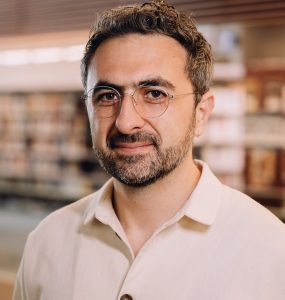
Mustafa Suleyman was born in August 1984 in London, England. As of September 2026 he is 42 years old. He is a British national.
Mustafa Suleyman Net Worth
No authoritative, independently audited figure for Suleyman’s personal net worth is publicly available. Wealth has been generated through the Google acquisition of DeepMind, equity and proceeds related to Inflection AI and the subsequent Microsoft arrangement, and compensation as a senior Microsoft executive. Online estimates circulating on secondary sites vary widely and should be treated as unverified speculation.
Mustafa Suleyman Social Media and Online Presence

Suleyman maintains a personal website at mustafa-suleyman.ai (also linked to the-coming-wave.com). He is active on professional platforms and occasionally shares writing and interviews through Microsoft channels and major publications. Official biographies appear on Microsoft’s site and in his own materials.
Mustafa Suleyman FAQs

Who is Mustafa Suleyman?
Mustafa Suleyman is a British AI entrepreneur, co-founder of DeepMind and Inflection AI, and CEO of Microsoft AI. He is also the author of The Coming Wave.
What is Mustafa Suleyman known for?
He is known for co-founding DeepMind (acquired by Google), building Inflection AI and its Pi companion, leading Microsoft’s consumer AI efforts, and advocating for responsible development of advanced AI systems.
How old is Mustafa Suleyman?
Born in August 1984, he is 42 years old as of 2026.
Where is Mustafa Suleyman from?
He was born and raised in London, England, specifically in the Islington area.
What is Mustafa Suleyman’s educational background?
He attended Queen Elizabeth’s School, Barnet, and briefly studied at Mansfield College, University of Oxford, before leaving without a degree.
What is The Coming Wave about?
The 2023 book, co-authored with Michael Bhaskar, examines the transformative power of AI and synthetic biology and argues for strategies to contain risks while capturing benefits.
Is Mustafa Suleyman involved in Web3 or cryptocurrency?
No. His career and public work centre on artificial intelligence, machine learning, and related policy and ethics questions.
Where can I follow Mustafa Suleyman’s work?
His personal site (mustafa-suleyman.ai), Microsoft AI announcements, and major interviews in outlets such as the Financial Times, Bloomberg, and NPR provide primary updates.
Mustafa Suleyman’s path—from a north London upbringing and an unfinished Oxford degree to co-founding two landmark AI companies and leading Microsoft’s AI division—illustrates both the unusual routes into frontier technology and the growing weight of questions about how powerful systems should be governed. Through DeepMind’s scientific advances, Inflection’s focus on personal AI, and Microsoft’s push for self-sufficient frontier models, he has helped define the practical and ethical contours of the current AI era. His writing and public statements continue to emphasise that the central challenge is not merely building more capable systems, but ensuring they remain tools that expand human possibility rather than diminish it.
Mustafa Suleyman’s career demonstrates how quickly the artificial intelligence industry has evolved over the past decade. From co-founding DeepMind to building Inflection AI and eventually becoming CEO of Microsoft AI, he has repeatedly positioned himself at the center of major developments in the AI ecosystem.
His Microsoft chapter is particularly significant. Suleyman joined the company in 2024 to lead a new Microsoft AI organization focused on consumer AI products and Copilot, and by 2026 his role had expanded toward Microsoft’s longer-term frontier-model and superintelligence ambitions. Microsoft says he will continue leading this high-ambition work as the company develops increasingly advanced AI models.
Beyond his executive positions, Suleyman has become an important voice in discussions about AI’s impact on society, work, technology, and human agency. His career offers a valuable case study for anyone interested in artificial intelligence, technology entrepreneurship, AI leadership, and the future of computing.
Ultimately, Mustafa Suleyman‘s story is not simply about becoming the CEO of Microsoft AI. It is about being involved in several of the defining chapters of modern AI—and his next chapter could be just as consequential as the ones that came before.