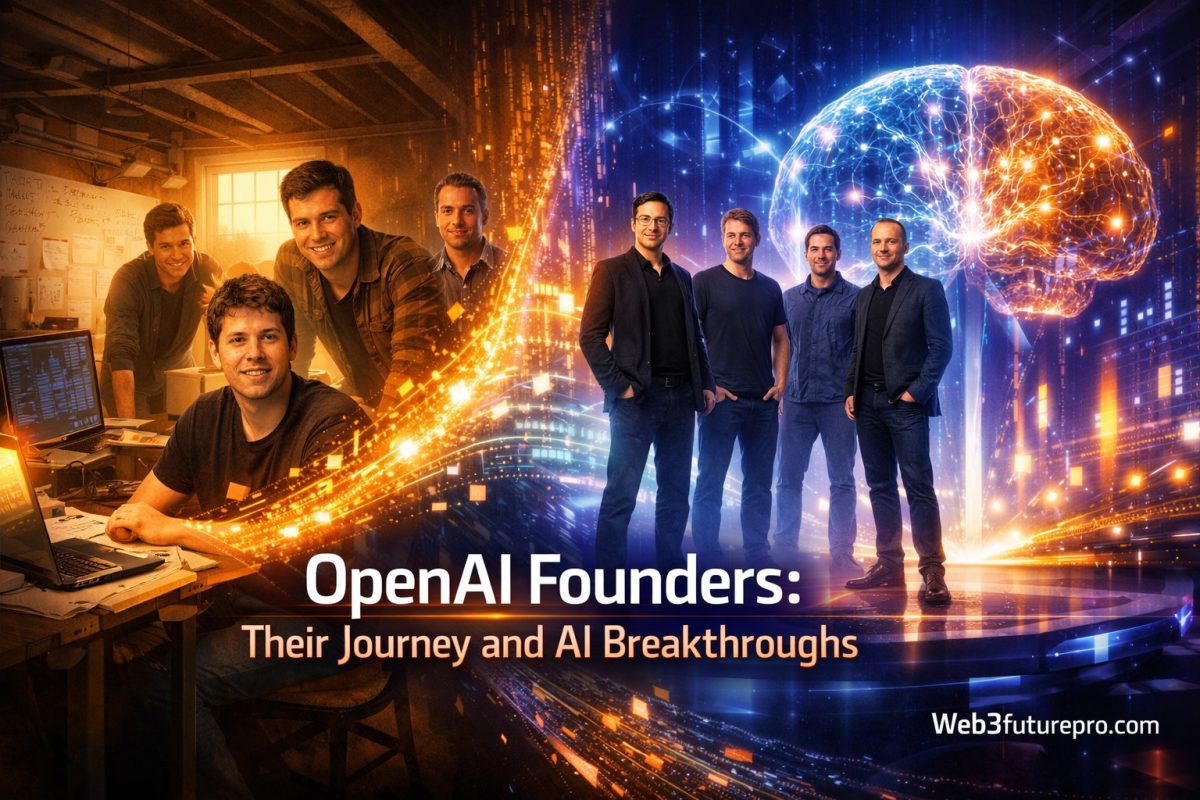
OpenAI Founders: OpenAI’s story is one of the most dramatic and consequential in modern technology. Founded in December 2015 as a nonprofit research lab dedicated to building artificial general intelligence (AGI) that benefits all of humanity, the organization has evolved into a global AI powerhouse valued in the hundreds of billions. Its journey—from idealistic open-source ambitions to massive commercialization, internal drama, and frontier model dominance—offers profound lessons on innovation, leadership, safety, and the tension between rapid progress and responsible development.
In 2026, OpenAI continues to push boundaries with advanced models, massive infrastructure deals, and enterprise expansion, while grappling with enormous compute costs and governance questions. For aspiring AI builders, entrepreneurs in Nigeria, South Africa, Asia, the Middle East, and the US, the founders’ paths highlight the power of bold vision paired with relentless execution.
CHECK: Elon Musk’s Influence on AI and Blockchain: Key Lessons for Builders in 2026
OpenAI Founders: Their Journey and the AI Breakthroughs That Changed Everything
The Founding Vision: A Counterweight to Corporate AI (2015)
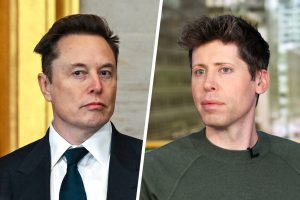
OpenAI emerged from private dinners in 2015 among Silicon Valley leaders concerned that advanced AI could be controlled by a few powerful corporations or governments. Key figures included:
Sam Altman: The Strategic Leader
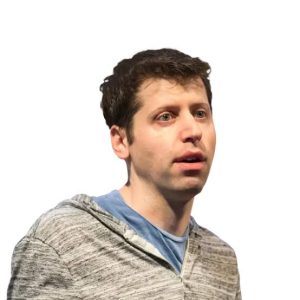
Former president of Y Combinator, Altman brought:
- Vision
- Fundraising ability
- Strategic direction
He transformed OpenAI into a global powerhouse.
- Sam Altman — Then-president of Y Combinator, known for his deal-making and long-term thinking. He became the public face and eventual CEO, driving commercialization while navigating safety debates.
- Elon Musk — Co-chair initially, motivated by existential risks from AI. He provided early vision and funding but departed the board in 2018 over potential conflicts with Tesla’s AI work.
- Greg Brockman — Former CTO of Stripe, who left a high-profile role to become OpenAI’s CTO and later president. He focused on engineering infrastructure and scaling.
- Ilya Sutskever — A star researcher from Google Brain, recruited as the first Research Director. His deep expertise in deep learning helped set the technical direction.
- Wojciech Zaremba — Robotics and deep learning expert who contributed to early research directions.
- John Schulman — Key contributor to reinforcement learning techniques.
Other early team members included Andrej Karpathy, Durk Kingma, and more. Backed by pledges exceeding $1 billion from Reid Hoffman, Peter Thiel, Jessica Livingston, and others, OpenAI positioned itself as an open, collaborative alternative to closed corporate labs.
The mission was clear: advance digital intelligence safely and for humanity’s benefit, initially emphasizing openness and publishing research freely.
Early Years: Research Breakthroughs and the Shift to Scale (2016–2018)
OpenAI’s first phase focused on foundational work in reinforcement learning, robotics, and game-playing systems:
- OpenAI Gym — A toolkit for developing and comparing reinforcement learning algorithms, which became widely adopted.
- Dota 1v1 and OpenAI Five — Demonstrated scaling reinforcement learning to complex environments, defeating professional players in Dota 2.
- Proximal Policy Optimization (PPO) — A foundational RL algorithm still influential today.
- Early robotics efforts and the “Emotion Neuron” discovery in language models, showing emergent semantic understanding.
These breakthroughs built credibility and attracted talent. However, the team realized that competing with well-resourced giants like Google required massive compute and data. This led to a pivotal shift: in 2019, OpenAI restructured with a “capped-profit” for-profit subsidiary to attract investment while keeping the nonprofit mission intact. Microsoft became a major partner with a $1 billion commitment.
The ChatGPT Moment and Commercial Explosion (2022–2024)
The release of ChatGPT in November 2022 changed everything. Built on the GPT series (with GPT-3 and GPT-4 as key milestones), it brought generative AI to the mainstream, reaching 100 million users faster than any previous technology.
Key breakthroughs included:
- GPT-3 and GPT-4 — Massive scaling of transformer models, demonstrating few-shot learning and impressive reasoning.
- DALL·E — Text-to-image generation that democratized creative tools.
- Codex — Powering GitHub Copilot, accelerating software development.
The 2023 board drama—Sam Altman’s brief ouster and rapid reinstatement—exposed tensions between rapid commercialization and safety concerns. Ilya Sutskever, who played a role in the events, later departed in 2024 to found Safe Superintelligence Inc. (SSI). Greg Brockman and Wojciech Zaremba remained among the few original founders still closely tied to the company.
By 2024–2025, OpenAI secured enormous funding rounds, partnerships (Microsoft, Apple, others), and enterprise adoption, while expanding into education, healthcare, and more.
2026 Landscape: Scale, Agents, and Infrastructure
In 2026, OpenAI operates at unprecedented scale, with plans to nearly double its workforce and major infrastructure investments. Breakthroughs include advanced reasoning models (o1 series and successors), multimodal capabilities, and agentic systems that handle complex workflows. The company pursues ambitious projects like AI infrastructure partnerships and applications across industries.
Valuation has soared into the hundreds of billions amid massive raises, though cash burn remains high due to compute demands. Leadership emphasizes enterprise priorities, safety research, and long-term AGI development.
Key Lessons from the OpenAI Founders’ Journey
- Bold Vision Attracts Talent and Capital — Starting with a clear, humanity-focused mission drew top researchers and billions in funding, even as the structure evolved.
- Scaling Laws Matter — Early recognition that bigger models + more data + more compute yields breakthroughs drove the shift from pure research to massive infrastructure investment.
- Governance and Safety Are Ongoing Challenges — The 2023 events and departures (including Sutskever) highlight the difficulty of balancing speed, safety, and commercial pressures. Transparent structures and clear decision-making are critical.
- Adapt or Risk Obsolescence — From nonprofit to hybrid to more commercial orientations, OpenAI repeatedly restructured to stay competitive while preserving core goals.
- Distribution and User Feedback Accelerate Progress — ChatGPT‘s viral adoption provided unprecedented real-world data, fueling rapid iteration.
- Leadership Continuity and Resilience — Altman’s return and the core team’s persistence through turmoil underscore the importance of strong, adaptable leadership.
For global AI builders—whether in Abuja developing localized models, Cape Town focusing on practical applications, or anywhere tackling vertical problems—the OpenAI story shows that transformative impact comes from combining deep technical ambition with pragmatic execution, user-centric products, and the ability to navigate complex trade-offs.
The Road Ahead
OpenAI’s founders set out to ensure AGI benefits humanity. A decade later, the company sits at the center of the AI revolution, with breakthroughs that have reshaped how we work, create, and think. Yet the journey also reveals the tensions inherent in frontier technology: speed versus safety, openness versus control, profit versus mission.
As AI capabilities advance in 2026 and beyond, the lessons from Sam Altman, Greg Brockman, Ilya Sutskever, Wojciech Zaremba, and the broader founding team remain relevant: pursue ambitious goals with rigor, iterate based on real feedback, build resilient teams and structures, and never lose sight of the ultimate purpose—beneficial intelligence for all.
The next chapter of AI will be written by those who learn from this remarkable journey while forging their own paths.