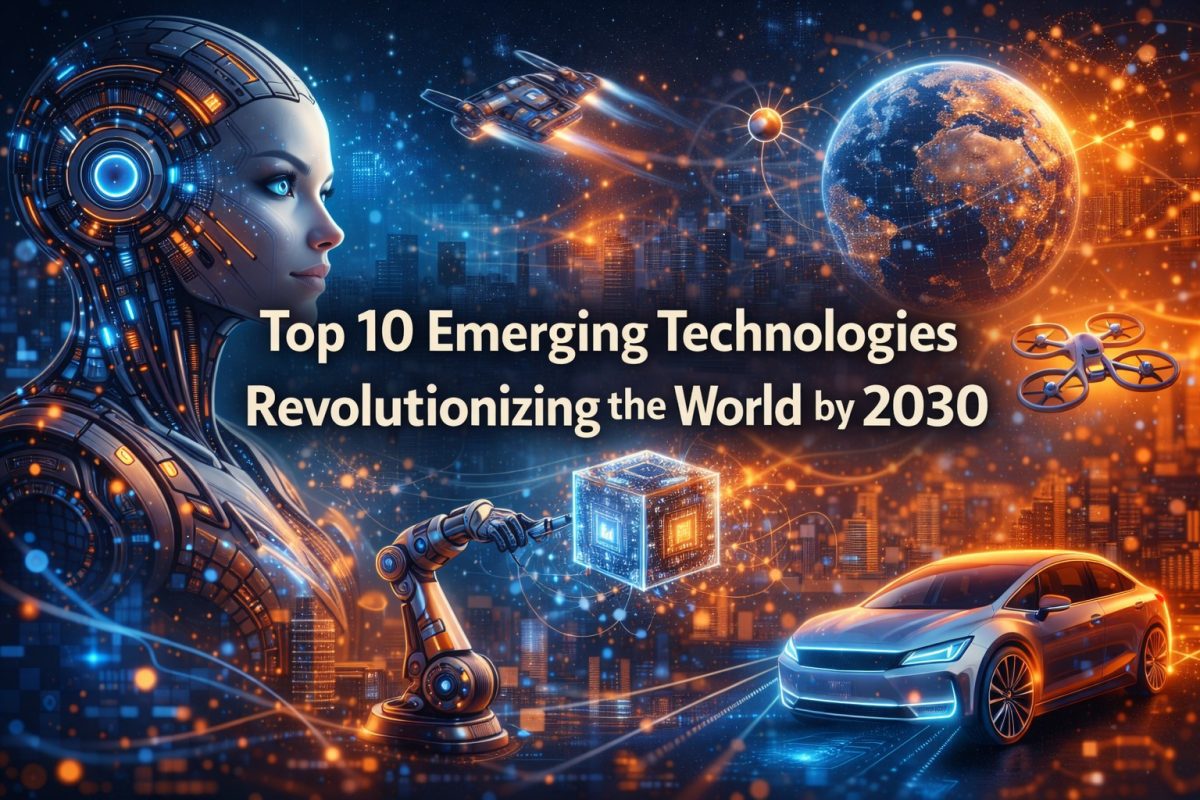
The Top 10 Emerging Technologies Revolutionizing the World by 2030 represent the most transformative forces shaping economies, societies, and daily life over the next four years. As of early 2026, these technologies are moving from labs and pilots to scalable deployment, driven by massive investments, regulatory progress, and urgent global needs like climate change, aging populations, and compute demands.
Drawing from authoritative sources—including the World Economic Forum’s Top 10 Emerging Technologies of 2025 (with forward projections), Gartner’s 2026 Strategic Technology Trends, MIT Technology Review’s breakthrough lists, and broader forecasts from McKinsey, PwC, and others—these innovations converge around AI intelligence, sustainable energy, biotechnology, quantum capabilities, and human augmentation.
By 2030, they could add trillions to global GDP, reshape industries, and address existential challenges—while raising ethical, equity, and security questions. For users in Lagos navigating financial inclusion via AI agents, U.S. firms optimizing supply chains, Asian manufacturers adopting robotics, or Middle Eastern economies investing in nuclear and quantum tech, these shifts offer both opportunity and adaptation pressure.
READ: AI vs Blockchain: Which Emerging Tech Will Lead Innovation in 2026?
This guide ranks the top 10 based on projected impact, maturity trajectory, and cross-sector influence by decade’s end.
Top 10 Emerging Technologies Revolutionizing the World by 2030
1. Agentic & Multiagent AI Systems
Autonomous AI agents that plan, execute, and collaborate on complex goals—without constant human prompts—are exploding. By 2030, Gartner predicts 80% of people will interact with smart robots/agents daily, up from 10% today.
Revolutionary impact: Enterprise workflows, personal assistance, scientific discovery, and commerce become agent-orchestrated. In emerging markets like Nigeria, agents handle remittances, job matching, and education personalization.
2. Quantum Computing & Hybrid Quantum-Classical Systems
Quantum systems solve problems intractable for classical computers—drug discovery, materials science, optimization, cryptography.
By 2030: Practical applications emerge in finance, logistics, and chemistry. Gartner and others forecast breakthroughs democratizing advanced problem-solving.
Global relevance: Accelerates climate modeling and personalized medicine worldwide.
3. Advanced Nuclear Technologies (Small Modular Reactors & Next-Gen)
SMRs and fusion-adjacent designs provide clean, reliable baseload power amid rising energy demands from AI data centers.
Impact: Addresses grid strain and decarbonization. WEF highlights next-generation nuclear as key for energy security.
Regional edge: Middle East and Asia lead deployments for sovereign energy.
4. Structural Battery Composites & Next-Gen Energy Storage
Batteries integrated into vehicle/aircraft structures (lighter EVs, drones) plus sodium-ion and advanced chemistries reduce reliance on rare materials.
By 2030: Cheaper, greener transport and grid storage. MIT and WEF emphasize osmotic power and high-density storage.
5. Engineered Living Therapeutics & Advanced Biotechnology
Programmable cells treat diseases (cancer, neurodegeneration) via living medicines; GLP-1s expand to brain health.
Revolutionary potential: Personalized, regenerative medicine. WEF lists engineered therapeutics and green nitrogen fixation.
Africa/Asia relevance: Affordable biotech for tropical diseases and food security.
6. Humanoid & Advanced Robotics
AI-powered humanoids tackle labor shortages in manufacturing, logistics, elder care, and agriculture.
By 2030: Morgan Stanley forecasts 63 million units by 2050, impacting trillions in wages.
Use cases: South Africa and Nigeria gain from automation in mining/agriculture.
7. Brain-Computer Interfaces & Neurotechnology
Direct mind-machine links restore function (paralysis) and enhance cognition.
Impact: Therapies for neurological disorders; potential augmentation.
Ethical frontier: Privacy and equity concerns grow.
8. Confidential Computing & Digital Provenance
Hardware-enforced data privacy protects AI training and sensitive computations.
By 2030: Gartner sees it as core for trust in AI era—vital for regulated sectors.
Global need: Safeguards data in cross-border AI collaborations.
9. Green & Sustainable Tech Convergence (Carbon Capture, Green Nitrogen, Osmotic Power)
Technologies like green nitrogen fixation and osmotic energy reduce emissions/food insecurity.
Impact: WEF prioritizes climate mitigation tech for net-zero pathways.
Emerging markets: Vital for agriculture and energy in Africa/Asia.
10. Immersive & Spatial Computing (AR/VR/Metaverse Evolution)
AR glasses and spatial AI blend digital/physical worlds for work, education, training.
By 2030: PwC’s Essential Eight includes VR/AR for reinvention.
Everyday change: Remote collaboration, skill training in underserved regions.
Why These Technologies Will Dominate by 2030
- Convergence — AI supercharges biotech, robotics, quantum, energy.
- Investment & Maturity — Trillions flow into AI infrastructure, clean energy, quantum.
- Societal Urgency — Climate, health, labor shortages drive adoption.
- Risks to Watch — Inequality, energy demands, ethics, regulation.
Preparing for 2030
- Individuals: Build AI literacy, reskill in agent orchestration/biotech interfaces.
- Businesses: Pilot agentic systems, explore quantum partnerships, invest in clean energy.
- Regions like Nigeria: Leverage mobile AI for inclusion; adopt modular nuclear/SMRs for power reliability.
Global Power Shifts by 2030
Emerging technologies are reshaping geopolitical influence:
- The United States remains dominant in AI and biotech
- China accelerates 5G, EVs, and quantum research
- The Middle East invests heavily in clean energy
- Africa emerges as a Web3 and fintech growth hub
Technology is becoming the new currency of power.
The Next Five Years Will Decide the Next Fifty
By 2030, we won’t simply use new tools.
We will live inside entirely new systems.
Those who understand and adapt early — entrepreneurs, policymakers, students, investors — will shape the next global era.
The question isn’t whether these technologies will change the world.
It’s who will lead that change.
By 2030, these technologies won’t feel futuristic—they’ll be infrastructure. The revolution is underway: focus on adaptation, ethics, and equitable access to thrive.