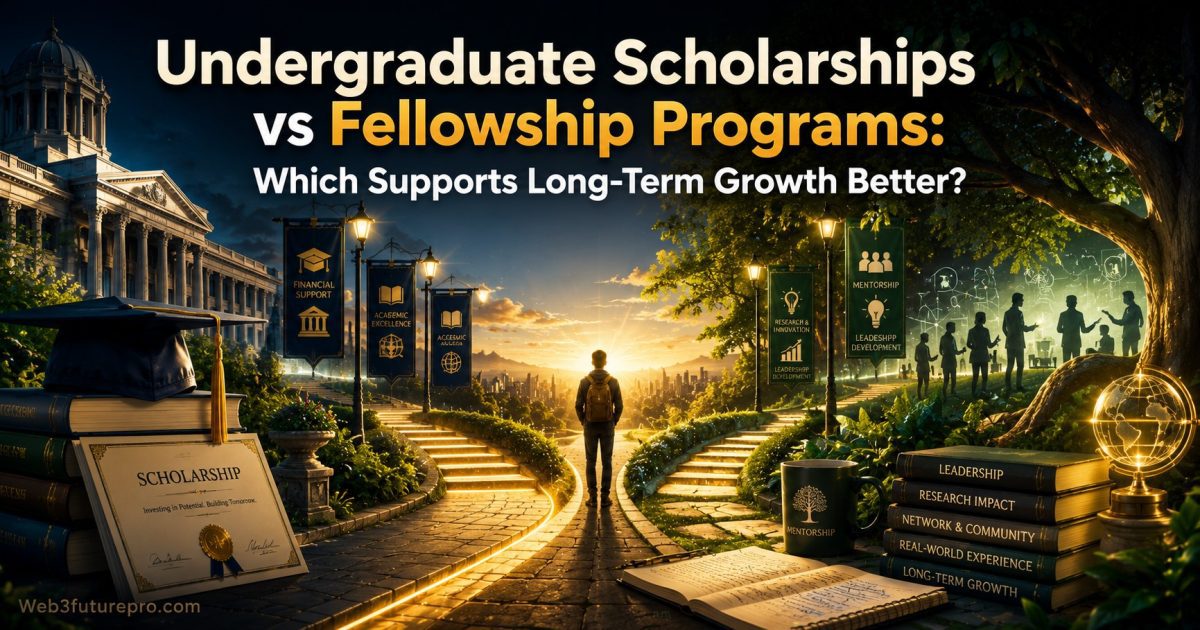
For ambitious students and young professionals, financial support can do much more than reduce the cost of education, it can shape the direction of an entire career. Two important opportunities that often appear in international education and professional development are undergraduate scholarships and fellowship programs. Although the terms are sometimes used interchangeably, they generally serve different purposes. This raises an important question: Undergraduate Scholarships vs Fellowship Programs: Which Supports Long-Term Growth Better?
Undergraduate scholarships are primarily designed to help students pursue bachelor’s degrees by reducing expenses such as tuition, accommodation, books, and other educational costs. They may be awarded based on academic achievement, financial need, leadership, community involvement, talent, or other criteria. Fellowships, meanwhile, are often associated with advanced study, research, professional development, leadership, specialized training, or career-focused projects. Their benefits can extend beyond financial assistance to include mentorship, networking, research experience, and professional recognition.
For an undergraduate student, receiving a scholarship can provide the foundation for long-term growth by making it possible to complete a degree without the same level of financial pressure. Fellowships can become particularly valuable later in the academic or professional journey, when specialized experience, research opportunities, leadership development, and professional networks become increasingly important.
CHECK: Online Certifications vs University Scholarships: Which Is Better for Tech Careers?
However, there is no universal winner. The better opportunity depends heavily on your current educational level, career ambitions, financial needs, academic interests, and the specific benefits attached to each program. Funding structures can also vary considerably from one award to another, so applicants should always examine the individual program’s eligibility requirements and conditions.
In this comprehensive comparison, we’ll examine undergraduate scholarships and fellowship programs based on financial support, eligibility, career development, mentorship, networking, academic opportunities, professional recognition, and long-term career impact. By the end, you’ll have a clearer understanding of which opportunity can provide the greatest value at different stages of your educational and professional journey.
For students planning higher education and careers that stretch over decades, the choice between undergraduate scholarships and fellowship programmes is more than a question of immediate funding. Scholarships primarily remove financial barriers so that capable students can complete a degree. Fellowships, by contrast, often invest in the individual—supporting research, leadership development, specialised projects, or professional immersion—while also providing financial resources. Both can be transformative. The critical difference lies in how each shapes skills, networks, credentials, and trajectories over the long term.
This comparison examines undergraduate scholarships and fellowship programmes (including those open to or designed for undergraduates, as well as the broader fellowship model that many strong undergraduates later pursue). It focuses on long-term growth: academic persistence, career optionality, research or leadership capacity, and lifetime professional impact. The analysis is written for a global audience, with relevance for students and families in the United States, Asia, the Middle East, and South Africa.
Program Overview: Undergraduate Scholarships vs Fellowship Programs

Undergraduate scholarships are financial awards that help cover tuition, fees, books, and sometimes living expenses for bachelor’s-level study. They may be merit-based (academic excellence, talent, leadership), need-based, or tied to specific criteria such as field of study, background, or geography. Many are renewable for multiple years provided the student maintains a required GPA or enrolment status. The core purpose is access and degree completion. Obligations are usually limited to academic progress.
Fellowship programmes are competitive awards that typically combine funding with structured development opportunities. While many classic fellowships target graduate students, postdocs, or early-career professionals, a growing number of undergraduate fellowships exist—research fellowships, public-service fellowships, leadership programmes, and summer research immersions. Fellowships often require a research proposal, project plan, or demonstrated potential for future contribution. Recipients commonly receive stipends, mentorship, research support, conference funding, and access to professional networks. The emphasis is on developing the person and their work, not solely on paying for classes.
| Aspect | Undergraduate Scholarships | Fellowship Programmes |
|---|---|---|
| Primary Purpose | Financial access to undergraduate education | Individual development, research, or professional growth |
| Typical Recipients | Undergraduates (sometimes broader) | Undergraduates (select programmes), graduates, researchers, professionals |
| Core Deliverable | Tuition/fee support + degree pathway | Stipend + project/mentorship + experience |
| Duration | Often multi-year / renewable | Fixed term (months to several years) |
| Obligations | Academic standing | Research output, reports, engagement, sometimes service |
Scholarships underwrite the degree. Fellowships underwrite the development of the scholar or leader.
Eligibility Requirements
Undergraduate scholarships vary widely. Common requirements include enrolment (or planned enrolment) in an accredited undergraduate programme, minimum academic performance, demonstration of financial need (for need-based awards), or evidence of merit, talent, or specific background. Some target particular fields, underrepresented groups, or geographic origins. Citizenship or residency rules apply to many government and institutional awards. Renewal usually depends on continued eligibility and satisfactory academic progress.
Fellowship programmes are generally more selective and forward-looking. Undergraduate research or leadership fellowships often require strong academic records, faculty recommendations, a statement of purpose or research interest, and sometimes prior experience or a clear project idea. Graduate and professional fellowships typically demand a completed bachelor’s degree, research potential, and a detailed proposal. Many emphasise future contribution to a field or society rather than past achievement alone. Work experience, publications, or demonstrated leadership can strengthen applications at higher levels.
| Criterion | Undergraduate Scholarships | Fellowship Programmes |
|---|---|---|
| Academic Stage | Current or incoming undergraduates | Undergraduates (some), graduates, postdocs, professionals |
| Selection Emphasis | Merit, need, or category | Potential, research quality, leadership, fit |
| Proposal / Project Required | Rarely | Frequently |
| Recommendations | Often required | Almost always required and heavily weighted |
| Prior Research / Experience | Helpful but not always essential | Frequently expected or strongly preferred |
Scholarships cast a wider net for access. Fellowships filter more tightly for demonstrated or projected excellence and initiative.
Application Process
Scholarship applications are often integrated into university financial-aid or admissions processes, or submitted through dedicated scholarship portals. Materials commonly include transcripts, a personal statement, recommendations, and financial information where relevant. Deadlines align with academic calendars. Selection committees review academic records, need, and fit with the award’s criteria. Decisions may be automatic for some institutional awards or competitive for external ones.
Fellowship applications are typically more intensive. Candidates prepare research or project proposals, detailed CVs, multiple strong recommendation letters, and sometimes writing samples or evidence of prior work. Undergraduate research fellowships may involve faculty nomination or campus competitions before national review. Deadlines are firm, and the process can include interviews. Success depends heavily on the quality of the intellectual or leadership narrative and the strength of endorsements.
The scholarship process rewards consistent academic performance and clear need or merit. The fellowship process rewards originality, clarity of purpose, and the ability to articulate future impact.
Benefits & Funding
Undergraduate scholarships primarily reduce the cost of earning a degree. Full-tuition or full-ride awards can eliminate or sharply reduce debt. Partial awards lower the net price. By enabling completion of a bachelor’s degree, scholarships support the well-documented long-term earnings and employment advantages associated with degree attainment. Additional benefits may include recognition on a résumé and, in some cases, modest mentoring or cohort activities.
Fellowships frequently provide stipends that support living costs while the recipient focuses on research, a project, or professional development. Many also cover research expenses, travel to conferences, or specialised training. The non-monetary benefits are often more distinctive: intensive mentorship, access to research groups or professional networks, structured leadership development, and a prestige signal that carries weight in graduate admissions, research careers, and selective employers. Because fellowships invest in the person’s trajectory, they can accelerate specialisation and open doors that pure financial aid does not.
| Benefit Dimension | Undergraduate Scholarships | Fellowship Programmes |
|---|---|---|
| Financial Focus | Tuition, fees, sometimes living costs | Stipend, research/project costs, living support |
| Debt Reduction | High potential | Variable; often indirect via opportunity |
| Mentorship & Networks | Limited / variable | Central design feature |
| Research / Project Experience | Rare | Core element |
| Prestige / Signal | Helpful | Often high |
| Long-Term Developmental Focus | Degree completion | Individual capacity and trajectory |
Scholarships optimise for affordable degree completion. Fellowships optimise for accelerated professional and intellectual growth.
Acceptance Rate
Undergraduate scholarships range from relatively accessible institutional awards to highly competitive national or international prizes. Many university scholarships have moderate acceptance rates once basic eligibility is met; flagship external scholarships can be far more selective.
Fellowships are typically more competitive. National undergraduate research fellowships, public-service fellowships, and especially graduate-level research fellowships often accept only a small percentage of applicants. The combination of limited slots, high-calibre pools, and the requirement for a compelling proposal produces low acceptance rates. This selectivity itself contributes to the prestige that supports long-term growth.
Global Opportunities
Both forms of support exist worldwide. Undergraduate scholarships from governments, universities, and foundations enable students from Asia, the Middle East, Africa, and elsewhere to access local or international bachelor’s programmes. Many include mobility components or partnerships.
Fellowships frequently emphasise international experience, research collaboration, or cross-border networks. Undergraduate research and leadership fellowships can include overseas components; graduate and professional fellowships often explicitly support global mobility, language study, or placement in international research environments. The networks formed through fellowships can be especially valuable for long-term international careers.
Career Impact
Long-term growth is where the distinction becomes clearest.
Undergraduate scholarships support degree completion. Research consistently links additional grant and scholarship aid to higher persistence, graduation rates, and subsequent employment and earnings outcomes. By reducing financial stress and debt, scholarships free students to focus on learning, pursue internships, and graduate on time—foundational advantages that compound over a career. A completed bachelor’s degree remains a powerful baseline credential in most labour markets.
Fellowships add layers that scholarships rarely provide. Research fellowships give undergraduates early experience designing and executing projects, presenting work, and receiving mentorship—experiences strongly associated with persistence in STEM and clearer post-graduation plans. Leadership and public-service fellowships build networks, practical skills, and a track record of initiative that graduate programmes and selective employers value. At higher levels, fellowships serve as launchpads into research careers, specialised professional paths, and influential roles. The combination of funding, structured development, and prestige often accelerates movement into graduate study, research positions, or leadership tracks.
In short, scholarships help more students reach the starting line of a degree-holding career. Fellowships help high-potential individuals run farther and faster once they are on the track—particularly in research, academia, policy, and specialised professional domains.
Tips for Winning
For undergraduate scholarships: Maintain strong grades from the outset. Apply broadly—institutional, national, field-specific, and background-based awards. Write clear, specific personal statements that connect your background to your goals. Meet every deadline and follow instructions precisely. Seek renewals by consistently meeting academic requirements. Combine multiple smaller awards when possible.
For fellowship programmes: Start building relationships with faculty early; strong recommendations are decisive. Seek research, leadership, or project experience even before applying. Craft proposals that are ambitious yet feasible and clearly articulate impact. Tailor every application to the funder’s priorities. Treat the process as professional development in itself—feedback from unsuccessful attempts often strengthens later applications. For undergraduate research fellowships, demonstrate curiosity and readiness to learn under mentorship.
In both cases, authenticity and evidence of sustained effort outperform generic claims of ambition.
Undergraduate scholarships support long-term growth primarily by enabling degree attainment and reducing financial barriers. They are the more inclusive and foundational instrument. For the majority of students, securing scholarship support that makes a quality bachelor’s degree affordable or debt-free is one of the highest-leverage steps available. The long-term benefits flow through graduation, lower debt, and the broad opportunities a degree unlocks.
Fellowship programmes support long-term growth more directly and intensively for those who obtain them. By combining funding with mentorship, research or leadership experience, networks, and prestige, fellowships accelerate specialised development and open selective pathways that pure financial aid seldom reaches. For students with clear research, academic, or leadership ambitions, a strong fellowship can shape the trajectory of an entire career more powerfully than a scholarship alone.
The optimal strategy for most ambitious students is sequential and complementary: pursue undergraduate scholarships aggressively to complete a strong degree with minimal debt, while simultaneously seeking research experiences, leadership roles, and undergraduate fellowships that build the profile needed for later, more selective fellowships or graduate opportunities. Scholarships create the platform; fellowships refine and elevate the trajectory.
In 2026, both remain essential tools. Scholarships democratise access to the degree that still underpins most high-growth careers. Fellowships invest in the individuals most likely to push fields forward. Assess your current stage, financial reality, and long-term aims honestly. Then pursue the combination that maximises both completion and distinctive development. The students who grow farthest usually secure both forms of support at the right moments.
When comparing undergraduate scholarships vs fellowship programs, the most important point is that they are generally designed to support different stages and objectives. An undergraduate scholarship is often the stronger option for students who need financial assistance to complete a bachelor’s degree, while a fellowship can provide additional value when the goal shifts toward specialized research, professional development, leadership, or advanced career preparation.
Undergraduate scholarships can have a powerful long-term impact because they provide access to higher education and may reduce the financial burden associated with earning a degree. This can allow students to concentrate more on academics, internships, extracurricular activities, networking, and building the foundation for future postgraduate or professional opportunities.
Fellowship programs, meanwhile, can offer benefits that extend beyond tuition assistance. Depending on the program, fellows may receive funding alongside research opportunities, specialized training, mentorship, professional networks, travel support, or opportunities to work on meaningful projects. These experiences can strengthen a candidate’s professional profile and create connections that remain valuable long after the fellowship ends.
For a student who has not yet earned a bachelor’s degree, an undergraduate scholarship is usually the more immediately valuable opportunity because it directly supports the education needed to establish a career foundation. For a graduate, researcher, or emerging professional seeking specialized experience and career acceleration, a fellowship may provide greater long-term professional value.
The smartest strategy is therefore not necessarily to choose one over the other. A student can use an undergraduate scholarship to obtain a strong academic foundation and later pursue competitive fellowships to gain research experience, leadership exposure, professional connections, and specialized expertise.
Ultimately, long-term growth comes from combining education with experience. Funding can open the door, but the skills, relationships, achievements, projects, and impact you build along the way will determine how far that opportunity takes you. Whether you secure an undergraduate scholarship, a fellowship, or eventually both, choosing opportunities that align with your long-term career goals can give you a powerful advantage in an increasingly competitive global job market.