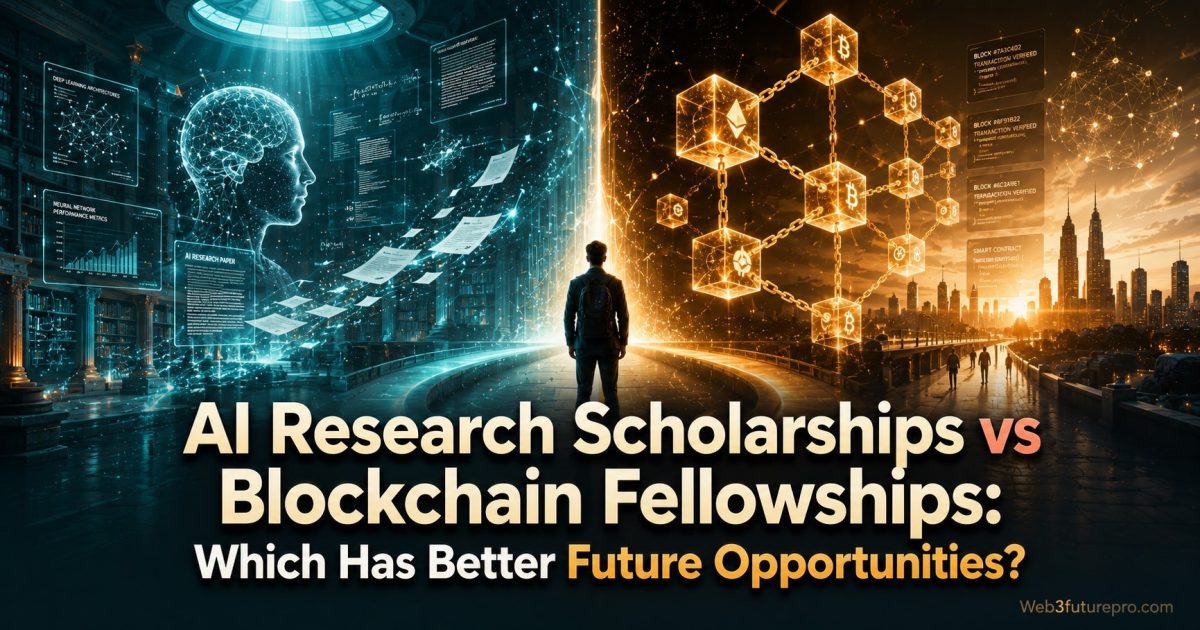
Artificial intelligence and blockchain are two of the most transformative technologies shaping the global economy, and both fields are creating new opportunities for students, researchers, and technology professionals. As universities, governments, and technology companies increase investment in advanced research, specialized funding opportunities are becoming increasingly valuable for people who want to build careers at the intersection of innovation and technology. This raises an important question: AI Research Scholarships vs Blockchain Fellowships: Which Has Better Future Opportunities?
AI research scholarships can help students pursue advanced study and research in areas such as machine learning, generative AI, computer vision, natural language processing, robotics, AI safety, and AI-enabled science. The growing demand for AI expertise is reflected in the global labor market: PwC’s 2026 AI Jobs Barometer found that jobs requiring specific AI skills were growing substantially faster than the overall jobs market, while AI skills carried a significant wage premium.
Blockchain fellowships, meanwhile, can provide researchers and emerging professionals with funding, mentorship, industry connections, and opportunities to investigate areas such as decentralized finance, smart contracts, Web3 infrastructure, tokenization, digital identity, and blockchain scalability. Current 2026 programs demonstrate that blockchain research opportunities can also extend into the intersection of AI and decentralized technology.
Both pathways can produce valuable academic credentials, research experience, professional networks, and career opportunities. However, they differ considerably in market size, research funding, technical specialization, industry adoption, and potential career paths. AI research currently benefits from broad adoption across numerous industries, while blockchain offers a more specialized ecosystem with opportunities concentrated around Web3, financial technology, decentralized infrastructure, and related applications.
CHECK: Remote Learning vs Studying Abroad: Which Is Better for African Tech Students?
In this comprehensive comparison, we’ll examine AI research scholarships and blockchain fellowships based on funding, eligibility, research opportunities, industry demand, career prospects, earning potential, mentorship, networking, and long-term growth. Whether you’re an undergraduate student, graduate researcher, PhD candidate, or aspiring technology professional, this guide will help you determine which pathway offers the strongest future opportunities in 2026 and beyond.
In 2026 the two most dynamic technology domains continue to attract ambitious students and early-career researchers: artificial intelligence and blockchain. Funding mechanisms reflect that energy. AI research scholarships—ranging from undergraduate support through doctoral and postdoctoral awards—channel substantial resources into fundamental and applied machine learning, AI safety, interdisciplinary applications, and workforce development. Blockchain fellowships and related research awards support work on distributed systems, cryptography, decentralised finance, tokenisation, and the growing intersection of blockchain with AI and real-world infrastructure.
Both pathways can launch high-impact careers. The decisive question for most applicants is which offers stronger and more durable future opportunities in terms of research positions, industry roles, funding continuity, geographic mobility, and long-term career optionality. This comparison examines AI research scholarships and blockchain fellowships through that lens for a global audience.
Program Overview: AI research scholarships vs blockchain fellowships 2026
AI research scholarships and fellowships form a broad ecosystem. They include university-administered scholarships for AI-focused degrees, national research-council awards, industry-sponsored PhD and postdoctoral fellowships (from organisations such as Google DeepMind, NVIDIA, Meta, Microsoft Research, and others), AI safety research programmes, and interdisciplinary centres that fund doctoral work at the intersection of AI and other fields. Support typically covers tuition or fees, stipends, compute resources, conference travel, and mentorship. Many programmes emphasise both foundational research and pathways into industry or entrepreneurship.
Blockchain fellowships and scholarships are more specialised. They encompass research funding for blockchain protocols, cryptography, decentralised systems, token engineering, and Web3 infrastructure; industry or foundation fellowships focused on open-source contribution or applied development; and emerging programmes that explore blockchain’s role in financing AI infrastructure, decentralised compute, or verifiable AI. Awards may provide research stipends, mentorship, certifications, publication support, or short-term intensive development experiences. Some explicitly target the AI–blockchain convergence.
| Aspect | AI Research Scholarships / Fellowships | Blockchain Fellowships |
|---|---|---|
| Primary Focus | Machine learning, AI systems, safety, applications | Distributed ledgers, cryptography, Web3, tokenisation |
| Typical Scope | Broad (foundations + applied + interdisciplinary) | Narrower, protocol- and application-specific |
| Common Duration | Multi-year (degrees) or 3–24 months (fellowships) | Months to 1–2 years |
| Institutional Backing | Universities, governments, major tech labs | Foundations, industry groups, specialised centres |
| Intersection Potential | High (AI applied widely) | Growing (AI × blockchain, DePIN, verifiable compute) |
AI funding is embedded in large, well-resourced research ecosystems. Blockchain funding is more concentrated and often more experimental.
Eligibility Requirements
AI research scholarships generally require strong academic records in computer science, mathematics, statistics, or related quantitative fields. Doctoral and postdoctoral awards emphasise research potential, prior publications or projects, and fit with specific labs or centres. Language proficiency, recommendation letters, and sometimes standardised tests or coding assessments appear in international programmes. Many awards are open globally, with some targeting specific regions or underrepresented groups.
Blockchain fellowships frequently seek demonstrated interest or experience in cryptography, distributed systems, smart contracts, or open-source contribution. Academic thresholds vary; some prioritise technical portfolios, protocol contributions, or prior Web3 work over traditional credentials. Research-oriented awards still value strong quantitative backgrounds. Certain programmes are open to developers and builders without advanced degrees, while others target graduate students.
AI pathways often demand deeper formal academic preparation. Blockchain pathways can reward practical systems experience and community contribution more readily.
Application Process
AI research scholarship applications typically involve academic transcripts, research statements or proposals, multiple recommendation letters, CVs highlighting projects or publications, and sometimes interviews or technical assessments. Deadlines align with university admissions or annual fellowship cycles. Competition is intense for prestigious lab-affiliated or industry-sponsored awards.
Blockchain fellowship applications often require a research or project proposal, evidence of relevant technical work (code repositories, prior contributions, or whitepapers), recommendations, and a statement of motivation. Some development-focused fellowships emphasise portfolios and practical assessments more than lengthy academic statements. Cycles may be more frequent or cohort-based.
Both demand clear articulation of research or contribution potential. AI processes lean more heavily on academic signalling; blockchain processes frequently weight demonstrated building experience.
Benefits & Funding
AI research awards commonly provide comprehensive support: competitive stipends, tuition coverage, access to significant compute resources, travel funds, and structured mentorship from leading researchers. Industry-linked fellowships can include high stipends, compute budgets, and clear pathways toward full-time research or engineering roles. The volume of available funding is large because governments, universities, and major technology companies treat AI as a strategic priority.
Blockchain fellowships typically offer stipends or research grants, mentorship, sometimes certifications or publication support, and access to specialised communities. Funding levels vary widely; some are modest relative to top AI awards, while selective programmes provide meaningful support. Additional value often comes from network effects within Web3 ecosystems and opportunities to contribute to open-source infrastructure that can attract further grants or industry interest.
| Benefit Dimension | AI Research Scholarships / Fellowships | Blockchain Fellowships |
|---|---|---|
| Stipend / Financial Support | Often competitive and multi-year | Variable; sometimes project-based |
| Compute / Infrastructure | Frequently substantial | More limited or community-sourced |
| Mentorship Quality | Access to top academic and industry labs | Strong within specialised communities |
| Career Transition Support | High (research → industry pathways) | Strong within Web3 / crypto ecosystems |
| Prestige Signal | Broadly recognised across tech and academia | Stronger within blockchain / crypto circles |
AI funding generally offers greater scale and institutional stability. Blockchain funding can deliver high leverage within its domain and at emerging intersections.
Acceptance Rate
Both categories are competitive. Flagship AI doctoral fellowships, industry research fellowships, and AI safety programmes often accept only a small percentage of applicants—sometimes in the low single digits for the most selective cohorts. The large applicant pools reflect the field’s popularity and the volume of funding.
Blockchain fellowships also face high competition relative to the number of slots, especially for well-known research or open-source programmes. Because the overall funding pool is smaller, absolute numbers of awards are lower, yet dedicated applicants with strong technical portfolios can find viable entry points.
Selectivity is high in both; the absolute number of opportunities is substantially larger on the AI side.
Global Opportunities
AI research scholarships and fellowships operate at global scale. Major programmes recruit internationally, support mobility between continents, and feed into research labs, technology companies, and academic departments worldwide. Opportunities exist in North America, Europe, Asia, and increasingly in other regions through targeted scholarships and partnerships. Remote and hybrid options continue to expand.
Blockchain fellowships are also internationally oriented, with strong activity in regions active in crypto and Web3 development. Many programmes welcome global applicants and support remote contribution. Physical hubs remain important for certain research and industry networks. The AI–blockchain intersection is creating additional cross-domain opportunities that draw talent from both communities.
AI pathways currently offer broader geographic and institutional reach. Blockchain pathways provide focused access to a globally distributed but more specialised ecosystem.
Career Impact
Future opportunities constitute the core of the comparison.
AI research training opens doors across a wide spectrum: academic research positions, industry research labs, applied machine learning and engineering roles, AI safety and governance work, interdisciplinary science, and entrepreneurship. Demand for AI talent remains high across sectors—technology, healthcare, finance, manufacturing, climate, and government. The skills developed (modelling, large-scale systems, evaluation, safety considerations) transfer readily. Funding continuity and institutional support reduce career risk.
Blockchain expertise supports roles in protocol development, cryptography engineering, decentralised systems, token engineering, Web3 product and infrastructure companies, and specialised consulting or research. High-upside opportunities exist, particularly for those who contribute meaningfully to core infrastructure or successful projects. The market is smaller and more cyclical than AI. Volatility in crypto markets and funding environments can affect short-term opportunity volume. However, intersections with AI (decentralised compute, verifiable machine learning, tokenised infrastructure financing) are expanding and may create hybrid career paths of rising value.
In aggregate, AI research scholarships currently position recipients for a larger, more stable, and more diversified set of future opportunities. Blockchain fellowships can produce excellent outcomes for those with genuine conviction in decentralised systems and the resilience to navigate a more specialised market—especially if they also build complementary AI or systems skills.
Tips for Winning
For AI research scholarships: Build a strong quantitative foundation and a portfolio of projects or publications. Target labs and programmes whose research agendas align with your interests. Craft precise research statements. Secure detailed recommendation letters from people who know your technical work. Apply broadly across university, national, and industry-sponsored opportunities. Demonstrate both technical depth and awareness of broader impacts (including safety and societal considerations where relevant).
For blockchain fellowships: Contribute visibly to open-source projects or protocol ecosystems. Develop demonstrable skills in relevant languages, cryptography, or systems design. Prepare clear proposals that address real technical or economic challenges. Engage with the community through forums, conferences, or prior contributions. Highlight any work at the AI–blockchain intersection. Treat the application as evidence of both technical ability and long-term commitment to the domain.
Across both: Start early, iterate on application materials, and seek feedback from mentors or past recipients. Consistency of output matters more than any single credential.
AI research scholarships currently offer better future opportunities for the majority of applicants. The combination of larger funding volumes, broader institutional support, higher absolute numbers of research and industry positions, greater geographic reach, and more diversified career pathways creates a more robust and lower-risk trajectory. Skills developed in AI research remain highly transferable across sectors and economic cycles.
Blockchain fellowships offer strong future opportunities for those specifically committed to decentralised systems, cryptography, and Web3 infrastructure. They can deliver high leverage, distinctive expertise, and access to rapidly evolving technical communities. The most promising long-term positions increasingly sit at the intersection of blockchain with AI, decentralised physical infrastructure, and real-world asset or compute financing. Candidates who treat blockchain as a complementary specialisation rather than an exclusive path improve their optionality.
The highest-upside strategy for many talented individuals is to pursue rigorous AI research training while remaining open to blockchain-related problems and tools. Foundational strength in machine learning, systems, and evaluation methods travels well into both pure AI roles and hybrid decentralised applications. Conversely, deep blockchain expertise paired with solid AI literacy positions candidates well for emerging infrastructure challenges.
Assess your genuine intellectual interests, risk tolerance, and preferred working style. Then select the funding pathway that maximises both skill development and exposure to the problems you most want to solve. In 2026, AI research scholarships provide the broader platform; blockchain fellowships provide focused intensity within a specialised and still-evolving domain. The stronger long-term opportunities generally accrue to those who build depth in AI while staying curious about the infrastructures—blockchain included—that will shape how intelligence is trained, verified, and deployed.
When comparing AI research scholarships vs blockchain fellowships, both can provide valuable pathways into emerging technology careers, but AI currently offers broader future opportunities because artificial intelligence is being adopted across a much wider range of industries. Healthcare, finance, education, manufacturing, cybersecurity, professional services, and technology companies are all increasing their demand for AI-related expertise. PwC’s 2026 analysis of more than one billion job advertisements found that jobs requiring AI skills were growing far faster than the overall jobs market.
AI research scholarships can therefore be particularly valuable for students who want to pursue careers in machine learning, AI research, robotics, generative AI, computer vision, natural language processing, or AI-enabled scientific discovery. Major research organizations are actively supporting this pipeline. For example, Google DeepMind currently supports AI-related scholarships and fellowships, including a Pan-African AI for Science master’s initiative designed to provide scholarships, equipment, and computing resources to African students.
Blockchain fellowships, however, remain highly attractive for people who want to specialize in decentralized technologies. Research opportunities can cover smart-contract security, DeFi, tokenomics, scalability, distributed systems, decentralized AI, and Web3 infrastructure. Some current programs combine research funding with mentorship, certifications, and publication support, demonstrating the growing ecosystem around blockchain research.
For students primarily focused on career breadth, research funding, and global employment opportunities, AI research scholarships currently have the stronger advantage. For candidates passionate about decentralization, cryptocurrency infrastructure, smart contracts, Web3, and emerging financial technologies, blockchain fellowships can provide a valuable specialized pathway.
The smartest long-term strategy may be to develop expertise across both fields. The intersection of AI and blockchain is already creating research opportunities involving decentralized AI, verifiable computation, AI-powered smart-contract auditing, blockchain analytics, and decentralized machine learning.
Ultimately, the best opportunity is the one that aligns with your research interests and career ambitions. AI offers broader market demand today, while blockchain offers powerful specialization and the potential for technological convergence with AI. Students who combine strong research ability with practical skills in both technologies could be particularly well positioned for the next generation of global technology careers.