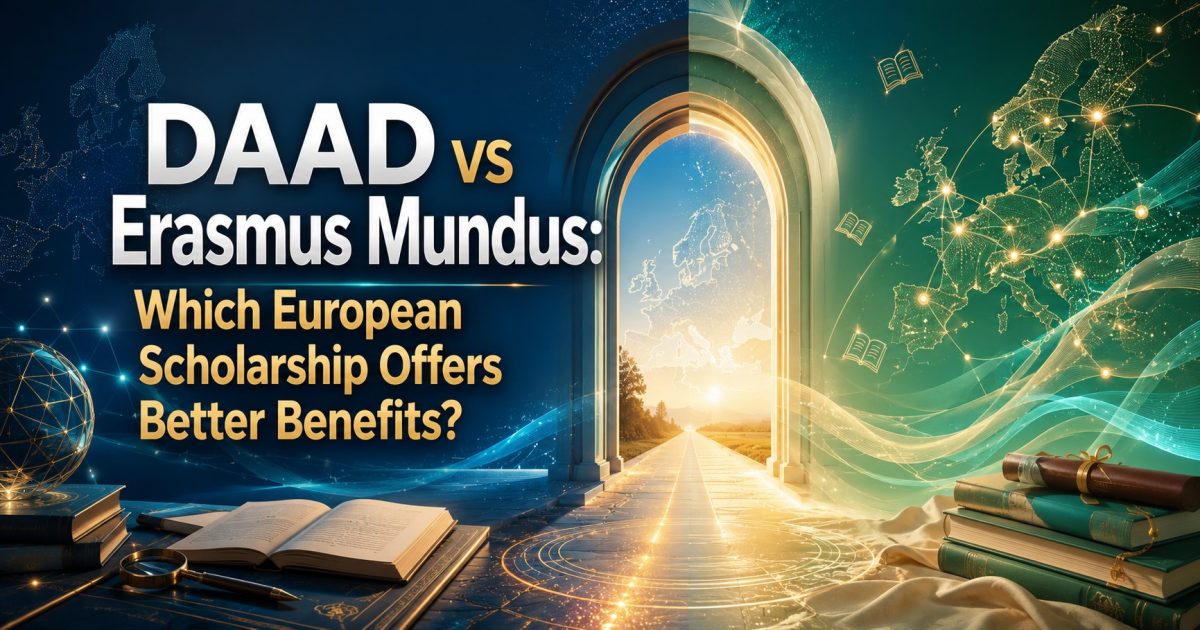
DAAD vs Erasmus Mundus: Europe remains one of the world’s most attractive destinations for international students, offering globally recognized universities, cutting-edge research opportunities, and numerous fully funded scholarship programs. Among the most prestigious are the DAAD Scholarship and the Erasmus Mundus Scholarship, both of which provide substantial financial support to talented students pursuing higher education in Europe. If you’re planning to study abroad in 2026, you may be asking: DAAD vs Erasmus Mundus: Which European Scholarship Offers Better Benefits?
While both scholarships aim to promote academic excellence and international collaboration, they differ in several key areas, including eligibility requirements, study destinations, funding coverage, program structure, and career opportunities after graduation. The DAAD (German Academic Exchange Service) Scholarship primarily supports students, graduates, and researchers pursuing studies or research at accredited universities in Germany. In contrast, the Erasmus Mundus Scholarship, funded by the European Union, enables students to earn joint or multiple master’s degrees while studying at several universities across different European countries.
As demand for international education continues to grow, both scholarship programs have become increasingly competitive, attracting thousands of applicants from around the world each year. Understanding their unique advantages can help you select the program that best matches your academic interests, career aspirations, and preferred study experience.
CHECK: Blockchain Developer vs AI Engineer: Which Remote Career Has More Opportunities?
In this comprehensive comparison, we’ll examine the DAAD Scholarship and the Erasmus Mundus Scholarship based on eligibility criteria, financial benefits, tuition coverage, monthly stipends, travel allowances, participating universities, application process, career prospects, and overall student experience. Whether your goal is to study in Germany or experience multiple European countries, this guide will help you determine which scholarship offers the greatest value in 2026.
DAAD vs Erasmus Mundus 2026: Best European Scholarships
For international students eyeing Europe, two names dominate the fully funded scholarship conversation: DAAD and Erasmus Mundus. One is Germany’s national academic exchange powerhouse, channeling talent into German universities and research institutes. The other is the European Union’s flagship joint master’s programme, moving scholars across multiple countries for a single integrated degree. Both remove nearly all financial barriers. Both carry serious prestige. Yet the packages, experiences, and long-term outcomes differ in ways that matter for career planning, lifestyle, and return on effort.
This 2026 comparison examines DAAD scholarships (particularly the Study Scholarships and development-related programmes such as EPOS) against Erasmus Mundus Joint Masters (EMJM). It is written for a global audience with stronger relevance for applicants from Asia, the Middle East, South Africa, and other regions seeking high-value European opportunities. The analysis covers structure, eligibility, process, funding details, competitiveness, mobility, career outcomes, and practical advice for maximising success.
Program Overview
DAAD (Deutscher Akademischer Austauschdienst – German Academic Exchange Service) is Germany’s primary organisation for international academic exchange. It funds a wide portfolio: full master’s degrees, doctoral research, short-term research stays, and specialised development-oriented postgraduate courses. Most awards support study or research inside Germany. Public universities in Germany often charge little or no tuition for international students, so a DAAD stipend layered on top can make the net cost of a degree extremely low. Programmes exist across virtually all disciplines, with strong representation in STEM, engineering, public policy, and development fields.
Erasmus Mundus Joint Masters are integrated master’s programmes delivered by consortia of at least three higher-education institutions from different countries (with a minimum of two from EU Member States or associated countries). Scholars typically study in two to four countries over 12–24 months and receive a joint, double, or multiple degree. The programme is explicitly international and mobility-focused. Funding comes through the EU’s Erasmus+ scheme. There are more than 100 active EMJM programmes spanning engineering, sciences, social sciences, humanities, and interdisciplinary fields.
| Aspect | DAAD (Study Scholarships / EPOS-style) | Erasmus Mundus Joint Masters |
|---|---|---|
| Primary Funder | German government (DAAD) | European Union (Erasmus+) |
| Study Location | Germany (primarily) | 2–4 European countries |
| Degree Type | German university degree (Master’s/PhD) | Joint / double / multiple Master’s |
| Typical Duration | 12–24 months (Master’s) | 12–24 months |
| Core Emphasis | Academic excellence + Germany focus | Academic excellence + multi-country mobility |
| Language of Instruction | English or German (many English options) | Predominantly English |
DAAD offers depth in one high-quality system with excellent industry and research links. Erasmus Mundus offers breadth across Europe and a genuinely transnational student experience.
Eligibility Requirements
DAAD requirements vary by specific scholarship line. For standard Study Scholarships, applicants generally need a recognised bachelor’s degree (usually completed no more than six years before application), a strong academic record, and motivation aligned with the chosen programme. English or German language proficiency is required according to the host programme. Development-related programmes such as EPOS commonly require at least two years of relevant professional experience after the bachelor’s degree (paid work; internships often do not count). There is usually no strict age limit, though some programmes prefer candidates who are not too far removed from their first degree.
Erasmus Mundus eligibility is programme-specific but broadly accessible. Applicants need a bachelor’s degree (or equivalent) by the start of the programme. Academic background should match the field of the chosen consortium. English proficiency (IELTS, TOEFL, or equivalent; some accept medium-of-instruction letters) is standard. Work experience is rarely mandatory but strengthens applications. There is generally no age limit and almost no nationality restriction (though some programmes limit the proportion of scholars from any single country). Prior Erasmus Mundus scholarship holders are typically ineligible for another EMJM scholarship.
| Criterion | DAAD | Erasmus Mundus |
|---|---|---|
| Bachelor’s Degree | Required | Required |
| Work Experience | Often required for EPOS (2+ years paid) | Rarely required |
| Language | English or German (programme-dependent) | English (most programmes) |
| Nationality | Open to most countries | Open to almost all countries |
| Age Limit | Generally none | Generally none |
| Prior Scholarship Restriction | Varies | Previous EMJM scholarship usually bars re-application |
Applicants from developing countries often find strong alignment with DAAD’s EPOS and similar lines. Erasmus Mundus remains open to virtually everyone who meets academic standards.
Application Process
DAAD applications are submitted through the DAAD portal or, for some programmes, directly to the German university or via the DAAD scholarship database. Deadlines commonly fall between August and October for the following academic year, though exact dates vary by programme and country of origin. Required materials typically include academic transcripts, CV, motivation letter, research or study proposal (where relevant), letters of recommendation, and language certificates. Selection involves academic assessment and, for many programmes, interviews or ranking by selection committees.
Erasmus Mundus applications are made directly to the individual Joint Master consortium, not to a central EU portal for students. Most programmes open applications in the autumn and close between December and mid-January for a September start the following year. Applicants usually submit transcripts, degree certificates, CV, motivation letter, recommendation letters, and proof of language proficiency. Some require additional essays, portfolios, or interviews. One person can (and often should) apply to several different EMJM programmes in the same cycle.
Both processes reward early preparation. Erasmus Mundus requires researching and applying to specific consortia; DAAD requires matching the right scholarship line and host university.
Benefits & Funding
This is the section where the practical differences become most visible.
DAAD Study Scholarships for master’s students typically provide a monthly stipend of approximately €934–€992 (figures in the mid-€900s are commonly cited for 2026), health/accident/liability insurance, a travel allowance (amount depends on country of origin), a one-time study allowance around €460, and often a pre-sessional German language course. Because many German public universities charge minimal or no tuition, the stipend largely covers living costs. Doctoral and research grants carry higher monthly rates (often €1,200–€1,400). Additional support for rent or family members is sometimes available.
Erasmus Mundus scholarships are structured around a higher monthly contribution—commonly €1,400 per month for the duration of the programme—plus full coverage of participation costs (tuition and related fees), a contribution to travel and installation costs, and insurance. For a typical 24-month programme the living-cost component alone can exceed €33,000, with total package value frequently cited in the €40,000–€45,000+ range depending on the consortium and allowances.
| Funding Element | DAAD (Master’s Study Scholarship) | Erasmus Mundus Joint Masters |
|---|---|---|
| Monthly Living Stipend | ~€934–€992 | ~€1,400 |
| Tuition / Participation Costs | Usually waived or very low in Germany | Fully covered |
| Travel / Installation | Travel allowance (country-dependent) | Travel + installation contribution |
| Insurance | Health, accident, liability | Included |
| Study / Research Allowance | ~€460 per year | Built into overall package |
| Language Course | Often included (German) | Not standard |
| Typical Total Value (2 years) | High (especially with low German tuition) | Very high (€40k+ range common) |
Erasmus Mundus generally offers a higher cash monthly stipend and explicit multi-country mobility funding. DAAD offers excellent net value in Germany thanks to low or zero tuition and strong institutional support, plus pathways into PhD and research funding.
Acceptance Rate
Both programmes are competitive, but the numbers differ.
DAAD Study Scholarships are often estimated in the 10–25% acceptance range globally, though rates vary significantly by field, programme, and applicant nationality. Development-oriented lines can be more selective. Country-specific bilateral programmes sometimes fall in the 8–15% band.
Erasmus Mundus is widely regarded as more competitive. Acceptance rates of 2–5% or 3–10% are frequently cited, with some programmes and nationalities experiencing even tighter odds. The combination of global applicant pools, limited scholarship places per consortium, and high visibility drives the selectivity. Geographic diversity considerations and programme-specific ranking further shape outcomes.
In short, a well-prepared applicant often faces better statistical odds with many DAAD lines than with the most popular Erasmus Mundus consortia. Applying to both remains a rational strategy.
Global Opportunities
DAAD concentrates opportunity inside Germany—one of Europe’s strongest economies and research environments. Scholars gain deep exposure to German academic culture, industry (especially in engineering, automotive, energy, and manufacturing), and post-study work pathways (including the 18-month job-seeker residence permit and routes toward the EU Blue Card). German language skills, even at intermediate level, significantly expand professional options.
Erasmus Mundus delivers multi-country mobility by design. Scholars live and study in different European cities, build networks across institutions, and graduate with a degree recognised across the consortium countries. The experience is inherently international and often cited by alumni for intercultural competence and broadened career horizons across the EU.
For students from Asia, the Middle East, and South Africa, both open high-quality European pathways. DAAD is the clearer route if Germany is the preferred destination or if a research/PhD trajectory is planned. Erasmus Mundus is stronger if multi-country exposure and a pan-European network are priorities.
Career Impact
DAAD alumni frequently enter German or European industry, research institutes, public administration, or continue to doctoral studies in Germany. The combination of a German degree, DAAD credential, and local networks supports strong employability, particularly in STEM and applied fields. Germany’s post-study work rules provide a practical runway.
Erasmus Mundus graduates report positive impacts on intercultural skills, career prospects, and subject expertise. Many move into professional roles aligned with their master’s, pursue PhDs (with high acceptance rates into further study), or work across European organisations. The joint degree and multi-country experience are valued by international employers and organisations that prize mobility and cross-cultural competence.
Neither programme imposes a strict long-term return-home obligation in the style of some national scholarships, giving graduates greater flexibility.
Tips for Winning
For DAAD: Match the specific scholarship line carefully (Study Scholarship vs EPOS vs research grant). Demonstrate clear academic preparation and, where required, relevant professional experience with concrete results. Write a focused motivation letter linking your background to the German programme and your future plans. Secure strong, specific recommendation letters. Apply early and verify language and document requirements for your target universities.
For Erasmus Mundus: Research individual consortia thoroughly—each has its own priorities and selection criteria. Craft a motivation letter that shows genuine fit with the multi-university structure and the specific academic focus. Highlight any international experience, interdisciplinary interest, or relevant projects. Apply to multiple programmes (within the allowed limits) to improve overall chances. Ensure all documents meet each consortium’s exact specifications and deadlines.
In both cases, authenticity, specificity, and evidence of impact outperform generic statements of ambition. Seek feedback from previous scholars or academic mentors. Start language preparation and document gathering months in advance.
Which offers better benefits depends on what you value most.
Erasmus Mundus generally provides the higher monthly cash stipend, full tuition coverage regardless of country, structured multi-country mobility, and a joint European degree. It is the stronger choice if you want breadth of European experience, a transnational network, and maximum living-cost support during a master’s.
DAAD delivers exceptional net value through Germany’s low or zero tuition, solid stipends, insurance, and deep integration into one of Europe’s leading academic and industrial ecosystems. It is often more accessible statistically, supports both master’s and doctoral pathways, and is the clearer route if you are drawn to Germany specifically or plan a research-oriented career.
Many successful candidates apply to both. The programmes have different calendars and selection logics, so dual applications are feasible and rational. Assess your preferred study destination(s), career geography, need for multi-country exposure, and academic profile honestly. Then invest the effort required to produce targeted, evidence-based applications.
In 2026 both remain among the highest-value fully funded routes into European higher education. The “better” package is the one that aligns with your goals, not a universal ranking. Choose deliberately, prepare rigorously, and the financial and professional returns can be transformative.
When comparing DAAD vs Erasmus Mundus, both scholarships provide exceptional opportunities for international students seeking a world-class education in Europe. However, the best option depends on your academic objectives, preferred learning environment, and long-term career goals.
The DAAD Scholarship is an excellent choice for students who want to study or conduct research in Germany, benefiting from its globally respected universities, strong research infrastructure, and close connections with leading industries. It is particularly well suited for those seeking specialized master’s, doctoral, or research programs while immersing themselves in Germany’s academic and professional environment.
The Erasmus Mundus Scholarship, on the other hand, offers a unique multinational experience by allowing students to study at multiple universities across different European countries. This international mobility, combined with joint or multiple degree programs, provides broader cultural exposure, diverse academic perspectives, and an extensive global professional network that can significantly enhance future career opportunities.
If your priority is research excellence, studying in Germany, and building expertise in a specific field, the DAAD Scholarship may be the stronger option. If you’re looking for international mobility, multicultural learning, and a degree recognized across several European institutions, Erasmus Mundus offers unmatched advantages.
Ultimately, both scholarships rank among Europe’s most prestigious funding opportunities and can open doors to outstanding academic and professional success. By preparing a strong application, demonstrating academic achievement, highlighting leadership potential, and clearly outlining your career goals, you can improve your chances of securing either scholarship. Whether you choose DAAD or Erasmus Mundus, you’ll be taking a significant step toward earning a globally recognized education and building a successful international career in 2026 and beyond.