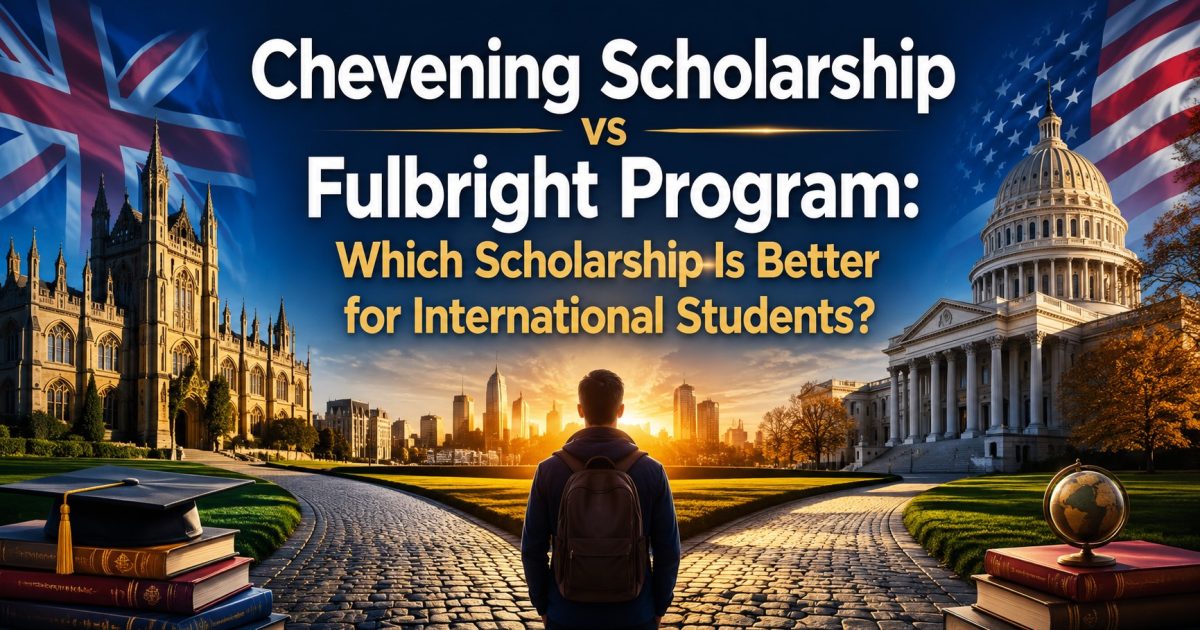
Chevening Scholarship vs Fulbright Program: Pursuing higher education abroad is a life-changing opportunity, but the cost of tuition, accommodation, and living expenses can be a significant challenge for many students. Fortunately, prestigious fully funded scholarship programs like the Chevening Scholarship and the Fulbright Program have helped thousands of talented individuals achieve their academic and professional goals at some of the world’s leading universities. If you’re planning to study overseas in 2026, you may be wondering: Chevening Scholarship vs Fulbright Program: Which Scholarship Is Better for International Students?
Both scholarships are internationally recognized and highly competitive, offering exceptional financial support, leadership development, and access to influential global networks. However, they differ in eligibility requirements, host countries, degree programs, funding coverage, application process, and long-term career opportunities. Understanding these differences is essential for choosing the scholarship that best aligns with your academic ambitions and professional aspirations.
CHECK: How to Write a Winning Scholarship Essay: Templates and Tips
The Chevening Scholarship, funded by the UK government, enables outstanding professionals from eligible countries to pursue a one-year master’s degree at universities across the United Kingdom. The Fulbright Program, sponsored by the U.S. government, supports international students, researchers, and scholars pursuing graduate studies, research, or teaching opportunities at accredited institutions throughout the United States.
In this comprehensive comparison, we’ll explore the eligibility criteria, financial benefits, application process, acceptance rates, leadership opportunities, career impact, and post-graduation advantages of the Chevening Scholarship and the Fulbright Program. Whether you’re aiming to study in the UK or the United States, this guide will help you determine which fully funded scholarship is the better choice for your educational journey in 2026.
Chevening Scholarship vs Fulbright Program
Every year thousands of ambitious international students face the same high-stakes decision: Chevening or Fulbright? Both are among the world’s most prestigious fully funded scholarships. Both open doors to top universities, global networks, and accelerated careers. Yet they are not interchangeable. One is a one-year leadership-focused Master’s program in the United Kingdom. The other is a flexible academic and cultural exchange program in the United States that can support Master’s, doctoral, or research work. Choosing correctly can save months of wasted effort and dramatically improve your odds of success.
This comprehensive comparison examines both programs through the lens of 2026 realities for international students, with particular relevance for applicants from the United States (as host context), Asia, the Middle East, and South Africa. It covers structure, eligibility, application mechanics, funding, competitiveness, global reach, career outcomes, and practical strategies for winning.
Program Overview
Chevening is the UK government’s flagship international scholarship programme, funded primarily by the Foreign, Commonwealth & Development Office. It supports outstanding emerging leaders for a one-year taught Master’s degree at any eligible UK university. The programme prioritises leadership potential, professional impact, and the ability to build lasting networks with the United Kingdom. Scholars are expected to return home and contribute to their countries’ development while maintaining strong UK ties. Approximately 1,500–1,800 awards are made annually across more than 160 countries and territories.
The Fulbright Program, specifically the Fulbright Foreign Student Program for international applicants, is the United States government’s premier international educational exchange initiative. Established in 1946, it funds graduate study (Master’s or PhD), research, and related academic activities in the United States. Selection emphasises academic excellence, leadership potential, and the capacity to serve as cultural ambassadors. The program operates through binational Fulbright commissions or U.S. embassies in each participating country, so rules, quotas, and priorities vary significantly by nationality. Thousands of awards are granted worldwide each year across all Fulbright categories.
| Feature | Chevening | Fulbright Foreign Student Program |
|---|---|---|
| Funding Government | United Kingdom | United States |
| Primary Focus | Leadership & professional networks | Academic merit & cultural exchange |
| Degree Level | Taught Master’s only | Master’s, PhD, or research |
| Typical Duration | 1 year | 1–2+ years (varies by award) |
| University Choice | Any eligible UK university | Varies; often guided placement or self-placement |
| Return Requirement | Minimum 2 years in home country | Often 2-year home-country physical presence (J-1) |
The core philosophical difference is clear: Chevening selects future leaders who will influence policy, business, or civil society; Fulbright selects scholars and professionals who will advance knowledge and mutual understanding between their home countries and the United States.
Eligibility Requirements
Chevening eligibility is relatively standardised and transparent. Applicants must be citizens of a Chevening-eligible country or territory (most of the world except the UK and a few others). They must hold an undergraduate degree that qualifies them for a UK Master’s programme, have completed that degree at least two years before the application deadline, and demonstrate a minimum of 2,800 hours of work experience after graduation (roughly two years full-time). Applicants must apply to three different eligible UK Master’s courses and later secure at least one unconditional offer. A commitment to return home for at least two years after the scholarship is mandatory. Dual British citizens and current UK government employees are generally ineligible.
Fulbright eligibility is decentralised and country-specific. Most programs require citizenship of the applying country, completion of an undergraduate degree, English proficiency (TOEFL or IELTS scores meeting university and program thresholds), and a strong academic or professional record. Work experience requirements vary: some countries expect two or three years of professional experience, while others accept recent graduates with exceptional academic profiles. Preference is often given to applicants who have not previously studied in the United States. The two-year home-country residency requirement under the J-1 visa applies to most recipients.
| Criterion | Chevening | Fulbright (typical) |
|---|---|---|
| Citizenship | Chevening-eligible country | Home-country citizen (program-specific) |
| Work Experience | 2,800 hours post-undergraduate (required) | Varies; often preferred or required (2–3 years) |
| Academic Qualification | UK Master’s-eligible undergraduate degree | Bachelor’s degree; strong academic record |
| English Requirement | Meets university offer conditions | TOEFL/IELTS + program thresholds |
| Prior Study in Host Country | Restricted for previous UK government awards | Preference against prior long-term U.S. study |
| Return Home Commitment | Mandatory 2 years | Usually mandatory via J-1 (2 years) |
Applicants from Asia, the Middle East, and South Africa must carefully check their national Fulbright commission pages, as quotas, priority fields, and exact experience rules differ.
Application Process
Chevening applications are centralised through the official Chevening online portal. The typical cycle for 2027 entry opens in early August 2026 and closes in early October 2026 (exact dates: 4 August to 6 October 2026 in the current published timeline). Applicants complete an online form, select three UK courses, provide two referees, and write four essays focused on leadership, networking, career plan, and study rationale. Eligible applications undergo reading-committee assessment, followed by shortlisting and interviews at British embassies or high commissions (usually March–April). Final awards are announced around June, with an unconditional university offer required by a mid-July deadline.
Fulbright applications are submitted through the relevant national Fulbright commission or U.S. embassy. Deadlines vary widely by country—some fall in February–May, others later in the year—for the following academic intake. The process generally includes a detailed application form, personal statement, study or research objectives, transcripts, letters of recommendation, and English test scores. Many countries conduct interviews. University placement may be handled by the Institute of International Education or left to the applicant, depending on the country program. The overall timeline from application to departure is often longer than Chevening’s, sometimes spanning 15–18 months.
Both processes are rigorous and multi-stage. Chevening’s timeline is more uniform globally; Fulbright’s requires close attention to local instructions.
Benefits & Funding
Both scholarships are fully funded, but the exact package and flexibility differ.
Chevening covers full tuition fees (paid directly to the university), a monthly living allowance (higher in London, currently in the range of approximately £1,200–£1,500 depending on location and year), return economy airfare, visa application costs, an arrival allowance, a departure allowance, a thesis grant, and a study travel grant. The total value for a typical one-year Master’s is often cited in the £30,000–£50,000 range, depending on tuition fees. Scholars also gain access to exclusive networking events and the global Chevening alumni community.
Fulbright packages typically include full or substantial tuition and fees, a monthly living stipend (varying by U.S. location, often $1,500–$2,500+), round-trip airfare, health insurance (Accident and Sickness Program for Exchanges), and sometimes book or research allowances. Pre-academic English training may be provided if needed. Total value frequently ranges from $60,000 to $120,000 or more over the award period, depending on degree length and university costs. Enrichment seminars and the extensive Fulbright alumni network are additional benefits.
| Benefit Component | Chevening | Fulbright (typical) |
|---|---|---|
| Tuition | Full | Full or substantial |
| Living Stipend | Monthly (London higher) | Monthly (location-dependent) |
| Airfare | Return economy | Round-trip |
| Visa Costs | Covered | Support provided |
| Health Insurance | Via UK student provisions | ASPE coverage |
| Duration of Funding | 1 year | 1–2+ years |
| Networking & Alumni | Strong leadership-focused network | Extensive academic & cultural network |
Neither program typically provides support for dependants.
Acceptance Rate
Both programs are highly competitive, but the numbers and selection logic differ.
Chevening receives tens of thousands of applications globally each year (figures exceeding 60,000–70,000 have been reported in recent cycles) for roughly 1,500–1,800 awards, producing a global acceptance rate commonly estimated at 2–5%. Country-level rates vary; larger applicant pools such as India can see tighter effective competition even if absolute numbers of awards are higher.
Fulbright acceptance rates are not uniform. They depend entirely on the number of awards allocated to each country and the size of the local applicant pool. Reported figures often fall in the 5–20% range depending on the country and year, with some nations more competitive than others. Overall, the Foreign Student Program awards several thousand grants annually across more than 160 countries, but individual country competitions can be intense.
In practical terms, Chevening is often described as leadership-selective; Fulbright as academically and holistically selective. Strong academic records help in both, but pure GPA is rarely the decisive factor.
Global Opportunities
Chevening places scholars exclusively in the United Kingdom, giving access to a dense concentration of world-class universities, policy institutions, and professional networks in Europe and the Commonwealth. The one-year format allows rapid re-entry into the workforce with an enhanced profile.
Fulbright opens the entire United States higher-education system—ranging from Ivy League research powerhouses to specialised state universities and liberal arts colleges. The longer possible duration supports deeper research, PhD pathways, and broader cultural immersion across a vast and diverse country. Scholars often engage in community activities and enrichment programs that extend far beyond the classroom.
For students from Asia, the Middle East, and South Africa, both destinations offer transformative exposure. The UK may feel more compact and internationally networked; the U.S. offers scale, research intensity, and a different professional culture.
Career Impact
Chevening alumni frequently move into government, international organisations, policy think-tanks, media, and private-sector leadership roles. The explicit leadership focus and the requirement to return home accelerate impact in national and regional contexts. The alumni network is actively cultivated and often cited as a major long-term asset.
Fulbright alumni are prominent in academia, research institutions, public service, and cultural diplomacy. The program’s emphasis on mutual understanding produces graduates who bridge their home countries and the United States effectively. Many pursue academic careers or roles requiring advanced research credentials. The J-1 home residency requirement reinforces contribution to the home country upon return.
Both credentials carry significant prestige with employers and admissions committees worldwide. The “better” impact depends on career goals: leadership and professional networks lean Chevening; research depth and academic pathways lean Fulbright.
Tips for Winning
For Chevening, prioritise concrete leadership examples with measurable results. Essays must show how you have influenced others, built networks, and formed a clear post-scholarship career plan linked to UK study. Choose courses that logically advance that plan. Secure referees who can speak specifically to your leadership. Prepare thoroughly for the embassy interview, which tests authenticity and clarity of purpose.
For Fulbright, craft a precise study or research objective that demonstrates knowledge of specific U.S. resources (faculty, labs, programs). Show academic preparation and the potential for cultural exchange. Highlight any community engagement or leadership that complements scholarly strengths. Follow your country’s exact instructions meticulously—deadlines, document formats, and interview expectations differ. Contact potential U.S. supervisors early if the program expects or allows it.
In both cases, start early, seek feedback on essays from successful alumni or mentors, and ensure every claim is backed by specific evidence. Generic statements of ambition are the most common reason strong candidates fail.
Final Verdict
Neither scholarship is universally “better.” The right choice depends on your profile and goals.
Choose Chevening if you have at least two years of solid post-undergraduate work experience, can demonstrate clear leadership impact, prefer a one-year Master’s, want intensive professional networking, and are drawn to the United Kingdom and its global connections. It is particularly well suited to mid-career professionals aiming for policy, government, or organisational leadership roles.
Choose Fulbright if your strengths are academic or research-oriented, you are open to a longer stay, seek Master’s or doctoral pathways in the United States, and value deep cultural exchange alongside scholarly development. It is often the stronger route for those targeting academic careers or specialised research fields.
Many successful applicants apply to both when eligible, tailoring each application rigorously to the distinct selection criteria. The competition is fierce in both programs, but preparation that matches the specific philosophy of each—leadership evidence for Chevening, academic and exchange potential for Fulbright—dramatically improves outcomes.
For international students in 2026, both remain among the highest-value fully funded opportunities available. Assess your experience, academic record, career vision, and preferred destination honestly, then invest the time required to submit a compelling, authentic application. The return on that effort can shape the next decade of your professional life.
Choosing between the Chevening Scholarship and the Fulbright Program depends on your academic goals, preferred study destination, and long-term career plans. Both scholarships rank among the world’s most prestigious funding opportunities for international students, providing comprehensive financial support, access to world-class universities, and lifelong professional networks.
The Chevening Scholarship is an excellent choice for professionals seeking a one-year master’s degree in the United Kingdom, particularly those with demonstrated leadership potential and a commitment to contributing to their home country after graduation. Its emphasis on leadership development and global networking makes it ideal for future policymakers, entrepreneurs, public servants, and business leaders.
The Fulbright Program, meanwhile, offers greater flexibility through opportunities for graduate study, research, teaching, and academic exchange in the United States. It is especially well suited for students and scholars interested in research-intensive programs, cultural exchange, and building international academic collaborations across a wide range of disciplines.
Ultimately, neither scholarship is universally “better”—the right choice depends on your personal and professional objectives. If your goal is to earn a master’s degree in the UK while developing leadership skills, Chevening may be the stronger fit. If you aspire to study, conduct research, or teach in the United States while engaging in cross-cultural exchange, the Fulbright Program could provide the ideal pathway.
Whichever scholarship you pursue, preparing a compelling application, demonstrating academic excellence, highlighting your leadership experience, and clearly explaining your future impact will significantly improve your chances of success. Both the Chevening Scholarship and the Fulbright Program remain outstanding opportunities for ambitious international students seeking a world-class education and a globally connected career in 2026 and beyond.