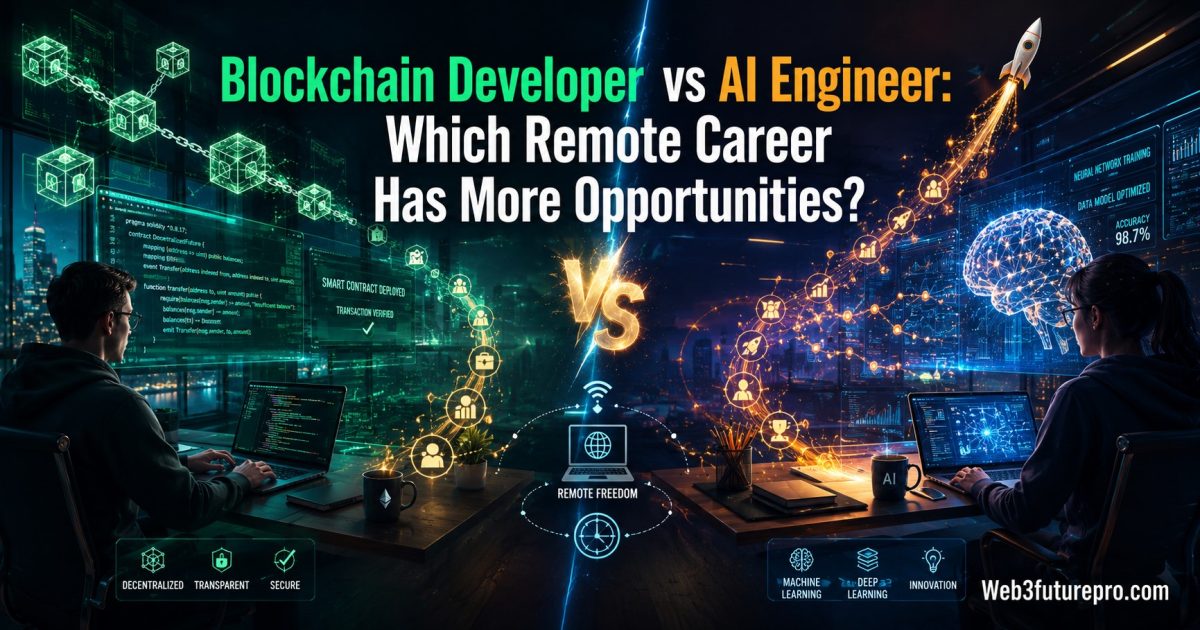
As emerging technologies reshape the global workforce, two careers have captured the attention of aspiring tech professionals and experienced developers alike: Blockchain Development and Artificial Intelligence (AI) Engineering. Both fields are driving innovation across industries, offering lucrative salaries, flexible work arrangements, and access to a rapidly expanding international job market. But for those seeking location-independent careers, one question stands out: Blockchain Developer vs AI Engineer: Which Remote Career Has More Opportunities?
Blockchain developers are at the forefront of decentralized technologies, building smart contracts, decentralized applications (dApps), Web3 platforms, and secure digital ecosystems. AI engineers, on the other hand, develop intelligent systems that power automation, machine learning models, natural language processing, computer vision, and generative AI solutions. As businesses accelerate digital transformation, both professions have become increasingly valuable—but they differ in job availability, industry demand, required skills, and long-term growth potential.
In 2026, remote hiring has become the norm for many technology companies, enabling organizations to recruit top talent from around the world. While AI adoption is expanding across virtually every industry, blockchain continues to revolutionize finance, supply chains, healthcare, gaming, and digital identity through decentralized innovation. Understanding where the greatest remote opportunities exist can help you choose a career that aligns with your interests while maximizing your earning potential and job security.
CHECK: Remote Web3 Developer Salaries: What to Expect in 2026
This comprehensive comparison explores the remote job market for blockchain developers and AI engineers, covering employment trends, salary expectations, required skills, career outlook, and future opportunities. Whether you’re a beginner entering the tech industry or a software professional planning your next career move, this guide will help you determine which path offers the strongest remote career prospects in 2026 and beyond.
Blockchain developer vs AI engineer remote careers in 2026/2027
In 2026 the remote tech job market has split into clear winners and niche specialists. Two of the most discussed paths sit at opposite ends of that spectrum: blockchain development and AI engineering. One builds decentralized systems, smart contracts, and the infrastructure of Web3. The other designs, trains, deploys, and scales the models that now power everything from customer support to scientific discovery. Both can be done from almost anywhere. Both pay well. Yet the volume of openings, the breadth of industries hiring, and the long-term trajectory look very different once you examine the data.
This comparison focuses on remote opportunities in 2026. It draws on live job-board counts, salary surveys, and hiring trends across the United States, Asia, the Middle East, and South Africa. The goal is straightforward: which path currently offers more genuine remote openings, stronger demand signals, and clearer routes for both newcomers and experienced engineers.
Job Role Overview
A remote blockchain developer designs, writes, tests, and deploys code that runs on distributed ledgers. Core work includes smart contracts (most often in Solidity for Ethereum and EVM chains, or Rust for Solana and other high-performance networks), protocol-level contributions, decentralized application backends, token standards, and sometimes cross-chain bridges or Layer-2 integrations. Many roles also involve security considerations—writing contracts that are hard to exploit—and collaboration with auditors.
Daily work tends to revolve around Git repositories, testnets, mainnet deployments, gas optimization, and asynchronous discussions with product and security teams. Crypto-native companies and traditional firms exploring tokenization or supply-chain transparency both hire these engineers. The culture is often fully remote and global by default.
An AI engineer (sometimes titled ML engineer, applied AI engineer, or LLM engineer) builds systems that learn from data and make predictions or generate content. Responsibilities range from data pipelines and model training to fine-tuning large language models, building retrieval-augmented generation (RAG) systems, deploying inference endpoints, monitoring model performance in production, and integrating AI into existing products. Sub-specialties include computer vision, natural language processing, reinforcement learning, MLOps, and agentic systems that can take multi-step actions.
The day-to-day mix includes Python notebooks or production code, experiment tracking, cloud GPU resources, evaluation metrics, and close work with product managers or domain experts. Demand comes from virtually every industry: tech, finance, healthcare, logistics, education, government, and media. Remote AI roles have become common as companies accept distributed teams for most applied work.
Both roles sit at the intersection of software engineering and specialized domain knowledge. Blockchain leans more toward distributed systems and cryptography. AI leans toward statistics, data, and model behavior.
Skills Required
Blockchain development requires strong software engineering fundamentals plus domain-specific tools. Essential technical skills in 2026 include proficiency in Solidity or Rust, familiarity with Ethereum or other major ecosystems, experience with development frameworks such as Hardhat, Foundry, or Anchor, understanding of smart-contract security patterns, knowledge of token standards and DeFi primitives, and comfort with testing on public testnets. Backend languages (TypeScript, Go, or Python) and basic cryptography concepts add value. Soft skills center on careful documentation, security-first thinking, and the ability to communicate risk in a high-stakes environment where a single bug can cost millions.
AI engineering demands a broader and deeper set of mathematical and engineering skills. Core requirements include strong Python, experience with PyTorch or TensorScript, solid understanding of machine learning fundamentals (supervised, unsupervised, and modern deep learning), data handling and feature engineering, model evaluation techniques, and production deployment skills (Docker, Kubernetes, cloud platforms, monitoring). In 2026, practical experience with large language models, fine-tuning, RAG architectures, vector databases, and agent frameworks is especially prized. Cloud and MLOps tooling matter heavily for production roles. Soft skills include experimental rigor, clear communication of model limitations, and collaboration with non-technical stakeholders who need reliable AI features.
Both fields reward continuous learning. Blockchain developers must track new protocols, security exploits, and regulatory changes. AI engineers must stay current with rapidly evolving model architectures, evaluation methods, and production best practices. Public proof of skill—GitHub repositories, deployed contracts, open-source contributions, or published models—often weighs more than formal degrees.
Salary Comparison
Compensation in 2026 favors AI engineering at most levels, especially for remote roles serving U.S. or global companies, though strong blockchain specialists still earn competitive packages, particularly when token or equity components are included.
Remote blockchain developers in the United States typically see base salaries clustered between $110,000 and $185,000 for mid-to-senior roles, with medians often cited near $140,000. Senior smart-contract or protocol engineers at well-funded crypto companies can reach $200,000–$300,000 once tokens and equity are factored in. Freelance rates for experienced U.S.-remote blockchain developers frequently sit around $110 per hour, with ranges from roughly $86 to $141 depending on specialization. In South Africa, local averages are considerably lower (often under $40,000), but remote international contracts raise the ceiling substantially. Asia shows a wide spread: domestic Indian roles remain modest, while remote contracts for proven talent improve the picture. Middle Eastern markets, particularly those with active digital-asset initiatives, offer competitive local packages for specialists.
AI engineers command higher figures overall. Remote U.S. medians for AI/ML engineers land near $194,000 in recent analyses of job postings, with mid-level ranges commonly $130,000–$220,000 and senior roles frequently $200,000–$400,000. Frontier-lab and specialized agentic or LLM roles push total compensation significantly higher. Freelance AI/ML rates average around $125 per hour in U.S. remote markets, with top specialists earning more. Africa-based engineers working remotely for international firms often earn $40,000–$150,000 depending on seniority and specialization—still a major premium over local markets. Asia and the Middle East show similar patterns: local salaries lag U.S. benchmarks, but remote global roles and tax-advantaged locations (such as certain Gulf markets) create attractive opportunities.
The gap reflects market scale. AI skills are required across almost every industry. Blockchain demand remains concentrated in crypto-native firms, fintech, and select enterprise pilots. When token upside is strong, blockchain total compensation can rival or exceed AI packages at certain companies, but base cash and breadth of openings currently favor AI.
Remote Work Opportunities
Both careers rank among the most remote-friendly in technology, yet the character of remote work differs.
Blockchain and Web3 companies were largely remote-first from the beginning. Job boards focused on the sector list tens of thousands of remote roles, many with global eligibility and minimal timezone restrictions. Protocol teams, DeFi projects, exchanges, and infrastructure companies routinely hire across continents. The culture emphasizes asynchronous collaboration and on-chain verification of work. Some roles still prefer candidates in certain jurisdictions for regulatory or banking reasons, but pure remote global postings remain abundant.
AI engineering remote opportunities have expanded rapidly as companies moved from experimentation to production deployment. Applied AI, MLOps, LLM application engineering, and many research-adjacent roles are regularly posted as fully remote. Weekly U.S. AI engineering postings stay in the thousands, with a substantial remote share. Some frontier research or hardware-adjacent positions still cluster around specific labs or require occasional on-site presence, but the majority of applied roles accept distributed teams. Time-zone overlap is sometimes preferred for collaboration with product and data teams, yet global talent from Asia, the Middle East, and Africa successfully lands remote AI positions when skills and communication are strong.
In pure volume of remote openings, AI currently offers more opportunities because the demand base is larger and more diversified across industries. Blockchain offers a high density of fully global remote roles within its smaller ecosystem.
Best Platforms to Apply
For blockchain developers, specialized boards deliver the highest signal. Web3.career remains one of the deepest sources of remote listings. CryptoJobsList, SailOnchain, and similar Web3-native platforms surface roles from exchanges, protocols, and startups. General remote boards such as We Work Remotely, Remote OK, Arc, and Wellfound also carry blockchain openings. LinkedIn works when filtered carefully, and direct company career pages at major crypto firms often post before broader distribution. Freelance marketplaces remain active for short-term smart-contract and audit work.
For AI engineers, a mix of general and specialized channels works best. LinkedIn, Wellfound, and Remote OK carry high volumes. AI-specific boards such as ai-jobs.net and Hugging Face Jobs attract candidates focused on ML and research. Company career pages at major tech firms, startups building AI products, and enterprises across industries are essential. Platforms that emphasize salary transparency and worldwide eligibility help international candidates. Freelance and contract work appears on Upwork, Toptal, and specialized AI talent networks.
In both fields, a strong public profile—GitHub activity, deployed projects, open-source contributions, or technical writing—improves response rates far more than mass applications.
Career Growth Potential
Blockchain developers can progress from junior smart-contract roles into senior protocol engineering, security auditing, architecture, or technical leadership within Web3 organizations. Some move into product, research, or founding roles. Hybrid AI-plus-blockchain positions are emerging and can accelerate advancement for those who combine both skill sets. The path is relatively specialized; staying current with new chains and security practices is required for continued growth.
AI engineers enjoy broader and often steeper trajectories. Progression runs from junior ML engineer through mid-level applied roles into senior, staff, or principal AI engineering, MLOps leadership, or specialized tracks such as LLM systems or agentic platforms. Movement into research, product management for AI features, or technical leadership is common. The rapid expansion of production AI creates frequent opportunities for impact and promotion. Engineers who master both model development and reliable deployment tend to advance fastest.
Both careers support independent consulting at senior levels. AI consulting currently has wider market reach; blockchain consulting remains strong within its ecosystem and in emerging regulated markets.
Pros and Cons
Blockchain Developer Pros High density of fully remote, globally open roles. Potential for significant token or equity upside. Work on novel distributed systems with clear technical challenges. Strong community and open-source culture. Niche scarcity can protect compensation when demand is high.
Blockchain Developer Cons Smaller overall market size and sensitivity to crypto market cycles. Security responsibility is intense—bugs can be catastrophic. Continuous need to track evolving protocols and exploits. Some roles still face regulatory or banking-access friction depending on location.
AI Engineer Pros Broad demand across nearly every industry creates more total openings. Higher average cash compensation at most levels. Rapid growth in production AI and agentic systems expands opportunities. Clear paths into specialized high-impact work. Skills transfer across domains.
AI Engineer Cons Intense competition at the highest levels and for frontier roles. Rapid tooling and model changes require constant upskilling. Some positions involve pressure around model reliability, bias, or evaluation. Entry can feel crowded at the junior end without strong projects or credentials.
Beginner Friendliness
Blockchain development has a relatively accessible technical entry point for strong software engineers. Learning Solidity or Rust, deploying simple contracts, and contributing to open-source projects can demonstrate ability. Security awareness and careful testing habits matter early. Self-taught developers with solid general programming backgrounds often transition successfully. The main barrier is proving reliability in a domain where mistakes are expensive.
AI engineering presents a steeper initial learning curve for complete beginners because of the mathematical and experimental foundations. Strong Python, linear algebra intuition, and hands-on project experience with real datasets help. Online courses, Kaggle-style competitions, open-source model contributions, and personal deployments of fine-tuned models or RAG systems provide proof of skill. Career switchers from software engineering or data roles often move faster than pure novices. In both fields, public work product outweighs credentials for remote hiring.
For candidates in Asia, the Middle East, or South Africa, English communication strength, reliable internet, and a visible portfolio significantly improve remote success rates in either path.
Industry Demand
Demand data in 2026 shows a clear difference in scale. AI engineering postings remain high and rising. U.S. weekly volumes for AI engineering roles stay in the thousands, with growth in applied, infrastructure, and agentic categories. Talent shortages are widely reported; in some markets the gap between openings and qualified candidates is extreme. Enterprise adoption of generative AI, automation, and intelligent agents continues to expand the hiring base beyond pure tech companies.
Blockchain demand is healthy within its sector. Specialized remote job boards list large numbers of openings, and growth in certain protocol, infrastructure, and hybrid AI-blockchain roles continues. Overall volume, however, remains smaller than the AI market. Crypto market conditions still influence hiring velocity, though enterprise and regulated use cases provide more stability than in earlier cycles. Projected growth for blockchain-related roles is solid but does not match the breadth or absolute numbers seen in AI.
Across the United States, Asia (especially India and Singapore), the Middle East (with active digital-asset and AI national strategies), and South Africa, both fields expand. AI currently generates more total remote opportunities because more industries are hiring.
In 2026, AI engineering offers more remote career opportunities than blockchain development. The difference is driven by sheer market size: AI skills are required across technology, finance, healthcare, logistics, government, and consumer products, while blockchain demand remains more concentrated in crypto-native and select enterprise use cases. Job-board volume, weekly posting trends, and reported talent shortages all point to broader and more consistent demand for AI engineers.
Blockchain development still provides excellent remote prospects, particularly for those who enjoy distributed systems, cryptography, and the Web3 ecosystem. Fully global remote roles are common, compensation can be strong (especially with tokens), and the work remains technically distinctive. Hybrid skills that combine AI and blockchain are emerging as a valuable niche.
For pure volume of openings, geographic flexibility, and long-term industry breadth, AI engineering currently leads. For specialists drawn to decentralized technology and willing to navigate a more focused market, blockchain remains a strong and well-compensated remote path. The better choice ultimately depends on genuine interest and aptitude. Skills demonstrated through real projects matter more than following the largest trend. Both careers can support high-earning, location-independent work in 2026—choose the one whose problems you want to solve for the next decade.
When comparing Blockchain Developer vs AI Engineer careers, both offer exciting opportunities, competitive salaries, and the flexibility to work remotely. However, the best choice depends on your career goals, technical interests, and the industries you want to impact. If you’re passionate about decentralized applications, smart contracts, cryptocurrencies, and Web3 innovation, blockchain development provides a specialized career with growing demand and excellent compensation. If you enjoy solving complex problems with machine learning, data science, automation, and intelligent systems, AI engineering offers broader opportunities across nearly every major industry.
In 2026, AI engineering generally provides a larger volume of remote job openings because organizations in healthcare, finance, education, manufacturing, retail, cybersecurity, and technology are rapidly integrating AI into their products and operations. Meanwhile, blockchain development remains a highly rewarding niche, with strong demand in fintech, decentralized finance (DeFi), digital identity, tokenization, enterprise blockchain, and Web3 startups.
Ultimately, success in either field depends on continuously upgrading your skills, building real-world projects, contributing to open-source communities, and staying current with evolving technologies. Whether you pursue blockchain development or AI engineering, both career paths offer outstanding long-term potential for professionals seeking high-paying remote jobs and future-proof careers in the global technology industry.