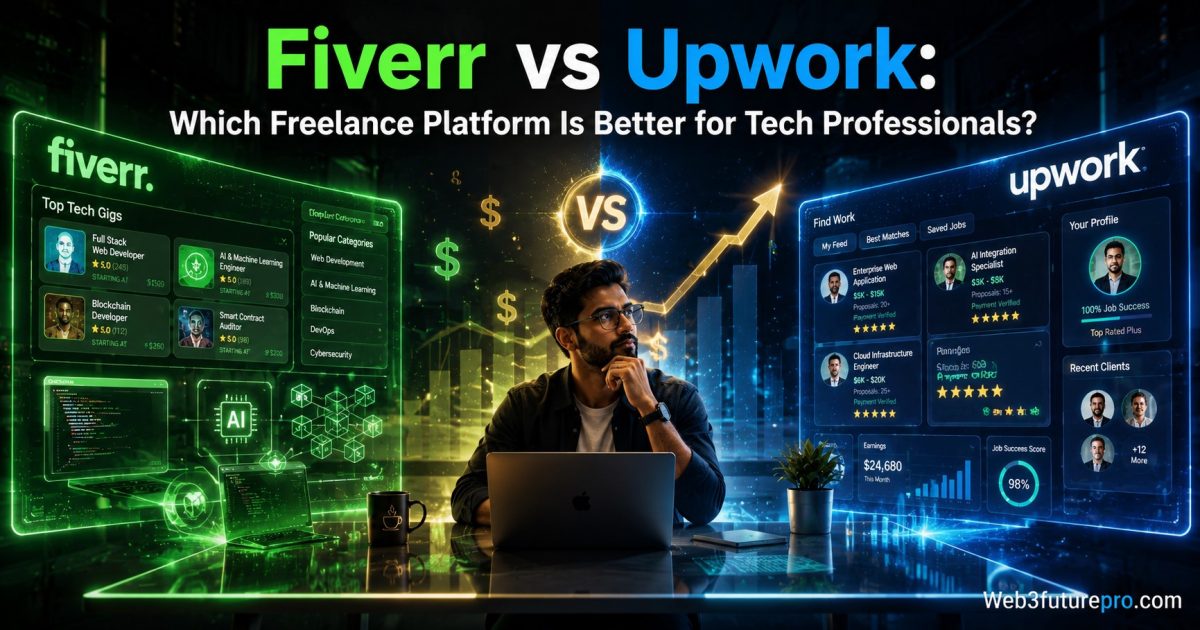
Fiverr vs Upwork: The freelance economy continues to thrive in 2026, giving technology professionals unprecedented access to clients and projects from around the world. Whether you’re a software developer, cybersecurity specialist, AI engineer, blockchain developer, cloud engineer, data analyst, UI/UX designer, or DevOps expert, freelance platforms have made it easier than ever to build a successful remote career. Among the industry’s leading marketplaces, Fiverr and Upwork consistently rank as the top choices for freelancers seeking global opportunities. But which platform offers the best experience for tech professionals? Fiverr vs Upwork: Which Freelance Platform Is Better for Tech Professionals?
Although both platforms connect freelancers with businesses, they operate using different business models. Fiverr allows freelancers to create predefined service packages (known as “Gigs”) that clients can purchase instantly, making it ideal for professionals who want to showcase specialized services with fixed pricing. Upwork follows a proposal-based system where freelancers submit bids for projects posted by clients, making it well-suited for long-term contracts, enterprise projects, and ongoing collaborations.
In 2026, companies increasingly rely on remote freelancers to accelerate software development, strengthen cybersecurity, build AI-powered solutions, design user-friendly products, and manage cloud infrastructure. As competition grows, selecting the right freelance platform can significantly influence your visibility, earnings, client relationships, and long-term career success.
CHECK: Freelancing vs Full-Time Remote Tech Jobs: Which Is Better for Beginners?
In this comprehensive comparison, we’ll evaluate Fiverr and Upwork based on earning potential, project availability, fees, competition, client quality, ease of getting started, remote opportunities, and overall suitability for technology professionals. Whether you’re launching your freelance career or looking to expand your client base, this guide will help you choose the platform that best supports your goals in 2026.
Fiverr vs Upwork for tech freelancers in 2026/2027
In 2026 the global freelance economy continues to expand, and two platforms still dominate the conversation for independent tech talent: Fiverr and Upwork. One invites clients to buy ready-made packages. The other invites freelancers to bid on open projects. For software developers, UI/UX designers, data specialists, cloud engineers, cybersecurity practitioners, and other tech professionals, the choice between them is not trivial. Fees, client quality, project complexity, earnings potential, and long-term growth differ in ways that directly affect take-home income and career trajectory.
This comparison examines both platforms through the lens of remote tech work across the United States, Asia, the Middle East, and South Africa. It covers how each marketplace functions, the skills that succeed, realistic earnings after fees, remote suitability, growth potential, and which platform currently delivers more value for most technical freelancers.
Job Role Overview
Fiverr operates as a gig marketplace. Freelancers create fixed-price “gigs” with defined packages (basic, standard, premium), delivery times, and deliverables. Clients browse, purchase, and receive the work. The model favors productized services—logo design, simple website builds, scripted automation, or discrete coding tasks that can be scoped tightly in advance. Success depends on ranking, reviews, and clear packaging.
Upwork functions as a project and talent marketplace. Clients post jobs (hourly or fixed-price). Freelancers submit proposals, often spending Connects (platform currency). Once hired, work can proceed via time tracking for hourly contracts or milestones for fixed-price projects. The model supports complex, evolving, or ongoing technical work—full application development, system architecture, data pipelines, security assessments, or retained consulting. Success depends on proposal quality, profile strength, and relationship building.
For tech professionals the distinction matters. A developer building a custom API integration or maintaining a production system usually finds Upwork’s flexible contracting better suited. A designer selling logo packages or a developer offering a fixed “WordPress setup” gig can thrive on Fiverr’s browse-and-buy flow.
Skills Required
Success on either platform requires core technical competence plus platform-specific execution skills.
On Fiverr the emphasis falls on productization and presentation. Tech freelancers need the ability to package services clearly, write compelling gig descriptions, create strong portfolio samples, set competitive yet profitable pricing, and deliver consistently within fixed scopes. Customer service responsiveness and review management are critical. Visual presentation of gigs and SEO within the platform help ranking. Soft skills include sales-oriented writing and managing client expectations inside rigid package boundaries.
On Upwork the emphasis falls on proposal writing, scoping, and professional communication. Freelancers must research client needs, craft tailored proposals that demonstrate understanding, estimate accurately, negotiate scope, and manage longer engagements. Time-tracking discipline (for hourly work), clear milestone definitions, and relationship cultivation matter. Strong profiles with verified skills, work history, and specialized tests improve visibility. Soft skills include persuasive writing, discovery conversations, and handling iterative feedback.
Both platforms reward specialization. Niche tech skills—AI integration, specific frameworks, cloud security, or industry-domain expertise—command higher rates and better conversion than generalist offerings. Portfolio quality and client communication remain universal requirements.
Salary Comparison
Earnings after platform fees determine real profitability. In 2026 Fiverr continues to charge freelancers a flat 20% on every order (including tips in many cases). Upwork charges a lower effective rate, commonly around 10% (with some variation by contract type and history; earlier tiered systems have largely standardized). The difference compounds quickly.
On a $1,000 project a Fiverr freelancer keeps roughly $800 before withdrawal costs. An Upwork freelancer keeps roughly $900. On $5,000 monthly gross the annual fee gap can exceed several thousand dollars in favor of Upwork. Tech professionals who bill higher rates or secure ongoing retainers amplify this advantage.
Typical tech rates on the platforms reflect the models. Upwork supports higher average hourly rates for developers, designers, and specialists—often $40–$150+ per hour depending on experience and niche, with seniors and specialized talent reaching the upper end. Fiverr gigs for similar skills tend to price lower because clients expect fixed, packaged deliverables; volume can compensate, but complex or open-ended work rarely fits the format well. Marketplace rates on both platforms generally sit 20–40% below equivalent direct-client rates, as the platforms provide discovery and payment protection in exchange for the fee.
Geographic patterns persist. Freelancers in the United States and high-cost markets often command higher listed rates. Those in Asia, the Middle East, and South Africa can still achieve strong local purchasing power through international clients, especially when specializing. Remote payment infrastructure on both platforms supports global talent.
Remote Work Opportunities
Both platforms are inherently remote and global. Work happens online; payments move digitally. Upwork’s hourly contracts with time-tracking screenshots and Fiverr’s asynchronous gig delivery both function across time zones.
Upwork currently offers stronger support for longer remote engagements and technical collaboration. Clients seeking ongoing development, maintenance, or consulting more often post there. Fiverr excels at discrete remote deliverables that require less continuous interaction. Tech professionals in Asia, the Middle East, and South Africa regularly win work on both platforms when profiles and communication are strong. Time-zone overlap preferences exist for real-time collaboration roles, yet fully asynchronous technical work remains available.
Best Platforms to Apply
The platforms themselves are the primary marketplaces. Optimization within each is the practical “application” strategy.
On Fiverr focus on gig titles, descriptions, tags, portfolio images, and pricing tiers that match buyer search behavior. Promote gigs externally and maintain high response rates and on-time delivery for ranking. Fiverr Pro offers a higher-tier path for vetted professionals.
On Upwork invest in a complete profile with skills tests, portfolio pieces, and a compelling overview. Monitor job feeds, submit targeted proposals early, and use Connects strategically. Rising to Top Rated or Expert-Vetted status improves visibility and conversion. Both platforms reward consistent activity and positive client feedback.
External promotion—LinkedIn, personal websites, communities—remains valuable for driving traffic or converting platform clients to direct relationships later.
Career Growth Potential
Fiverr growth often comes from scaling volume, raising package prices, adding related gigs, or moving into Fiverr Pro. Some freelancers build agencies by outsourcing lower-tier work. The model supports productized businesses but can limit exposure to complex, high-value strategic work.
Upwork growth more readily supports rising rates, longer retainers, specialized positioning, and eventual transition to direct clients. Strong work history and reviews create a portable reputation. Many tech freelancers use Upwork as a bridge to higher-paying independent practices or agency models. The proposal-based system also develops sales and scoping skills that transfer beyond the platform.
Both can serve as stepping stones. Upwork’s structure generally aligns better with the progressive complexity and relationship depth that technical careers reward.
Pros and Cons
Fiverr Pros Easy entry and package-based selling. Clients come to you once gigs rank. Fast for discrete, well-scoped deliverables. Strong for visual and creative tech-adjacent services. Simple order flow. Global buyer base.
Fiverr Cons Flat 20% fee reduces take-home pay. Price pressure and competition in many categories. Fixed-scope model limits complex or evolving technical work. Ranking algorithms and review dependence create volatility. Higher risk of low-budget or unclear clients in some niches.
Upwork Pros Lower effective fees (around 10%). Better suited to complex, hourly, and ongoing tech projects. Higher average rates for skilled developers and specialists. Strong tools for contracts, tracking, and protection. Professional positioning and long-term client potential. Larger share of higher-budget technical work.
Upwork Cons Requires active proposal writing and Connects investment. Competition for good jobs can be intense. Profile and proposal quality determine early success. Platform policies and occasional account issues create risk. Learning curve for effective bidding.
Beginner Friendliness
Fiverr is generally easier for absolute beginners with packageable skills. Creating a gig requires no proposals or Connects; buyers can purchase immediately. Designers, simple website builders, or script providers often land first sales faster. The downside is heavy competition and the need to stand out visually and through reviews.
Upwork has a steeper early curve. New freelancers must write competitive proposals, often against established profiles, and invest Connects. Technical beginners with strong portfolios and clear communication can succeed, especially in niches with demand. The proposal process itself builds useful professional skills. Many tech professionals report better long-term results once traction is achieved.
A practical approach for beginners is to test both: productize simple offerings on Fiverr while building proposal experience and higher-value positioning on Upwork.
Industry Demand
Demand for freelance tech talent remains robust in 2026 across software development, design, data, cloud, and security. Both platforms capture significant volume. Upwork holds a larger overall market share in many analyses and attracts more of the complex technical and ongoing work that tech professionals prefer. Fiverr continues to generate substantial transaction volume, particularly in creative and packaged services.
Specialized skills—AI-related development, cloud architecture, cybersecurity testing, advanced data work—command premium rates on both, with Upwork often supporting higher effective earnings through hourly and retainer models. Global clients from the United States, Europe, Asia, the Middle East, and elsewhere actively hire. Competition is real; differentiation through specialization, communication, and proven results separates those who earn consistently from those who struggle.
For most tech professionals in 2026—software developers, product designers, data specialists, cloud engineers, and similar roles—Upwork is the stronger platform. Lower fees, better alignment with complex and ongoing technical work, higher typical rates, and superior support for long-term client relationships produce greater take-home income and career leverage for the majority of skilled practitioners.
Fiverr remains valuable for productized, fixed-scope services and for beginners who need an easier on-ramp or who excel at packaging discrete deliverables. Many successful freelancers use both strategically: Fiverr for volume or simple gigs, Upwork for higher-value technical engagements.
The optimal path is rarely exclusive. Start where your current offerings fit best, optimize ruthlessly for results, raise rates as reviews and skills grow, and gradually move high-value relationships off-platform when appropriate. Fees and algorithms matter, but consistent delivery, clear communication, and specialized expertise matter more. In a competitive remote market, the freelancers who treat the platforms as tools rather than destinations capture the strongest outcomes.
When comparing Fiverr vs Upwork, both platforms offer valuable opportunities for tech professionals, but each serves a different type of freelancer. Fiverr is an excellent choice for beginners and specialists who want to sell clearly defined services, attract clients through optimized Gig listings, and build a steady stream of orders without constantly submitting proposals. It works particularly well for services such as website development, WordPress customization, UI/UX design, logo design, AI automation, blockchain consulting, and cybersecurity assessments.
Upwork, on the other hand, is often the better option for professionals seeking larger projects, long-term contracts, and higher-value clients. Software developers, cloud engineers, DevOps specialists, data scientists, AI engineers, and cybersecurity consultants frequently find opportunities to work with startups, established businesses, and enterprise organizations through ongoing engagements that can lead to stable, recurring income.
For most new freelancers, Fiverr is generally easier to start because you can publish service packages and allow clients to discover your expertise through search. For experienced professionals, Upwork often provides greater earning potential thanks to its emphasis on long-term projects and direct client relationships.
Ultimately, you don’t have to choose just one platform. Many successful freelancers maintain active profiles on both Fiverr and Upwork to diversify their income, reach different client audiences, and maximize remote work opportunities. By building a strong portfolio, earning positive reviews, communicating professionally, and continuously improving your technical skills, you can create a sustainable freelance business regardless of which platform you choose. In 2026, both Fiverr and Upwork remain among the best marketplaces for tech professionals looking to grow a profitable global freelance career.