As businesses continue to prioritize digital experiences in 2026, the demand for skilled design professionals has reached an all-time high. Companies of all sizes are investing in intuitive websites, mobile applications, and digital products that deliver exceptional user experiences, creating abundant remote career opportunities for creative professionals. Among the most sought-after roles are UI/UX Designers and Product Designers, both of which offer competitive salaries, flexible work arrangements, and strong long-term career prospects. However, many aspiring designers still ask an important question: UI/UX Designer vs Product Designer: Which Remote Career Is More Profitable?
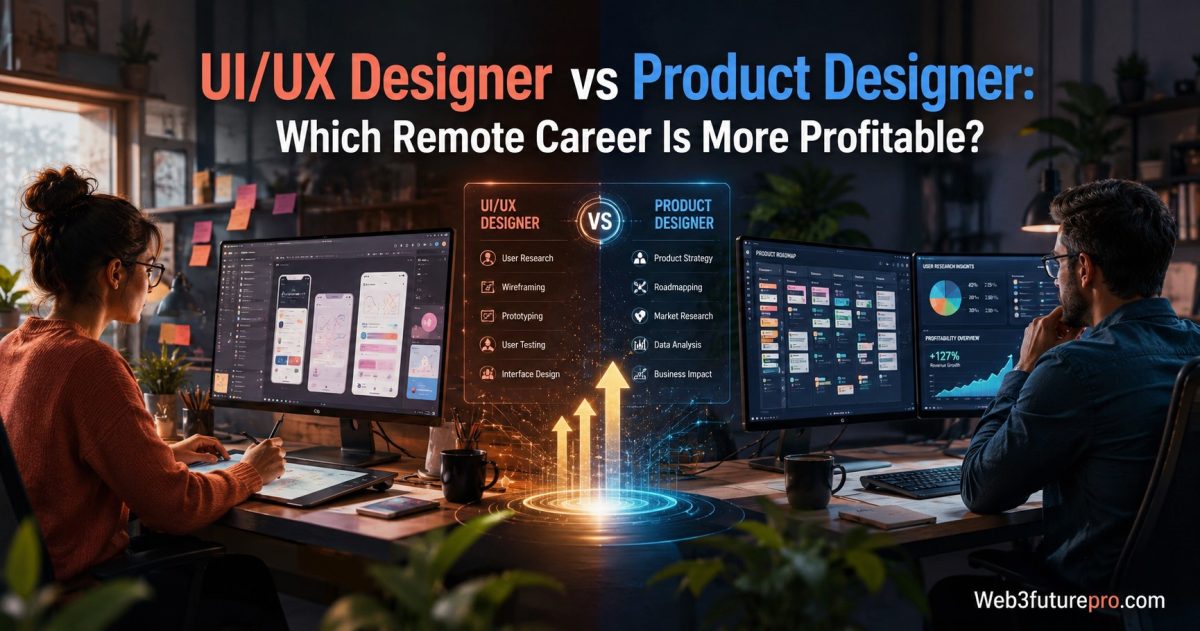
Although these roles share similar design principles and often collaborate closely, they differ in scope, responsibilities, and business impact. UI/UX designers primarily focus on creating visually appealing interfaces and ensuring seamless user experiences through research, wireframing, prototyping, usability testing, and interaction design. Product designers, on the other hand, take a broader approach by overseeing the entire product lifecycle—from identifying user needs and defining product strategy to designing solutions that align with business goals and customer expectations.
CHECK: Freelancing vs Full-Time Remote Tech Jobs: Which Is Better for Beginners?
As remote work becomes a standard practice across the technology industry, organizations are actively hiring talented designers who can collaborate with global teams, improve customer experiences, and contribute to successful digital products. Whether you’re starting your design career or considering a specialization, understanding the differences between these professions is essential for making an informed decision.
In this comprehensive comparison, we’ll explore the earning potential, job demand, required skills, career progression, remote work opportunities, and future outlook for UI/UX designers and product designers. By the end of this guide, you’ll have a clear understanding of which career path offers greater profitability and long-term growth in 2026.
UI/UX Designer vs Product Designer remote careers in 2026
In 2026 the design profession inside tech has clarified into two overlapping but distinct paths that remote job seekers encounter constantly. UI/UX Designers focus on the craft of interfaces and user experience—research, flows, usability, and visual execution. Product Designers own a broader slice of the product lifecycle, blending research, interaction design, visual design, and business impact. Both roles can be fully remote. Both appear regularly on job boards. Yet when the question turns to long-term profitability—salary ceilings, remote compensation packages, career leverage, and demand—the data points in a consistent direction.
This comparison examines the 2026 market for remote opportunities across the United States, Asia, the Middle East, and South Africa. It looks at role definitions, required skills, realistic salary bands, remote work patterns, platforms, growth trajectories, and which path currently offers stronger financial upside for most practitioners.
Job Role Overview
A UI/UX Designer (often written UI/UX or UX/UI) specializes in the user-facing side of digital products. The work typically includes user research, information architecture, wireframing, prototyping, usability testing, interaction design, and high-fidelity visual design. Some roles lean more heavily toward research (UX), others toward visual systems and interface polish (UI). In many companies the combined title still signals a craft-focused specialist who delivers usable, accessible, and visually coherent experiences.
A Product Designer carries wider ownership. The role usually spans problem definition, research synthesis, end-to-end design of features or products, collaboration with product managers and engineers on prioritization, measurement of design impact through metrics, and iteration based on real user behavior. Product Designers are expected to think in terms of business outcomes as well as user needs. In startups and many mid-size product companies, “Product Designer” has become the default title for the person who owns design from discovery through shipping.
The titles are not perfectly standardized. Some organizations use them interchangeably. Others treat Product Designer as the more senior or broader role and reserve UI/UX for specialists. In remote job postings the distinction often appears in the scope of responsibility rather than the exact wording of the title.
Skills Required
UI/UX Designers need strong foundations in design principles, user research methods, interaction design, visual design, accessibility, and prototyping. Tool proficiency centers on Figma (dominant in 2026), with supporting skills in prototyping tools, basic HTML/CSS awareness, and design systems. Soft skills include empathy, clear communication of design rationale, and collaboration with developers. A polished portfolio of case studies showing process and outcomes is essential.
Product Designers require the same craft skills plus additional layers: product thinking, prioritization, metric literacy, stakeholder management, and the ability to frame ambiguous problems. They are expected to run or synthesize research, design solutions that balance user value and business goals, and measure success after launch. Familiarity with analytics tools, A/B testing concepts, and design systems at scale adds value. Soft skills lean more heavily toward strategic communication and cross-functional influence.
Both roles reward continuous practice and a strong public portfolio. Product Design roles typically demand evidence of broader ownership and business impact in case studies.
Salary Comparison
Product Design roles generally command higher or comparable compensation, especially at mid and senior levels, reflecting the broader scope and closer alignment with product outcomes.
In the United States, remote mid-level Product Designer base salaries frequently sit in the $90,000–$130,000 range, with seniors commonly reaching $140,000–$180,000 or higher at strong companies. Staff and principal levels can exceed $200,000 base, and total compensation at top firms (including equity) pushes significantly higher. UI/UX Designer ranges overlap but often sit slightly lower on average: entry or junior roles around $55,000–$80,000, mid-level $80,000–$110,000, and seniors $120,000–$160,000. Some datasets show UX and Product Designer total compensation nearly identical at certain levels, yet Product Designer postings more frequently list higher upper bands.
Freelance rates follow a similar pattern. Experienced UI/UX freelancers in U.S. remote markets commonly bill $56–$92 per hour, with medians around $72. Product Design freelancers with stronger strategic credentials often command premiums within or above that band.
Outside the United States the absolute numbers drop, but the relative ordering holds. In Asia-Pacific remote Product Designer ranges for mid-level roles often fall between $45,000–$65,000, with seniors reaching $65,000–$100,000; local market rates in India or Southeast Asia are lower still, while international remote contracts improve the picture. Middle Eastern markets offer competitive packages tied to digital transformation initiatives. South African designers working remotely for international companies can earn multiples of local rates. In all these regions, Product Designer titles or broader ownership scopes tend to attract higher offers than pure UI/UX specialist roles.
Equity, bonuses, and benefits further widen the gap at growth-stage and public companies that hire Product Designers into core product teams.
Remote Work Opportunities
Both roles are remote-compatible, yet Product Designer openings appear more frequently in fully remote or remote-first product companies. Design collaboration still benefits from real-time interaction, so hybrid remains common, but genuine fully remote roles exist in meaningful numbers for both titles. Some analyses show design roles less remote-heavy than pure engineering, yet the volume of remote Product Designer and UI/UX listings remains substantial on specialized boards.
Product Design roles often align with companies that already operate distributed product teams (startups, SaaS, fintech). UI/UX specialist roles appear across a wider set of industries, including agencies and larger enterprises that may retain more onsite or hybrid expectations. Candidates in Asia, the Middle East, and South Africa successfully land remote international design roles when portfolios demonstrate strong craft and clear process.
Best Platforms to Apply
Remote design opportunities surface on We Work Remotely, Remote OK, Wellfound, LinkedIn, Dribbble, Behance (for portfolio discovery), and specialized design job boards. Company career pages at remote-first firms (GitLab, Zapier, and similar) and product companies remain high-signal. FlexJobs and curated boards help filter for legitimate remote listings.
Portfolios matter more than résumés. Case studies that show problem framing, research, iteration, and measurable outcomes outperform pure visual galleries. For Product Designer roles, evidence of business impact or cross-functional work strengthens applications. Networking through design communities and LinkedIn continues to open doors that pure applications miss.
Career Growth Potential
UI/UX Designers can progress into senior specialist roles, design systems leadership, UX research, or management. Some transition into Product Design by expanding their ownership of strategy and metrics. The path is solid but can plateau if the work remains purely craft-focused.
Product Designers typically enjoy a clearer runway into senior, staff, and principal levels, design leadership, or adjacent product management. The broader skill set creates leverage for higher-impact roles and compensation. Many design leaders and heads of design come from Product Designer backgrounds. The title itself often signals readiness for greater responsibility.
Both paths support independent consulting and freelance practices at senior levels. Product Design freelancers with strategic depth currently access higher-value projects.
Pros and Cons
UI/UX Designer Pros Deep craft focus and clear specialization. Strong demand for high-quality visual and interaction work. More accessible entry for pure designers. Portfolio work is highly visual and shareable. Flexible across agencies, product companies, and freelance.
UI/UX Designer Cons Potential lower average compensation ceiling compared with broader Product Design roles. Risk of being siloed into execution. Some markets show title compression toward “Product Designer.” Competition at junior levels can be intense.
Product Designer Pros Higher average and senior compensation in many datasets. Broader ownership and business impact. Stronger alignment with product teams and growth-stage companies. Clearer path to leadership and high-leverage roles. Preferred title at many modern product organizations.
Product Designer Cons Higher expectations around strategy, metrics, and cross-functional influence. Steeper requirements for case studies that demonstrate end-to-end ownership. Fewer pure junior openings that match the full scope. Requires comfort with ambiguity and business trade-offs.
Beginner Friendliness
UI/UX Design is generally more approachable for pure beginners focused on craft. Learning Figma, basic research methods, and visual principles can produce portfolio pieces relatively quickly. Junior UI/UX or “UI/UX Designer” openings exist, although competition is high and many require demonstrable projects.
Product Design roles more often expect evidence of broader thinking even at mid-level. True junior Product Designer openings are less common; many companies prefer candidates who already show end-to-end ownership. Beginners can still enter by starting in UI/UX or generalist design roles and expanding scope over time.
Self-taught designers and career switchers with strong visual portfolios often land first roles under UI/UX titles and later rebrand toward Product Design as experience grows.
Industry Demand
Demand for both remains healthy in 2026. Product Designer has become the more common preferred title at product companies and startups, reflecting the desire for designers who own outcomes rather than isolated craft deliverables. UI/UX specialist roles continue to appear, especially in larger organizations and agencies, but the overall market signal favors designers who can operate across research, design, and impact.
Remote listings for Product Designers are robust at mid and senior levels. Entry-level design roles of any title face saturation. Growth in fintech, AI-assisted products, SaaS, and digital transformation initiatives across the United States, Asia, the Middle East, and South Africa sustains openings for skilled practitioners in both categories. Designers who combine strong craft with product thinking and AI literacy currently sit in the strongest position.
In 2026 the more profitable remote career path for most designers is Product Design. The combination of broader ownership, closer alignment with product outcomes, preferred status in many hiring markets, and higher average and senior compensation bands gives it the edge on long-term earnings potential. UI/UX Design remains a solid, craft-focused career with good remote opportunities and lower barriers for pure visual or research specialists, yet the salary ceiling and strategic leverage tend to favor the Product Designer title and skill set.
The practical route for many beginners is to develop strong UI/UX foundations, build a portfolio that demonstrates process and impact, land an early role (often under a UI/UX or generalist design title), and deliberately expand into product thinking, metrics, and end-to-end ownership. That progression positions designers for the higher-paying Product Design opportunities that dominate remote product-company hiring.
Profitability ultimately follows demonstrated value. Designers who ship measurable improvements to products—whether their title says UI/UX or Product—capture the strongest offers. In the current market, the Product Designer path simply aligns more directly with the scope and compensation that companies are willing to pay at the upper end.
When comparing UI/UX Designer vs Product Designer, both career paths provide excellent opportunities for remote work, creative problem-solving, and attractive salaries. However, product designers generally have higher earning potential because their responsibilities extend beyond interface design to include product strategy, user research, cross-functional collaboration, business objectives, and end-to-end product development. This broader scope often positions them for senior leadership roles and higher compensation.
UI/UX designers remain highly valuable as organizations continue to invest in customer-centric digital experiences. Their expertise in usability, accessibility, interaction design, and visual communication makes them essential members of product teams across industries such as technology, healthcare, finance, education, e-commerce, and entertainment.
Ultimately, the right career depends on your interests and professional goals. If you enjoy crafting intuitive interfaces and enhancing user experiences, UI/UX design offers a rewarding and accessible path with strong remote demand. If you’re interested in influencing product strategy, solving broader business challenges, and leading the design process from concept to launch, product design may offer greater long-term profitability and career advancement.
Regardless of which path you choose, continuously improving your design skills, mastering industry-standard tools such as Figma and Adobe Creative Suite, building a compelling portfolio, and staying informed about emerging design trends will significantly increase your chances of securing high-paying remote opportunities. In the rapidly evolving digital economy of 2026, both UI/UX design and product design remain among the most promising and future-ready careers in the global tech industry.