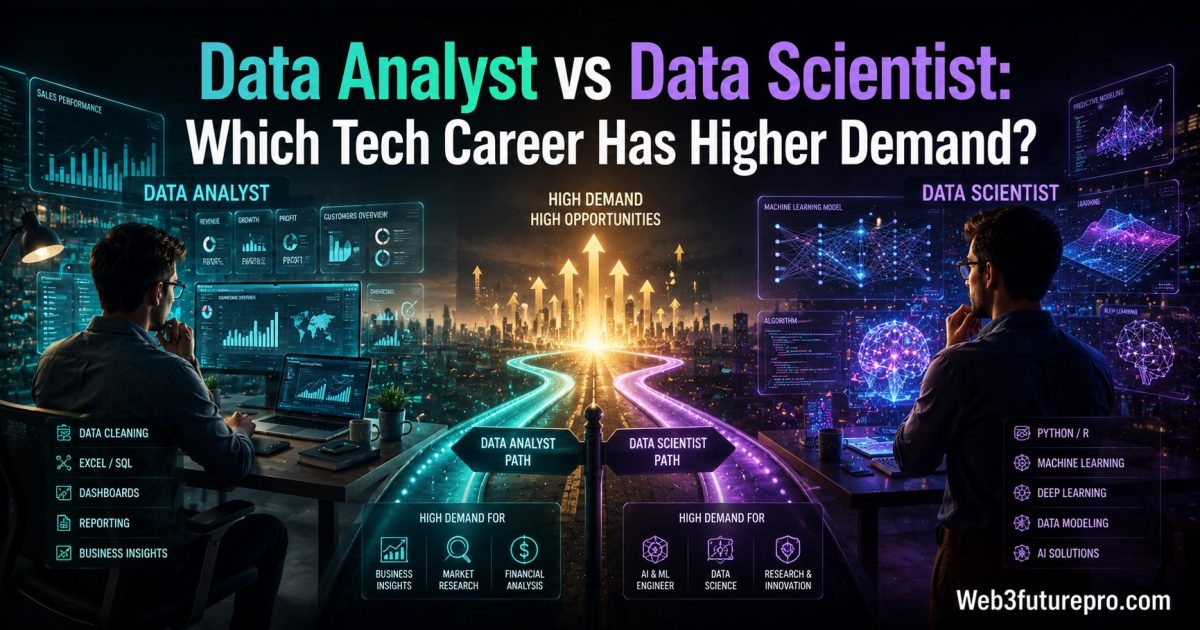
The explosion of big data, artificial intelligence, and business intelligence has made data-driven decision-making a top priority for organizations worldwide. As companies increasingly rely on data to improve operations, understand customer behavior, and drive innovation, careers in data analytics and data science have become some of the fastest-growing and highest-paying roles in the technology industry. This has led many aspiring professionals to ask an important question: Data Analyst vs Data Scientist: Which Tech Career Has Higher Demand?
Although both professions work with data to help businesses make informed decisions, their responsibilities, technical skills, and career paths differ significantly. Data analysts focus on collecting, cleaning, visualizing, and interpreting data to uncover actionable insights that support business decisions. Data scientists go a step further by leveraging advanced programming, machine learning, predictive modeling, and artificial intelligence to solve complex problems and forecast future trends. Both roles are essential in today’s digital economy, but they vary in terms of job availability, educational requirements, salary expectations, and long-term career growth.
In 2026, organizations across industries—including finance, healthcare, e-commerce, technology, manufacturing, government, and cybersecurity—are actively recruiting data professionals to transform raw information into strategic business value. With remote work becoming increasingly common, skilled data analysts and data scientists can access career opportunities from companies around the globe.
CHECK: Freelancing vs Full-Time Remote Tech Jobs: Which Is Better for Beginners?
In this comprehensive comparison, we’ll examine the differences between data analysts and data scientists by exploring job demand, salary potential, required skills, educational background, remote work opportunities, career progression, and future industry outlook. Whether you’re beginning your journey in data or considering a career transition, this guide will help you determine which path offers the strongest opportunities in 2026.
Data Analyst vs Data Scientist demand in 2026
In 2026 the data profession sits at the center of almost every industry conversation about growth, efficiency, and AI. Two titles dominate the discussion: Data Analyst and Data Scientist. One focuses on describing what happened and why. The other builds models that predict what will happen next and recommends what to do about it. Both roles are in demand. Both can be remote. Yet the volume of openings, the projected growth rates, the salary trajectories, and the ease of entry differ in ways that matter for anyone choosing a path.
This comparison examines the current market reality across the United States, Asia, the Middle East, and South Africa. It draws on 2026 job-posting volumes, salary benchmarks, remote-work patterns, and skill requirements to answer a practical question: which career currently shows higher demand, and which offers the clearer route for someone just starting out.
Job Role Overview
A Data Analyst turns existing data into clear business insights. Typical work includes querying databases with SQL, cleaning and transforming datasets, building dashboards in tools such as Tableau or Power BI, running statistical summaries, and presenting findings to stakeholders. The core questions are descriptive and diagnostic: What happened? Why did it happen? How are key metrics trending? Analysts often support marketing, product, finance, or operations teams with recurring reports and ad-hoc investigations.
A Data Scientist goes further into prediction and optimization. The role involves statistical modeling, machine learning, experimental design, and translating complex results into actionable recommendations. Work frequently includes feature engineering, model training and evaluation, A/B testing frameworks, and sometimes deploying models into production environments. The questions shift toward the future: What is likely to happen? Which intervention will produce the best outcome? How can we automate or scale this insight?
The boundary is not always sharp. Many job descriptions blend elements of both. In smaller companies one person may wear both hats. In larger organizations the roles are more distinct, with Analysts focused on reporting and insight delivery and Scientists focused on modeling and experimentation. Both roles sit inside broader data teams that may also include data engineers, analytics engineers, and machine-learning engineers.
Skills Required
Data Analyst skills center on practical data handling and communication. Core technical requirements in 2026 include strong SQL, proficiency with Excel or Google Sheets, data visualization tools (Tableau, Power BI, or Looker), and basic statistical literacy. Python or R for data manipulation (pandas, dplyr) is increasingly expected. Soft skills emphasize clear storytelling, stakeholder management, and the ability to translate numbers into business language. Domain knowledge in a specific industry (finance, e-commerce, healthcare) often accelerates progress.
Data Scientist skills build on the analyst foundation and add depth in statistics, programming, and modeling. Essential tools include advanced Python (or R), machine-learning libraries (scikit-learn, PyTorch, TensorFlow), experimental design, and often cloud platforms or MLOps basics. Strong mathematical foundations in probability, linear algebra, and inference are required. Soft skills include the ability to frame ambiguous problems, communicate uncertainty, and collaborate with engineers on deployment. Many postings now expect familiarity with large language models or generative AI techniques applied to structured data.
Both roles reward continuous learning. Analysts must stay current with visualization platforms and business metrics. Scientists must track evolving modeling techniques and production best practices. Public portfolios—dashboards for Analysts, GitHub repositories with reproducible modeling projects for Scientists—remain critical for remote hiring.
Salary Comparison
Data Scientists generally earn more than Data Analysts at comparable experience levels in 2026, reflecting the additional technical depth and the scarcity of strong modeling talent.
In the United States, median base salaries for Data Analysts often fall near $91,000–$95,000, with junior roles commonly starting in the $55,000–$75,000 range and seniors reaching $115,000–$150,000. Data Scientists show higher medians, frequently $112,000–$127,000, with junior ranges around $85,000–$120,000 and seniors commonly $150,000–$200,000 or more at strong companies. The gap of roughly $20,000–$32,000 at the median is consistent across multiple 2026 datasets.
Outside the US the pattern holds with lower absolute numbers. In South Africa local Data Analyst medians sit around ZAR 32,000 per month, while Data Scientist roles command noticeably higher figures. In Asia, Indian entry-level Analyst ranges often start at ₹3–6 LPA and Scientists at ₹5–8 LPA or higher at product companies; remote international contracts raise both substantially. Middle Eastern markets, particularly Saudi Arabia and the UAE, offer competitive packages for both roles tied to national digital and AI strategies, with Scientists again showing a premium. Remote roles paid by US or European companies frequently close much of the geographic gap for strong candidates in all these regions.
Freelance and contract rates follow the same hierarchy. Experienced Data Scientists command higher hourly rates than Analysts, reflecting the specialized modeling work.
Remote Work Opportunities
Both roles support remote work at similar rates in 2026. Analyses of postings show fully remote tags on roughly 20–25% of roles for each title, with hybrid arrangements more common and onsite still significant in many industries. Neither is predominantly remote-first, yet genuine fully remote opportunities exist across companies of all sizes.
Data Analyst remote roles often appear in product, marketing, and operations teams that value clear reporting and dashboard ownership. Data Scientist remote openings are more frequent in tech, fintech, and AI-focused organizations that already operate distributed modeling teams. Time-zone preferences exist for both, especially when collaboration with product or engineering is required, but global-friendly companies hire across regions when communication and delivery are strong.
For candidates in Asia, the Middle East, and South Africa, remote international contracts remain one of the most effective ways to access higher compensation while remaining location-flexible.
Best Platforms to Apply
Specialized and general remote boards both surface these roles. We Work Remotely, Remote OK, LinkedIn (with remote and skill filters), Wellfound, and FlexJobs consistently list Data Analyst and Data Scientist openings. Data-focused boards and communities (DataJobs.com and similar) improve signal. Company career pages at tech, finance, healthcare, and retail firms remain essential, as many roles never reach broad aggregators.
For Analysts, emphasizing SQL proficiency, dashboard examples, and business impact in applications works well. For Scientists, reproducible modeling projects, clear problem framing, and evidence of end-to-end work (from data to insight or model) stand out. Networking through LinkedIn and data communities often yields better results than pure volume applying.
Career Growth Potential
Data Analyst growth paths include Senior Analyst, Analytics Manager, Analytics Engineer, Product Analyst, or transition into Data Science. Many Analysts move into specialized domains (marketing analytics, financial analytics) or leadership. The ceiling is solid, though the staff-level individual-contributor track is thinner than in Data Science.
Data Scientist paths lead toward Senior or Staff Data Scientist, Machine Learning Engineer, Applied Scientist, Research roles, or technical leadership. The senior and staff market is deeper, with higher compensation ceilings and more specialized tracks (recommendation systems, causal inference, generative AI applications). The projected long-term growth for data science occupations remains among the strongest in technology.
Both careers support consulting and independent work at senior levels. Scientists currently enjoy higher average contract rates and broader demand for advanced modeling.
Pros and Cons
Data Analyst Pros Lower barrier to entry for many candidates. Clearer early responsibilities and faster path to first role. Strong demand across almost every industry. Excellent foundation for later moves into science, engineering, or management. Tangible business impact through dashboards and reports.
Data Analyst Cons Lower average compensation than Data Scientist roles. Some routine reporting work faces pressure from AI tooling. Senior individual-contributor ceiling is more limited. Competition at junior levels can be high because the path is accessible.
Data Scientist Pros Higher salary trajectory and stronger senior/staff market. Direct involvement with predictive modeling and AI systems. Higher projected occupational growth. Greater technical depth and variety of problems. Strong remote opportunities at AI-forward companies.
Data Scientist Cons Steeper skill requirements and longer preparation time. Fewer pure entry-level openings relative to the technical bar. Higher expectations around statistics, programming, and experimentation. Greater ambiguity in day-to-day problem definition.
Beginner Friendliness
Data Analyst roles are generally more beginner-friendly. The core tools (SQL, visualization platforms, Excel) can be learned to a job-ready level more quickly. Portfolios of dashboards and business analyses are straightforward to build and demonstrate. Many companies hire juniors or career switchers into Analyst positions and provide on-the-job growth. Entry-level share of postings is comparable or slightly favorable in some datasets.
Data Scientist roles demand more upfront investment in statistics, programming, and modeling. Pure junior openings exist but often expect internship experience, strong academic credentials, or polished project portfolios that already show modeling competence. The path is accessible to motivated self-taught learners, yet the time to first role is typically longer.
A common and effective route is to begin as a Data Analyst, build domain knowledge and technical confidence, then transition into Data Science once modeling skills are solid.
Industry Demand
Demand for both roles remains high in 2026, but the nature of that demand differs. Job-posting volumes are often close—sometimes Analyst listings slightly outnumber Scientist listings, sometimes the reverse—depending on the board and time window. Overall volume is substantial for both.
Projected growth favors Data Science. U.S. Bureau of Labor Statistics figures place data science among the fastest-growing occupations, with growth rates frequently cited around 34% over a decade—well above average. Analyst roles also grow solidly, often in the 20%+ range in related categories, but the AI and modeling emphasis in current business priorities amplifies demand for Scientist skills.
Across the United States, Asia (especially India and Singapore), the Middle East (driven by national AI and digital strategies), and South Africa, both titles appear regularly in remote and hybrid postings. Scientists command a scarcity premium and longer senior runway; Analysts offer broader entry-level volume and industry coverage.
In 2026, Data Scientist roles show higher overall demand intensity when measured by projected growth, salary premium, and senior-level opportunity. The combination of AI integration, predictive modeling needs, and scarcity of strong practitioners keeps the market competitive and well-compensated. Data Analyst roles remain highly demanded in absolute volume, especially at junior and mid levels, and provide a more accessible entry point for many beginners.
For pure volume of openings accessible to newcomers, Data Analyst currently has the edge. For long-term growth trajectory, compensation ceiling, and alignment with AI-driven priorities, Data Scientist leads. Many successful Data Scientists began as Analysts. The practical decision for most people starting out is to enter through the Analyst door if speed to first role matters most, or to invest the extra preparation time in Scientist skills if the modeling work itself is the primary attraction.
Both careers offer strong remote possibilities, global relevance, and durable value. Choose the path whose day-to-day problems you find more engaging—the market will reward genuine competence in either.
Choosing between a Data Analyst and a Data Scientist career depends on your interests, technical abilities, and long-term professional goals. Data analysts play a vital role in helping organizations understand historical and current performance through reporting, dashboards, and business insights. Their skills are in high demand across virtually every industry, making data analytics an excellent entry point into the world of data careers.
Data scientists, meanwhile, specialize in building predictive models, developing machine learning solutions, and solving complex business challenges using advanced statistical techniques and programming. While the learning curve is steeper, data science often offers higher earning potential and opportunities to work on cutting-edge AI and automation projects.
In 2026, data analysts generally have a broader volume of job openings, particularly for entry-level and mid-level roles, because businesses of all sizes need professionals who can analyze and interpret data. Data scientists, however, remain among the most sought-after specialists, especially in organizations investing heavily in artificial intelligence, machine learning, and advanced analytics. Both career paths offer excellent remote work opportunities, competitive salaries, and long-term job security.
Ultimately, success in either profession depends on continuously expanding your technical skills, mastering industry-standard tools, building a strong portfolio of real-world projects, and staying current with evolving technologies. Whether you pursue data analytics or data science, both careers provide a rewarding pathway into one of the most dynamic and future-proof sectors of the global technology industry.