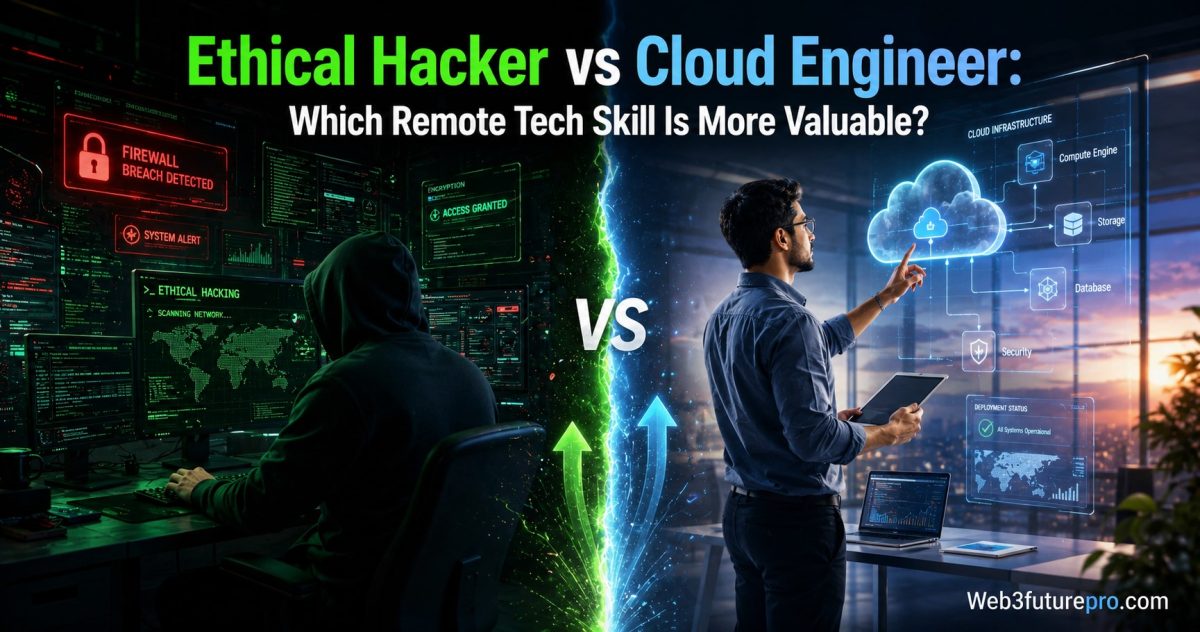
The rapid growth of cloud computing and cybersecurity has transformed the global technology landscape, creating thousands of high-paying remote jobs for skilled professionals. As organizations migrate critical workloads to the cloud and face increasingly sophisticated cyber threats, two career paths have emerged as some of the most valuable in the tech industry: Ethical Hacking and Cloud Engineering. Both roles are in high demand, offer excellent salaries, and provide opportunities to work remotely for companies around the world. But one question continues to attract aspiring IT professionals: Ethical Hacker vs Cloud Engineer: Which Remote Tech Skill Is More Valuable?
Ethical hackers, also known as penetration testers or offensive security specialists, help organizations identify and fix security vulnerabilities before cybercriminals can exploit them. Their work involves conducting security assessments, penetration testing, vulnerability analysis, and compliance audits to strengthen an organization’s digital defenses. Cloud engineers, on the other hand, design, deploy, manage, and optimize cloud infrastructure using platforms such as Amazon Web Services (AWS), Microsoft Azure, and Google Cloud Platform (GCP). They ensure that cloud environments are scalable, secure, reliable, and cost-effective.
In 2026, businesses across industries are investing heavily in both cybersecurity and cloud technologies. The rise of remote work, artificial intelligence, digital transformation, and cloud-native applications has made these professionals indispensable to modern organizations. While both careers promise outstanding earning potential and long-term job security, they differ in technical requirements, certifications, career progression, and the types of challenges professionals solve daily.
CHECK: Data Analyst vs Data Scientist: Which Tech Career Has Higher Demand?
In this comprehensive comparison, we’ll examine ethical hacking and cloud engineering based on salary potential, job demand, required skills, certifications, learning curve, remote work opportunities, and future career growth. Whether you’re beginning your IT journey or planning a career transition, this guide will help you determine which remote tech skill offers the greatest value in 2026 and beyond.
Ethical Hacker vs Cloud Engineer remote value in 2026
In 2026 the technology industry continues to reward two very different kinds of expertise. One protects systems by breaking them first. The other builds and maintains the infrastructure that modern businesses run on. Ethical hackers (often titled penetration testers or offensive security specialists) simulate real attacks to expose weaknesses before criminals do. Cloud engineers design, deploy, and operate the scalable platforms that power applications, data, and AI workloads. Both skills are in demand. Both support remote work. Yet when the question turns to long-term value—salary potential, volume of opportunities, career durability, and ease of entry—the comparison is more nuanced than simple headlines suggest.
This article examines the 2026 market for remote Ethical Hacker and Cloud Engineer roles across the United States, Asia, the Middle East, and South Africa. It covers role definitions, required skills, realistic compensation, remote work patterns, application platforms, growth paths, and which skill currently offers stronger overall value for most professionals.
Job Role Overview
An Ethical Hacker, also commonly called a penetration tester or red team operator, is authorized to attack systems, networks, applications, and sometimes physical or social layers in order to find vulnerabilities. The work involves reconnaissance, vulnerability scanning, exploitation, post-exploitation analysis, and clear reporting that helps organizations fix issues. Some roles focus on web applications, others on infrastructure, cloud environments, mobile, or specialized areas such as AI model security. The goal is always defensive: identify weaknesses so they can be remediated before real attackers exploit them.
A Cloud Engineer builds and operates cloud infrastructure. Typical responsibilities include designing architectures on AWS, Azure, or Google Cloud, implementing infrastructure as code, managing containers and Kubernetes, configuring networking and security controls, optimizing costs and performance, and ensuring reliability and scalability. Many Cloud Engineer roles overlap with DevOps or platform engineering. The work is constructive rather than adversarial: create environments that are secure, efficient, and ready for application teams.
The two skills intersect more than they once did. Cloud environments are now primary attack surfaces, so ethical hackers increasingly need cloud knowledge, while cloud engineers are expected to embed security from the start. Still, the day-to-day focus remains distinct—one tests and breaks, the other builds and runs.
Skills Required
Ethical Hacking demands deep technical curiosity and offensive tooling. Core skills include networking fundamentals, operating system internals (Linux and Windows), web application security (OWASP Top 10 and beyond), scripting (Python, Bash, PowerShell), and hands-on experience with tools such as Burp Suite, Nmap, Metasploit, and custom exploit development. Certifications carry significant weight: OSCP remains a widely recognized benchmark, alongside CEH, PNPT, or specialized cloud security credentials. Soft skills center on clear technical writing, responsible disclosure, and the ability to explain risk to non-technical stakeholders. A portfolio of documented lab work, capture-the-flag results, or authorized bug bounty findings is often more persuasive than formal degrees.
Cloud Engineering emphasizes practical infrastructure and automation. Essential skills include at least one major cloud platform (AWS is most frequently requested, followed by Azure and GCP), infrastructure as code (Terraform is dominant), containerization (Docker and Kubernetes), networking, monitoring, and scripting or programming (Python is common). DevOps practices, CI/CD pipelines, and cost optimization are regularly required. Certifications such as AWS Solutions Architect, Azure Administrator, or Kubernetes credentials help, though demonstrated project experience often matters more. Soft skills include collaboration with development teams, documentation, and the ability to balance reliability, security, and cost.
Both roles reward continuous learning. Ethical hackers must track new attack techniques and defensive controls. Cloud engineers must stay current with platform updates, new services, and evolving best practices around security and efficiency.
Salary Comparison
Compensation in 2026 reflects both scarcity and business criticality. Cloud Engineer roles often show higher volume and competitive mid-to-senior bands, while specialized Ethical Hacker / penetration testing roles can command strong premiums, especially with proven offensive skills.
In the United States, remote Cloud Engineer median or typical base salaries frequently fall in the $120,000–$160,000 range for mid-level practitioners, with seniors commonly reaching $155,000–$200,000 or higher and staff-level roles pushing further. Some remote postings and total compensation packages at strong companies exceed these figures substantially. Ethical Hacker and penetration tester ranges commonly start lower at entry levels ($60,000–$90,000) and move into $110,000–$160,000 for experienced practitioners, with senior or specialized red team roles reaching $165,000–$220,000 or more. Top-end security compensation can rival or exceed cloud figures when the work involves high-stakes environments or rare expertise.
Outside the United States the absolute numbers are lower, but relative patterns hold. In India and broader Asia, Cloud Engineer salaries at product companies often range from mid-teens to mid-fifties LPA depending on experience, while cybersecurity and penetration testing roles can start with a slight premium at junior levels yet see Cloud Architect tracks overtake at senior levels. Middle Eastern markets, particularly the UAE and Saudi Arabia, offer competitive tax-advantaged packages for both skills tied to national digital and security initiatives. South African professionals working remotely for international employers can earn multiples of local rates in either field. Remote contracts paid by U.S. or European companies remain one of the strongest levers for raising effective compensation in all these regions.
Freelance and contract rates follow similar logic. Experienced penetration testers with strong track records can bill high hourly rates for short engagements. Cloud engineers more often secure longer-term contracts or full-time remote positions with steadier income.
Remote Work Opportunities
Both skills support remote work, yet Cloud Engineering currently offers broader volume of fully remote openings. Cloud infrastructure work lends itself to asynchronous collaboration, documentation, and tooling that functions well across time zones. Many product companies and remote-first organizations hire Cloud Engineers without geographic restrictions beyond time-zone overlap preferences.
Ethical Hacking and penetration testing roles are also remote-friendly in many cases, particularly for application testing and cloud-focused assessments. However, some engagements still require onsite presence for physical testing, sensitive environments, or client preference, and certain government or highly regulated contracts impose location or clearance constraints. Overall, the proportion of fully remote security roles has risen, yet pure Cloud Engineer listings often appear in greater numbers on remote job boards.
Candidates based in Asia, the Middle East, and South Africa regularly secure remote international roles in both fields when they demonstrate strong technical portfolios and clear communication.
Best Platforms to Apply
Remote opportunities for both skills appear on We Work Remotely, Remote OK, LinkedIn, Wellfound, and FlexJobs. Specialized security boards and communities (including those focused on bug bounties and offensive security) surface Ethical Hacker roles. Cloud and DevOps-focused listings are plentiful on the major remote boards and company career pages. Direct applications to cloud providers, security consultancies, and product companies remain effective.
For Ethical Hackers, documented lab results, write-ups, and any authorized findings strengthen applications. For Cloud Engineers, infrastructure-as-code repositories, architecture diagrams, and evidence of production systems carry weight. Networking through relevant communities and LinkedIn continues to generate opportunities that pure volume applying misses.
Career Growth Potential
Ethical Hacking paths lead toward senior penetration tester, red team lead, offensive security engineer, application security specialist, or broader security architecture and leadership roles including CISO tracks for those who expand into strategy and management. The skill remains highly specialized and valued as threat landscapes evolve.
Cloud Engineering offers paths into senior cloud engineer, cloud architect, platform engineering, site reliability engineering, DevOps leadership, or specialized tracks such as cloud security or AI infrastructure. The foundational nature of cloud platforms creates durable demand and multiple adjacent career options.
Both skills support independent consulting. Ethical hackers can build practices around assessments and bug bounty programs. Cloud engineers can offer architecture, migration, and optimization services. Hybrid profiles that combine strong cloud knowledge with offensive security skills currently sit in especially strong positions.
Pros and Cons
Ethical Hacker Pros Intellectually engaging adversarial work. Strong specialized demand driven by persistent workforce shortages. Clear impact when vulnerabilities are found and fixed. Good compensation for proven practitioners. Flexible project and contract opportunities. High relevance as attack surfaces expand into cloud and AI systems.
Ethical Hacker Cons Steeper practical barrier to entry (labs, certifications, and demonstrated exploitation ability). Some roles involve pressure of client deadlines and detailed reporting. Fewer pure junior openings relative to the technical bar. Occasional location or clearance constraints. Continuous need to stay ahead of new techniques.
Cloud Engineer Pros Broader volume of remote openings. Foundational skill set that remains relevant across industries. Clear certification and project pathways. Strong mid-to-senior compensation and architecture tracks. High demand driven by ongoing cloud adoption and AI infrastructure needs. More predictable full-time remote roles.
Cloud Engineer Cons Can involve operational toil and on-call responsibilities in some environments. Rapid platform changes require ongoing learning. Competition at junior levels can be high. Pure “cloud engineer” titles sometimes overlap with adjacent DevOps or platform roles, requiring careful positioning.
Beginner Friendliness
Cloud Engineering is generally more beginner-friendly for structured learners. Cloud provider free tiers, documentation, and certification paths allow steady skill building. Infrastructure-as-code projects and personal labs can demonstrate competence relatively quickly. Entry-level or junior cloud roles exist, though many still prefer some prior experience or strong project portfolios.
Ethical Hacking has a higher practical barrier. Theoretical knowledge is insufficient; employers want evidence of hands-on exploitation ability. Capture-the-flag platforms, home labs, and progressive certifications (starting from foundational security knowledge toward OSCP-level practical exams) form the typical route. Pure junior penetration testing openings are limited; many practitioners begin in broader security analyst or junior security roles and transition into offensive work.
A common effective path is to build foundational IT, networking, and cloud skills first, then specialize into either offensive security or deeper cloud engineering according to interest and aptitude.
Industry Demand
Both skills face strong demand in 2026, but the nature differs. Cloud Engineering benefits from the continued expansion of cloud adoption, multi-cloud strategies, and the infrastructure required for AI and data workloads. Job posting volumes for cloud and related infrastructure roles remain high across remote boards.
Ethical Hacking and broader cybersecurity face a well-documented global workforce shortage measured in millions of unfilled positions. Penetration testing specifically appears in hundreds of recent postings and is frequently listed among high-demand security specializations. Growth projections for information security roles remain well above average. Cloud security—the intersection of the two skills—is particularly sought after.
Across the United States, Asia (especially India and Singapore), the Middle East (driven by national cybersecurity and digital strategies), and South Africa, both skill sets appear regularly in remote and hybrid opportunities. Cloud roles often provide higher absolute volume; specialized ethical hacking provides scarcity value and strong compensation for those who clear the practical bar.
In 2026, Cloud Engineering currently offers broader remote opportunity volume and a more accessible structured path for many beginners, making it highly valuable as a foundational remote tech skill. Ethical Hacking provides specialized scarcity value, intellectually distinctive work, and strong compensation for practitioners who develop genuine offensive capability, particularly as cloud and AI attack surfaces expand.
The more valuable skill for most people depends on aptitude and goals. Those who enjoy building reliable systems, automation, and infrastructure will find Cloud Engineering durable and well-compensated. Those drawn to adversarial problem-solving, creative exploitation, and defensive impact will find Ethical Hacking rewarding—provided they invest the practical hours required to demonstrate competence.
The highest long-term value often belongs to professionals who combine elements of both: cloud engineers who understand offensive techniques, or ethical hackers with deep cloud platform knowledge. In a market defined by expanding cloud estates and persistent security gaps, that hybrid profile is especially well positioned.
Either path supports meaningful remote careers. Choose the one whose day-to-day problems you find more engaging, then execute deliberately on skills, portfolio, and certifications. The market continues to reward demonstrated ability in both.
Choosing between an Ethical Hacker and a Cloud Engineer career depends on your interests, technical strengths, and long-term professional goals. Ethical hackers play a critical role in protecting organizations from cyberattacks by identifying vulnerabilities, testing security controls, and improving overall cyber resilience. As cyber threats continue to evolve, demand for skilled cybersecurity professionals remains exceptionally strong, making ethical hacking one of the most respected and rewarding careers in technology.
Cloud engineers, meanwhile, are responsible for building and maintaining the cloud infrastructure that powers modern businesses. Their expertise in cloud architecture, automation, networking, virtualization, and DevOps enables organizations to scale efficiently while reducing operational costs. With more companies adopting hybrid and multi-cloud environments, cloud engineering continues to rank among the fastest-growing and highest-paying remote technology careers.
In 2026, cloud engineering generally offers a broader range of remote job opportunities because organizations across nearly every industry rely on cloud infrastructure for their operations. Ethical hacking, however, remains one of the most valuable specialized skills, particularly for companies handling sensitive data, financial transactions, healthcare records, and critical infrastructure. Professionals who combine cloud expertise with cybersecurity knowledge are especially sought after, as organizations increasingly prioritize securing cloud environments against evolving threats.
Ultimately, both career paths provide excellent salaries, global remote work opportunities, and strong long-term growth. By earning industry-recognized certifications, building hands-on projects, gaining practical experience, and continuously updating your skills, you can position yourself for success in either field. Whether you choose ethical hacking or cloud engineering, you’ll be investing in a future-proof career that will remain essential as technology continues to shape the digital world.