Machine learning and deep learning power most of today’s intelligent systems—from spam filters in your inbox to voice assistants on your phone and medical image analysis in hospitals. Yet many still confuse the two, or assume deep learning simply means “better” machine learning.
In 2026, the distinction matters more than ever: machine learning remains the go-to for interpretable, efficient models on structured data, while deep learning dominates unstructured, high-dimensional problems like vision, speech, and generative tasks.
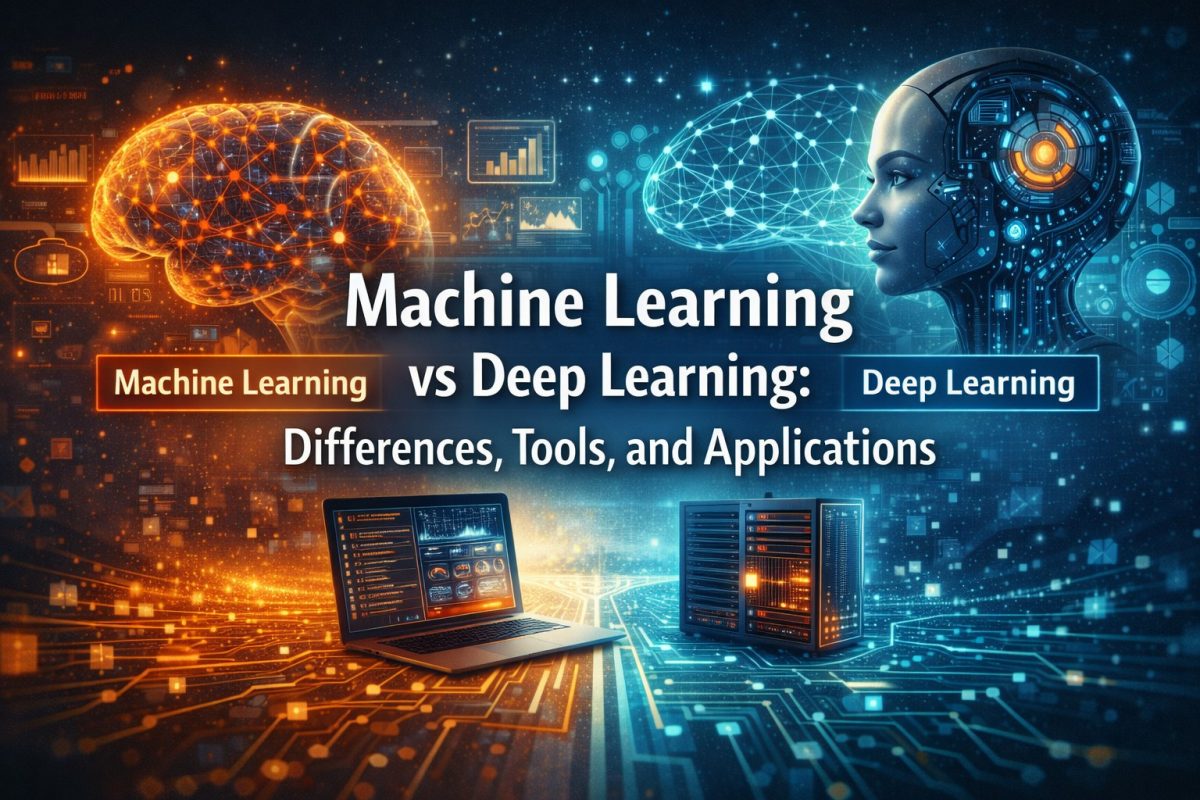
Deep learning is a specialized subset of machine learning. Both fall under artificial intelligence, but they differ in approach, data needs, hardware, and ideal use cases. Understanding these helps developers, businesses, and students choose the right path—whether building fraud detection in AB’s fintech scene or deploying autonomous systems in Asia’s manufacturing hubs.
CHECK: Ethical AI Challenges: Solutions and Guidelines for Developers in 2026
This guide breaks down the key differences, popular tools in 2026, and real-world applications—with clear examples showing when to use each.
What is Machine Learning?
Machine Learning is a subset of AI that enables computers to learn patterns from data without being explicitly programmed for every task.
Instead of writing rules manually, developers train algorithms on datasets so the system can make predictions or decisions.
Common machine learning algorithms include:
- Linear Regression
- Decision Trees
- Random Forest
- Support Vector Machines
- K-Means Clustering
Many ML systems are built using tools like Scikit-learn and TensorFlow.
Example
A spam email filter trained on thousands of emails can automatically classify new emails as spam or legitimate.
What is Deep Learning?
Deep Learning is a specialized subset of machine learning that uses neural networks with many layers to analyze complex data patterns.
These networks are inspired by the structure of the human brain.
Deep learning models are particularly effective for:
- Image recognition
- Speech recognition
- Natural language processing
- Autonomous systems
Frameworks such as PyTorch and TensorFlow are widely used to build deep learning systems.
Deep learning is the technology behind systems like voice assistants and advanced image recognition tools.
Core Definitions
- Machine Learning (ML) — Algorithms that learn patterns from data to make predictions or decisions without explicit programming for every scenario. It includes supervised (labeled data), unsupervised (patterns in unlabeled data), and reinforcement learning (trial-and-error rewards).
- Deep Learning (DL) — A subset of ML that uses multi-layered artificial neural networks (inspired by the brain) to automatically learn hierarchical features from raw data—no manual feature engineering required.
Key Differences: Side-by-Side Comparison
| Aspect | Machine Learning (Traditional) | Deep Learning | Winner in 2026 & Why |
|---|---|---|---|
| Data Requirements | Works well with smaller, structured datasets | Requires massive volumes of data (often unstructured) | ML for limited data; DL for big/raw data |
| Feature Engineering | Manual—humans select/extract relevant features | Automatic—learns features through layers | DL (less human effort) |
| Model Complexity | Simpler algorithms (trees, SVMs, linear models) | Deep neural networks (many layers, millions+ parameters) | DL for complexity |
| Interpretability | High (e.g., decision trees show rules) | Low (“black box”—hard to explain decisions) | ML (regulated domains) |
| Hardware Needs | Runs on CPUs; GPUs optional | Demands GPUs/TPUs for training | ML (cheaper to run) |
| Training Time | Faster (hours/days) | Slower (days/weeks on large data) | ML for quick iterations |
| Performance | Strong on tabular/structured data | State-of-the-art on images, text, audio, video | DL for sensory/unstructured tasks |
| Overfitting Risk | Moderate (with regularization) | High (mitigated by dropout, large data) | Comparable with good practices |
In 2026, hybrid approaches thrive: use ML for explainable baselines or edge devices, and DL for cutting-edge accuracy on rich data.
Top Tools & Frameworks in 2026
Machine Learning (General-Purpose & Traditional)
- Scikit-learn — Still the gold standard for classical ML (classification, regression, clustering); simple, fast, interpretable.
- XGBoost / LightGBM / CatBoost — Gradient boosting leaders for tabular data; dominate Kaggle and enterprise predictive modeling.
- H2O.ai — AutoML platform for quick, scalable ML pipelines.
- Spark MLlib — Distributed ML on big data clusters.
Deep Learning
- PyTorch — Dominant in research and increasingly production (dynamic graphs, ease of debugging); Meta-backed and researcher favorite.
- TensorFlow / Keras — Enterprise powerhouse (Google ecosystem, strong deployment tools like TensorFlow Serving, TFLite for mobile/edge).
- JAX — Rising fast for high-performance research (autograd + XLA compilation); great for custom models.
- Hugging Face Transformers — De facto library for NLP, vision, multimodal DL (pre-trained models, fine-tuning pipelines).
Many 2026 projects mix both: Scikit-learn/XGBoost for feature prep and baselines, then PyTorch/TensorFlow for deep models.
Real-World Applications in 2026
Machine Learning Shines In
- Fraud Detection — Banks and fintech (e.g., Nigerian mobile money platforms) use XGBoost or random forests on transaction features for real-time scoring—explainable and fast on modest hardware.
- Recommendation Systems — E-commerce (Jumia, Konga) and streaming use collaborative filtering or matrix factorization—effective with user-item matrices.
- Predictive Maintenance — Manufacturing predicts equipment failure from sensor data using time-series ML (no need for deep architectures on tabular logs).
- Credit Scoring & Risk Modeling — Regulated finance prefers interpretable models (logistic regression, decision trees) for compliance.
Deep Learning Dominates In
- Medical Imaging & Diagnostics — CNNs (e.g., ResNet, EfficientNet) detect cancer in X-rays/MRIs with superhuman accuracy; deployed in hospitals globally.
- Autonomous Vehicles & Robotics — Perception stacks (object detection via YOLOv8+, segmentation) rely on deep vision models.
- Natural Language Processing — Transformers power chatbots, translation (Google Translate), sentiment analysis, and code generation.
- Generative AI — Diffusion models (Stable Diffusion successors), LLMs (GPT-style), and multimodal agents create text, images, video—almost exclusively deep learning.
- Voice & Speech — ASR (automatic speech recognition) and TTS use recurrent/transformer architectures for assistants like Siri or local language tools.
In emerging markets like Nigeria and South Africa, ML powers accessible fraud tools and credit scoring on mobile data, while DL drives telemedicine imaging and voice apps in local languages.
Future Trends in Machine Learning and Deep Learning
By 2030, several developments are expected to shape the field.
Automated Machine Learning (AutoML)
Tools will automatically select algorithms and optimize models.
Edge AI
AI models will run directly on devices instead of cloud servers.
Hybrid AI Systems
Combining symbolic reasoning with deep learning may create more powerful systems.
Energy-Efficient AI
Researchers are working to reduce the massive energy consumption of large neural networks.
Which Should You Choose in 2026?
- Choose Machine Learning when: data is structured/tabular, interpretability/compliance matters, resources are limited, or you need fast training/deploy.
- Choose Deep Learning when: dealing with images, text, audio/video, or need maximum accuracy on complex patterns—and you have compute + data.
- Hybrid — Most real systems start with ML baselines, then layer DL where it adds value.
For developers in Africa or globally: Begin with Scikit-learn + XGBoost for quick wins, then learn PyTorch (rising standard) for deep models. The future favors those who master both—not one over the other.
Machine learning and deep learning are two of the most powerful technologies driving the AI revolution.
Machine learning offers efficient solutions for many predictive problems, while deep learning excels at analyzing complex data such as images, speech, and text.
Understanding the differences between the two helps developers choose the right tools and build smarter AI solutions.
As computing power increases and datasets grow larger, both technologies will continue to shape industries ranging from healthcare to finance and transportation.