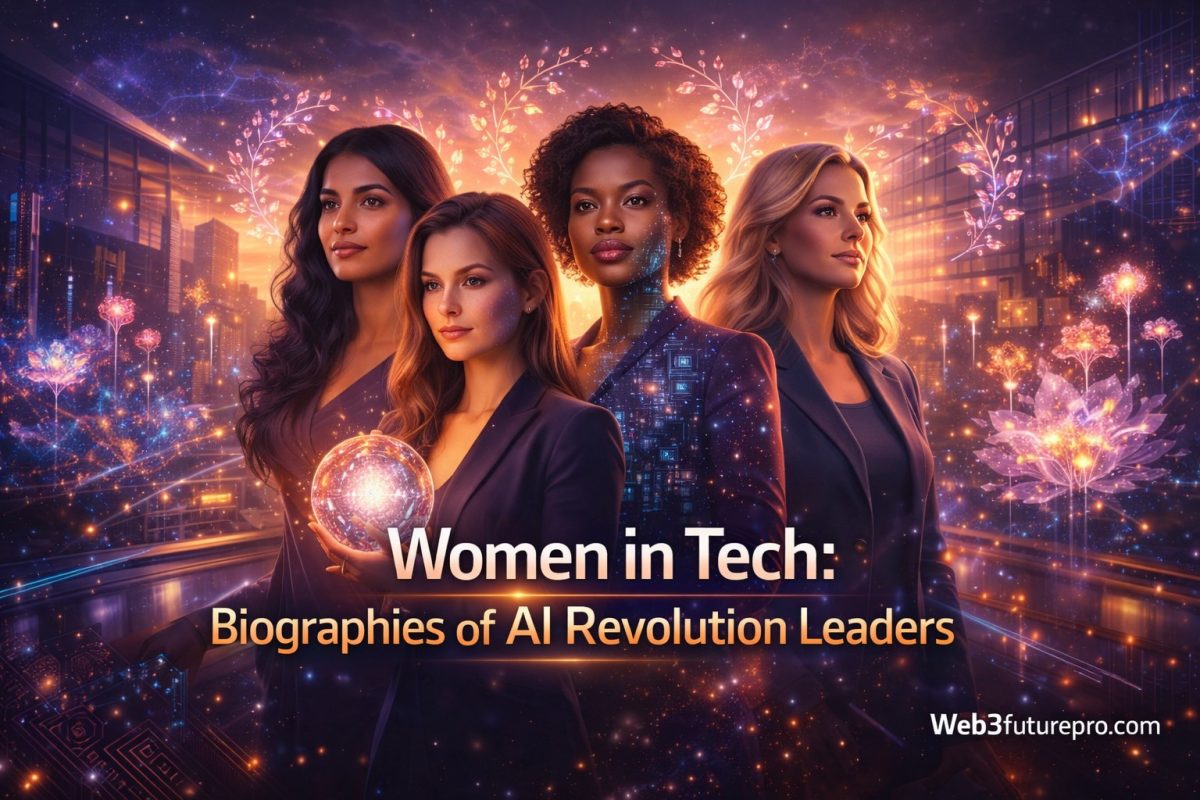
Women in Tech: Women have been instrumental in shaping the AI revolution, often bringing human-centered perspectives, ethical rigor, and groundbreaking research that complement technical breakthroughs. In 2026, as AI scales into agents, spatial intelligence, enterprise workflows, and multimodal systems, female leaders continue to drive innovation while advocating for responsible development, diversity, and real-world impact.
This selection highlights 10 influential women whose journeys and contributions stand out. It spans research pioneers, founders, ethicists, and executives, with global representation including voices from or relevant to Africa, Asia, and emerging markets. Their stories demonstrate resilience, first-principles thinking, and a commitment to AI that serves humanity.
The Shift: Women at the Center of the AI Revolution
The AI industry has historically faced gender imbalance.
But in recent years, that dynamic has begun to shift.
Women are now:
- Leading major AI companies
- Driving groundbreaking research
- Influencing global AI policy
- Building high-impact startups
Their contributions are not just important—they are essential to the future of responsible AI.
1. Fei-Fei Li – The “Godmother of AI” and Pioneer of Computer Vision
Fei-Fei Li, often called the “Godmother of AI,” transformed the field through her creation of ImageNet, the massive annotated dataset that powered the deep learning revolution in computer vision. Born in China and raised in the US, she overcame early challenges, including her family’s struggles, to earn degrees from Princeton and Caltech.
As a Stanford professor and co-director of the Stanford Human-Centered AI Institute (HAI), Li has long championed human-centered AI that prioritizes ethics, social impact, and accessibility. In recent years, she founded World Labs, raising significant funding (including a $1 billion round reported in early 2026) to advance spatial intelligence—AI systems that understand and interact with the three-dimensional physical world.
Key Breakthroughs: ImageNet catalyzed modern vision models; her work on cognitively inspired AI and healthcare applications continues to influence the field. Li’s memoir The Worlds I See and advocacy for diversity underscore her belief that AI must reflect humanity’s full spectrum.
Why She Matters in 2026: Her focus on ethical, spatially aware AI addresses real-world deployment challenges, making her a guiding voice for responsible innovation.
2. Mira Murati – Former OpenAI CTO and Founder of Thinking Machines Lab
Mira Murati rose to prominence as Chief Technology Officer at OpenAI, where she played a central role in developing and deploying models like GPT-4 and advancing the company’s agentic capabilities. An Albanian-born engineer with a background in mechanical engineering and AI, she brought operational excellence and a thoughtful approach to scaling frontier systems.
In 2026, Murati leads Thinking Machines Lab, focusing on practical AI deployment, infrastructure, and systems that bridge research with real-world applications.
Key Breakthroughs: Oversaw critical scaling efforts at OpenAI; advocated for transparent and responsible AI development during a period of rapid commercialization.
Why She Matters: Murati exemplifies technical depth combined with strategic leadership, showing how women can steer some of the most ambitious AI organizations while emphasizing deployment challenges like safety and usability.
3. Daniela Amodei – President and Co-Founder of Anthropic
Daniela Amodei co-founded Anthropic with her brother Dario after key roles at OpenAI. As President, she has helped shape the company’s focus on constitutional AI—systems designed with explicit principles for safety, honesty, and helpfulness.
Anthropic’s Claude models have emerged as strong competitors to GPT series, emphasizing reliability and reduced hallucination in enterprise and research settings.
Key Breakthroughs: Contributed to Anthropic’s public benefit corporation structure and its emphasis on scalable oversight and alignment research.
Why She Matters: Her work highlights the importance of institutional design and safety-first approaches in frontier AI labs, influencing how companies balance speed with responsibility.
4. Ayanna Howard – Robotics and Ethical AI Pioneer
Dr. Ayanna Howard, Dean of Engineering at The Ohio State University and founder of Zyrobotics, is a leading figure in robotics, human-robot interaction, and ethical AI. Her research integrates AI with physical systems to create assistive technologies, particularly for children with disabilities.
Key Breakthroughs: Developed socially interactive robots and algorithms that prioritize fairness and inclusivity; her work bridges AI, robotics, and accessibility.
Why She Matters: Howard brings a strong equity lens to AI and robotics, ensuring technology serves underrepresented populations—an increasingly vital perspective as AI enters healthcare, education, and daily life.
5. Cassie Kozyrkov – Decision Intelligence Pioneer and Former Google Chief Decision Scientist
Cassie Kozyrkov founded the field of Decision Intelligence at Google, where she served as the company’s first Chief Decision Scientist. She focuses on making AI practical for decision-making in organizations, emphasizing rigorous processes over blind automation.
Key Breakthroughs: Developed frameworks that help leaders apply AI responsibly and effectively across business contexts.
Why She Matters: Kozyrkov demystifies AI for executives and promotes evidence-based decision culture, making advanced tools accessible and less prone to misuse.
6. Rana el Kaliouby – Human-Centered and Emotional AI Pioneer
Rana el Kaliouby, co-founder of Affectiva (pioneering emotion AI), is a leading advocate for human-centered AI. She now supports the next generation of women AI founders through Blue Tulip Ventures.
Key Breakthroughs: Advanced affective computing—AI that understands human emotions—which has applications in mental health, automotive safety, and customer experience.
Why She Matters: Her work humanizes AI, addressing the emotional and social dimensions often overlooked in technical development.
7. Nina Schick – Generative AI and Deepfake Expert
Nina Schick is a leading authority on generative AI, deepfakes, and their societal implications. Author of one of the first books on deepfakes, she advises organizations on responsible deployment.
Key Breakthroughs: Early analysis of synthetic media risks and opportunities, shaping policy and industry practices.
Why She Matters: As generative tools proliferate in 2026, her focus on truth, misinformation, and ethical use provides critical guardrails.
8. Toju Duke – AI Ethics and Responsible Innovation Leader
Toju Duke is recognized as one of the top women leading the AI revolution in 2026, with expertise in responsible AI practices, governance, and inclusive development. She contributes to global conversations on building thoughtful AI systems.
Key Breakthroughs: Advocacy and frameworks for ethical deployment, particularly in enterprise and public sector contexts.
Why She Matters: Duke ensures AI development considers broader societal impacts, a perspective essential for sustainable progress.
9. Dr. Ayanna Howard (additional context) and Emerging African Voices like Betelhem Dessie
Betelhem Dessie (Ethiopia) stands out as an AI prodigy and founder of iCog-Anyone Can Code. She trains thousands of young Africans in robotics, programming, and AI while applying these technologies to local challenges like agriculture optimization.
Her work exemplifies how African women are building inclusive AI ecosystems from the ground up.
10. Additional Influential Voices: Tatyana Kanzaveli and Regional Leaders
Tatyana Kanzaveli, founder of Women in GenAI, trains women globally in generative tools, driving broader adoption and diverse perspectives in AI development.
Across Africa, leaders like those in agritech AI (e.g., teams behind farmer-focused GPT tools) and data governance (e.g., Kenya’s data commissioners) are expanding the field’s inclusivity.
Why These Women Matter for the AI Revolution
These leaders share common threads: technical excellence paired with ethical awareness, a focus on human impact, and resilience in male-dominated spaces. They advance core technologies (vision, agents, robotics) while addressing bias, accessibility, governance, and societal risks—ensuring AI benefits diverse populations worldwide.
In 2026, as AI integrates into daily life, their emphasis on human-centered design, spatial intelligence, decision frameworks, and inclusive training becomes even more critical. For aspiring innovators—especially women and those in emerging markets—their journeys prove that bold vision, rigorous research, and ethical leadership can drive transformative change.
The AI revolution is not just about more powerful models—it’s about who builds them and for what purpose. These women are ensuring the future is more equitable, thoughtful, and human.
Follow their work, support diverse talent pipelines, and consider how your contributions can advance responsible AI. The next breakthrough may come from any background—the field is richer when all voices lead.