In February 2026, artificial intelligence isn’t just a buzzword—it’s a tangible force reshaping economies worldwide. From AI-driven investment surges boosting U.S. GDP growth to generative tools accelerating digitalization in emerging markets, AI’s impact is visible in productivity gains, job shifts, and infrastructure booms. Global GDP projections hover around 3.2–3.3% for 2026, with AI-related tailwinds offsetting trade tensions and demographic pressures in many regions.
Yet the transformation remains uneven. Advanced economies lead in AI investment and adoption, while emerging markets in Africa, Asia, and Latin America show rapid uptake in practical applications like mobile money enhancements and localized tools—though gaps in infrastructure and talent persist. Forecasts vary: optimistic views see AI adding trillions in value through productivity, while cautious analyses highlight modest near-term effects amid a “productivity paradox” where massive spending hasn’t yet fully translated to output.
For businesses in Abuja leveraging AI for financial inclusion, U.S. firms riding the capex wave, Asian manufacturers optimizing supply chains, or Middle Eastern economies investing in sovereign AI, understanding these dynamics is key to navigating 2026’s opportunities and risks.
This guide explores AI’s current economic footprint, sector impacts, workforce effects, regional differences, and realistic 2026 outlook—drawing from recent reports and data.
What Changed Between 2020 and 2026?
AI development accelerated rapidly after the mainstream adoption of generative AI tools. Companies like OpenAI, Google, Microsoft, and NVIDIA intensified competition in:
- Large language models
- AI infrastructure chips
- Enterprise AI integrations
- Automation platforms
But the economic shift wasn’t just about new tools.
It was about integration.
By 2026, AI has become:
- Embedded in enterprise software
- Integrated into cloud platforms
- Standard in data analytics workflows
- Central to digital transformation strategies
AI is no longer a niche investment. It’s a macroeconomic driver.
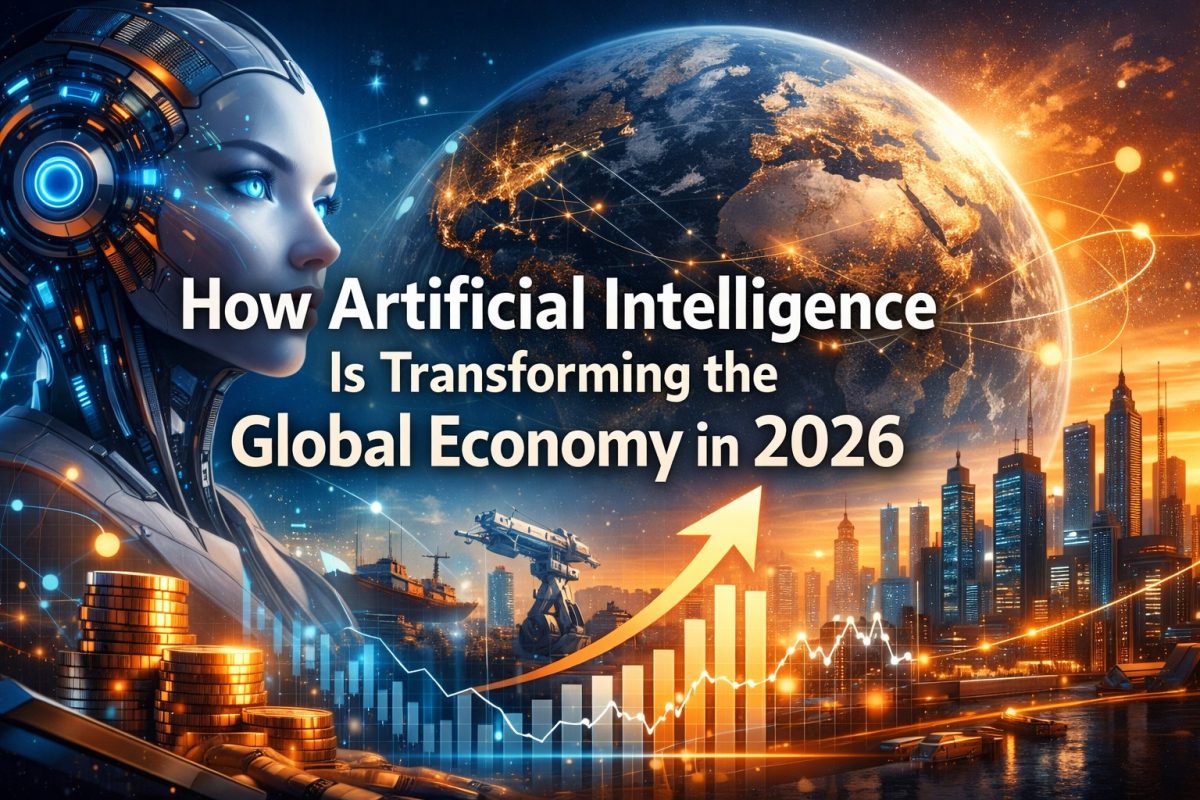
How Artificial Intelligence Is Transforming the Global Economy in 2026
AI’s Macroeconomic Footprint in 2026
AI influences growth through three channels: massive capital investment (data centers, chips, infrastructure), productivity enhancements from adoption, and new business models/digitalization.
- Investment Surge — AI capex drives GDP. In the U.S., AI spending added ~0.4 percentage points to growth in 2025 and is expected to contribute similarly in 2026, equating to hundreds of billions in nominal terms. Globally, AI infrastructure investments (hyperscalers alone projected at over $1 trillion in 2026–2027) fuel construction, energy demand, and related sectors.
- Productivity Outlook — Gains are emerging but not yet explosive. Chief economists expect AI to lift labor productivity by 1.5–3% over the next decade, with meaningful effects in major economies within 1–2 years. U.S. nonfarm productivity rose sharply in late 2025, partly attributed to AI efficiencies. However, aggregate data shows modest boosts so far—some call it an “AI productivity paradox” reminiscent of IT in the 1980s–1990s.
- GDP Projections — IMF forecasts steady global growth at 3.3% in 2026, with AI investment providing upside (potential +0.3 pp if adoption accelerates). U.S. growth could hit 3%+ with AI offsetting shocks; emerging markets benefit from digital leapfrogging.
Sector Transformations Driven by AI
AI delivers the biggest value in knowledge-intensive and digital sectors:
- Finance & Professional Services — Automation of analysis, risk assessment, and compliance yields high returns. Banking could capture $200–340 billion annually from generative AI.
- Tech & High-Tech Manufacturing — AI optimizes R&D, supply chains, and production. Asia leads in semiconductor/AI hardware.
- Healthcare & Retail — Diagnostics, personalized services, and inventory management drive efficiency.
- Small Businesses & Digitalization — Generative AI accelerates e-commerce, marketing, and operations—especially in emerging markets where SMEs adopt mobile-first tools.
Emerging markets show stronger strategic transformation (36–42% impact in South Africa, Central/South Asia) versus cautious adoption in North America/Europe (18–22%).
Workforce and Job Market Shifts
AI’s dual nature—displacement and creation—defines 2026’s labor story:
- Displacement Risks — Entry-level white-collar roles (customer service, basic coding) face early pressure. Younger workers in AI-exposed jobs see higher unemployment in some data. Goldman Sachs notes potential temporary unemployment rise (0.5 pp during transition).
- Net Effects — Most forecasts see modest, temporary impacts. Jobs lost are offset by new roles in AI development, data curation, and AI-augmented fields. Productivity gains create wealth that supports consumption and investment.
- Adoption & Reskilling — Firms using AI report tripled revenue per employee. Emerging markets leverage mobile ecosystems for inclusive growth.
Regional Spotlight: Emerging Markets Leading in Practical Adoption
- Africa (e.g., Nigeria, South Africa) — Mobile money success (e.g., Kenya’s 91% penetration) extends to AI-driven finance. Adoption surges via localized tools; GenAI could unlock $100 billion+.
- Asia — Rapid infrastructure and sovereign AI pushes (China, Kazakhstan). Trade/digital services grow fast.
- Middle East — Investments in data centers and partnerships position the region for AI sovereignty.
The global divide widens: high adoption in UAE/Singapore (>60%), lower in many African/Asian markets—but leapfrogging potential remains high.
Challenges and Realistic Outlook for 2026
- Paradox & Timing — Massive investments haven’t fully yielded productivity yet; 2026 may see measurement focus and “high-frequency AI dashboards.”
- Risks — Over-optimism could trigger corrections; energy demands, talent shortages, and uneven readiness pose hurdles.
- Upside Potential — Faster adoption could add 1–2 extra growth years globally; complementary policies (retraining, infrastructure) amplify benefits.
In 2026, AI transforms the economy through investment momentum and incremental efficiencies rather than overnight revolution. The technology amplifies human capabilities—boosting productivity where adopted—while creating adaptation needs.
AI and the Labor Market: Disruption or Reinvention?
This remains the most debated issue.
Will AI eliminate jobs — or create new industries?
The answer is nuanced.
Jobs at Risk
Roles involving repetitive, data-heavy tasks are most exposed:
- Data entry
- Basic accounting
- Customer support
- Routine legal drafting
Automation reduces demand for certain administrative functions.
Jobs Being Created
AI also generates demand in areas like:
- AI model training
- Data science
- Prompt engineering
- AI ethics and compliance
- Human-AI collaboration design
Moreover, entirely new business models are emerging:
- AI consulting firms
- AI infrastructure providers
- AI security companies
The labor market shift is less about mass unemployment — and more about skill transformation.
Workers who adapt thrive. Those who don’t may struggle.
Regional Perspectives: AI’s Uneven Economic Impact
AI adoption varies significantly by geography.
United States
The US remains a global leader in AI research and venture funding.
Key drivers:
- Strong tech ecosystem
- Private-sector investment
- Cloud infrastructure dominance
Economic focus:
- Enterprise AI integration
- Defense AI systems
- Advanced semiconductor production
The US AI economy is innovation-driven.
Asia
China, South Korea, Singapore, and India are major AI players.
Focus areas:
- Manufacturing automation
- Smart cities
- Digital finance
- E-commerce personalization
Asia’s scale advantage accelerates AI deployment across consumer markets.
Middle East
Countries like the UAE and Saudi Arabia are investing heavily in AI as part of economic diversification strategies.
Focus:
- Government digital services
- Smart infrastructure
- Energy optimization
AI is positioned as a pillar of post-oil economic transformation.
South Africa & Emerging Markets
AI adoption focuses on:
- Fintech
- Agricultural optimization
- Education technology
- SME digital tools
The challenge remains infrastructure gaps, but opportunity is significant.
AI Infrastructure: The Silent Economic Engine
Behind every AI application is massive infrastructure.
Semiconductor companies like NVIDIA supply high-performance chips essential for AI training.
Cloud providers such as Amazon (AWS) and Microsoft (Azure) dominate AI deployment environments.
AI is not just software innovation — it’s hardware economics.
Countries investing in chip manufacturing and data centers are positioning themselves strategically.
Risks and Economic Challenges
Despite rapid growth, AI presents structural risks.
1. Inequality Amplification
If AI tools remain concentrated in advanced economies, wealth gaps could widen.
Small businesses without AI integration may fall behind.
2. Data Privacy Concerns
AI relies heavily on large datasets.
Regulatory frameworks must balance innovation with privacy rights.
3. Energy Consumption
AI training requires significant computational power.
Energy-efficient infrastructure is becoming a policy priority.
4. Algorithmic Bias
Biased training data can produce discriminatory outcomes.
Governance frameworks are evolving to address this.
2026 Predictions: What’s Next?
Looking ahead, several trends are emerging.
1. AI-Augmented Workplaces
Rather than full automation, most industries will adopt AI copilots that assist workers.
Human oversight remains essential.
2. AI Regulation Becomes Standardized
Expect clearer regulatory standards across major economies.
International cooperation may increase around AI governance.
3. AI Becomes Invisible Infrastructure
Users won’t interact with “AI tools” explicitly.
Instead, AI will operate seamlessly within apps, platforms, and services.
4. Developing Nations Leapfrog with AI
Just as mobile phones allowed regions to skip landlines, AI may enable emerging markets to bypass traditional industrial stages.
This could accelerate economic modernization.
Final Analysis: Is AI Reshaping the Global Economy Permanently?
Yes — but not uniformly.
AI in 2026 is:
- Enhancing productivity
- Restructuring labor markets
- Accelerating innovation cycles
- Redefining competitive advantage
The transformation is structural, not temporary.
The countries and companies that invest in:
- AI education
- Infrastructure
- Ethical frameworks
- Workforce reskilling
will likely dominate the next economic phase.
AI is not replacing the global economy.
It is rewiring it.
And in 2026, the shift is already well underway.
For emerging markets like S.A, focus on accessible tools for inclusion; globally, prioritize reskilling and ethical deployment. AI’s economic story is one of steady, compounding impact—poised to accelerate as adoption matures.