Smart contracts sound futuristic, but they’re already powering billions in everyday transactions across finance, gaming, supply chains, and more. Imagine a vending machine that automatically dispenses a snack when you insert the exact coins—no cashier needed, no trust required, and no way to cheat the system. That’s the essence of a smart contract in Web3: code that acts as an unbreakable, self-enforcing agreement.
In 2026, smart contracts aren’t just theory. They’re the engine behind tokenized real-world assets, AI agents that manage treasuries autonomously, decentralized lending worth hundreds of billions, and instant global payments. Whether you’re in Abuja exploring Web3 for financial inclusion, the US diving into DeFi yields, Asia building cross-border trade tools, or the Middle East tokenizing infrastructure, understanding smart contracts unlocks the decentralized future.
CHECK: Ultimate Guide to Web3 Trends and Innovations in 2026
This beginner’s guide explains exactly what smart contracts are, how they work step-by-step, real-world examples in 2026, benefits, risks, and how to get started—no prior coding experience required.
What Exactly Is a Smart Contract?

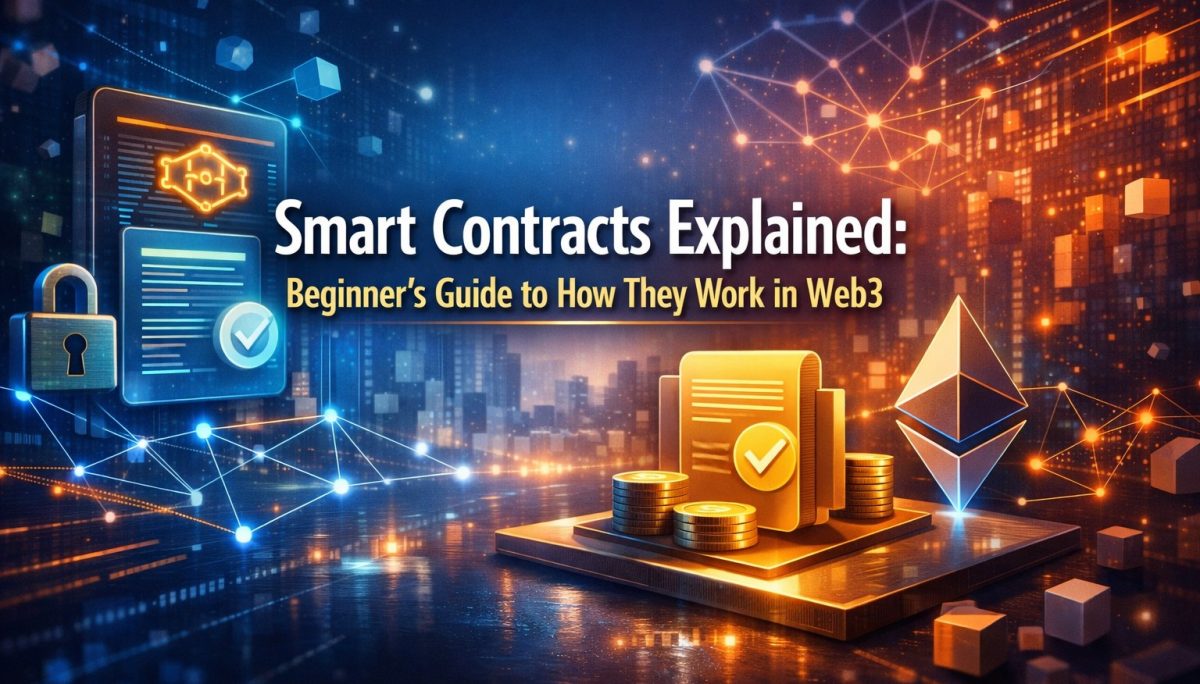
A smart contract is a self-executing computer program stored on a blockchain. Its terms (the “contract”) are written directly in code, and when predefined conditions are met, it automatically performs actions—no middleman, no paperwork, no delays.
The term was coined in 1994 by Nick Szabo, but they became reality with Ethereum in 2015. Today, they’re the core of Web3, enabling trustless interactions where parties don’t need to know or trust each other.
Think of it as:
- If/then logic baked into unbreakable code.
- “If payment received = 1 ETH, then transfer ownership of this digital asset.”
- Once deployed on the blockchain, the code can’t be changed (immutability), and execution is visible to everyone (transparency).
Unlike traditional contracts enforced by courts, smart contracts enforce themselves through blockchain consensus.
How Do Smart Contracts Work? Step-by-Step Breakdown
Smart contracts live on blockchains like Ethereum, Solana, or Polygon. Here’s the simple flow:
- Creation and Writing Developers write the code in languages like Solidity (most popular for Ethereum-compatible chains). Example: A basic agreement to release funds when a task completes.
- Compilation The human-readable code compiles into bytecode that the blockchain’s virtual machine understands.
- Deployment The developer pays a small fee (gas on Ethereum) to deploy the contract to the blockchain. It gets a permanent address—like a bank account number for code.
- Interaction Users (or other contracts) send transactions to call functions in the contract.
- Example: Send ETH to buy an NFT → contract checks balance, transfers token ownership automatically.
- Execution Nodes on the network run the code identically. If conditions match (“if/when…then…”), actions happen: transfer funds, update data, mint tokens. Everything records immutably on the blockchain.
- Verification Anyone can audit the code and transaction history. No hidden changes possible.
Key tech enablers in 2026:
- Ethereum Virtual Machine (EVM) — Runs the code deterministically.
- Gas fees — Prevent spam; pay for computation.
- Oracles — Bring real-world data (e.g., weather, stock prices) on-chain securely.
Real-World Examples of Smart Contracts in 2026
Smart contracts power practical applications worldwide:
- DeFi Lending (Aave, Compound) Borrow or lend crypto without banks. Smart contracts lock collateral, calculate interest in real-time, and liquidate positions if undercollateralized—all automatically.
- Tokenized Real-World Assets (RWAs) BlackRock-style funds and sovereign assets (Middle East oil/infrastructure) tokenized. Smart contracts handle fractional ownership, dividends, and 24/7 trading.
- Supply Chain Automation In agriculture or logistics, contracts trigger payments when goods arrive (verified via IoT sensors/oracles), reducing fraud and disputes—huge in Asia and Africa.
- Insurance Claims Parametric insurance: If flight delayed (oracle confirms), contract pays out instantly—no claims adjuster needed.
- NFTs and Gaming Ownership transfers, royalties paid forever to creators when resold.
- AI Agents and Autonomous DAOs Emerging in 2026: AI-driven agents execute trades, manage treasuries, or vote in governance via smart contract logic.
In South Africa and Nigeria, stablecoin-based remittances use smart contracts for low-cost, instant transfers—bypassing expensive traditional rails.
Benefits of Smart Contracts
- Trustless — No need to trust counterparties; code enforces rules.
- Transparent — All transactions public and auditable.
- Efficient — Automates processes, cuts intermediaries, reduces costs.
- Fast — Seconds/minutes vs. days for settlements.
- Global & Inclusive — Anyone with internet can participate, vital in emerging markets.
- Immutable — Once live, tamper-proof (though upgradeable patterns exist).
Common Risks and Limitations
No technology is perfect—especially code handling real value:
- Bugs and Exploits — Coding errors lead to hacks (e.g., reentrancy attacks, access control flaws). Audits essential.
- Immutability Double-Edge — Can’t easily fix bugs post-deployment without upgrade proxies.
- Oracle Dependency — Bad data in = bad execution out.
- Gas Costs & Scalability — High fees during congestion (improved by Layer 2s in 2026).
- Regulatory Uncertainty — Varies by region; compliance features emerging.
Best practice: Start small, use audited libraries (OpenZeppelin), test thoroughly.
How to Get Started as a Beginner in 2026
- Learn Basics Understand blockchain first (Ethereum.org docs excellent).
- Try Remix IDE Browser-based tool—no install needed. Write, compile, deploy test contracts instantly.
- Write Your First Contract Classic “Hello World” or Simple Storage:
solidity
// SPDX-License-Identifier: MIT
pragma solidity ^0.8.0;

contract SimpleStorage {
    uint256 private storedData;

    function set(uint256 x) public {
        storedData = x;
    }

    function get() public view returns (uint256) {
        return storedData;
    }
}
Deploy on testnet (Sepolia), interact via wallet like MetaMask.
- Free Resources
- Tools You’ll Need
- MetaMask wallet
- Testnet ETH (faucets)
- Remix or VS Code + Hardhat/Foundry
Start experimenting on testnets—zero real money at risk.
Smart Contracts vs Traditional Contracts
| Feature | Traditional Contract | Smart Contract |
|---|---|---|
| Enforcement | Legal system | Code execution |
| Speed | Days to weeks | Minutes to seconds |
| Transparency | Limited | Publicly verifiable |
| Cost | High administrative fees | Lower automation cost |
| Human involvement | Required | Minimal |
However — smart contracts don’t fully replace legal contracts yet. They often complement them.
Are Smart Contracts Truly “Smart”?
Despite the name, they aren’t intelligent.
They:
- Don’t interpret context
- Don’t understand intent
- Only execute programmed rules
If the code contains an error, the contract executes that error precisely.
This is why security audits are critical.
Why Smart Contracts Matter in Web3
Smart contracts are the engine of Web3. Without them, blockchain would only record transactions — not automate agreements.
Here’s why they’re revolutionary:
1. Eliminate Middlemen
Banks, brokers, clearinghouses — all act as trust intermediaries.
Smart contracts replace institutional trust with mathematical certainty.
2. Reduce Costs
Automation cuts:
- Administrative fees
- Legal processing time
- Settlement delays
For emerging economies — especially in Africa and Southeast Asia — cost reduction can dramatically increase financial access.
3. Increase Transparency
Every interaction is recorded on-chain.
This builds:
- Auditability
- Fraud resistance
- Public verification
For governments and corporations, this enhances accountability.
4. Enable Decentralized Finance (DeFi)
Most DeFi platforms rely entirely on smart contracts.
Lending platforms, staking systems, and decentralized exchanges operate without traditional banks — powered by automated contract logic.
Industries Already Using Smart Contracts in 2026
Smart contracts are no longer theoretical. They’re actively transforming industries.
1. Finance
- Automated lending
- Decentralized exchanges
- Tokenized bonds and assets
Global institutions are exploring blockchain frameworks under guidance from organizations like the Bank for International Settlements.
2. Insurance
Smart contracts can:
- Automatically verify claims
- Release payouts instantly
- Reduce fraud
For example:
If flight data confirms a delay → payout triggers automatically.
3. Supply Chain
Smart contracts track goods from manufacturing to delivery.
When shipment milestones are verified:
- Payments release automatically
- Ownership updates instantly
This improves efficiency in global trade hubs across Asia and the Middle East.
CHECK: How Blockchain Technology Will Revolutionize Finance in 2026
4. Government & Identity
Digital identity initiatives increasingly rely on blockchain-based verification systems.
Institutions such as the World Economic Forum have explored decentralized identity frameworks built on smart contracts.
The Bottom Line: Why Smart Contracts Matter in Web3
Smart contracts turn “code is law” into reality, creating a more efficient, inclusive digital economy. In 2026, they’re not optional—they’re infrastructure for DeFi, RWAs, AI agents, and beyond.
Whether building dApps, investing in protocols, or simply using Web3 apps, grasp smart contracts and you’ll navigate the decentralized world confidently.
Ready to code your first one? Head to Remix IDE and try the example above. The future runs on smart contracts—start writing yours today.