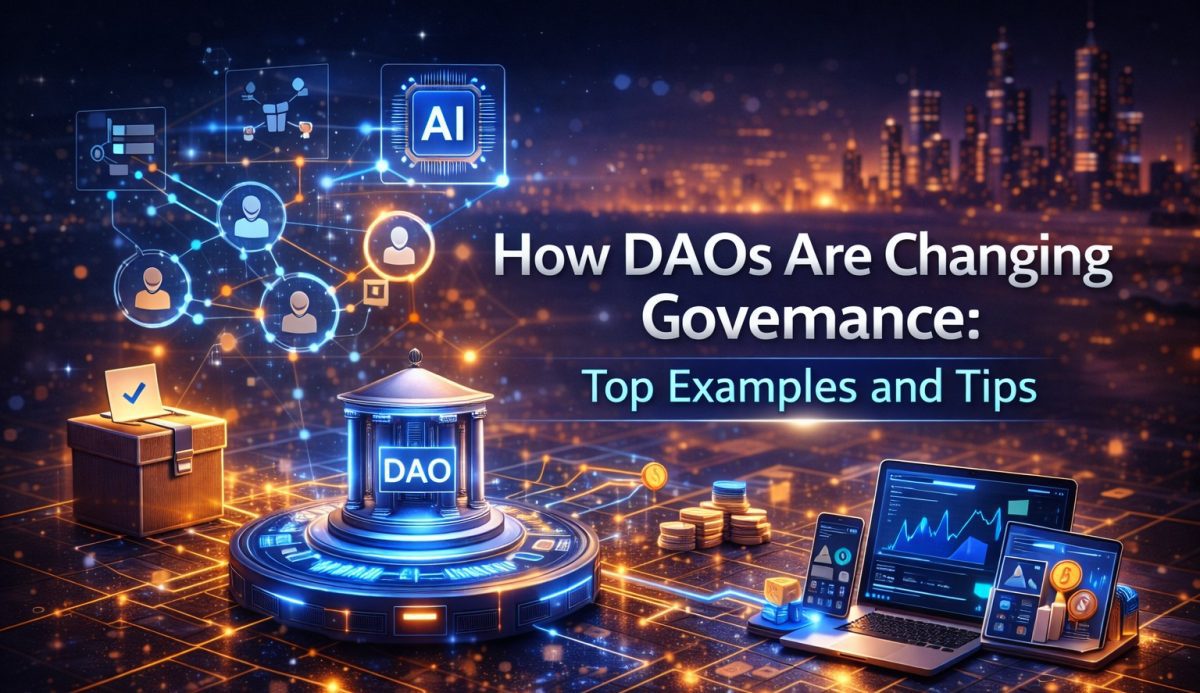
How DAOs Are Changing Governance in 2026: Imagine a global organization where decisions aren’t made in closed boardrooms but through transparent, on-chain votes accessible to thousands of participants worldwide. No CEOs dictating terms, no annual shareholder meetings shrouded in opacity—just code-enforced rules, community proposals, and executable outcomes.
In 2026, Decentralized Autonomous Organizations (DAOs) have matured from experimental experiments into powerful governance engines reshaping finance, communities, and even enterprise models.
DAOs replace traditional hierarchies with programmable, trust-minimized systems. Token holders propose changes, delegate votes, and execute upgrades via smart contracts—creating continuous, inclusive decision-making. Trends show hybrid models emerging: delegated voting, reputation-weighted systems, AI-assisted analysis, and partial centralization for efficiency. Some protocols paused pure DAO governance in 2025–2026 to reassess slowness, but the core idea persists: decentralization aligns incentives better than top-down control.
CHECK: Top 10 Decentralized Apps (dApps) Shaping the Future in 2026 — The Web3 Frontier
For users in Abuja pooling funds for local projects, the US participating in protocol upgrades, Asia coordinating creator economies, or the Middle East managing collective investments, DAOs democratize power and build trust at scale.
This guide explores how DAOs transform governance, top real-world examples in 2026, and practical tips to engage or build one.
What Is a DAO? A Clear, Beginner-Friendly Explanation
A Decentralized Autonomous Organization (DAO) is an internet-native organization governed by smart contracts and community voting rather than centralized executives.
Instead of:
- A CEO making final decisions
- A board approving budgets
- A bank controlling funds
A DAO operates through:
- Smart contracts on a blockchain
- Token-based voting systems
- Transparent treasury management
- Community-driven proposals
Most DAOs are built on networks like Ethereum, Solana, or other programmable blockchains that support smart contracts.
At its core, a DAO replaces trust in people with trust in code — but as we’ll see, humans still play a critical role.
How DAO Governance Works (Step-by-Step)
Understanding DAO governance requires looking at its operational mechanics.
1. Proposal Creation
Any eligible member (depending on the DAO’s rules) can submit a proposal. This may include:
- Funding a new product
- Changing treasury allocation
- Adjusting tokenomics
- Partnering with another protocol
- Hiring contributors
Proposals are often discussed publicly before formal voting.
2. Token-Based Voting
Members vote using governance tokens. Voting power typically depends on:
- Number of tokens held
- Delegated tokens
- Staked tokens
Some DAOs experiment with quadratic voting to reduce the influence of large token holders.
3. Smart Contract Execution
If a proposal meets quorum and passes:
- Smart contracts automatically execute the decision
- Funds are released
- Rules are updated
- Governance changes are implemented
No manual approval required.
4. Treasury Transparency
All funds are visible on-chain. Anyone can verify:
- Treasury balances
- Spending history
- Grant distributions
This level of financial transparency is rare in traditional institutions.
How DAOs Fundamentally Change Governance
Traditional governance relies on intermediaries, opaque processes, and infrequent votes. DAOs flip this:
- Transparency — Every proposal, vote, and treasury transaction lives on-chain, auditable by anyone.
- Inclusivity — Anyone holding governance tokens participates—no gatekeepers.
- Automation — Smart contracts execute decisions instantly (e.g., fund releases, parameter tweaks).
- Alignment — Token-based incentives reward long-term thinking over short-term gains.
- Resilience — No single point of failure; networks persist even if leaders depart.
In 2026, key evolutions include:
- Delegated and liquid democracy (vote without constant participation).
- Hybrid structures balancing speed and decentralization.
- AI tools for proposal summarization and risk assessment.
- Legal wrappers (e.g., Wyoming DUNAs) for real-world legitimacy.
These changes make governance faster, fairer, and more adaptive than corporate or governmental models.
Top Examples of DAOs Reshaping Governance in 2026
Here are standout DAOs demonstrating real impact:
- MakerDAO (now evolving as Sky ecosystem) Governs the decentralized stablecoin USDS (formerly DAI). Token holders vote on collateral types, stability fees, and risk parameters—managing billions in value without a central bank. Impact: Proves DAOs can run stable, inflation-resistant financial systems with community oversight.
- Uniswap DAO Controls the world’s leading decentralized exchange. UNI holders vote on fee switches, treasury use, and protocol upgrades. Impact: Turned a protocol into a community-owned business, directing billions in trading volume democratically.
- Aave DAO Manages lending/borrowing parameters, risk modules, and GHO stablecoin. Governance includes flash loans and credit delegation. Impact: Institutional-grade DeFi with community-driven risk management.
- Curve DAO Token holders decide liquidity pool incentives, fee structures, and gauge weights for stablecoin trading. Impact: Optimizes low-slippage swaps; ongoing developer activity keeps it a DeFi backbone.
- Compound DAO Votes on market additions, interest rate models, and treasury allocations for lending. Impact: Classic example of executable governance via timelocks and on-chain proposals.
- Aragon DAO / Frameworks (OSx, DAOhaus) Powers modular governance for thousands of DAOs—used for grants, investment clubs, and social initiatives. Impact: Enables customizable, scalable structures beyond DeFi.
- Gitcoin DAO Funds public goods via quadratic funding rounds; community votes on grants and ecosystem direction. Impact: Redirects capital to open-source and impact projects democratically.
- Decentraland DAO Governs virtual land, content, and platform updates via MANA token votes. Impact: Shows DAOs managing digital worlds and real estate-like assets.
These DAOs manage treasuries worth billions, proving decentralized governance scales for complex operations.
Practical Tips for Engaging with or Building a DAO in 2026
Whether joining or launching, focus on sustainability and participation:
- For Participants:
- Start small: Delegate votes to trusted experts via tools like Snapshot or Tally.
- Stay informed: Follow forums (Discourse, Discord) and on-chain activity (DeepDAO, Tally).
- Vote actively: Even small stakes influence outcomes; use reputation models where available.
- Diversify: Join multiple DAOs to spread influence and learn models.
- For Builders/Creators:
- Choose the right framework: Aragon OSx for modularity, OpenZeppelin Governor for protocols, DAOhaus for simplicity.
- Design fair mechanics: Use quadratic voting or reputation weighting to curb whale dominance.
- Prioritize legal clarity: Explore wrappers like Wyoming DAO LLCs or DUNAs for liability protection.
- Build incentives: Tie tokens to value capture (fees, revenue shares) for long-term engagement.
- Test governance: Launch with low-stakes proposals; use AI for analysis to avoid voter fatigue.
- Measure health: Track metrics like voter turnout, power concentration (Gini coefficient), and proposal success.
- Common Pitfalls to Avoid:
- Low participation → Use delegation and notifications.
- Centralization risks → Balance with hybrid models.
- Security → Audit contracts rigorously.
The Bigger Picture: DAOs as the Future of Coordinated Action
In 2026, DAOs aren’t replacing governments or corporations—they’re offering a superior alternative for specific coordination needs: transparent funding, protocol management, community ownership. As legal recognition grows and tools mature, expect DAOs in impact finance, open-source funding, and even municipal pilots.
For everyday users, DAOs mean real influence over systems you use. Start by claiming governance tokens in protocols you interact with—your vote could shape the next upgrade.
The revolution isn’t top-down; it’s distributed, on-chain, and just getting started.
The Future of DAOs: 2026 and Beyond
We are entering the second generation of DAO governance.
Trends to watch:
- Hybrid governance (DAO + legal entity)
- AI-assisted proposal evaluation
- On-chain identity verification
- Governance-as-a-Service platforms
- Real-world asset DAOs
The next wave will not eliminate leadership — it will redefine it.
Leadership in DAOs becomes:
- Community-driven
- Transparent
- Performance-based
Are DAOs the Future of Governance?
DAOs are not a silver bullet.
They do not eliminate politics.
They do not remove human conflict.
They do not automatically guarantee fairness.
But they introduce something rare:
Programmable trust.
For businesses, startups, nonprofits, and global communities, DAOs offer a governance model that is:
- Transparent
- Borderless
- Automated
- Community-driven
In 2026, ignoring DAO governance means ignoring one of the most important structural innovations in digital coordination.
The real shift is not technological.
It is philosophical.
From centralized power —
To shared ownership.
And that may be the most transformative governance experiment of our time.