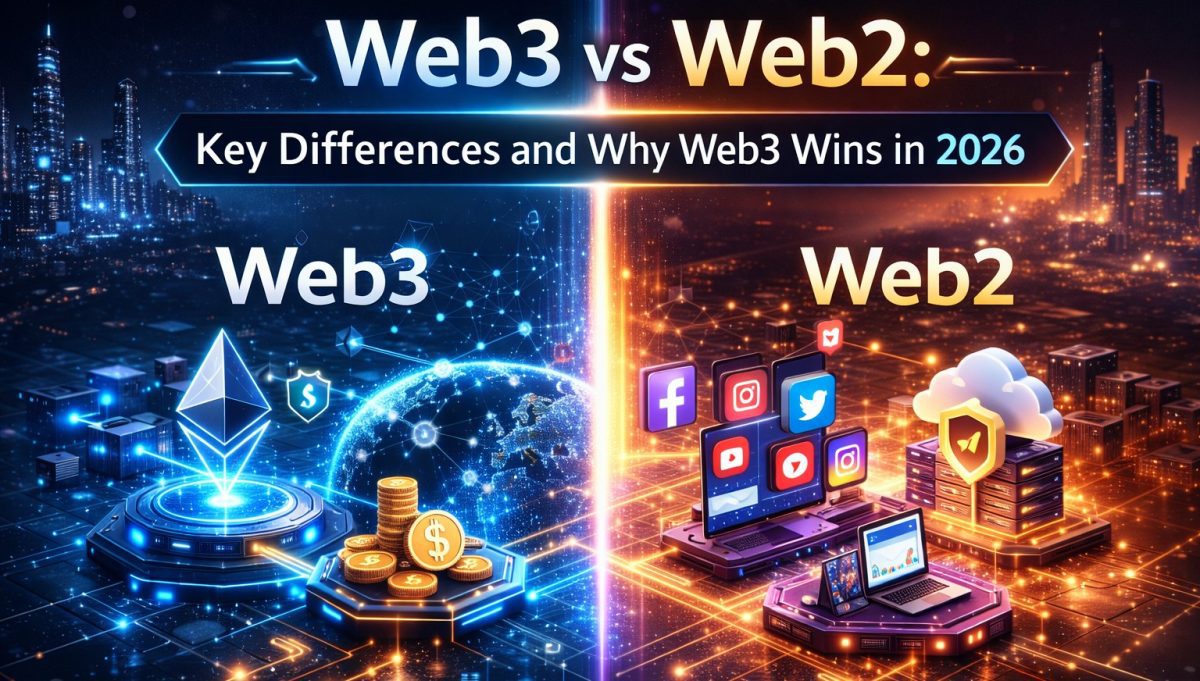
Web3 vs Web2: The internet isn’t just evolving—it’s undergoing a fundamental power shift. Web2 gave us social media, streaming, and instant global connectivity, but at the cost of massive centralization: your data, identity, and economic value largely belong to a handful of tech giants.
In 2026, Web3 flips that script. Powered by blockchain, decentralized networks, and user-owned assets, Web3 delivers transparency, true ownership, and resilience that Web2 simply can’t match.
Forget the early hype cycles. 2026 marks Web3’s practical breakthrough: regulatory clarity accelerates institutional entry, Layer 2 scaling makes dApps feel native, AI convergence adds intelligence, and real-world utility—from tokenized assets to censorship-resistant platforms—drives adoption. Market projections show explosive growth, with the Web3 blockchain sector hitting around $10 billion in 2026 and broader estimates pushing toward tens of billions as tokenization and stablecoins go mainstream.
For users in Abuja powering remittances via stablecoins, the US accessing tokenized Treasuries, Asia building high-speed consumer apps, or the Middle East tokenizing sovereign infrastructure, Web3 isn’t a replacement—it’s an upgrade that solves Web2’s deepest flaws.
CHECK: Ultimate Guide to Web3 Trends and Innovations in 2026
This guide compares the two eras head-to-head, highlights why Web3 pulls ahead in 2026, and shows real-world examples proving the shift is already underway.
Web3 vs Web2: Core Definitions

Web2 (the social/centralized web, ~2005–present): Platforms like Facebook, Google, Amazon, and YouTube dominate. Users create and consume content, but platforms own the infrastructure, data, and monetization.
Web3 (the decentralized/ownership web, emerging strongly in 2020s): Built on blockchain, smart contracts, and peer-to-peer networks. Users control data, assets, and governance through wallets and tokens.
What Is Web2?
Web2 refers to the interactive, social internet that emerged in the mid-2000s.
It introduced:
- Social media platforms
- User-generated content
- Cloud computing
- Centralized apps and services
Major Web2 companies include:
- Meta
- Amazon
Web2 made the internet dynamic and participatory.
But it also introduced:
- Centralized data ownership
- Platform-controlled algorithms
- Monetization models based on advertising
- Privacy vulnerabilities
In Web2, you are the product.
What Is Web3?
Web3 is the decentralized internet powered by blockchain technology.
Instead of platforms controlling data and infrastructure, Web3 uses:
- Distributed ledgers
- Smart contracts
- Decentralized applications (dApps)
- Token-based economies
Major Web3 ecosystems include:
- Ethereum
- Solana
- Polygon
In Web3:
- Users own their digital assets
- Data lives on decentralized networks
- Transactions are transparent
- Governance can be community-driven
You are not the product. You are a participant.
The core pivot: Web2 rents you access; Web3 gives you ownership.
Key Differences: Side-by-Side Comparison
Here’s how they stack up across the dimensions that matter most in 2026:
| Aspect | Web2 (Centralized Platforms) | Web3 (Decentralized Networks) | Winner in 2026 & Why |
|---|---|---|---|
| Data Ownership | Platforms own and monetize your data | Users own data via wallets; control sharing | Web3 – Privacy scandals push demand for self-sovereignty |
| Governance | Corporate boards decide rules, algorithms, bans | Token holders/DAOs vote; community-driven | Web3 – Reduces arbitrary censorship |
| Architecture | Client-server; single points of failure | Peer-to-peer blockchain + Layer 2s | Web3 – More resilient to outages/hacks |
| Trust Model | Trust intermediaries (banks, companies) | Trustless via code and consensus | Web3 – Eliminates counterparty risk |
| Currency/Payments | Fiat via centralized processors (Visa, PayPal) | Crypto, stablecoins, programmable money | Web3 – Instant, borderless, low-fee |
| Monetization | Platforms take majority cut; ads dominate | Direct creator earnings, tokens, royalties forever | Web3 – Fairer value capture |
| Speed/Scalability | Fast, seamless UX | Improving rapidly (L2s < $0.01 fees, high TPS) | Tie – Web3 closes gap |
| Censorship Resistance | High risk (deplatforming, geo-blocks) | Near-impossible to shut down | Web3 – Vital in restricted regions |
| Interoperability | Siloed (data locked in apps) | Open protocols, cross-chain bridges | Web3 – Reduces vendor lock-in |
| Accessibility | Plug-and-play; no learning curve | Wallet setup required, but wallets simplify UX | Web2 currently – Web3 catching up fast |
Web3’s advantages shine brightest where Web2 fails: privacy erosion, intermediary fees, and centralized control.
Why Web3 Wins in 2026: The Inflection Point
2026 isn’t about ideology—it’s about utility winning. Key drivers include:
- Regulatory Clarity Unlocks Scale — Frameworks like Europe’s MiCA and U.S. stablecoin rules reduce uncertainty, drawing institutions. Stablecoins handle trillions in flows; tokenized RWAs surge toward hundreds of billions.
- UX Breakthroughs — Account abstraction, gasless transactions, and super apps (Jupiter-style aggregators) make Web3 feel like Web2. Bridges and modular chains eliminate fragmentation.
- Convergence with AI & Real-World Assets — AI agents manage on-chain treasuries; tokenized bonds, real estate, and commodities unlock liquidity. DeFi yields beat traditional savings in low-rate environments.
- Mass Adoption Signals — Emerging markets lead via mobile wallets and remittances. Institutions integrate Web3 rails for efficiency. Projections show Web3 markets growing 40%+ CAGR, with blockchain adoption hitting mainstream sectors.
- Invisible Infrastructure — Web3 becomes “invisible crypto”: stablecoins power everyday payments, RWAs enhance capital markets, DAOs fund public goods—without users noticing the blockchain underneath.
Web3 doesn’t replace Web2 apps overnight; it upgrades the backend for better economics, security, and inclusion.
Real-World Examples Proving Web3’s Edge in 2026
- DeFi vs Traditional Banking — Aave and Compound offer instant, overcollateralized loans without credit checks. In Nigeria and South Africa, users borrow/lend globally at lower costs than banks.
- Tokenized Real-World Assets (RWAs) — BlackRock-style funds and sovereign assets (Middle East infrastructure) trade 24/7 fractionally. Web3 unlocks liquidity Web2 gatekeeps.
- Creator Economies & Social — Lens Protocol lets users own profiles and content, portable across apps. Creators earn directly via tokens/royalties—no platform 30% cut.
- Payments & Remittances — Stablecoins via Base or Solana enable instant, near-free transfers. In Asia and Africa, this slashes fees from 6–7% (traditional) to pennies.
- Censorship-Resistant Platforms — Decentralized social graphs resist deplatforming; prediction markets (e.g., Polymarket successors) turn information into tradable truth.
- Institutional Adoption — Banks experiment with on-chain treasuries; enterprises use DePIN for compute/storage, bypassing centralized clouds.
These aren’t hypotheticals— they’re live, with billions in TVL and growing daily users.
Remaining Challenges for Web3
Web3 isn’t perfect yet:
- Onboarding friction (wallets, seed phrases) — though improving.
- Volatility and scams — mitigated by regulation and education.
- Energy/scalability concerns — addressed by efficient consensus and L2s.
Still, momentum favors Web3 as fixes arrive faster than Web2’s entrenched issues worsen.
The Bottom Line: Web3 Isn’t Coming—It’s Here and Winning
In 2026, Web3 wins because it fixes what Web2 broke: centralized power, data exploitation, and exclusion. It offers ownership, transparency, and efficiency in a world demanding trust and inclusion.
For individuals: Start with a wallet, explore stablecoins, and claim your data. For businesses: Pilot tokenized assets or DeFi tools. For developers: Build on modular chains for scalable, user-owned apps.
The internet’s next chapter isn’t about choosing sides—it’s about upgrading to a version where users, not platforms, hold the power. Web3 delivers that reality today.
Web2 built the social internet.
Web3 is rebuilding the economic internet.
Web3 wins not because it’s trendier — but because it addresses fundamental structural issues:
- Data ownership
- Transparency
- Financial access
- Programmable trust
As digital economies expand globally, systems that empower users — rather than centralize control — naturally gain momentum.
The future likely isn’t Web2 or Web3.
It’s an internet where decentralization becomes embedded infrastructure.
And in 2026, that transition is already underway.