In 2026, the Ethereum mainnet has successfully transitioned into its final form: the world’s most secure and decentralized settlement layer. However, the real story of Web3’s explosive growth is happening one level up. Ethereum Layer-2 (L2) networks have officially surpassed the mainnet in transaction volume by a factor of 100x, driven by near-zero fees and the mainstream adoption of “Chain Abstraction.” This report on Why Ethereum L2s are dominating in 2026 explores how the “Rollup-centric” roadmap has transformed a once-congested network into a high-performance engine for global commerce.
As we hit mid-2026, the economic landscape of blockchain has been fundamentally rewritten by the “Blobspace” revolution. Following the long-term success of early scaling upgrades, Ethereum Layer-2 networks like Arbitrum, Optimism, and Base have reduced transaction costs to a fraction of a cent. This 2026 Ethereum L2 growth analysis examines why these networks are now the primary destination for 95% of new Web3 developers. With “Proto-Danksharding” legacies now fully matured, L2s have unlocked use cases that were previously impossible, from high-frequency DeFi trading to decentralized social media platforms that handle millions of daily interactions.
The dominance of L2s in 2026 is a data-driven reality. This report provides a breakdown of the Top L2 Networks by TVL (Total Value Locked) and transaction throughput, highlighting how Base has utilized its integration with the Coinbase ecosystem to onboard the next 100 million retail users. We dive into the specific catalysts—including the rise of Smart Account (ERC-4337) adoption—that have made L2s the standard for user-friendly, high-velocity digital finance, effectively ending the era of high gas fees for the average consumer.
CHECK: The Rise of Real World Assets (RWA) in Crypto and Why Investors Are Watching
The narrative around blockchain scalability has shifted dramatically. While Layer-1 chains compete fiercely for supremacy, Ethereum Layer-2 networks have quietly taken the lead in driving real Web3 adoption, user activity, and economic value in 2026.
What started as experimental scaling solutions has evolved into the primary engine powering decentralized finance, gaming, social applications, tokenized real-world assets, and institutional on-chain activity. In 2026, Ethereum L2s consistently process the majority of Web3 transactions, capture the highest DeFi TVL growth, and deliver the user experience that feels closer to traditional apps — all while inheriting Ethereum’s unmatched security and decentralization.
This comprehensive guide explains why Layer-2 networks built on Ethereum are dominating Web3 growth, the key technological and economic factors behind their success, the leading players, measurable impact, challenges they still face, and what the future holds for this critical infrastructure layer.
Understanding Ethereum Layer-2 Networks
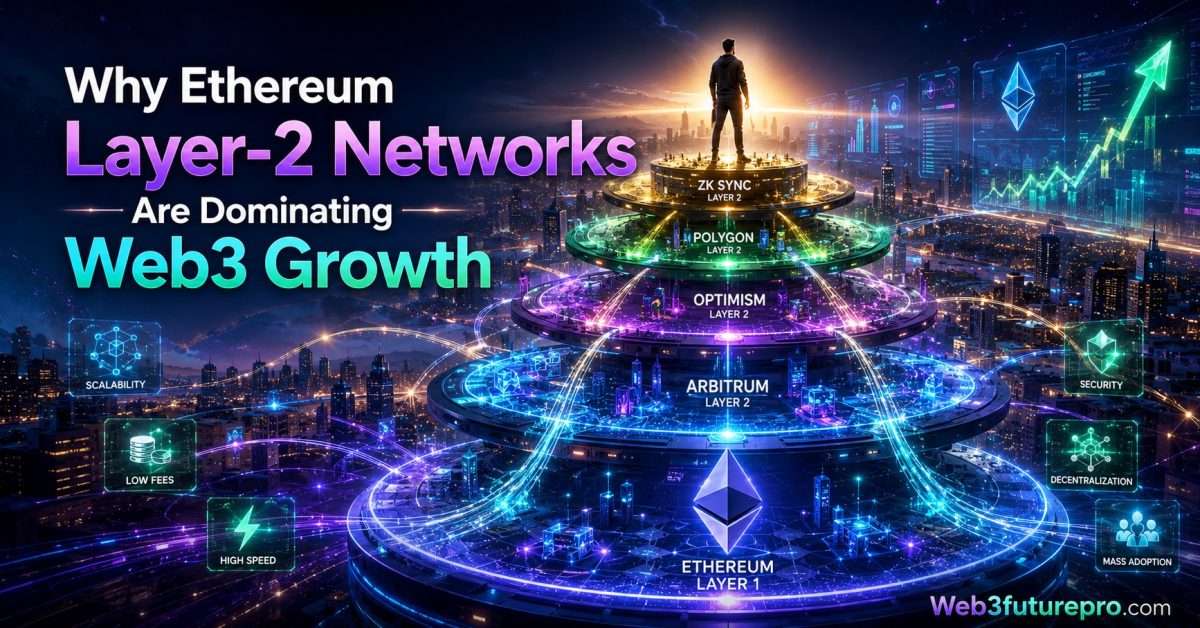
Layer-2 (L2) solutions are secondary blockchains or protocols built on top of Ethereum (Layer-1) that handle transaction execution while posting data and inheriting security from the Ethereum mainnet.
There are two primary types dominating in 2026:
- Optimistic Rollups — Assume transactions are valid by default and use a challenge period for fraud proofs (e.g., Arbitrum, Optimism, Base).
- Zero-Knowledge (ZK) Rollups — Use cryptographic proofs to verify transactions instantly without revealing underlying data (e.g., zkSync, Starknet, Polygon zkEVM).
This architecture allows L2s to achieve dramatically higher throughput (thousands of transactions per second) and much lower fees while maintaining Ethereum’s security guarantees through periodic data posting and dispute mechanisms.
Why Ethereum L2s Are Winning the Scalability Race

Several powerful advantages explain their dominance:
1. Security Inheritance L2s don’t need to bootstrap their own validator sets or economic security. They leverage Ethereum’s battle-tested consensus and massive validator network. This dramatically reduces risk compared to new Layer-1 chains that must build security from scratch.
2. Ethereum’s Network Effects Ethereum has the strongest developer community, deepest liquidity, most established tooling, and highest institutional trust. L2s tap directly into this ecosystem rather than competing against it.
3. Superior User Experience In 2026, top L2s deliver sub-second confirmations and fees often below $0.01. This makes complex DeFi strategies, NFT minting, gaming, and social applications practical for everyday users.
4. Rapid Innovation and Modularity The L2 ecosystem benefits from shared standards (like the OP Stack) and fast iteration. Teams can experiment aggressively without risking the base layer.
5. Institutional Comfort Institutions prefer building on Ethereum’s proven security rather than newer, less-battle-tested L1s. This has accelerated adoption of tokenized assets, institutional DeFi, and enterprise applications on L2s.
Key Metrics Showing L2 Dominance in 2026
- Ethereum L2s now process over 90% of total Ethereum ecosystem transactions on many days.
- Combined L2 TVL has grown significantly, often surpassing Ethereum mainnet in daily active users and transaction count.
- Daily transaction volumes on major L2s frequently exceed Ethereum mainnet by 5–10x.
- Average fees remain extremely low even during high activity periods.
- User growth has been explosive, with millions of new addresses interacting primarily through L2s.
These numbers demonstrate that real activity and usage have shifted decisively to Layer-2 networks.
Leading Ethereum Layer-2 Networks in 2026
Arbitrum Consistently ranks among the top by TVL and DeFi activity. Strong in gaming and institutional applications with excellent developer tooling.
Base (Coinbase) One of the fastest-growing L2s, excelling in consumer applications, social, and onboarding new users through Coinbase’s massive user base. Known for simplicity and low costs.
Optimism Pioneer of the OP Stack, enabling the “Superchain” vision of interconnected L2s. Strong focus on public goods funding and sustainable economics.
zkSync Era Leading ZK-rollup with excellent UX features like native account abstraction and gas sponsorship. Popular for privacy-sensitive and high-performance applications.
Other Notable L2s:
- Polygon zkEVM (enterprise and gaming focus)
- Starknet (ZK-STARKs technology)
- Scroll and Linea (strong technical innovation)
The diversity of approaches within the Ethereum L2 ecosystem creates healthy competition and rapid innovation.
How L2s Are Powering Web3 Growth Sectors
Decentralized Finance (DeFi) L2s host the majority of new DeFi innovation and liquidity migration. Lower fees enable sophisticated strategies that were previously uneconomical on mainnet.
Gaming and Consumer Applications High throughput and low costs make on-chain gaming viable. Projects can run complex mechanics without gas constraints.
Real-World Assets (RWAs) Institutions prefer Ethereum’s security for tokenizing bonds, real estate, and credit. L2s provide the scalability needed for mass adoption.
Social and Creator Economies New social graphs, content platforms, and creator tools thrive on cheap, fast transactions.
AI and Agentic Applications Autonomous AI agents require frequent, low-cost interactions — perfect for L2 environments.
Challenges Facing Ethereum L2s
Despite their success, Layer-2 networks still face meaningful hurdles:
- Fragmentation — Liquidity and users are spread across multiple L2s, creating a somewhat disjointed experience.
- Bridging Risks — Moving assets between layers still carries smart contract and user error risks.
- Sequencer Centralization — Many L2s still use centralized sequencers (though decentralization roadmaps are advancing).
- User Onboarding Complexity — Switching between L2s and managing gas tokens can confuse newcomers.
- Data Availability and Finality — Different approaches create varying security and UX trade-offs.
The ecosystem is actively addressing these issues through shared sequencers, better bridging solutions, and improved wallet experiences.
The Future of Ethereum Layer-2 Networks

2026–2027 will likely see continued consolidation around a few dominant L2s while specialized chains carve out niches. Key trends to watch include:
- Further maturation of the OP Stack and shared sequencing.
- Wider adoption of account abstraction for seamless user experiences.
- Deeper integration of ZK technology for privacy and scaling.
- Increased institutional building and RWA activity.
- Potential emergence of “L3” applications built on top of L2s.
Ethereum’s rollup-centric roadmap appears to be working. By scaling through L2s while maintaining a secure, decentralized settlement layer, Ethereum has created a flexible architecture that competitors are struggling to match.
Why This Matters for Web3’s Long-Term Success
Ethereum Layer-2 networks are proving that blockchain can scale without sacrificing its core values of security and decentralization. Their success is critical for Web3’s mainstream adoption because they deliver the performance users expect from modern applications while preserving the ownership and transparency that make blockchain revolutionary.
For developers, L2s provide a fertile ground for building with excellent tooling and access to liquidity. For users, they offer practical, low-cost ways to participate in decentralized systems. For institutions, they provide trusted infrastructure with regulatory-friendly options.
The dominance of Ethereum L2s in 2026 is not just about technology — it’s about creating the rails for the next phase of the internet: one that is more open, more efficient, and more aligned with user ownership.
As these networks continue to mature, improve interoperability, and onboard millions more users, they are positioning Ethereum — and Web3 as a whole — for sustained, long-term growth.
The Layer-2 revolution is well underway, and it is redefining what’s possible in decentralized technology.
By 2026, the debate over whether Ethereum can scale has been settled with a resounding “Yes.” The dominance of Layer-2 networks represents the final victory of the Modular Blockchain thesis. By separating Execution (L2s) from Settlement and Security (L1), Ethereum has achieved a level of scalability that monolithic chains simply cannot match without sacrificing decentralization.
Ultimately, the L2 era is defined by the disappearance of the blockchain. In 2026, users no longer care which Layer-2 they are on; they only care about the application they are using. As we look toward the 2030s, Ethereum L1 will remain the “Digital Fort Knox,” while the L2 ecosystem continues to evolve into a vibrant, multi-layered “Internet of Value” that supports the entire global financial and social stack.