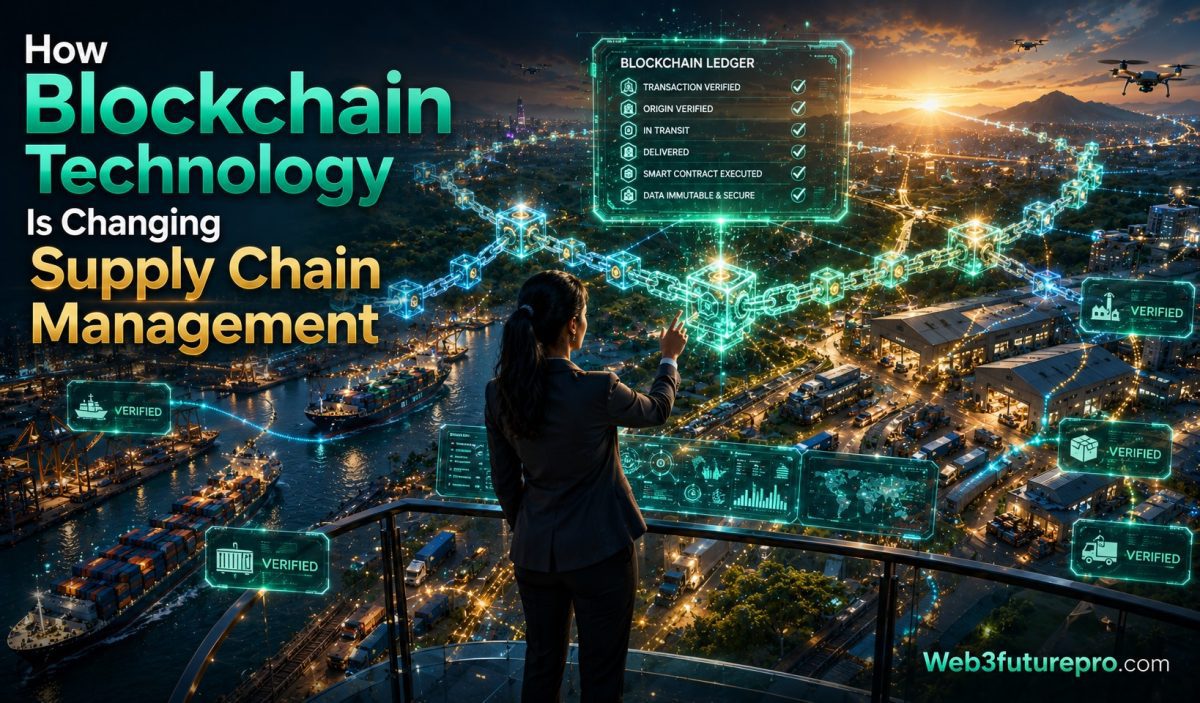
blockchain technology: In 2026, a physical product without a Digital Twin is considered a liability. This analysis of Blockchain in Supply Chain Management explores how every pallet, container, and raw material is now tokenized on-chain from the point of origin. By linking IoT (Internet of Things) sensors directly to decentralized ledgers, companies have achieved 100% end-to-end transparency, reducing “inventory ghosting” and administrative errors by over 70%. This isn’t just about tracking; it’s about the mathematical certainty of provenance in an era where consumers demand to know the exact carbon footprint and ethical history of every purchase.
We dive into the 2026 adoption of Zero-Knowledge Proofs (ZKP) in logistics, allowing competitors to share a common ledger for efficiency without revealing sensitive commercial data or pricing. From pharmaceutical cold chains that self-audit via smart contracts to luxury goods protected by non-fungible authenticity certificates, blockchain has become the “invisible glue” of global trade.
Imagine ordering a bottle of olive oil or a pair of premium sneakers and being able to trace its entire journey — from the exact farm where the olives were harvested or the factory where the leather was processed, through every logistics partner, all the way to your doorstep — with tamper-proof, real-time records. No more blind trust in paperwork, no more hidden labor violations, and dramatically reduced fraud, waste, and delays.
CHECK: Top Blockchain Startups Building the Future of Decentralized Finance
This is not science fiction. In 2026, blockchain technology is fundamentally transforming global supply chain management. What started as a promising concept for improving transparency has matured into a production-ready infrastructure used by some of the world’s largest corporations. From Walmart tracking food safety to luxury brands fighting counterfeits and pharmaceutical companies ensuring drug authenticity, blockchain is delivering measurable improvements in efficiency, trust, and sustainability.
This comprehensive guide explores how blockchain is reshaping supply chains, the key mechanisms driving change, real-world results in 2026, major challenges, leading platforms and use cases, integration with emerging technologies, and what the future holds for businesses that adopt it.
Why Traditional Supply Chains Are Ripe for Disruption
Global supply chains have long suffered from systemic problems:
- Lack of Transparency — Multiple parties (suppliers, manufacturers, logistics providers, distributors) use fragmented systems, making end-to-end visibility nearly impossible.
- Inefficiency and Delays — Manual paperwork, reconciliation, and disputes slow down processes and increase costs.
- Fraud and Counterfeiting — Billions are lost annually to fake goods, especially in pharmaceuticals, luxury, and electronics.
- Compliance and Sustainability Issues — Proving ethical sourcing, carbon footprints, or regulatory adherence is difficult and often unverifiable.
- Single Points of Failure — Centralized databases are vulnerable to cyberattacks, errors, or manipulation.
Blockchain addresses these pain points by creating a shared, immutable, decentralized ledger where all authorized participants can view and add verified information without trusting a central authority.
How Blockchain Technology Works in Supply Chain Management

At its core, blockchain provides three powerful capabilities for supply chains:
- Immutability — Once data is recorded, it cannot be altered without consensus.
- Transparency with Privacy Controls — Participants see relevant information while sensitive data remains protected (via zero-knowledge proofs or permissioned networks).
- Smart Contracts — Self-executing agreements that automatically trigger actions (payments, alerts, transfers of ownership) when conditions are met.
When combined with IoT sensors, AI analytics, and oracles (secure data feeds), blockchain creates a powerful “digital twin” of physical supply chains that updates in near real-time.
Major Benefits Transforming Supply Chains in 2026
End-to-End Traceability Companies can track products at the batch or even individual item level. In food safety, this means recalls happen in minutes instead of weeks.
Reduced Fraud and Counterfeiting Luxury brands and pharmaceutical companies use blockchain to verify authenticity through the entire chain.
Faster Settlements and Lower Costs Smart contracts automate payments upon delivery confirmation, reducing working capital requirements and disputes.
Improved Sustainability and Compliance Proving ethical sourcing, carbon emissions, and fair labor practices becomes verifiable and auditable.
Enhanced Collaboration Competitors and partners can securely share data on a need-to-know basis without revealing proprietary information.
Inventory Optimization Real-time visibility reduces overstocking and stockouts.
Real-World Impact and Case Studies in 2026
Food and Agriculture Walmart and IBM Food Trust have scaled their blockchain system globally. Contaminated food can now be traced to the source in seconds, preventing widespread outbreaks and reducing waste.
Pharmaceuticals Blockchain is used to combat counterfeit drugs, which still kill hundreds of thousands annually. Serialized tracking from manufacturer to patient ensures authenticity.
Luxury and Fashion Brands like LVMH (through Aura Blockchain Consortium) allow customers to verify the provenance of high-value items, building consumer trust and fighting fakes.
Logistics and Shipping Maersk’s TradeLens (now evolved) and other platforms have digitized bills of lading and documentation, cutting processing times from days to hours.
Mining and Critical Minerals Blockchain tracks conflict-free sourcing of cobalt, lithium, and rare earths, helping companies meet ESG requirements.
Automotive Supply Chains Major manufacturers use blockchain for parts traceability, warranty management, and ethical sourcing verification.
Leading Blockchain Supply Chain Platforms in 2026
- IBM Food Trust — The most established food-focused network.
- VeChain — Strong in luxury, automotive, and sustainability tracking with dual-token model.
- OriginTrail — Decentralized knowledge graph for supply chain data.
- Hedera Hashgraph — High-throughput enterprise-grade network used by major corporations.
- Hyperledger Fabric — Permissioned blockchain framework favored by consortia.
- Walmart’s proprietary systems and newer startups combining IoT with blockchain.
Integration with Emerging Technologies
Blockchain’s true power in 2026 comes from convergence:
- IoT + Blockchain — Sensors automatically record temperature, location, and conditions on-chain.
- AI + Blockchain — Predictive analytics for disruptions combined with immutable records.
- Digital Twins — Virtual replicas of supply chains updated in real time.
- Tokenization — Fractional ownership and trading of physical goods via RWAs.
- DePIN — Decentralized networks for logistics and sensor data.
This multi-technology approach is creating smarter, more resilient supply chains.
Challenges and Limitations in 2026
Despite strong progress, adoption still faces hurdles:
- Interoperability — Different blockchains and legacy systems don’t always connect smoothly.
- Data Quality — “Garbage in, garbage out” remains an issue at the point of origin.
- Cost and Complexity — Implementation requires investment and change management.
- Regulatory Fragmentation — Rules vary significantly across countries.
- Scalability — High-volume global supply chains still push technical limits.
- Talent Shortage — Few professionals understand both supply chain operations and blockchain.
Successful implementations usually start with focused pilot projects rather than company-wide overhauls.
The Future Outlook: 2026–2030
By 2030, experts predict:
- Most major global supply chains will have some blockchain component.
- Regulatory frameworks will mature, supporting wider adoption.
- Consumer-facing transparency (QR codes showing full provenance) will become standard in premium and regulated goods.
- Carbon tracking and ESG reporting will be largely automated via blockchain.
- Integration with AI agents for autonomous supply chain optimization.
Blockchain will not replace all existing systems but will serve as the trust layer connecting them.
How Businesses Can Start Implementing Blockchain Today

- Identify High-Pain Areas — Start with problems like traceability, compliance, or reconciliation.
- Choose the Right Approach — Permissioned (Hyperledger) for private networks or public (Ethereum L2s) for transparency.
- Partner Strategically — Collaborate with established platforms rather than building from scratch.
- Focus on Data Standards — Ensure interoperability from day one.
- Pilot, Measure, Scale — Begin small, track ROI on cost savings, speed, and risk reduction.
- Invest in Talent and Training — Build internal capability or work with specialized consultants.
The New Standard for Trust and Efficiency
Blockchain is not a silver bullet, but it is becoming the foundational technology for transparent, efficient, and resilient supply chains. In 2026, companies that embrace it gain competitive advantages through faster operations, stronger consumer trust, better compliance, and reduced risk.
For businesses, the message is clear: supply chain transformation through blockchain is no longer optional for those who want to lead their industries. For consumers, it means greater confidence in the products they buy. For society, it offers hope for more ethical, sustainable, and accountable global trade.
By mid-2026, the impact of blockchain on supply chain management is best measured by its invisibility. The industry has successfully moved from “experimenting with crypto” to “relying on decentralized infrastructure.” The shift from reactive tracking to proactive automated settlement has redefined global commerce, making it faster, more ethical, and significantly more efficient.
The takeaway for 2026 is clear: the winners in the global market are those who have digitized their physical assets. As we look toward 2030, the convergence of AI, IoT, and Blockchain will continue to dismantle the “silos of information” that once defined logistics, leaving behind a unified, transparent, and sovereign global trade network.
The supply chain of the future will be digital, decentralized, and verifiable. That future is already taking shape — and the companies adopting blockchain today will define the standards of tomorrow.