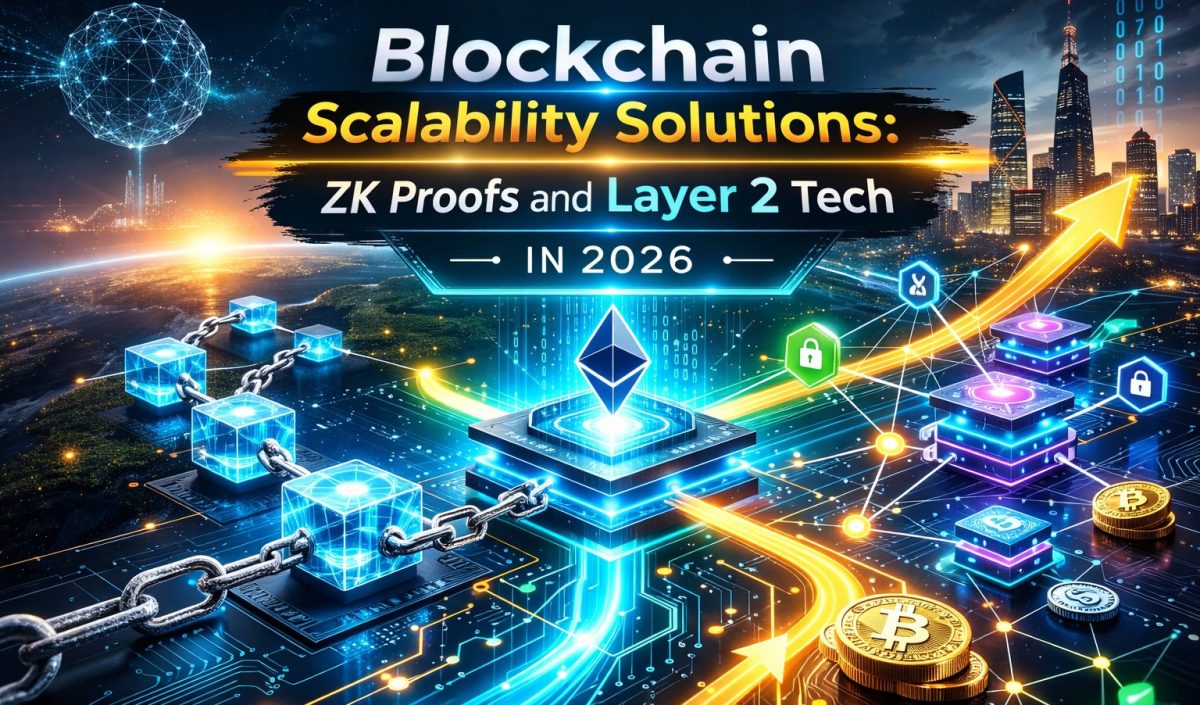
Blockchain scalability remains the defining challenge of the decade, but in 2026, the industry has crossed a major threshold. Ethereum mainnet processes ~15–30 TPS under normal conditions, yet combined Layer 2 networks now handle tens of thousands of TPS—often 50,000+ across major rollups—with average fees dropping below $0.01 in many cases. This leap comes primarily from Layer 2 (L2) architectures, where Zero-Knowledge (ZK) proofs have emerged as the superior path for fast finality, privacy, and efficiency.
No longer experimental, ZK-powered L2s like zkSync Era, Starknet, and Polygon zkEVM dominate high-value and privacy-sensitive use cases, while optimistic rollups (Arbitrum, Optimism, Base) lead in TVL and everyday adoption. The result? Web3 apps feel native, remittances in Abuja cost pennies, DeFi yields flow seamlessly in the US, gaming economies thrive in Asia, and tokenized infrastructure settles instantly in the Middle East.
CHECK: Best Real-World Blockchain Use Cases Beyond Crypto for Businesses in 2026
This guide explains the core scalability solutions, dives deep into ZK proofs and Layer 2 mechanics, compares leading implementations in 2026, and shows why this tech unlocks mass adoption.
Why Blockchain Scalability Became the Defining Issue

To understand the importance of scalability, we need to revisit the blockchain trilemma — the idea that networks struggle to optimize:
- Decentralization
- Security
- Scalability
Historically, networks like Ethereum prioritized decentralization and security — but that meant limited transaction throughput.
When demand surged, fees followed.
For global adoption — from fintech startups in New York to remittance platforms in Lagos and DeFi innovators in Dubai — blockchains needed to process thousands (even millions) of transactions per second without compromising trust.
That’s where Layer 2 and ZK proofs step in.
The Scalability Trilemma: Why We Need Layer 2 and ZK
The blockchain trilemma—balancing decentralization, security, and scalability—forces trade-offs. Layer 1 (L1) chains like Ethereum prioritize security and decentralization, but cap throughput to avoid centralization risks.
Layer 2 solutions address this by moving execution off-chain while anchoring security to L1. They batch transactions, compress data, and post proofs or summaries back to the base layer.
Two dominant L2 rollup types exist:
- Optimistic Rollups — Assume validity; include a challenge period for fraud proofs.
- ZK Rollups — Use cryptographic validity proofs upfront for instant finality.
In 2026, ZK rollups gain ground rapidly due to faster withdrawals, stronger guarantees, and privacy features—making them ideal for institutional DeFi, enterprise, and high-frequency apps.
Zero-Knowledge Proofs Explained (Without the Math)
A Zero-Knowledge (ZK) proof allows one party to prove something is true without revealing the underlying data.
Imagine proving:
- You are over 18 — without revealing your birthdate
- You have enough funds — without showing your balance
- A batch of 10,000 transactions is valid — without exposing every detail
That’s the power of ZK cryptography.
In blockchain scalability, ZK proofs allow networks to:
- Compress thousands of transactions
- Generate one proof
- Submit that proof to the main chain
Result: Massive efficiency gains.
How ZK Proofs Work and Why They Revolutionize Scalability
Zero-Knowledge proofs let one party prove a statement is true without revealing underlying data. In blockchain:
- A prover computes transactions off-chain.
- Generates a succinct cryptographic proof verifying correctness.
- Submits the proof + minimal data to L1.
Key advantages in 2026:
- Instant finality — No 7-day challenge windows; withdrawals in minutes.
- Privacy — Hide transaction details while proving validity.
- High throughput — Batch thousands of TPS; compress data via proofs.
- Efficiency — zk-SNARKs/STARKs advancements reduce proof generation time and size.
zk-SNARKs (Succinct Non-interactive ARguments of Knowledge) offer tiny proofs but require trusted setups (mitigated in modern variants). zk-STARKs provide transparency and quantum resistance, though larger proofs—hybrids emerge for optimal balance.
ZK rollups inherit L1 security: invalid proofs are rejected by the base chain.
Leading Layer 2 Scaling Solutions in 2026
Here’s a snapshot of the ecosystem, where consolidation favors a few dominant players:
- Arbitrum One (Optimistic) — Leads TVL and DeFi/gaming liquidity. High developer adoption, EVM compatibility.
- Base (Optimistic, Coinbase-backed) — Fastest-growing for consumer onboarding; seamless fiat ramps drive retail volume.
- Optimism (Optimistic) — Powers the Superchain; shared infrastructure for interoperable rollups.
- zkSync Era (ZK) — Strong zkEVM parity, native account abstraction, gas sponsorship; excels in privacy and UX.
- Starknet (ZK-STARKs) — High-performance execution; suits complex apps and quantum-resistant scaling.
- Polygon zkEVM — Enterprise focus; strong partnerships for DeFi and real-world assets.
2026 trends:
- Optimistic rollups dominate TVL (~70–80% share via Arbitrum/Base).
- ZK rollups surge in adoption for finality and privacy.
- Combined L2 activity doubles mainnet volume daily.
- Modular designs and interoperability (bridges, shared sequencers) reduce fragmentation.
Real-World Impact and Use Cases in 2026
- DeFi & Finance — ZK rollups enable private trades and institutional lending with compliance.
- Gaming & Social — Sub-cent fees and fast execution power on-chain games and mini-apps.
- Payments & Remittances — In emerging markets like Nigeria, L2s make stablecoin transfers instant and cheap.
- Enterprise & RWAs — Tokenized assets settle efficiently with verifiable proofs.
Challenges persist: sequencer centralization (mitigated by decentralization roadmaps), bridging risks, and proof generation compute demands—but hardware acceleration and zkVM optimizations advance rapidly.
Preparing for the ZK + L2 Future
For developers: Build on zkEVM chains (zkSync, Polygon) for future-proof EVM compatibility; leverage account abstraction for seamless UX.
For users: Use wallets like MetaMask or Argent on L2s; bridge via official portals for low-risk transfers.
For businesses: Pilot on ZK rollups for privacy-sensitive apps or optimistic ones for liquidity-heavy use cases.
In 2026, Layer 2 with ZK proofs isn’t optional—it’s the execution layer where real value flows. Ethereum settles trust; L2s deliver speed and affordability. The trilemma is cracking, one proof at a time.
Real-World Impact Across Regions
United States
Fintech companies integrating blockchain demand:
- Low transaction fees
- Regulatory compliance tools
- High throughput
Layer 2 networks reduce costs for:
- Stablecoin transfers
- Tokenized securities
- On-chain settlement systems
Wall Street isn’t waiting for scalability — it’s demanding it.
Asia
Countries like Singapore and South Korea have thriving Web3 ecosystems.
Scalable infrastructure supports:
- NFT gaming platforms
- Web3 social networks
- High-frequency DeFi trading
ZK-based privacy tools also align well with regional data protection standards.
Middle East
Dubai and Abu Dhabi have become blockchain innovation hubs.
Layer 2 solutions enable:
- Smart city blockchain integrations
- Tokenized real estate markets
- Enterprise blockchain pilots
Governments prefer scalable solutions that handle large populations efficiently.
South Africa & Emerging Markets
Scalability directly affects:
- Remittance costs
- Microtransactions
- Digital identity programs
Lower gas fees make blockchain practical — not just aspirational.
For many users, L2 isn’t optional. It’s survival.
Comparing Optimistic vs ZK Rollups in 2026
| Feature | Optimistic Rollups | ZK Rollups |
|---|---|---|
| Transaction Speed | Fast | Very Fast |
| Finality | Delayed | Near Instant |
| Withdrawal Time | 7+ days typical | Minutes to hours |
| Security Model | Fraud proofs | Validity proofs |
| Long-Term Outlook | Strong | Dominant |
Most experts believe ZK rollups will dominate long-term due to cryptographic certainty and faster user experience.
Beyond Rollups: Other Scalability Innovations
1. Data Availability Layers
Projects are separating:
- Execution
- Settlement
- Data storage
This modular approach improves scalability dramatically.
2. Validium and Hybrid Models
Some systems use ZK proofs but store transaction data off-chain to increase speed.
Trade-off: Slightly reduced transparency for massive performance gains.
3. Cross-Chain Interoperability
Bridges and shared security layers allow assets to move seamlessly across networks.
Scalability now includes communication — not just speed.
Enterprise Adoption: Why Businesses Care
Businesses don’t care about blockchain ideology.
They care about:
- Cost
- Efficiency
- Compliance
- User experience
Layer 2 solutions reduce transaction costs by up to 90%+ compared to congested Layer 1 networks.
For high-volume applications like:
- Supply chain tracking
- Tokenized assets
- Loyalty programs
- Cross-border payroll
Scalability is the difference between pilot projects and full deployment.
Risks and Challenges of Layer 2 & ZK Tech
Despite progress, challenges remain.
1. Centralization Risks
Some Layer 2 networks rely on centralized sequencers.
Mitigation efforts include decentralizing these components over time.
2. Complexity
ZK cryptography is mathematically intensive.
Development tools are improving, but talent shortages still exist.
3. Regulatory Scrutiny
As scalability increases usage, governments pay closer attention.
Compliance frameworks are evolving.
The 2026 Outlook: Where This Is Headed
The next phase of scalability focuses on:
- Fully decentralized sequencers
- AI-assisted proof generation
- Hardware acceleration for ZK computations
- Institutional-grade compliance layers
- Consumer-friendly onboarding
We are approaching a point where users won’t know — or care — whether they’re using Layer 1 or Layer 2.
It will just work.
And when blockchain “just works,” adoption accelerates exponentially.
Scalability Is No Longer Optional
In 2026, blockchain scalability is not a technical footnote.
It’s the foundation for:
- Global financial infrastructure
- Digital identity systems
- Tokenized real-world assets
- Web3 gaming
- Enterprise blockchain
ZK proofs and Layer 2 technologies have transformed blockchain from a promising innovation into a scalable digital backbone.
The future of Web3 depends not on hype — but on throughput.
And thanks to ZK cryptography and Layer 2 architecture, that future is finally within reach.