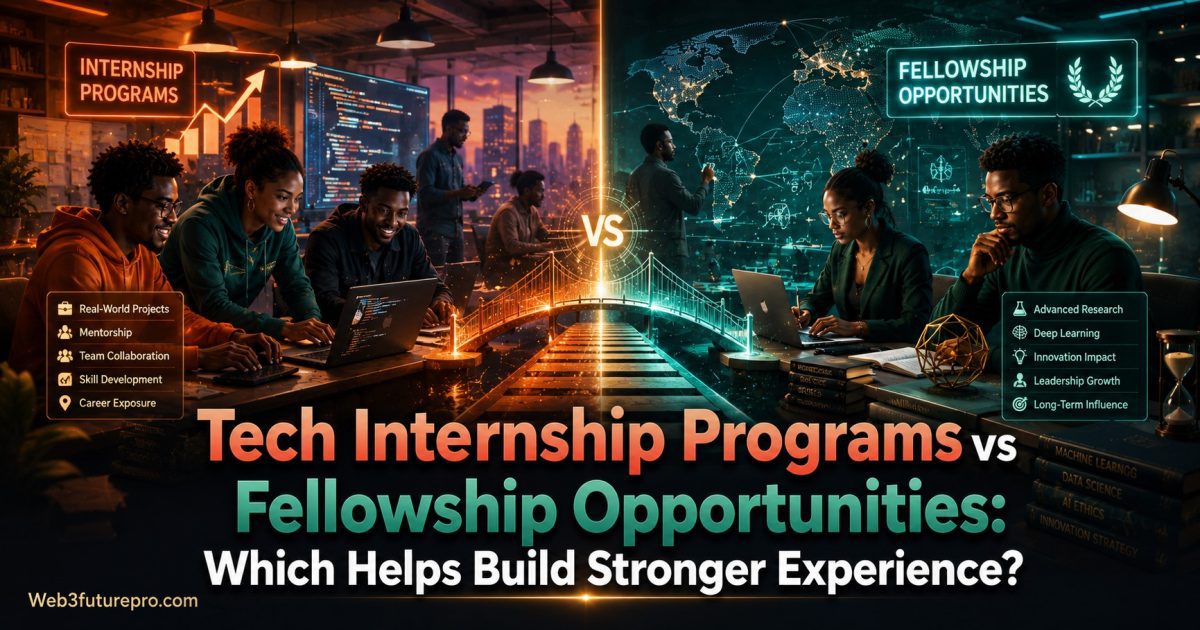
Gaining practical experience has become one of the most important steps toward building a successful technology career. A strong academic background can open doors, but employers increasingly want candidates who can demonstrate how they have applied their knowledge to real projects, solved problems, collaborated with teams, and delivered measurable results. For students, graduates, and aspiring technology professionals, two popular pathways for gaining this experience are tech internship programs and fellowship opportunities. This raises an important question: Tech Internship Programs vs Fellowship Opportunities: Which Helps Build Stronger Experience?
Technology internships typically place participants inside a professional organization where they can work alongside experienced employees, contribute to real projects, learn workplace practices, and gain exposure to specific roles. Internships can be particularly valuable for students and beginners because they provide an opportunity to understand how the technology industry operates before pursuing full-time employment.
Fellowship programs often take a more specialized or project-driven approach. Depending on the organization, fellows may conduct research, develop innovative projects, receive mentorship, participate in professional development activities, or work independently on a defined challenge. Fellowships can therefore provide deeper specialization and professional development, particularly for candidates who already possess some academic or professional experience.
However, the distinction is not always absolute. Some modern technology fellowships are designed specifically around hands-on projects, mentorship, and workplace experience, while some internships involve substantial research and independent technical work. The actual structure, responsibilities, mentorship, duration, and expected outcomes of each program matter more than the title alone.
CHECK: Coding Bootcamps vs Computer Science Degrees: Which Gives Better Career Opportunities?
In this comprehensive comparison, we’ll examine tech internships and fellowship opportunities based on practical experience, technical skills, mentorship, networking, project ownership, career advancement, compensation, professional recognition, and employment opportunities. Whether you’re a university student, recent graduate, career changer, or aspiring tech professional, this guide will help you determine which opportunity can build the strongest foundation for your long-term career.
In tech careers, experience is the decisive currency. Employers, graduate programmes, and research labs look for evidence that a candidate can deliver results, work with others, and grow under real conditions. Two of the most common ways to accumulate that evidence early are tech internship programmes and fellowship opportunities. Internships place participants inside companies to contribute to live products and teams. Fellowships more often centre on structured professional or research development, frequently around a defined project, with mentorship and greater autonomy.
Both build valuable experience. They do so in different ways and suit different stages and goals. This comparison examines tech internships and fellowship opportunities in 2026, focusing on which tends to produce stronger, more transferable experience for long-term career growth. It is written for a global audience of students and early-career professionals.
Program Overview: Tech Internship Programs vs Fellowship Opportunities

Tech internship programmes are temporary work placements, typically lasting 8–16 weeks (often summer) or up to six months. Participants join engineering, product, data, design, or research teams at companies ranging from startups to large technology firms. The emphasis is on contributing to real work—writing code, analysing data, supporting product launches, or assisting research—while learning professional norms, tools, and collaboration practices. Many programmes include mentorship, social events, and a pathway to full-time conversion. Compensation is common, especially at larger firms.
Fellowship opportunities in tech and adjacent fields are competitive, time-bound programmes that combine funding with focused development. They may be research fellowships (academic labs, industry research groups, or AI safety programmes), professional fellowships (leadership, public interest tech, or diversity-focused pipelines), or specialised residencies. Fellows often propose or are assigned substantial projects, receive dedicated mentorship, and operate with more independence than typical interns. Durations range from a few months to a year or longer. Stipends are usual, and the experience is framed around growth, contribution to a field or mission, and building a distinctive profile.
| Feature | Tech Internship Programmes | Fellowship Opportunities |
|---|---|---|
| Primary Focus | Practical industry contribution & workplace skills | Professional/research development & project ownership |
| Typical Duration | 2–6 months | 3–12+ months |
| Level of Autonomy | Guided / team-integrated | Higher; often project-driven |
| Common Setting | Company product or engineering teams | Research labs, specialised programmes, mission-driven orgs |
| Conversion Potential | High at many firms | Variable; strong for research or specialised paths |
| Compensation | Often paid (sometimes highly) | Stipend common |
Internships prioritise immersion in industry workflows. Fellowships prioritise deeper ownership and developmental intensity.
Eligibility Requirements
Tech internships are generally accessible to current students (undergraduate or graduate) and, in some cases, recent graduates or career switchers. Requirements commonly include enrolment in a relevant degree programme, foundational technical skills (demonstrated via coursework, projects, or assessments), and the ability to work for the programme duration. Some target specific years of study or underrepresented groups. Prior internship experience helps but is not always required for entry-level programmes.
Fellowships tend to be more selective and stage-specific. Research fellowships often prefer candidates with demonstrated research aptitude, strong academic records, or prior project work; many target advanced undergraduates, master’s students, PhD candidates, or early-career researchers. Professional and diversity-focused tech fellowships may emphasise leadership potential, domain interest, or background criteria alongside technical ability. A clear project idea or alignment with the fellowship’s mission strengthens applications.
Internships cast a wider net for those seeking initial industry exposure. Fellowships filter more tightly for candidates ready for greater responsibility or specialised contribution.
Application Process
Internship applications typically involve a résumé, transcript or academic summary, and technical assessments or interviews (coding challenges, behavioural rounds, system design for more advanced roles). Large tech firms run structured recruiting cycles with early deadlines; startups may hire more flexibly. Portfolio projects and prior experience improve odds. Multiple applications are common.
Fellowship applications are often more intensive. Candidates submit detailed statements of purpose or research proposals, multiple recommendation letters, CVs highlighting relevant work, and sometimes writing samples or code. Selection emphasises fit with the programme’s goals, potential for impact, and the quality of the proposed or expected contribution. Interviews or presentations may follow. Deadlines are firm and cycles can be less frequent than internship recruiting.
Internship processes reward technical preparation and breadth of applications. Fellowship processes reward depth of narrative, endorsements, and project vision.
Benefits & Funding
Both provide experience, but the nature and supporting resources differ.
Internships deliver direct exposure to production environments, codebases, team processes, and business constraints. Participants learn how real software is built, shipped, and maintained. Many gain mentors, references, and a realistic view of full-time roles. Paid internships reduce financial pressure and, at top firms, can be lucrative. Conversion to full-time offers is a major benefit at organisations that treat internships as extended interviews.
Fellowships often provide stipends that support focused work without the same commercial pressures. The experience tends to emphasise ownership of a meaningful project, deeper mentorship, skill-building workshops, and access to specialised networks or research communities. In research fellowships, participants may produce papers, open-source contributions, or public artefacts. Professional fellowships frequently include leadership training and alumni communities that persist for years. The funding model supports concentration on growth rather than short-term output metrics.
| Benefit Element | Tech Internships | Fellowships |
|---|---|---|
| Type of Experience | Industry workflow & collaboration | Project ownership & specialised development |
| Mentorship | Team / manager-based | Often dedicated and intensive |
| Output | Contributions to company products | Projects, research, or mission deliverables |
| Networking | Company & industry contacts | Programme cohort + broader field networks |
| Financial Support | Salary common | Stipend common |
| Full-Time Conversion Path | Strong at many firms | Stronger for research/specialised tracks |
Internships excel at workplace readiness and conversion. Fellowships excel at depth, autonomy, and distinctive profile-building.
Acceptance Rate
Tech internships at well-known companies are highly competitive; popular programmes attract large applicant pools relative to available slots. Conversion rates from internship to full-time offer have been strong at many organisations in recent cycles, increasing the value of securing a place. Smaller companies and less-hyped roles can be more accessible.
Fellowships are typically even more selective. Limited cohort sizes, specific mission alignment, and the requirement for a strong proposal or demonstrated potential produce low acceptance rates for prestigious programmes. The selectivity itself becomes part of the experience signal.
Both require preparation; fellowships generally demand a higher bar for intellectual or leadership differentiation.
Global Opportunities
Tech internships exist worldwide and increasingly include remote or hybrid options. Students in Africa, Asia, the Middle East, and elsewhere can access local tech firm internships, multinational programmes with regional offices, or fully remote placements. International internships may involve visas and relocation, adding complexity but also exposure.
Fellowships also operate globally. Research fellowships, AI-focused programmes, public-interest tech fellowships, and diversity pipelines recruit internationally. Some are fully remote or offer location flexibility; others require presence at a lab or hub. For candidates outside major tech centres, fellowships can provide structured access to high-calibre mentorship and networks that local internship markets may not yet match.
Both expand geographic and professional reach; the best fit depends on whether industry immersion or specialised developmental intensity is the priority.
Career Impact
Strong experience is defined by what it enables next: better interviews, stronger references, clearer career direction, and accelerated progression.
Tech internships build résumé credibility for industry roles. Hiring managers consistently value relevant internship experience highly when evaluating early-career candidates. The combination of technical contribution, collaboration skills, and potential full-time conversion makes internships one of the most direct bridges into software engineering, product, data, and related jobs. In competitive markets, the absence of internship experience can be a noticeable gap.
Fellowships build a different kind of strength. Research fellowships develop the ability to formulate questions, execute open-ended work, and communicate results—skills prized in research scientist, applied research, and advanced technical tracks. Professional fellowships cultivate leadership, domain expertise, and networks that support non-linear or mission-driven careers. The prestige and depth of a selective fellowship can differentiate candidates for competitive graduate programmes, specialised roles, or future funding.
In practice, the strongest profiles often combine both over time: internships for industry fluency and conversion opportunities, fellowships for depth and distinction. For pure industry entry, internships frequently provide more immediately actionable experience. For research, academia-adjacent, or highly specialised paths, fellowships often produce stronger long-term positioning.
Tips for Winning
For tech internships: Build a portfolio of projects that demonstrate real ability. Practise coding interviews and system-design fundamentals. Apply early and broadly, including to smaller companies and less obvious teams. Tailor résumés and cover notes to the role. Prepare behavioural stories that show collaboration and impact. Treat the internship itself as an extended interview—deliver reliably and seek feedback.
For fellowships: Develop a clear narrative of interest and potential impact. Seek research, open-source, or leadership experiences that provide evidence for recommendations. Craft precise proposals or statements of purpose. Cultivate relationships with mentors who can write strong letters. Align applications tightly with each programme’s mission. Use the experience to produce tangible outputs (code, writing, presentations) that travel beyond the fellowship.
On both paths: Focus on learning and contribution rather than credential collection. Document results. Maintain relationships with supervisors and peers. Continuously update technical skills.
Tech internship programmes generally help build stronger experience for industry-oriented careers. They provide direct exposure to professional environments, tangible contributions that hiring managers recognise, collaboration skills, and a proven pathway to full-time roles. In a market that heavily weights relevant work experience, a solid internship remains one of the highest-leverage steps an early-career tech candidate can take.
Fellowship opportunities generally help build stronger experience for specialised, research-oriented, or mission-driven trajectories. They offer greater autonomy, deeper project ownership, intensive mentorship, and a prestige signal that supports advanced study, research roles, and distinctive career narratives. When the goal is depth and differentiation rather than immediate industry conversion, fellowships often produce more powerful long-term experience.
The most effective strategy for many people is sequential or complementary. Secure internships to gain workplace fluency and conversion options. Pursue fellowships when ready for greater ownership or when targeting research, leadership, or specialised domains. Experience compounds: the candidate who can speak concretely about both team delivery and independent contribution stands out.
Evaluate your current stage, target roles, and the type of strength you most need next. Then choose the programme that maximises authentic skill development and evidence of impact. In tech, the label matters less than what you can demonstrably do afterward. Both internships and fellowships can supply that evidence—when chosen and executed with intention.
When comparing tech internship programs vs fellowship opportunities, both can provide valuable experience, but they tend to serve different career-development purposes. For beginners who need their first exposure to a professional technology environment, an internship is often the stronger starting point. It can provide direct experience with workplace processes, team collaboration, professional communication, technical tools, and real-world projects. Internships can also help participants build professional relationships and, in some cases, position themselves for future employment with the organization.
Fellowships, meanwhile, can provide deeper professional development for candidates who are ready to take on specialized projects or research. Fellows may have greater independence, work on defined projects, develop advanced expertise, and receive structured mentorship. Some fellowship programs can also provide stipends and longer-term professional development opportunities.
For an entry-level tech professional, an internship will usually provide more direct exposure to how companies operate and what employers expect from junior employees. For someone with existing academic or professional experience who wants to specialize, conduct research, develop an innovative project, or build leadership capabilities, a fellowship may provide greater depth.
The strongest strategy, however, is not necessarily to choose one and ignore the other. A student could begin with a tech internship to gain practical workplace experience and later pursue a fellowship to develop specialized expertise, conduct research, or work on a high-impact project. Combining both experiences can create a particularly strong professional profile.
Ultimately, the quality of the experience matters more than the label attached to the program. When evaluating an opportunity, look beyond whether it is called an internship or fellowship. Consider whether you’ll work on real projects, receive meaningful mentorship, develop measurable skills, build a portfolio, interact with experienced professionals, and produce achievements you can demonstrate to future employers.
For aspiring technology professionals in 2026, the ideal opportunity is one that transforms learning into evidence of capability. A strong internship can provide the foundation, while a well-designed fellowship can deepen your expertise and expand your professional network—making either pathway a valuable step toward a successful global tech career.