Web3 trends: The defining narrative of early 2026 is the convergence of Artificial Intelligence and Blockchain. As autonomous AI agents begin to dominate digital commerce, Web3 has become their native financial operating system. This report on Agentic Finance (AgentFi) examines how AI agents are using decentralized protocols to manage treasuries, settle micropayments via stablecoins, and verify their identity using Proof of Personhood standards. In 2026, the most active “users” on the blockchain are no longer humans, but algorithms.
We explore the explosion of Decentralized Physical Infrastructure Networks (DePIN), where AI compute networks like Render and Akash are providing the GPU power necessary to sustain the 2026 AI boom. By decentralizing the hardware layer, these protocols are challenging the AWS/Google monopoly, offering investors a stake in the literal “processing power” of the future. This is the era of the Autonomous Economy, where blockchain provides the trustless rails for an AI-driven world.
The Web3 landscape in 2026 is no longer driven by hype alone. It has entered a phase of mature, utility-focused growth where real capital, institutional participation, and technological breakthroughs are creating sustainable opportunities — and risks — for investors.
CHECK: How Decentralized Identity Could Replace Traditional Logins
After years of boom-and-bust cycles, the ecosystem is consolidating around trends that deliver tangible value: bringing traditional assets on-chain, combining artificial intelligence with decentralized systems, improving scalability through modular architecture, and building infrastructure that solves real-world problems. For crypto investors, understanding these trends is no longer optional — it is essential for identifying where capital is flowing, where alpha still exists, and which projects are positioned for long-term success.
This in-depth guide breaks down the most important Web3 trends shaping the market in 2026. Each section covers why the trend matters, current momentum, leading projects and sectors, investment implications, and practical advice for positioning your portfolio.
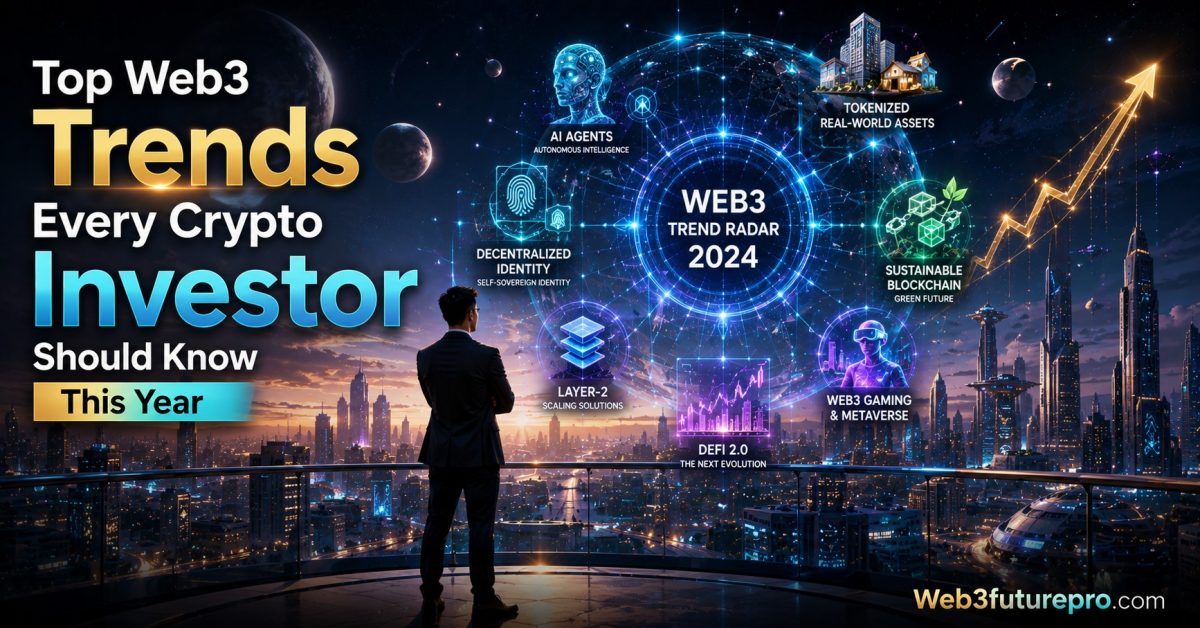
Top Web3 Trends Every Crypto Investor Should Know in 2026

1. Real World Assets (RWA) Tokenization — The Trillion-Dollar Bridge
Why it matters: Tokenization of traditional assets (Treasuries, real estate, private credit, bonds, commodities) is the strongest bridge between traditional finance and crypto. It unlocks liquidity in illiquid markets, enables 24/7 trading, fractional ownership, and programmable features.
Current Momentum in 2026:
- Tokenized RWAs have grown into a multi-hundred-billion-dollar asset class.
- Institutional giants like BlackRock, Franklin Templeton, and major banks are actively issuing products.
- On-chain U.S. Treasuries alone represent tens of billions in value.
- Private credit and real estate segments are accelerating rapidly.
Investment Angle:
- High-yield opportunities in tokenized fixed income.
- Exposure to traditional assets with crypto liquidity premium.
- Strong tailwinds from regulatory clarity (MiCA in Europe and evolving U.S. frameworks).
Key Projects: Ondo Finance, Centrifuge, Maple Finance, Mantra, and institutional products from BlackRock (BUIDL).
Investor Tip: Focus on platforms with strong legal wrappers, reputable custodians, and real yield generation. RWAs are likely to remain one of the dominant capital inflow narratives throughout 2026–2028.
2. AI × Web3 Convergence and Agentic Economies
Why it matters: Artificial intelligence needs trust, verification, payments, and ownership layers — exactly what blockchain provides. Conversely, Web3 benefits from AI’s automation and intelligence.
Key Developments in 2026:
- Autonomous AI agents that hold wallets, execute transactions, manage portfolios, and interact with dApps.
- Decentralized compute networks (Render, Akash, Bittensor) powering AI training and inference.
- On-chain AI oracles and verifiable machine learning (ZK-ML).
- AI-enhanced DeFi strategies, risk management, and content creation.
Investment Opportunities:
- AI agent infrastructure and marketplaces.
- Decentralized compute and data protocols.
- Projects combining AI with RWAs or DeFi.
This convergence is creating entirely new categories of economic activity where machines become active participants in the economy.
3. Restaking and Advanced Yield Mechanisms
Why it matters: Restaking (pioneered by EigenLayer) allows staked assets to secure additional networks, dramatically improving capital efficiency.
2026 Status:
- Restaking TVL has grown into one of the largest DeFi sectors.
- Multiple Actively Validated Services (AVS) across oracles, bridges, data availability, and more.
- New variants and risk-managed restaking products have emerged.
Investor Perspective: High-yield opportunities exist, but with increased complexity and risk. Due diligence on AVS security and slashing conditions is critical.
4. Modular Blockchains and Layer-2 Dominance
Ethereum’s rollup-centric roadmap has proven highly effective. In 2026:
- Layer-2 networks handle the vast majority of Web3 activity.
- Modular architecture (shared sequencers, data availability layers like Celestia) enables specialized, high-performance chains.
- Account abstraction and gasless experiences are becoming standard.
Investment Angle: Infrastructure plays (L2s, bridges, data availability) and applications built specifically for modular ecosystems often deliver strong growth.
5. Decentralized Physical Infrastructure Networks (DePIN)
DePIN incentivizes real-world hardware deployment using blockchain tokens.
Hot Sectors in 2026:
- Decentralized wireless (Helium successors)
- Compute and GPU networks for AI
- Sensor networks for environmental data
- Energy grids and EV charging
Why Investors Care: DePIN combines real revenue (from hardware usage) with token incentives, creating more sustainable economics than pure speculative projects.
6. Stablecoins as Global Payment Infrastructure
Stablecoins have matured into the internet’s native currency. In 2026:
- Transaction volumes continue breaking records.
- Integration with traditional banking rails is deepening.
- Use cases in remittances, corporate treasury, and merchant payments are exploding, especially in emerging markets.
Investment Opportunity: Protocols and companies building stablecoin rails, compliance tools, and on/off-ramp solutions.
7. Decentralized Identity and Verifiable Credentials
Self-sovereign identity is gaining real traction for KYC, credentials, reputation, and access control. This trend reduces reliance on centralized providers and enhances privacy.
8. SocialFi, Creator Economies, and Decentralized Social Graphs
New social platforms built on portable identities (Lens Protocol and others) give creators true ownership and better monetization. Expect continued innovation in decentralized social, content, and community tools.
9. Regulatory Maturation and Institutional Infrastructure
Clearer rules are attracting serious capital. Projects focused on compliance, custody, and institutional-grade tools are seeing strong adoption and funding.
10. Sustainability and Green Blockchain Initiatives
Projects addressing energy use, carbon credits, and regenerative finance are gaining favor with conscious investors and institutions.
Portfolio Strategy Recommendations for 2026
- Core Holdings: Blue-chip L1/L2 infrastructure and established DeFi protocols.
- High Conviction Bets: Leading RWA and AI-Web3 projects.
- Yield Generation: Restaking and RWA yield products (with careful risk management).
- Speculative Allocation: Early DePIN and modular ecosystem plays.
- Risk Management: Diversify across narratives, maintain stablecoin buffers, and stay informed on regulatory shifts.
Risks Every Investor Must Monitor
- Smart contract and protocol risks
- Regulatory surprises
- Macroeconomic correlation (Bitcoin and risk assets)
- Overhyped narratives without real usage
- Liquidity and exit risks in smaller tokens
Positioning for the Next Cycle
2026 is a year of execution and maturation in Web3. The trends with the strongest momentum — RWAs, AI integration, restaking, modular scaling, and DePIN — share one thing in common: they solve real problems and create measurable utility.
The investors who will outperform are those who move beyond pure speculation toward projects with sustainable economics, strong teams, real adoption metrics, and defensible moats. Focus on fundamentals, on-chain activity, revenue generation, and community strength rather than short-term hype.
Web3 is still early, but the foundation is solidifying. The opportunities in 2026 are substantial for those who do the work, manage risk intelligently, and align with trends that are delivering genuine value to users and institutions alike.
The future belongs to builders and thoughtful capital allocators — not just speculators. Position accordingly.
As we look toward the final months of 2026, the “Top Trends” share a common theme: The Professionalization of Decentralization. The shift from retail-driven speculation to institutional-grade infrastructure is complete. Whether it is the $128 billion sitting in US Spot Bitcoin ETFs or the 650+ DePIN projects rebuilding the global energy and telecom grids, Web3 has become the “Invisible Backend” of modern finance.
For the global investor, the 2026 strategy is no longer about finding the next meme coin, but about identifying the Infrastructure Winners that will power the next decade of digital growth. As AI agents, RWA pools, and Bitcoin L2s converge into a single, interoperable financial layer, the “Web3 Future” we have discussed for years is finally, and firmly, here.