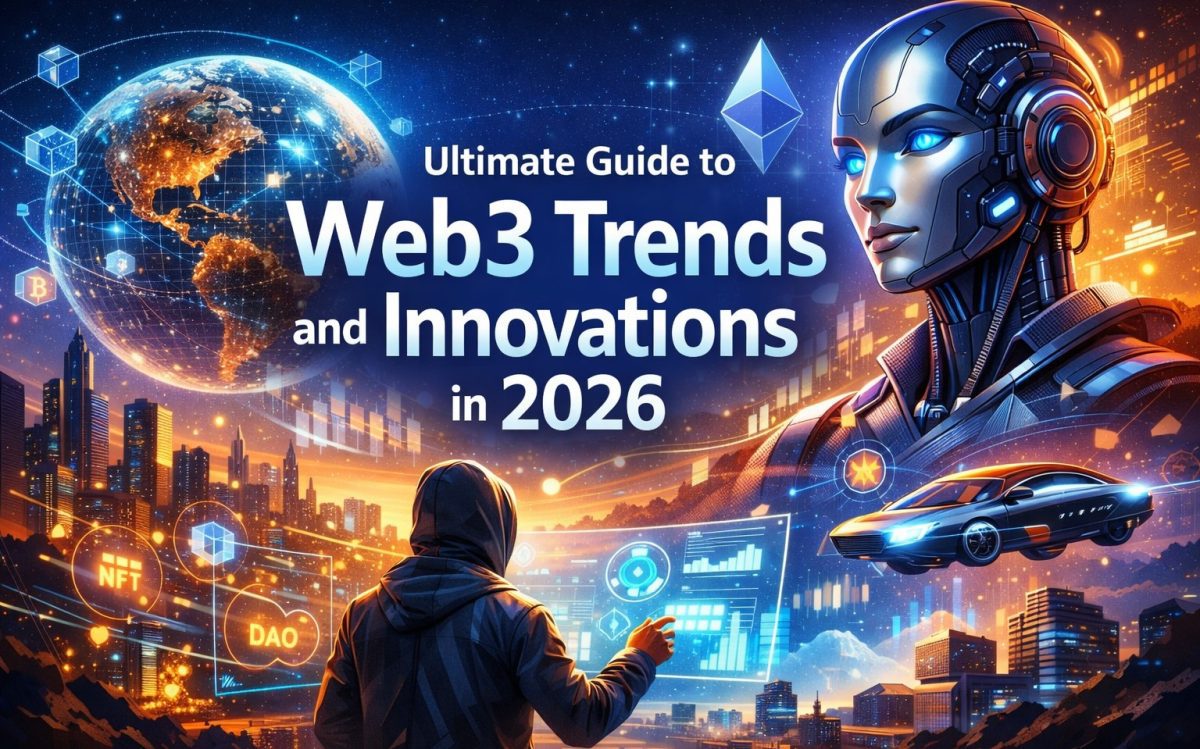
The Ultimate Guide to Web3 Trends and Innovations in 2026 reveals a pivotal year where blockchain evolves from experimental tech into practical infrastructure powering finance, AI, physical networks, and everyday digital experiences. Forget the hype cycles of previous years—2026 marks the inflection point where Web3 delivers real utility, institutional scale, and measurable impact.
As regulatory clarity solidifies (think MiCA in Europe and evolving frameworks globally), capital flows in, and technologies converge, Web3 isn’t just surviving—it’s becoming the backbone of the next digital economy. Whether you’re in the United States navigating ETF-driven institutional adoption, Asia leading in DePIN deployments, the Middle East tokenizing sovereign assets, or South Africa exploring financial inclusion via stablecoins, these trends affect global users.
This comprehensive guide breaks down the dominant forces shaping Web3 in 2026, with actionable insights, real-world examples, and what they mean for developers, investors, businesses, and everyday users.
Web3 has been called everything from “the future of the internet” to “a speculative bubble.” But here’s the truth few headlines tell you: Web3 in 2026 is tangible, practical, and rapidly moving beyond hype towards real utility.
Forget the simplistic crypto chatter — this guide digs into the profound shifts, emerging trends, and real-world innovations defining Web3’s next era. Think of it as your roadmap — whether you’re an investor, developer, creator, or curious learner.
What Is Web3 Really? (No Buzzwords – Just Clarity)
At its core, Web3 refers to a decentralized digital infrastructure powered by blockchain technology. Instead of centralized platforms controlling data and value, Web3 aims to return ownership to users directly.
Let’s break that down:
- Web1 was static — read-only pages.
- Web2 was interactive — social media, platforms, centralized services.
- Web3 is decentralized — data ownership, governance tokens, decentralized apps (dApps), smart contracts.
In 2026, Web3 isn’t just a theory. It’s actively powering new economic systems and reshaping how businesses operate online.
How Web3 Is Evolving in 2026
From Blockchain to Multichain Ecosystems
Earlier iterations of blockchain (like Bitcoin and Ethereum 1.0) focused on single-chain utility. But 2026 Web3 means multichain ecosystems. Projects span across:
- Ethereum L2s (Layer-2 solutions)
- Cosmos and IBC (Inter-Blockchain Communication)
- Polkadot parachains
This shift improves scalability, reduces fees, and enables cross-chain liquidity and communication — a pivotal breakthrough for real-world adoption.
Emerging Decentralized Infrastructure
Web3 isn’t just apps — it’s infrastructure:
- Decentralized Identity (DID) replaces passwords
- Decentralized storage replaces centralized servers
- On-chain governance replaces top-down corporate control
These layers work together to form a more user-centric web where you control your digital identity and assets.
Web3 Adoption Drivers Around the World
Web3’s growth isn’t uniform. Different regions are adopting at varying speeds — shaped by economic incentives, regulation, and digital infrastructure.
United States
The U.S. remains a major hub for innovation, research, and venture capital in Web3, especially in:
- Decentralized Finance (DeFi)
- Web3 gaming and tokenized communities
- Blockchain interoperability
However, regulatory uncertainty — especially around digital assets — continues to affect institutional adoption.
Asia
Asia leads in crypto adoption, blockchain infrastructure, and digital payments. Countries like:
- Singapore — friendly policies for blockchain startups
- South Korea — mass interest in gaming, NFTs, and blockchain tech
- Japan — strong commitment to digital asset regulation
Overall, Asia is a powerhouse for Web3 innovation and user activation.
Middle East
Places like the UAE and Saudi Arabia are rapidly investing in Web3:
- Blockchain hubs and free zones
- National blockchain strategies
- Digital identity initiatives
These policies make the Middle East an attractive destination for global Web3 projects.
Africa & South Africa
The African continent is leapfrogging traditional infrastructure challenges through Web3:
- Mobile-first digital economies
- Crypto remittances
- Blockchain identity solutions
South Africa, Nigeria, and Kenya are emerging as Web3 adoption hotspots, driven by youth innovation and flexible regulation.
Why 2026 Feels Different: From Speculation to Sustainable Utility

Web3 in 2026 sheds much of its speculative skin. Market forecasts show explosive growth—the global Web3 in financial services sector is projected to surge from around $4-5 billion in 2025 to over $50 billion by 2031 (CAGR ~48%), while broader Web 3.0 markets eye hundreds of billions by the early 2030s.
Key drivers include:
- Clearer regulations enabling mainstream entry
- AI-blockchain convergence creating intelligent systems
- Tokenization bridging real-world value to chains
- Scalability solutions making dApps feel like Web2 apps
The result? Web3 moves to production-ready platforms, with focus on user experience, interoperability, and security.
1. AI and Blockchain Convergence: Smart Contracts Get Brains
The biggest story of 2026 is AI meeting blockchain. Smart contracts evolve from static rules to autonomous agents capable of decision-making, data analysis, and execution.
AI agents transact on-chain, verify data, and manage complex workflows. Decentralized AI platforms address compute shortages by leveraging blockchain incentives.
Real-world implications:
- On-chain AI for prediction markets and automated trading
- AI-assisted DeFi strategies and risk management
- Privacy-preserving AI via zero-knowledge proofs
In the US and Asia, enterprises experiment with AI agents for supply chain and finance. Developers: Learn tools like on-chain ML frameworks.
This fusion could redefine automation, making Web3 the trust layer for AI-driven economies.
2. Real-World Asset (RWA) Tokenization: Mainstream Momentum
Tokenization accelerates dramatically in 2026. Traditional institutions tokenize bonds, real estate, funds, and commodities, unlocking liquidity and fractional ownership.
BlackRock-style funds and on-chain T-bills expand beyond experimental stages. RWAs integrate into DeFi for lending, yield, and vaults.
Global relevance:
- Middle East sovereign funds explore tokenized oil/infrastructure
- South Africa and emerging markets use RWAs for accessible investments
- Asia leads in tokenized real estate platforms
Benefits include 24/7 trading, reduced intermediaries, and global access. Challenges remain around regulation and oracle reliability, but momentum builds.
3. Decentralized Physical Infrastructure Networks (DePIN): Connecting the Physical World
DePIN explodes as blockchain incentivizes real-world hardware deployment—compute, storage, sensors, energy grids, and wireless networks.
With AI demand outstripping supply (Nvidia constraints into 2026), DePIN provides decentralized alternatives for GPU sharing and data integrity.
Top trends:
- Proof-of-service models ensuring reliable contributions
- Integration with IoT for smart cities
- Consumer apps monetizing unused resources
Asia and the US see heavy DePIN activity in wireless and compute. This trend bridges digital and physical economies, creating new income streams.
4. Institutional DeFi and TradFi-DeFi Convergence
DeFi matures with institutional integration. Banks and funds enter via regulated products, hybrid models, and on-chain treasuries.
Stablecoins become the internet’s dollar for payments and settlements. Cross-chain DeFi ecosystems enable seamless liquidity.
Key developments:
- Yield-bearing stablecoins and tokenized funds
- DeFi as treasury infrastructure for NGOs and impact funds
- Prediction markets surpassing $1 trillion in volume projections
In regulated regions like the EU/UK (MiCA enforcement) and the US (post-ETF era), this convergence brings legitimacy and scale.
5. Modular Blockchains and Scalability Breakthroughs
The monolithic chain era fades. Modular stacks dominate: execution on rollups (Arbitrum, Optimism, zkSync), data availability via Celestia-like layers, and settlement on secure bases.
Account abstraction simplifies wallets—no seed phrases, gasless experiences.
Benefits:
- Lower fees and faster transactions
- Better UX rivaling centralized apps
- Interoperability standards reducing fragmentation
This makes Web3 accessible globally, from US gamers to African mobile users.
6. Prediction Markets and Collective Intelligence
Prediction markets boom as tools for truth-seeking and revenue. Platforms let users stake on events—from elections to sports to news outcomes.
Traditional media experiments with staked journalism. AI enhances accuracy and automation.
With potential trillion-dollar volumes, this trend turns information into tradable assets.
7. Privacy Tech and Self-Sovereign Identity (SSI)
Zero-knowledge proofs go mainstream for private transactions and identity without compromising compliance.
SSI markets grow rapidly, empowering users with data control—crucial in privacy-focused regions like Europe and emerging data laws elsewhere.
8. Web3 for Good and Impact Finance
Stablecoins fund impact treasuries. DeFi yields support NGOs. Tokenized RWAs enter climate finance and public goods.
AI assists evaluation, while DePIN tackles environmental monitoring (MRV).
Challenges in 2026: What to Watch
- Regulatory unevenness across regions
- UX hurdles for mass adoption
- Security in complex systems
- Energy/compute demands
Solutions emerge through better tooling and education.
Looking Ahead: Preparing for Web3 in 2026 and Beyond
2026 cements Web3 as foundational tech. Focus on utility-driven projects with revenue, real users, and sustainable models.
For developers: Master modularity, AI integration, and ZK. For investors: Prioritize RWAs, DePIN, and AI-crypto plays. For businesses: Explore tokenization and decentralized identity.
Web3 isn’t replacing the internet—it’s upgrading it with ownership, transparency, and resilience.
Whether you’re a developer, entrepreneur, investor, or lifelong learner — understanding Web3 isn’t optional anymore. It’s your window into the future of the internet.