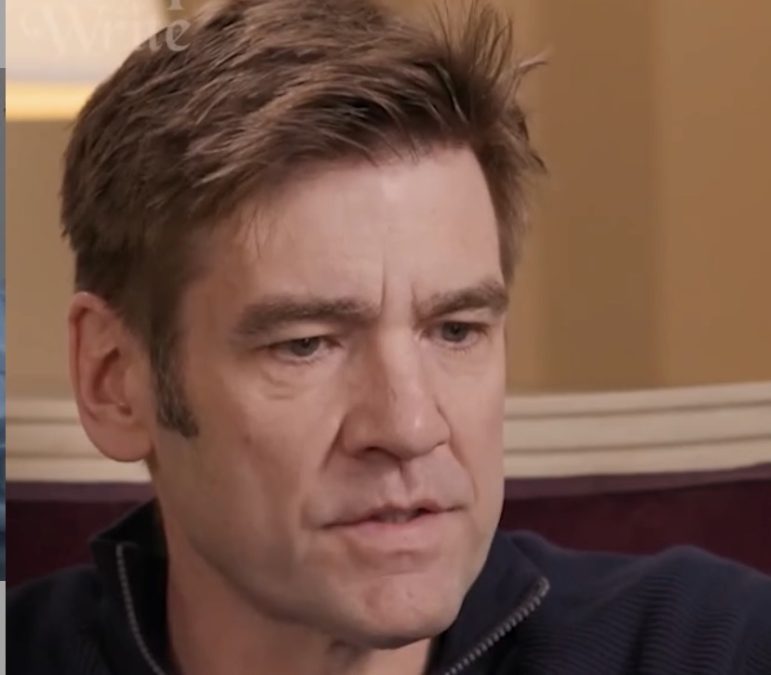
Chris Dixon Net Worth: Chris Dixon is one of the most influential venture capitalists in the world of technology and cryptocurrency. As the founder and managing partner of a16z Crypto and a general partner at Andreessen Horowitz (a16z), Dixon has built a reputation for identifying groundbreaking technologies long before they reach mainstream adoption. His early investments in companies such as Coinbase, along with his leadership in blockchain investing, have made him one of Silicon Valley’s most respected technology investors.
Before becoming a venture capital leader, Chris Dixon was a successful entrepreneur who founded two technology startups—SiteAdvisor and Hunch—both of which were acquired by larger companies. He later transitioned into angel investing before joining Andreessen Horowitz, where he launched a16z Crypto in 2018 to focus exclusively on blockchain, Web3, and decentralized technologies. Since then, the fund has grown into one of the largest crypto-focused investment platforms globally, managing billions of dollars in assets.
Although Chris Dixon is not listed on Forbes’ Billionaires List, industry estimates place his personal net worth between $400 million and $500 million in 2026. His wealth comes primarily from venture capital profits, carried interest from a16z Crypto’s investment funds, startup exits, equity stakes in successful technology companies, book royalties, and personal investments. While these estimates are widely cited, Dixon has not publicly disclosed his exact net worth.
This article explores Chris Dixon’s estimated net worth in 2026, career achievements, major income sources, investment portfolio, lifestyle, and his vision for the future of blockchain and Web3.
Who Is Chris Dixon?
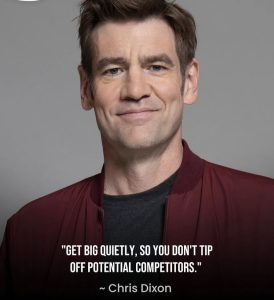
In venture capital, almost everyone claims to be a long-term thinker. Chris Dixon actually is one.
He is the founder and managing partner of a16z crypto — the cryptocurrency and Web3 investment arm of Andreessen Horowitz, one of Silicon Valley’s most powerful venture capital firms. He is the man who turned a $300 million seed fund in 2018 into the largest dedicated crypto investment vehicle in history, eventually raising $9.8 billion across five funds. He backed Coinbase in 2013 when most Wall Street investors refused to take a meeting. He backed Oculus VR before virtual reality was considered a serious business. He backed Uniswap, OpenSea, Avalanche, Solana, and dozens of other projects that became the infrastructure of the decentralised internet — often years before the broader market understood what they were.
He also studied philosophy at Columbia University, has a master’s degree from Columbia’s Graduate School of Arts and Sciences, and holds an MBA from Harvard Business School. He is the son of two English literature professors. He learned to code as a child on a TRS-80 Model 1. He built algorithms for a Wall Street high-frequency trading firm straight out of college. He is a person who has, genuinely and unusually, combined rigorous intellectual training with the willingness to write large cheques on ideas that looked foolish at the time.
In 2026, Chris Dixon’s estimated net worth sits between $400 million and $500 million — making him one of the wealthiest venture capitalists in the cryptocurrency space who does not directly own an exchange or hold a large personal crypto treasury. His wealth is built on a more traditional but equally powerful foundation: carried interest from fund returns, equity in portfolio companies, and the early bets he made personally as an angel investor before anyone else was willing to sit at the table.
He is ranked #36 on Forbes’ 2026 Midas List of the top tech investors in the world. In 2022, he held the #1 spot on that same list. The drop in ranking reflects the difficult cycle crypto has experienced since the 2022 crash and the 2025–2026 correction — but it does not reflect the underlying strength of the thesis he has built his career on, or the $2.2 billion Fund 5 his firm closed in May 2026 while much of the rest of the venture world was quietly moving to AI.
Quick Snapshot of Net Worth
| Metric | Detail |
|---|---|
| Full Name | Chris Dixon |
| Date of Birth | June 10, 1972 |
| Place of Birth | Springfield, Ohio, USA |
| Nationality | American |
| Current Residence | California (primarily), New York |
| Estimated Net Worth (2026) | $400M – $500M |
| Forbes Midas List Ranking (2026) | #36 |
| Forbes Midas List Peak Ranking | #1 (2022) |
| Primary Wealth Sources | Carried interest (a16z crypto funds), early portfolio equity, angel investments |
| Key Role | Founder & Managing Partner, a16z crypto (Andreessen Horowitz) |
| Total Funds Raised (a16z crypto) | $9.8 billion across five dedicated funds |
| Notable Portfolio Companies | Coinbase, Uniswap, OpenSea, Solana, Kalshi, Anchorage, Oculus VR |
| Book | Read Write Own: Building the Next Era of the Internet (Random House, Jan 2024 — NYT Bestseller) |
Career Journey
Early Life and Education
Chris Dixon grew up in Springfield, Ohio — a mid-sized city in the American Midwest that would not typically be described as a cradle of technology entrepreneurship. His father and mother were both English department professors at Wittenberg University, a liberal arts college in Springfield. He is one of four sons. The household was intellectual, reading-oriented, and fundamentally humanistic in its values — an environment that shaped Dixon’s unusual capacity to blend philosophical argument with technical thinking.
The earliest formative technology experience in his life came not from a computer lab at a prestigious school but from sitting in on user clubs at Wright-Patterson Air Force Base — the vast military research facility located near Dayton, Ohio, the same base near which Andreas Antonopoulos had his own early technology exposure. These informal computing communities gave Dixon access to early personal computers and, more importantly, to the culture of people who built things with them. He began coding on a TRS-80 Model 1 — one of the earliest mass-market personal computers, produced by Tandy Corporation from 1977. He was, by his own account, a programmer before he was a teenager.
Dixon began his undergraduate education at Wesleyan University in Connecticut before transferring to Columbia University in New York City, where he completed both a Bachelor of Arts in Philosophy and a Master of Arts from Columbia’s Graduate School of Arts and Sciences, also in philosophy. It is a disciplinary choice that runs counter to what most people might expect from a technologist. Philosophy — particularly its formal logic, epistemology, and philosophy of language — trains the mind to identify weak arguments, to distinguish valid from invalid reasoning, and to find the precise point at which a compelling claim fails under scrutiny.
These are exactly the skills that make a great venture capitalist.
“His background in philosophy, logic, and syllogisms has resurfaced in his writing and even in his investments,” Fortune observed in its landmark 2022 profile. One founder who received early funding from Dixon recalled that the first thing Dixon mentioned in their initial conversation was that he had studied philosophy. It was not a non-sequitur. For Dixon, the structure of an argument and the quality of the underlying thesis have always been the primary criteria for evaluating whether something is worth backing.
After Columbia, Dixon did not immediately enter venture capital or entrepreneurship. He went to work as a professional programmer at Arbitrade, a high-speed options trading firm on Wall Street. The role — building algorithms for high-frequency financial trading — required a combination of mathematical precision, software engineering skill, and an understanding of financial markets that would prove directly useful when Dixon later began making investments at the intersection of technology and finance. Arbitrade eventually rolled into Citigroup through a series of acquisitions.
Dixon then pursued an MBA at Harvard Business School, where his intellectual restlessness continued to express itself through side projects. As an MBA student, he built an experimental product called DidTheyReadIt with his classmate Alex Rampell — an email tracking tool that embedded pixels to report back the time a message was opened. It was an early experiment in the kind of behavioural data infrastructure that would later become the foundation of modern digital advertising. Rampell went on to become a general partner at Andreessen Horowitz alongside Dixon.
People who knew Dixon during this period consistently described him as exceptionally intelligent and unusually multi-disciplinary. “He is very adept at synthesising information, taking risk, and learning at an amazingly accelerated level,” said one former colleague. “I never met a more innovative programmer, and it wasn’t even his full-time job, just something he learned because he was interested and nobody else could do what he wanted done.”
Entry Into the Tech Industry
After Harvard, Dixon joined Bessemer Venture Partners — one of the most established venture capital firms in Silicon Valley, with a portfolio that includes LinkedIn, Twilio, and Shopify. The role gave him formal exposure to the mechanics of institutional venture investing, but it also gave him something more important: the freedom to start his first company while still employed there.
In 2005, while at Bessemer, Dixon co-founded SiteAdvisor — a web security startup that warned internet users about potentially harmful websites, malware, phishing threats, and scam operations. The company had an unusually sophisticated media strategy for its size and age: despite being in business for less than a year, SiteAdvisor had a dedicated media relations person and maintained a curated list of press coverage to establish institutional credibility before the company had institutional scale. It was an early demonstration of Dixon’s understanding that perception and reality are closely linked in the tech ecosystem — and that narrative is a competitive advantage.
SiteAdvisor was acquired by McAfee in 2006 — giving Dixon his first successful exit and his first significant capital base for subsequent investments and ventures.
The McAfee acquisition positioned Dixon as a credible founder-turned-investor in the New York technology scene, which was in the early stages of what would become a major entrepreneurship renaissance. He joined the emerging community of angel investors and seed-stage backers who were funding a new generation of internet companies. He made personal angel investments in companies that would go on to become household names: Kickstarter (crowdfunding), Pinterest (visual discovery), Stack Overflow (developer Q&A), Stripe (payments infrastructure), Venmo (peer-to-peer payments), Twilio (developer communications API), Uber (ride-sharing), and BuzzFeed (digital media). These early bets — made before any of these companies achieved the scale that would make them obvious — reflect the pattern of Dixon’s investing: identify an infrastructure idea that seems too early, back it aggressively, and hold.
In 2009, Dixon co-founded two significant ventures simultaneously. Hunch — a personalised recommendation engine — was co-founded with Caterina Fake (co-founder of Flickr), Tom Pinckney, and others. The company was built in New York’s Flatiron District and aimed to generate personalised recommendations across a wide range of topics and products using structured decision trees and user preference data. Hunch was acquired by eBay in 2011 for a reported $80 million — Dixon’s second successful exit.
Also in 2009, Dixon co-founded Founder Collective — a seed-stage venture capital fund created by and for entrepreneurs. The fund’s model was unusual: rather than being backed by university endowments or family offices, Founder Collective was capitalized by successful founders who wanted to invest in the next generation of startups with the credibility and insight of people who had actually built and sold companies. Founder Collective became one of the most respected seed funds in New York and has backed companies including PillPack, Uber, and The Trade Desk.
Major Achievements and Milestones
In November 2012, Dixon was recruited to join Andreessen Horowitz (a16z) as a general partner — relocating from New York to the firm’s Menlo Park headquarters. He was the seventh partner at the firm. Marc Andreessen and Ben Horowitz had built a16z into Silicon Valley’s most aggressive and intellectually opinionated investment firm since its founding in 2009, and Dixon’s arrival deepened the firm’s capacity for early-stage technology investing.
One of Dixon’s earliest and most consequential moves at a16z was his advocacy for Bitcoin. His blog posts explaining Bitcoin’s potential — published on cdixon.org and widely shared in the early crypto community — became, as Fortune documented, “something of a gospel among young crypto entrepreneurs.” He argued, with the careful logical structure of a trained philosopher, that Bitcoin represented a new form of internet-native money that could fundamentally challenge the relationship between individuals and the institutions that controlled their access to financial services. By 2014, a16z had invested nearly $50 million in Bitcoin-related companies, including leading a $25 million investment in Coinbase in December 2013 — one of the most consequential early venture bets in cryptocurrency history.
That investment’s ultimate return was staggering. Coinbase went public on the NASDAQ via direct listing on April 14, 2021, briefly achieving a market capitalisation of approximately $100 billion before settling into a more modest — but still extraordinary — trading range. As of May 2026, Coinbase trades with a $51 billion market capitalisation. A16z’s early stake, acquired at $25 million in 2013, has generated returns measured in billions.
In 2018, Dixon founded a16z crypto — a dedicated cryptocurrency and blockchain investment arm of Andreessen Horowitz, initially capitalised with a $300 million fund. This was the institutional expression of the thesis he had been developing publicly for years: that blockchain technology was not a speculative asset class but a new computing paradigm with the potential to rebuild the architecture of the internet on more open, user-owned, and permissionless foundations.
The fund grew rapidly. By 2022, a16z crypto had raised a landmark $4.5 billion for its fourth fund — the largest dedicated crypto venture fund ever raised at the time of its closing. Forbes placed Dixon at #1 on its 2022 Midas List of the world’s best venture capital investors — the summit of the most prestigious investor ranking in the industry. Fortune published a landmark profile calling him “the world’s top crypto investor.”
Then the storm came.
The 2022 crypto crash — triggered by the collapse of the TerraUSD algorithmic stablecoin, followed shortly by the implosion of FTX — caused the Wall Street Journal to report that during the first half of 2022, a16z crypto’s fund had lost approximately 40% of its value, a decline “much larger than the 10% to 20% drops recorded by other venture funds.” A16z had backed FTX before its collapse, adding reputational damage to financial loss. The $4.5 billion Fund 4 had arrived at the worst possible moment — just as the market entered one of its most severe bear cycles.
Dixon’s response was characteristic. Rather than pivot away from the thesis, he leaned into the distinction between speculation and infrastructure. “Using blockchains and tokens purely for gambling distracts from the true potential of this computing movement,” he wrote. He acknowledged the losses while maintaining the long-term argument. He continued building.
In January 2024, Dixon published Read Write Own: Building the Next Era of the Internet through Random House — a book that made the comprehensive, philosophical case for why blockchain technology matters beyond cryptocurrency speculation. The book reached the New York Times Bestsellers List and was endorsed by Bob Iger (CEO of Disney), Sam Altman (co-founder of OpenAI), Mark Cuban, and Kevin Kelly. It was not universally praised — critics, most notably blockchain researcher Molly White, argued that Dixon failed to cite any blockchain project that had achieved widespread, non-speculative utility at scale — but it succeeded in elevating the public discourse about Web3 beyond the noise of NFT speculation and exchange collapses.
In May 2026, a16z crypto closed its fifth fund at $2.2 billion — bringing total committed capital across all five dedicated crypto vehicles to $9.8 billion. The fund arrived during a slower period for crypto venture capital, with quarterly deal counts down sharply in early 2026 and several prominent crypto-native firms pivoting to AI. Dixon and his partners framed the raise around what he called crypto’s transition from speculation to financial utility — arguing that stablecoins, tokenization of real-world assets, and the convergence of blockchain with AI represented a more mature and commercially viable opportunity than the NFT and DeFi speculation of the previous cycle.
Net Worth Breakdown
Estimated Chris Dixon Net Worth in 2026
Chris Dixon’s net worth as of 2024 is estimated to be in the hundreds of millions, with some estimates reaching over $500 million, coming from a combination of salary, equity in Andreessen Horowitz funds, and stakes in the companies he has invested in.
In 2026, the most reliable range places his net worth at approximately $400 million to $500 million. Forbes listed his real-time net worth at approximately $400 million in its 2022 Midas List profile. According to estimates, Chris Dixon has a net worth of approximately $400 to $500 million, serving as a general partner at Andreessen Horowitz leading the firm’s cryptocurrency investing arm, a16z crypto.
The opacity of venture capital economics makes precise calculation structurally impossible. Unlike a publicly traded equity position — where you can multiply shares by price and arrive at a number — Dixon’s wealth is primarily held through:
Carried interest — the percentage of fund profits that general partners receive as performance compensation. In a typical VC fund structure, GPs receive 20% of profits above the hurdle rate. With $9.8 billion raised across five funds and a portfolio that includes Coinbase (still trading with a $51 billion market cap), Uniswap (a16z holds approximately 44 million UNI tokens, worth approximately $575 million as of January 2025), and dozens of other positions, the carried interest Dixon has earned and is entitled to earn from successful exits is substantial.
Dixon turned a $350 million crypto fund into an unrealized profit of $6 billion, representing a 17x gain. Even accounting for the losses in subsequent funds, the aggregate carried interest from that first fund alone represents hundreds of millions of dollars in personal wealth.
Personal angel investments — Dixon’s pre-a16z angel bets on Coinbase, Kickstarter, Pinterest, Stripe, and Twilio all either generated exits or significant paper returns. Stripe alone — still privately valued at approximately $65 billion — would represent significant personal wealth if Dixon’s early stake has been partially retained.
SiteAdvisor and Hunch exits — the proceeds from two successful acquisitions (McAfee and eBay) provided the initial capital base for Dixon’s subsequent investment activity.
Salary and compensation at a16z — general partners at Andreessen Horowitz receive both base compensation and fund economics that generate multi-million-dollar annual earnings independent of carried interest.
Sources of Income
Tech Companies and Startups — a16z Crypto Portfolio
A16z crypto’s portfolio across five funds is the primary engine of Dixon’s wealth. With $9.8 billion in committed capital and a portfolio that spans the most significant infrastructure in decentralised finance, Dixon’s carried interest position — even after accounting for the losses in Fund 4 — is one of the most valuable in venture capital.
The fund has backed standout companies like Coinbase, Kalshi, and Solana Foundation. The broader portfolio is a map of Web3’s development: Uniswap (the largest decentralised exchange by volume), OpenSea (the leading NFT marketplace), Avalanche (smart contracts infrastructure), Anchorage Digital (institutional crypto custodian), Dapper Labs (NBA Top Shot, the pioneering NFT sports collectibles platform), Aztec (zero-knowledge privacy infrastructure), and Helium (decentralised wireless network infrastructure). The firm was early to Coinbase, backing the exchange in 2013 when most VCs wouldn’t touch cryptocurrency, and also invested in OpenSea before NFTs went mainstream and Dapper Labs before Flow blockchain launched NBA Top Shot.
By January 2025, a16z Crypto had amassed over $7.6 billion in assets under management, with the firm’s largest holding being UNI, with approximately 44 million tokens valued at $575 million.,
The new $2.2 billion Fund 5, closed in May 2026, positions Dixon and a16z crypto to continue dominating deal flow in what has become an increasingly capital-scarce environment. Total crypto VC funding dropped 68% year-over-year in 2025, according to PitchBook data — which means a16z’s $2.2 billion war chest, in a market where fewer firms are writing large cheques, gives the fund disproportionate influence over which projects get built next.
Investments
Beyond his carried interest in a16z crypto’s funds, Dixon holds personal investment positions across both public and private markets.
His earliest and most significant personal bets — made before joining a16z — include positions in Coinbase (backed personally as an angel investor before a16z led the institutional round), Stripe, Pinterest, Kickstarter, Stack Overflow, Twilio, Venmo, and Uber. The aggregate return on these early angel investments, which were made when each company was either pre-revenue or in its earliest stages, represents an enormous multiple on the original capital deployed.
Through Founder Collective, the seed fund he co-founded in 2009, Dixon also holds fund economics on a portfolio that has produced multiple successful exits and unicorns. Founder Collective’s portfolio includes The Trade Desk (a programmatic advertising platform now publicly traded at a multi-billion-dollar market cap), PillPack (acquired by Amazon), and Uber.
His personal investment approach mirrors his professional philosophy: identify ideas that seem too early, back the infrastructure rather than the application, and hold through multiple market cycles. This is the same thesis that led him to back Bitcoin-related companies in 2013, Oculus VR in 2014 (sold to Facebook for $2 billion), and Uniswap and other DeFi infrastructure in 2018 — all of which seemed either premature or implausible to many investors at the time of the investment.
Endorsements and Partnerships
Dixon does not have a traditional endorsement portfolio in the celebrity sense. His influence is generated through intellectual output — essays, podcasts, policy advocacy, and now a published book — rather than through paid promotional relationships.
Read Write Own, published by Random House in January 2024, generated both royalty income and an extraordinary amount of earned media attention. The book reached the New York Times Bestsellers List and was endorsed by the CEOs of Disney and OpenAI, the co-founder of Shark Tank’s Dallas Mavericks, and some of the most respected voices in technology and business. The combination of Random House’s distribution network and a16z’s institutional profile made the launch unusually powerful for a first-time author — though it also attracted scrutiny, with one Vice investigation suggesting that bulk purchases by crypto-affiliated companies contributed to the initial bestseller list placement.
His speaking fee for private corporate events and keynote appearances is not publicly disclosed but, at his profile level, would typically range from $50,000 to $200,000 per engagement. He speaks at conferences including Web Summit, Consensus, and major financial services industry events globally.
His MasterClass course on cryptocurrency, Web3, and venture capital — part of a broader MasterClass crypto curriculum that also features Changpeng Zhao and Coinbase’s Emilie Choi — generates ongoing royalty income from one of the world’s largest premium online learning platforms.
His Substack newsletter and public writing at cdixon.org have built an audience of tens of thousands of readers across the technology, finance, and policy communities — generating both direct subscriber revenue and significant deal flow value for a16z crypto.
Policy advocacy adds an indirect commercial dimension to his influence. Dixon has been a consistent and prominent voice in Washington D.C. on cryptocurrency regulation, arguing for clear, principle-based regulatory frameworks that would enable the U.S. to maintain its position as the centre of blockchain innovation rather than ceding it to offshore jurisdictions. This advocacy has positioned a16z crypto as an institutional force in shaping the regulatory environment in which its portfolio companies operate — creating a strategic advantage that competitors without a16z’s policy infrastructure cannot easily replicate.
Yearly Earnings Growth
| Year | Estimated Net Worth | Key Driver |
|---|---|---|
| 2006 | < $5 million | SiteAdvisor acquired by McAfee |
| 2009–2011 | ~$10–20 million | Hunch angel investing; Founder Collective launch |
| 2011 | ~$20–30 million | Hunch acquired by eBay ($80M) |
| 2012–2017 | ~$50–100 million | a16z carried interest; Coinbase, Oculus early bets |
| 2018 | ~$100–150 million | a16z crypto Fund 1 ($300M) launched |
| 2021 | ~$300–400 million | Coinbase IPO; bull market peak; Fund 3 |
| 2022 | ~$300–400 million | Fund 4 ($4.5B) raised; FTX losses; #1 Midas List |
| 2024 | ~$400 million | Read Write Own NYT Bestseller; market recovery |
| 2025 | ~$400–500 million | Crypto super cycle; Fund 5 preparation |
| 2026 | ~$400–500 million | Fund 5 closed ($2.2B); crypto correction; #36 Midas List |
Lifestyle and Assets
Real Estate Holdings
Chris Dixon’s primary residence is in California — consistent with his role at a16z, which is headquartered in Menlo Park. He has spent significant portions of his career in New York, where his entrepreneurial activities and early angel investing career were centred, and maintains professional ties to the city. His official speaking biography notes that he “generally travels from New York, NY, USA” for speaking engagements.
Dixon’s real estate profile is not widely documented in the press — a reflection of his overall approach to personal privacy. Unlike some tech founders who use trophy real estate acquisitions as public statements of wealth, Dixon’s personal asset profile appears to centre on professional and intellectual capital rather than physical assets.
He is a California resident for the purpose of his primary employment and fund management responsibilities. The a16z Menlo Park campus is one of the most well-appointed in Silicon Valley — but Dixon’s personal residence, while presumably substantial for someone of his wealth, has not been the subject of significant press coverage.
Cars, Luxury Items and Collectibles
Dixon maintains a relatively private personal life relative to his public intellectual profile. He does not publicise a collection of supercars, yachts, or luxury goods, and his public image is defined almost entirely by ideas — the essays he writes, the investments he makes, and the framework he uses to think about technology.
His most visible “luxury” is intellectual access: the ability to back the most interesting founders in the world at the earliest stages of their companies, to shape the conversations that define an industry’s direction, and to be present at the moments when new paradigms are being established. For someone of Dixon’s intellectual disposition, these are not incidental perks of a lucrative career. They are the point.
He is an active presence on X (formerly Twitter) under the handle @cdixon, where his posts on blockchain, AI, technology history, and investment philosophy have built an audience of hundreds of thousands of followers in the technology and finance communities. This public intellectual platform is itself a form of currency — it generates deal flow, attracts talent, influences policy, and sustains the narrative infrastructure that makes a16z crypto’s portfolio companies more credible to institutional investors.
Philanthropy and Donations
Dixon’s most significant philanthropic contribution to the broader technology ecosystem is arguably the a16z Crypto Startup School — a curriculum-based accelerator and education programme for early-stage Web3 founders. First launched in 2021 and subsequently relaunched and expanded, the school has graduated hundreds of builders who have gone on to found or contribute to meaningful blockchain projects. The programme combines mentorship, technical education, and institutional access to the a16z network — a model that, while not purely philanthropic (a16z takes stakes in the most promising graduates), provides genuine educational value to a large number of founders who might not otherwise have access to institutional crypto knowledge.
Beyond the Startup School, Dixon’s public intellectual output — his blog, his essays, his podcast appearances, and now Read Write Own — functions as a form of public goods provision. His essay “Why Decentralisation Matters,” published in 2018, remains one of the most widely cited arguments for the social and economic case for blockchain technology. It was freely available from the day of publication, shared across millions of social media accounts, and has shaped the thinking of entrepreneurs, policymakers, and investors worldwide.
Dixon has not publicly signed the Giving Pledge or announced major charitable foundation commitments. His philanthropic model appears to be one of access and education — using the platform and credibility his career has built to advance ideas and support founders who might not otherwise find institutional backing, rather than writing large cheques to traditional charitable organisations.
Comparison and Influence
Net Worth Compared to Other Tech Entrepreneurs
| Name | Role | Estimated Net Worth (2026) |
|---|---|---|
| Changpeng Zhao (CZ) | Binance Founder | $50B – $110B |
| Brian Armstrong | Coinbase CEO | ~$8.9B – $9.4B |
| Michael Saylor | Strategy Exec. Chairman | ~$3.4B – $4.7B |
| Chris Dixon | a16z Crypto Founder | ~$400M – $500M |
| Anthony Pompliano | ProCap Financial CEO | ~$100M – $200M |
| Marc Andreessen | a16z Co-Founder | ~$1.7B |
| Andreas Antonopoulos | Author & Educator | ~$50M |
Dixon’s position in this table reveals something fundamental about the difference between building financial infrastructure and investing in it. CZ, Armstrong, and Saylor built the plumbing — the exchanges, treasuries, and blockchains that carry the actual flow of crypto capital. Dixon invested in that plumbing at the earliest stages and earned returns measured in multiples on the capital deployed. His $400–500 million represents venture capital economics applied to one of the most extraordinary asset class appreciations in financial history.
The comparison with Marc Andreessen — his a16z co-founder and one of the most storied figures in Silicon Valley — is instructive. Andreessen’s estimated net worth of approximately $1.7 billion is higher than Dixon’s, reflecting his earlier founding of both Netscape and a16z itself, his longer investment track record, and his broader technology portfolio. But within the crypto-specific domain, Dixon’s influence and deal flow clearly exceed Andreessen’s — a16z crypto is Dixon’s creation, and its $9.8 billion in committed capital is a testament to his specific franchise value within the firm.
Influence in the Tech World
Chris Dixon’s influence in 2026 operates on multiple levels simultaneously — and each level reinforces the others in ways that distinguish him from almost any other figure in crypto investing.
As a philosopher-investor, Dixon has done more than almost any other institutional figure to provide a coherent, non-speculative intellectual framework for blockchain technology’s significance. His essays — particularly “Why Decentralisation Matters,” “Crypto Tokens: A Breakthrough in Open Network Design,” and the arguments in Read Write Own — have given thousands of entrepreneurs, policymakers, and institutional investors a way to think about blockchain that does not depend on price appreciation to validate the thesis. Whether or not those arguments are ultimately proven right, they have been enormously influential in shaping the terms on which the debate about crypto’s future is conducted.
As an institutional kingmaker, Dixon controls one of the two or three largest pools of dedicated crypto venture capital in the world. <cite index=”73-1″>A16z raised more than $15 billion across all its investment vehicles in January 2026, representing over 18% of all venture capital allocated in the U.S. in 2025.</cite> The portfolio companies a16z crypto backs gain not just capital but access to a16z’s regulatory team, communications infrastructure, talent network, and policy relationships — a bundle of support that no other crypto venture fund currently matches.
As a policy architect, Dixon has been among the most active and effective advocates for pro-crypto regulation in Washington D.C. His consistent argument — that the U.S. risks ceding blockchain innovation leadership to offshore jurisdictions through regulatory inaction or overreach — has shaped the environment in which the Trump administration’s pro-crypto posture emerged. The SEC’s dismissal of its lawsuit against Coinbase, the approval of Bitcoin ETFs, and the growing bipartisan support for stablecoin legislation are all outcomes in an environment that Dixon and a16z have spent years helping to create.
Future Outlook
Upcoming Projects
Dixon’s most immediate focus in 2026 is deploying the freshly closed $2.2 billion Fund 5. The investment priorities a16z crypto has articulated for this vehicle reflect a strategic pivot from the Web3 idealism of the 2021–2022 cycle toward what Dixon has called crypto’s “transition from speculation to financial utility.”
Dixon framed the raise around crypto’s transition from speculation to financial utility, with his partners writing: “The founders we’re backing with this $2.2 billion fund are working on the part of the cycle that gets less attention and produces more of the lasting value: turning new infrastructure into products people use every day.”
The specific priority areas for Fund 5 include:
Stablecoin payments infrastructure — Dixon has argued publicly that stablecoins represent the most immediate near-term commercial opportunity in crypto. A growing global market for dollar-denominated digital payments, combined with improving regulatory clarity in the U.S., has created conditions in which stablecoin-based payment rails could achieve genuine mainstream adoption. A16z crypto has already backed projects in this space and is likely to deepen those commitments.
Real-world asset tokenisation — bringing traditional financial assets (government bonds, real estate, private equity) onto blockchain rails in a way that improves liquidity, transparency, and access. A16z has described this as a multi-trillion-dollar opportunity if the regulatory and infrastructure conditions are met.
AI and blockchain convergence — Dixon has consistently argued that AI and blockchain are complementary rather than competitive technologies. AI systems require provenance, attribution, and data marketplace infrastructure that blockchain can provide. Dixon has noted that many of the Web3-based projects the firm backed earlier have petered out, including a16z-backed Farcaster, a decentralised social media platform that repaid the full $180 million it raised from investors earlier in 2026 after selling its infrastructure to a different company. The pivot toward financial utility and AI integration reflects lessons learned from these setbacks.
Crypto Startup School — the accelerator programme Dixon helped establish continues as an ongoing commitment, graduating new cohorts of Web3 builders and maintaining a16z crypto’s position as the institutional entry point for the most talented early-stage crypto founders globally.
Potential Net Worth Growth
Dixon’s wealth trajectory from 2026 onward is primarily a function of three variables: the performance of a16z crypto’s existing portfolio, the success of Fund 5 in generating competitive returns, and the macro environment for crypto and technology venture capital broadly.
The bull case is grounded in the Coinbase precedent. A16z’s initial $25 million investment in Coinbase in 2013 has already generated returns that would make the entire first fund a generational success regardless of any other outcome. If even one or two of the Fund 4 or Fund 5 portfolio companies achieves a comparable trajectory — Uniswap‘s governance token, the Solana ecosystem, the stablecoin infrastructure plays — the carried interest Dixon earns from those exits would push his personal net worth significantly above the current $500 million upper bound of most estimates.
The bear case involves continued market weakness, additional high-profile portfolio failures (the Farcaster implosion being a recent example), and the possibility that the AI sector’s continued dominance in institutional capital allocation leaves blockchain venture as a persistently less attractive destination for limited partner capital.
The most likely scenario, based on current trajectory, is gradual net worth appreciation anchored to the multi-year deployment of Fund 5 and the continued appreciation of existing portfolio positions in a more favourable regulatory environment. Analysts tracking the crypto venture space generally expect that the combination of stablecoin regulatory clarity, Bitcoin ETF maturation, and AI-blockchain convergence will create meaningful new opportunities for infrastructure investments over the next three to five years — exactly the thesis that underpins Dixon’s Fund 5.
If the crypto market follows its historical four-year cycle and enters a new bull phase in 2027–2028, Dixon’s portfolio positions and fund economics could push his net worth toward and potentially beyond $1 billion for the first time.
Summary of Wealth and Legacy
Chris Dixon’s net worth of $400–500 million in 2026 is the product of one of the most distinctive investment careers in modern venture capital — built on the unusual foundation of rigorous philosophical training, early technical competence, two successful startup exits, a prolific angel investing record, and the courage to commit $9.8 billion of institutional capital to a technology that most of the financial establishment still regarded as either a scam or a speculation for most of the decade he was building it.
The $9.8 billion raised across five dedicated crypto funds is Dixon’s most enduring financial monument. No other individual has built a larger dedicated cryptocurrency investment vehicle from scratch. The portfolio it has funded — Coinbase, Uniswap, OpenSea, Solana, Anchorage, Kalshi — is a meaningful portion of the infrastructure on which decentralised finance currently operates globally.
His intellectual contribution — the essays, the book, the policy advocacy — is more difficult to quantify but equally significant. Dixon has provided the most sustained and rigorous institutional argument for blockchain technology’s social and economic importance of anyone operating at his level of capital deployment. Whether that argument is ultimately validated by technology adoption at scale remains the open question of his career.
There is a version of Chris Dixon’s story that focuses on the setbacks — the FTX investment, the 40% fund losses in 2022, the Farcaster implosion, the critics who argue that Web3’s promise of user-owned internet has largely not been delivered. Those criticisms deserve to be taken seriously.
But the more complete version recognises what Dixon has consistently gotten right: that blockchain technology is a meaningful computing paradigm, not just a speculative asset; that the infrastructure investments made during bear markets often produce the best long-term returns; and that the combination of regulatory clarity, institutional adoption, and AI-blockchain convergence now visible in 2026 closely resembles the environment his thesis always predicted would eventually arrive.
He has not been a fair-weather advocate. He made his arguments for Web3 when the narrative was dominated by NFT speculation and exchange fraud, and he continued making them through the crash, the lawsuits, and the Wall Street Journal investigations. That consistency — maintained through hundreds of millions in paper losses and significant reputational risk — is what distinguishes a genuine long-term investor from an opportunist.
In 2026, with Fund 5 deployed, Read Write Own in bookshops worldwide, and the regulatory environment finally beginning to catch up with the vision he has been articulating for over a decade, Dixon’s thesis is closer to being proven than at any point in his career.
The philosopher from Springfield, Ohio, may yet be right about everything.
Chris Dixon has built his fortune by combining entrepreneurial experience with exceptional long-term investment judgment. From founding successful startups to leading one of the world’s largest crypto-focused venture capital funds, he has consistently backed technologies capable of transforming entire industries. His early investments in companies such as Coinbase, combined with the success of a16z Crypto, have established him as one of the most influential investors in blockchain and Web3.
While his exact financial position remains private, most industry estimates place Chris Dixon’s net worth at between $400 million and $500 million in 2026. The majority of his wealth is believed to come from carried interest in a16z Crypto’s multi-billion-dollar funds, equity in successful startups, proceeds from the acquisitions of SiteAdvisor and Hunch, and personal investments in high-growth technology companies. These figures are estimates rather than officially confirmed values.
Beyond financial success, Dixon has become one of the leading intellectual voices advocating for a decentralized internet. Through his bestselling book Read Write Own, public speaking, and investment strategy, he continues to promote a vision of Web3 in which users, creators, and developers have greater ownership and control over digital platforms. Under his leadership, a16z Crypto launched its fifth dedicated crypto fund in 2026, reinforcing its long-term commitment to blockchain innovation despite market cycles.
As artificial intelligence, blockchain, and decentralized technologies continue to reshape the digital economy, Chris Dixon remains one of the industry’s most influential architects. His legacy extends beyond personal wealth—it lies in identifying transformative innovations early and helping build the next generation of internet infrastructure and technology companies.