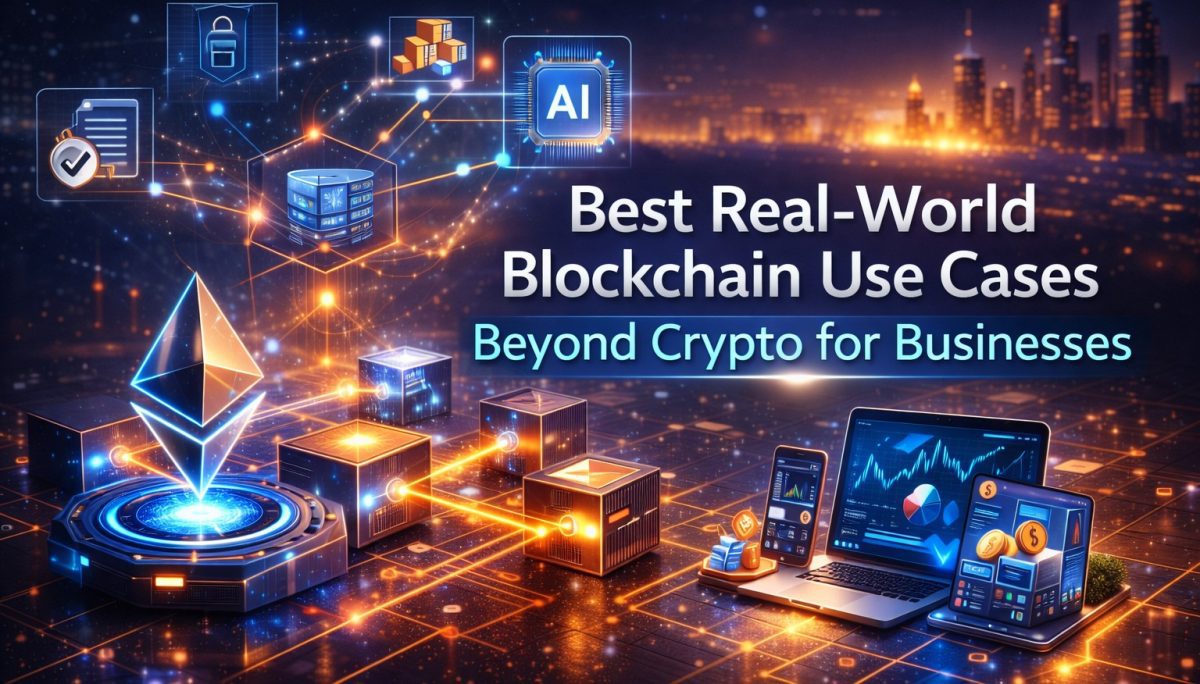
The Best Real-World Blockchain Use Cases Beyond Crypto for Businesses in 2026 reveal blockchain’s true strength: it’s no longer about speculation—it’s enterprise infrastructure solving multi-party trust issues, slashing inefficiencies, and delivering measurable ROI.
By mid-2026, blockchain has matured into practical tools for industries needing immutable records, shared accountability, and automation without intermediaries. Enterprises report 30–50% reductions in reconciliation time, fraud losses, and paperwork in targeted deployments. Supply chain transparency leads adoption, followed by healthcare data integrity, digital identity, and tokenized assets (non-speculative).
For businesses in Abuja streamlining logistics amid global trade, the US optimizing compliance, Asia managing manufacturing flows, or the Middle East securing infrastructure projects, these use cases offer tangible advantages over traditional systems.
CHECK: Layer 1 vs Layer 2 Blockchains: Best Comparisons and Real-World Examples
In 2026, blockchain’s most powerful impact isn’t speculation — it’s infrastructure.
Across finance, logistics, healthcare, retail, energy, and government services, distributed ledger technology is quietly reducing fraud, automating trust, increasing transparency, and cutting operational costs.
The real question for businesses is no longer “Should we consider blockchain?” but rather:
Where does blockchain create measurable value beyond crypto?
This guide highlights the top real-world applications, with examples, benefits, and implementation considerations—no hype, just proven value.
Why Blockchain Beyond Crypto Matters in 2026
Blockchain excels in scenarios with:
- Multiple untrusting parties sharing data
- High-stakes verification needs
- Complex workflows prone to errors/fraud
- Demand for audit trails and automation
Regulatory clarity (e.g., enterprise-friendly frameworks) and scalable platforms (Hyperledger, Corda, permissioned Ethereum) have accelerated adoption. Unlike crypto volatility, these applications focus on efficiency, compliance, and resilience.
Blockchain offers three structural advantages that traditional systems struggle to match:
- Immutable record-keeping
- Shared, synchronized data across parties
- Automated execution through smart contracts
Unlike centralized databases, blockchain creates a single source of truth shared among stakeholders — without requiring a single controlling authority.
According to research initiatives from institutions like the World Economic Forum and the Bank for International Settlements, distributed ledger systems are increasingly viewed as enterprise infrastructure rather than speculative tools.
Best Real-World Blockchain Use Cases Beyond Crypto for Businesses in 2026

1. Supply Chain Transparency and Traceability
The #1 enterprise use case: Blockchain creates an tamper-proof record of every step—from raw materials to end consumer.
Real-world impact:
- IBM Food Trust (with Walmart, Nestlé) tracks produce in seconds vs. weeks, reducing recall costs and food safety risks.
- Maersk’s TradeLens (now evolved) digitizes shipping documents, cutting paperwork by 80% for global logistics.
- Pharmaceutical chains verify authenticity to combat counterfeits (vital in emerging markets).
Benefits for businesses:
- Fraud reduction and ESG compliance (trace sustainable sourcing).
- Faster recalls and dispute resolution.
- Shared visibility without revealing proprietary data.
In Africa and Asia, this combats counterfeit goods and builds consumer trust.
2. Healthcare Data Management and Secure Sharing
Blockchain secures patient records, consent, and clinical trials while enabling interoperability.
Key applications:
- Decentralized EHRs (Electronic Health Records) give patients control; providers access verified data across systems.
- Clinical trial integrity: Immutable records of protocols, results, and consent prevent tampering.
- Pharmaceutical supply chains track drugs end-to-end, ensuring cold-chain compliance.
Benefits:
- HIPAA/GDPR-aligned privacy with patient-owned data.
- Reduced administrative costs and errors in claims/records.
- Faster research collaboration via verifiable provenance.
In 2026, pilots expand to telehealth and insurance claims automation.
3. Digital Identity and Self-Sovereign Identity (SSI)
Businesses verify identities without central databases vulnerable to breaches.
Enterprise examples:
- Verifiable credentials for employees, partners, or customers (e.g., reusable KYC across banks).
- Clinician credentialing and patient consent management.
- Supply chain partner verification.
Benefits:
- Reduces identity fraud and onboarding friction.
- Privacy-focused: Users share only necessary data.
- Compliance with emerging data laws.
Useful in regulated sectors and regions with high fraud risks.
4. Smart Contracts for Automated Business Processes
Self-executing code automates agreements, payments, and compliance.
Practical uses:
- Trade finance: Automatic release of funds upon proof of delivery (oracles verify).
- Insurance: Parametric payouts (e.g., flight delays trigger instant claims).
- Procurement: Milestone-based payments without manual invoicing.
Benefits:
- Cuts settlement time from days to minutes.
- Eliminates intermediaries and disputes.
- Enforces SLAs programmatically.
Enterprises use permissioned platforms for control.
5. Real-World Asset Tokenization (Non-Speculative)
Tokenizing physical assets for efficiency, not trading speculation.
Applications:
- Real estate: Fractional ownership, faster transfers, automated dividends.
- Commodities/infrastructure: Tokenized bonds or project shares for funding.
- Inventory financing: Use verified assets as collateral.
Benefits:
- Unlocks liquidity in illiquid markets.
- Streamlines settlements and reduces intermediaries.
- Enhances access for SMEs.
Middle East sovereign projects and global real estate pilots lead here.
6. Cross-Border Payments and B2B Settlements (Beyond Stablecoin Hype)
Permissioned networks enable faster, cheaper wholesale transfers.
Examples:
- mBridge (multi-CBDC project): Real-time settlements across borders.
- Enterprise platforms for supplier payments and treasury management.
Benefits:
- Lower fees and FX risks vs. traditional rails.
- 24/7 availability and traceability.
Ideal for international trade in Africa, Asia, and beyond.
Additional Emerging Use Cases Gaining Traction
- Manufacturing & IP Protection — Track components and prove originality.
- Retail & Loyalty Programs — Transparent, fraud-resistant rewards.
- Government & Public Systems — Secure voting pilots, land registries.
Implementation Tips for Businesses in 2026
- Start with permissioned networks (Hyperledger Fabric, Corda, Quorum) for privacy/control.
- Focus on hybrid models: Blockchain for trust layer, existing systems for UX.
- Prioritize ROI: Target high-pain areas like reconciliation or compliance.
- Partner with proven providers (IBM, ConsenSys, R3).
- Address challenges: Integration costs, change management, and regulatory alignment.
Blockchain’s enterprise value lies in reducing friction in trust-scarce environments. In 2026, successful adopters treat it as infrastructure—not innovation theater—delivering cost savings, risk reduction, and competitive edges.
Blockchain’s Business Value Is Infrastructure, Not Hype
Cryptocurrency sparked attention.
Enterprise blockchain is driving transformation.
The real power of blockchain lies in:
- Trust automation
- Cost reduction
- Transparency
- Cross-border efficiency
By 2030, many businesses may rely on blockchain systems without even marketing them as “blockchain.”
Just as cloud computing became invisible infrastructure, distributed ledgers are becoming foundational enterprise architecture.
The winners in 2026 aren’t chasing trends.
They’re redesigning processes.