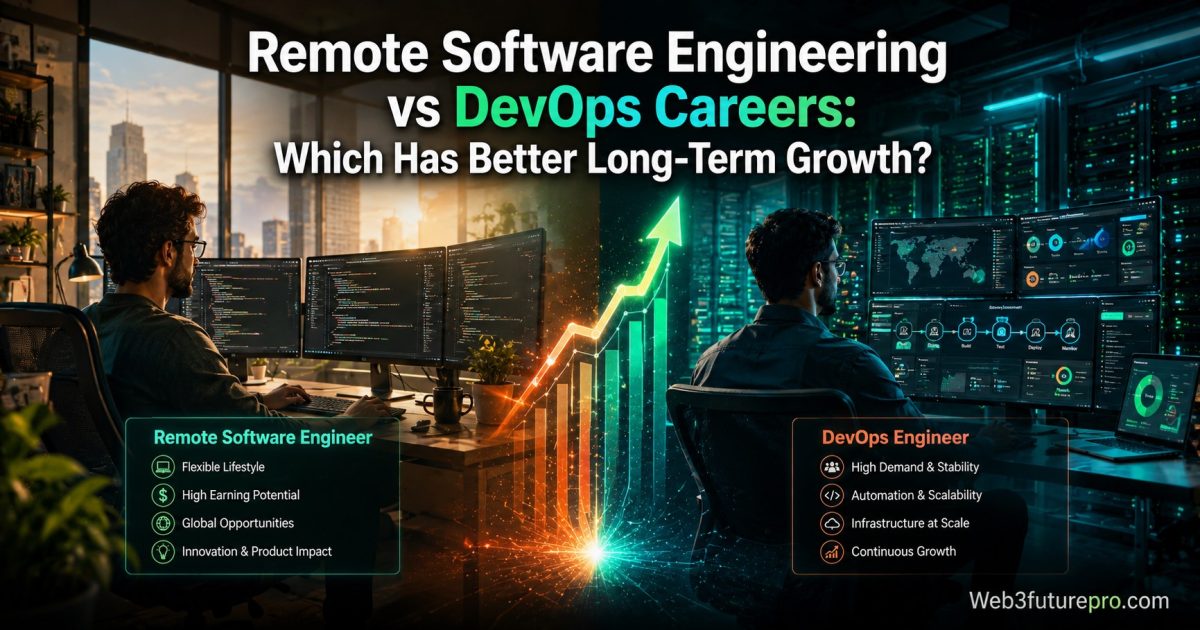
As businesses continue to accelerate digital transformation, the demand for highly skilled technology professionals has never been stronger. Among the most sought-after roles in 2026 are Software Engineers and DevOps Engineers, both of which offer excellent salaries, global remote work opportunities, and long-term career stability. These professions play crucial roles in developing, deploying, and maintaining modern applications, making them indispensable across industries. However, one question continues to interest aspiring tech professionals: Remote Software Engineering vs DevOps Careers: Which Has Better Long-Term Growth?
Software engineers are responsible for designing, developing, testing, and maintaining applications that power websites, mobile apps, enterprise systems, and cloud-based platforms. DevOps engineers, meanwhile, focus on automating software delivery, managing cloud infrastructure, improving deployment pipelines, and ensuring applications run reliably and securely in production environments. While both careers require strong technical expertise and problem-solving skills, they differ in responsibilities, learning paths, certifications, and long-term career progression.
CHECK: Ethical Hacker vs Cloud Engineer: Which Remote Tech Skill Is More Valuable?
In 2026, organizations are increasingly adopting cloud-native technologies, artificial intelligence, containerization, and automation to remain competitive. As a result, both software engineering and DevOps have become essential to modern software development teams. Whether you’re entering the tech industry, transitioning from another IT role, or planning your long-term career, understanding the growth potential of these two professions can help you make a more informed decision.
In this comprehensive comparison, we’ll examine software engineering and DevOps careers based on job demand, salary expectations, required skills, learning curve, remote work opportunities, certifications, career advancement, and future industry trends. By the end of this guide, you’ll have a clear understanding of which career offers stronger long-term growth and aligns best with your professional goals in 2026 and beyond.
Remote Software Engineering vs DevOps careers in 2026
In 2026 the remote technology job market continues to reward two closely related but distinct paths. Software engineers design, build, and maintain the applications and systems that users interact with every day. DevOps engineers focus on the pipelines, infrastructure, automation, and reliability practices that get that software into production safely and keep it running. Both careers support fully remote work. Both offer strong compensation. Yet when the question turns to long-term growth—volume of opportunities, career ceiling, resilience to industry shifts, and progression options—the data reveals meaningful differences.
This comparison examines the 2026 landscape for remote Software Engineering and DevOps careers across the United States, Asia, the Middle East, and South Africa. It covers role definitions, required skills, salary realities, remote patterns, application channels, growth trajectories, and which path currently shows stronger long-term potential for most professionals.
Job Role Overview
A Software Engineer writes, tests, and iterates on application code. Typical work includes implementing features, designing APIs or services, debugging, collaborating with product and design teams, and ensuring code quality through reviews and testing. Specializations range from frontend and backend to full-stack, mobile, embedded, or domain-specific areas such as fintech or healthcare. The focus is primarily on creating functional, maintainable software that solves user or business problems.
A DevOps Engineer (or the closely related Platform Engineer or Site Reliability Engineer) concentrates on the systems that support software delivery and operations. Core activities include building and maintaining CI/CD pipelines, managing infrastructure as code, configuring cloud resources, implementing monitoring and observability, automating deployments, and improving reliability and developer experience. The role bridges development and operations, emphasizing speed, safety, and scalability of the delivery process.
The boundary has blurred over time. Many software engineers now work with containers, pipelines, and cloud services. Many DevOps practitioners write substantial amounts of code for tooling and automation. Still, the primary orientation differs: one builds the product, the other builds and runs the factory that produces and operates the product.
Skills Required
Software Engineering centers on programming languages, data structures, algorithms, system design, testing, and collaboration. Proficiency in at least one major language (Python, JavaScript/TypeScript, Java, Go, etc.), version control, debugging, and the ability to ship working features remain foundational. Increasingly, familiarity with AI-assisted coding tools, cloud basics, and distributed systems appears in job descriptions. Soft skills include clear communication, estimation, and working effectively in cross-functional teams.
DevOps Engineering requires a broader operational toolkit. Essential skills include Linux fundamentals, cloud platforms (AWS, Azure, or GCP), containerization (Docker), orchestration (Kubernetes), infrastructure as code (Terraform or equivalents), CI/CD tools, monitoring and logging stacks, and scripting or programming for automation. Networking, security practices, and reliability concepts (SLOs, incident response) add depth. Soft skills emphasize collaboration with development teams, documentation, and balancing speed with stability.
Both roles reward continuous learning. Software engineers must track language and framework evolution plus AI tooling. DevOps engineers must stay current with cloud services, platform capabilities, and emerging reliability practices. Public portfolios—GitHub repositories with meaningful projects for software engineers, infrastructure-as-code examples and pipeline demonstrations for DevOps—strengthen remote candidacies.
Salary Comparison
Compensation in 2026 is competitive for both, with Software Engineering often showing a modest median premium and far greater volume of openings.
In the United States, median base salaries for Software Engineers frequently sit near $140,000 in large samples, while DevOps Engineer medians appear around $132,500 in comparable data—a gap of roughly $7,500 that specialization can erase. Remote DevOps figures in some reports reach medians near $149,000. Senior and staff levels for both roles commonly exceed $180,000–$250,000+ in total compensation at strong companies, with equity and bonuses playing significant roles.
Outside the United States the absolute numbers are lower but the relative closeness persists. In Asia (particularly India and Singapore), product-company and remote international contracts lift both roles substantially above local services rates. Middle Eastern markets offer competitive packages tied to digital transformation initiatives. South African professionals working remotely for global employers can achieve strong local purchasing power in either field. Remote contracts paid at or near U.S. or European rates remain the most effective way to maximize earnings for talent based in these regions.
Specialization matters more than the base title. AI-related software engineering, distributed systems, or high-scale backend work can command premiums. On the DevOps side, deep Kubernetes expertise, platform engineering, or SRE skills often produce similar or higher outcomes.
Remote Work Opportunities
Both careers support remote work effectively. Software Engineering postings show meaningful remote and hybrid shares. DevOps roles often appear slightly more remote-friendly in some datasets (around 23% fully remote versus 18% for Software Engineer in one large sample), reflecting the infrastructure-centric nature of the work that can be managed asynchronously with strong tooling.
Remote-first companies, SaaS providers, and global product teams hire both profiles without requiring physical presence. Time-zone preferences exist for collaboration-heavy roles, yet fully distributed teams succeed when communication and documentation are strong. Candidates in Asia, the Middle East, and South Africa regularly secure remote international positions in both fields when they demonstrate clear technical results and reliable collaboration.
Best Platforms to Apply
Remote opportunities surface on LinkedIn, We Work Remotely, Remote OK, Wellfound, FlexJobs, and company career pages. Specialized engineering boards and communities add signal. For Software Engineering, GitHub activity and portfolio projects strengthen applications. For DevOps, infrastructure-as-code repositories, pipeline examples, and evidence of production reliability work stand out.
Networking through technical communities, open-source contribution, and targeted outreach remains effective. Many strong remote roles never appear on broad aggregators; direct applications and referrals often yield better results.
Career Growth Potential
Software Engineering offers a deep individual-contributor track (senior, staff, principal) alongside management paths. Specializations in systems, AI, security, or domain expertise create durable leverage. The sheer volume of openings provides more options for lateral moves and geographic or company flexibility.
DevOps growth leads into senior DevOps, Platform Engineer, Site Reliability Engineer, or infrastructure architecture roles. The path into platform engineering—building internal developer platforms—is particularly strong as organizations focus on developer productivity. Some practitioners move into broader engineering leadership or specialized reliability and security tracks. Because experienced DevOps talent remains scarcer relative to demand in many markets, progression can feel faster for those who build depth.
CHECK: Freelancing vs Full-Time Remote Tech Jobs: Which Is Better for Beginners?
Both careers support consulting and independent work at senior levels. Hybrid profiles that combine strong software engineering fundamentals with solid DevOps practices currently enjoy especially broad options.
Pros and Cons
Software Engineering Pros Much higher volume of openings. Slight median salary edge in many datasets. Broad specialization options and deep IC tracks. Clear entry paths for juniors. Strong long-term demand driven by continued software needs across industries. Flexible remote opportunities at every level.
Software Engineering Cons Intense competition at junior and mid levels in popular stacks. AI tooling is changing day-to-day coding work, shifting value toward higher-level design and judgment. Some roles involve significant feature pressure and shifting priorities.
DevOps Pros Slightly higher remote share in some analyses. Strong demand for reliability and platform skills. Clear path into high-leverage platform and SRE roles. Work that directly improves delivery speed and system stability. Good compensation with specialized premiums. Often faster perceived progression due to relative scarcity of experienced practitioners.
DevOps Cons Fewer pure openings compared with Software Engineering (roughly 6.5x fewer in one large 2026 sample). Higher practical barrier for pure beginners. On-call and operational responsibilities in many environments. Rapid evolution of tools and platforms requires continuous upskilling.
Beginner Friendliness
Software Engineering is generally more beginner-friendly. Structured learning paths, bootcamps, university programs, and abundant junior roles exist. Portfolios of personal or open-source projects can demonstrate capability. Entry-level share of postings is higher than for DevOps.
DevOps roles typically expect prior experience with systems, cloud, or development. Pure junior DevOps openings exist but are less common; many practitioners enter via software engineering, system administration, or cloud support roles and transition. Hands-on labs, home infrastructure projects, and certifications help, yet employers often prefer demonstrated production exposure.
A practical route for many is to begin in Software Engineering, gain coding and collaboration experience, then expand into infrastructure, pipelines, and reliability practices.
Industry Demand
Software Engineering maintains substantially higher absolute demand. One 2026 analysis of active postings showed roughly 48,000 Software Engineer openings versus about 7,400 for DevOps Engineer—a 6.5x difference. Projected growth for software developers remains well above average. AI is shifting the nature of the work toward orchestration, systems thinking, and higher-level design rather than eliminating the need for engineers.
DevOps demand is robust and specialized. Organizations continue to invest in faster, more reliable delivery, cloud migration, and platform capabilities. Platform engineering and SRE tracks show particular strength. Remote share is healthy, and the skills remain scarce relative to need in many markets.
Across the United States, Asia, the Middle East, and South Africa, both profiles appear regularly in remote postings. Software Engineering offers broader volume and flexibility. DevOps offers specialized leverage and strong remote suitability.
Final Verdict
In 2026, Software Engineering currently shows stronger long-term growth potential for most people when measured by volume of opportunities, entry accessibility, depth of career tracks, and overall market size. The 6.5x difference in posting volume, combined with solid projected growth and evolving but durable demand, creates more options and resilience across economic cycles and technology shifts.
DevOps remains an excellent career with competitive compensation, strong remote characteristics, and high-leverage specialized paths—particularly into platform engineering and reliability. For those drawn to infrastructure, automation, and the systems that enable software delivery, it offers satisfying work and good progression.
The highest long-term value often belongs to engineers who develop strength in both. Software engineers who understand pipelines, infrastructure, and reliability become more effective and more marketable. DevOps practitioners with solid software engineering fundamentals write better tooling and collaborate more effectively. In a market shaped by cloud, AI, and continuous delivery, that combined capability is especially well positioned.
Choose the path whose day-to-day problems you find more engaging. Execute deliberately on skills, projects, and communication. Both careers support strong remote futures; Software Engineering currently provides the wider runway for the majority of practitioners.
When comparing Remote Software Engineering vs DevOps Careers, both paths offer exceptional long-term opportunities, competitive salaries, and strong demand in the global technology market. Software engineering provides a broad and versatile career with opportunities to specialize in frontend, backend, mobile, full-stack, AI, blockchain, game development, or embedded systems. This flexibility makes it an excellent choice for professionals seeking diverse career options and continuous growth.
DevOps engineering, however, has experienced remarkable growth as organizations embrace cloud computing, continuous integration and deployment (CI/CD), infrastructure as code, Kubernetes, and automation. Businesses increasingly rely on DevOps professionals to streamline software delivery, improve system reliability, and optimize cloud infrastructure, making the role one of the most valuable in today’s remote workforce.
In 2026, generally offers a larger number of remote job openings due to its broad applicability across industries. DevOps engineering, on the other hand, often commands higher average salaries and faster advancement into senior infrastructure, cloud architecture, and site reliability engineering (SRE) roles, thanks to the specialized expertise it requires. Professionals who combine software development skills with DevOps knowledge are especially attractive to employers, as they can contribute across the entire software development lifecycle.
Ultimately, the best career depends on your interests and long-term ambitions. If you enjoy building applications and writing code, software engineering offers endless opportunities to innovate and specialize. If you’re passionate about cloud technologies, automation, scalability, and operational excellence, DevOps provides a highly rewarding and future-proof career path. Whichever direction you choose, continuously learning new technologies, earning relevant certifications, building hands-on projects, and gaining practical experience will position you for lasting success in the evolving remote tech industry.