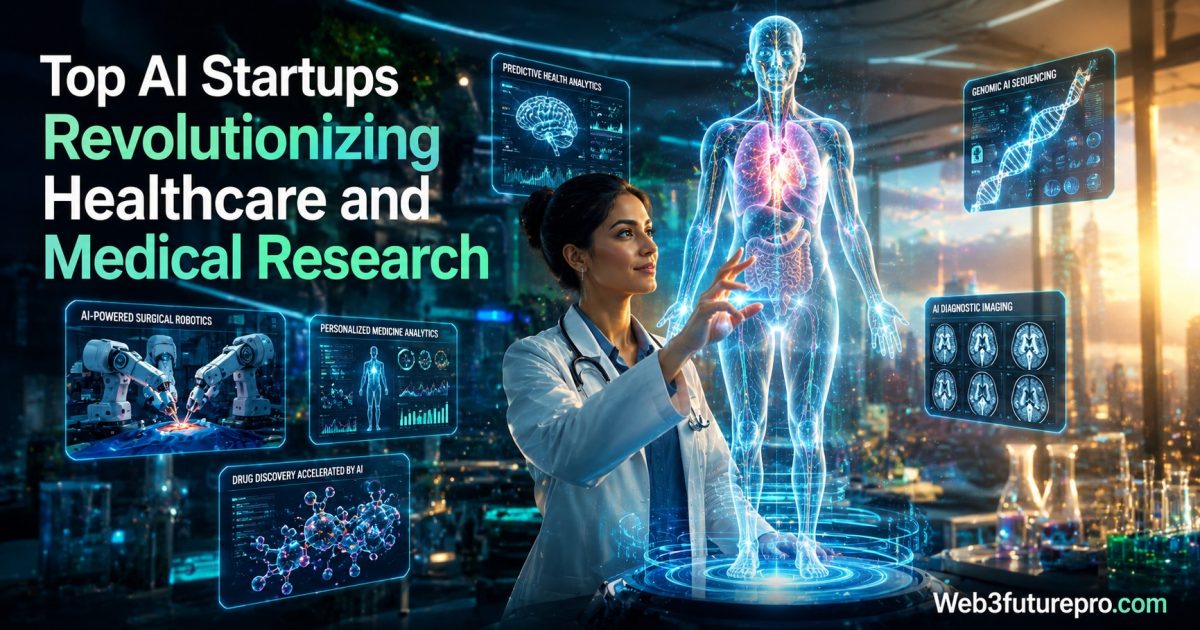
Top AI Startups: Artificial Intelligence is rapidly transforming the healthcare industry, creating smarter systems capable of improving diagnosis accuracy, accelerating drug discovery, and enhancing patient care like never before. From AI-powered medical imaging to predictive analytics and precision medicine, innovative startups are leading a new era of healthcare technology that is reshaping hospitals, laboratories, and research institutions worldwide.
In recent years, AI healthcare startups have attracted billions in investments as demand grows for faster medical research, automated clinical workflows, and personalized treatment solutions. Companies such as Isomorphic Labs, Tempus, and Aidoc are pushing the boundaries of what artificial intelligence can achieve in medicine. Their technologies are helping doctors detect diseases earlier, streamline diagnostics, and reduce the time required to develop life-saving treatments.
CHECK: AI in Healthcare: Breakthrough Innovations and Case Studies in 2026
As the global healthcare sector continues embracing digital transformation, AI startups are becoming critical drivers of innovation. These companies are not only improving operational efficiency in healthcare systems but are also revolutionizing medical research by using machine learning, generative AI, and deep learning models to analyze massive amounts of clinical and genomic data. The result is a future where healthcare becomes more accurate, accessible, personalized, and efficient for millions of patients worldwide.
Imagine a world where a cancer diagnosis that once took weeks is delivered in hours with higher accuracy, where new drugs are discovered in months instead of decades, and where personalized treatment plans are designed by AI models trained on millions of patient outcomes. This is not a distant future — it is happening right now in 2026.
Artificial intelligence is no longer experimental in healthcare. It has become a core force accelerating diagnostics, drug discovery, clinical workflows, and medical research at an unprecedented pace. The global AI healthcare market is experiencing explosive growth, with investments pouring into startups that are delivering measurable improvements in patient outcomes, cost reduction, and scientific breakthroughs.

From oncology and radiology to rare disease research and administrative efficiency, a new generation of AI startups is fundamentally reshaping one of the world’s most critical industries. This comprehensive guide explores the leading AI startups driving this transformation in 2026, their groundbreaking innovations, real-world impact, the major trends shaping the sector, key challenges, and what the future holds for patients, doctors, researchers, and investors.
Why AI Is the Biggest Disruptor in Healthcare History

Healthcare has always been constrained by three major bottlenecks: data complexity, human cognitive limits, and time. AI directly attacks all three:
- It can analyze millions of medical images, genetic sequences, and patient records in seconds.
- It discovers patterns humans miss and predicts outcomes with remarkable accuracy.
- It automates repetitive tasks, freeing clinicians to focus on complex care and human connection.
In 2026, AI systems are not just assisting — they are co-piloting many aspects of medicine. Regulatory bodies have approved hundreds of AI-powered medical devices, and hospitals worldwide are integrating these tools into daily operations. The result is faster diagnoses, more effective treatments, reduced medical errors, and accelerated scientific progress.
Top AI Startups Revolutionizing Healthcare and Medical Research

Here are the standout companies leading the charge across key categories:
1. Tempus – Precision Oncology Pioneer
Tempus has built one of the world’s largest clinical and molecular data libraries. Using AI, the company analyzes genetic, clinical, and imaging data to deliver personalized cancer treatment recommendations.
Key Achievements in 2026:
- Partnerships with major cancer centers and pharmaceutical companies.
- AI models that improve survival prediction accuracy.
- Expansion beyond oncology into cardiology and neurology.
Tempus represents the gold standard for data-driven precision medicine.
2. Insilico Medicine – AI Drug Discovery Leader
Insilico uses generative AI and deep learning to discover novel drugs at unprecedented speed. Their platform has successfully moved multiple candidates into clinical trials, dramatically shortening the traditional 10–15 year drug development timeline.
Notable Strength: End-to-end AI pipeline from target identification to clinical candidate selection, with a focus on age-related diseases and oncology.
3. PathAI – Transforming Pathology
PathAI applies deep learning to pathology slides, helping pathologists diagnose diseases like cancer with greater accuracy and consistency. Their tools reduce diagnostic variability and enable faster turnaround times.
Impact: Significantly improved cancer detection rates and better treatment planning through more precise tumor characterization.
4. Viz.ai – Intelligent Care Coordination
Viz.ai specializes in AI-powered stroke detection and care coordination. Their platform analyzes CT scans in real time and alerts specialists instantly, shaving critical minutes off treatment times.
Expansion: Now covers multiple neurological and cardiovascular emergencies, saving lives through faster intervention.
5. Recursion Pharmaceuticals – AI-Powered Drug Discovery at Scale
Recursion combines massive biological datasets with machine learning to map relationships between genes, diseases, and drugs. Their approach has generated a rich pipeline of new therapeutic candidates.
Advantage: Ability to run thousands of experiments in parallel using AI guidance.
6. Owkin – Federated Learning for Medicine
Owkin uses federated learning — training AI models across hospitals without sharing raw patient data — to protect privacy while building powerful predictive tools.
Focus Areas: Cancer research, rare diseases, and treatment response prediction.
7. Paige.AI – Digital Pathology Transformation
Paige.AI develops clinical-grade AI for prostate, breast, and other cancer diagnostics. Their systems assist pathologists by highlighting suspicious areas and providing confidence scores.
8. Atomwise – AI for Molecular Discovery
Atomwise uses convolutional neural networks to predict how drugs will interact with targets, dramatically accelerating early-stage discovery.
Other notable players include Butterfly Network (AI ultrasound), Caption Health (acquired, AI-guided imaging), and various startups focused on mental health, radiology, and administrative automation.
Major AI Applications Transforming Healthcare
Medical Imaging and Diagnostics AI now matches or exceeds radiologist performance in detecting cancers, fractures, and neurological conditions on X-rays, CTs, MRIs, and ultrasounds.
Drug Discovery and Development AI reduces the cost and time of bringing new drugs to market by identifying promising compounds, optimizing molecular structures, and predicting clinical trial outcomes.
Personalized Medicine Models analyze a patient’s genetics, lifestyle, and medical history to recommend tailored treatments with higher success rates.
Clinical Workflow Optimization Ambient clinical documentation, AI scribes, predictive staffing, and intelligent scheduling are reducing administrative burden on healthcare workers.
Research Acceleration AI analyzes scientific literature at scale, identifies research gaps, and suggests new hypotheses for rare diseases and complex conditions.
Measurable Impact and ROI in 2026
Hospitals and health systems using advanced AI report:
- 20–40% reduction in diagnostic errors in key areas.
- 15–30% faster treatment initiation for time-sensitive conditions.
- Significant cost savings through operational efficiency.
- Improved patient satisfaction and outcomes.
Pharmaceutical companies leveraging AI in R&D are seeing higher success rates in clinical trials and faster pipeline progression.
Challenges and Ethical Considerations
Despite impressive progress, important hurdles remain:
- Data Bias and Fairness — Models trained on limited datasets can perform poorly on underrepresented populations.
- Regulatory and Validation — Ensuring AI tools are safe and effective requires rigorous oversight.
- Integration Complexity — Legacy hospital systems make deployment challenging.
- Clinician Trust and Adoption — Many doctors remain cautious about relying on AI recommendations.
- Privacy and Security — Protecting sensitive health data is paramount.
- Job Transformation — AI will change roles rather than eliminate them, requiring significant reskilling.
Leading startups address these through transparent validation studies, diverse training data, and strong focus on human-AI collaboration.
The Road Ahead: AI as a Core Pillar of Healthcare
By 2030, AI is expected to be embedded in nearly every aspect of healthcare delivery and research. The most successful companies will combine powerful technology with deep clinical expertise, ethical frameworks, and seamless integration into existing workflows.
For patients, this means earlier detection, more effective treatments, and more personalized care. For doctors, it means less administrative burden and more time for complex decision-making. For researchers, it means accelerated discovery and the ability to tackle previously intractable problems. For society, it offers hope for more equitable, efficient, and affordable healthcare.
How Different Stakeholders Can Engage
For Investors: Focus on companies with strong clinical validation, regulatory progress, and clear paths to revenue. Precision medicine, diagnostics, and operational AI currently show strong momentum.
For Healthcare Professionals: Actively participate in pilot programs, provide feedback to developers, and invest time in learning AI tools relevant to your specialty.
For Patients: Ask providers about AI-assisted tools, seek second opinions when appropriate, and stay informed about new diagnostic and treatment options.
For Entrepreneurs: Identify specific pain points in workflows, partner with clinicians early, and prioritize regulatory strategy alongside technology development.
A Historic Transformation Is Underway
In 2026, AI is not just improving healthcare — it is redefining what is possible. The startups highlighted here, and many others, are writing a new chapter in medical history where technology amplifies human capability rather than replacing it.
The convergence of vast medical datasets, powerful algorithms, and clinical expertise is creating a brighter future for patients worldwide. While challenges remain, the trajectory is clear: AI will continue to make healthcare faster, smarter, more precise, and ultimately more human.
The revolution in healthcare is no longer coming. It is here — powered by artificial intelligence and driven by visionary startups determined to solve medicine’s greatest challenges.
For anyone touched by healthcare — as a patient, provider, researcher, or investor — understanding these developments is essential. The future of medicine is being built today, and it looks remarkably promising.
The healthcare industry is entering a transformative age where artificial intelligence is no longer a futuristic concept but a powerful reality driving medical breakthroughs worldwide. AI startups are redefining how diseases are diagnosed, treatments are developed, and patient care is delivered through advanced technologies capable of processing complex medical data with incredible speed and precision.
From AI-assisted radiology platforms to next-generation drug discovery systems, startups like PathAI, Recursion Pharmaceuticals, and Insilico Medicine continue to demonstrate the enormous potential of artificial intelligence in solving some of healthcare’s biggest challenges. Their innovations are helping healthcare providers improve efficiency, reduce costs, and deliver more personalized treatments to patients globally.
As investments in AI healthcare technology continue to grow, the coming years are expected to bring even more groundbreaking discoveries and smarter healthcare systems. The startups leading this revolution are not only shaping the future of medicine but are also creating a world where healthcare becomes more proactive, predictive, and patient-centered. For medical professionals, researchers, investors, and technology enthusiasts alike, keeping an eye on these AI-driven healthcare innovators will be essential in understanding the future of global healthcare.