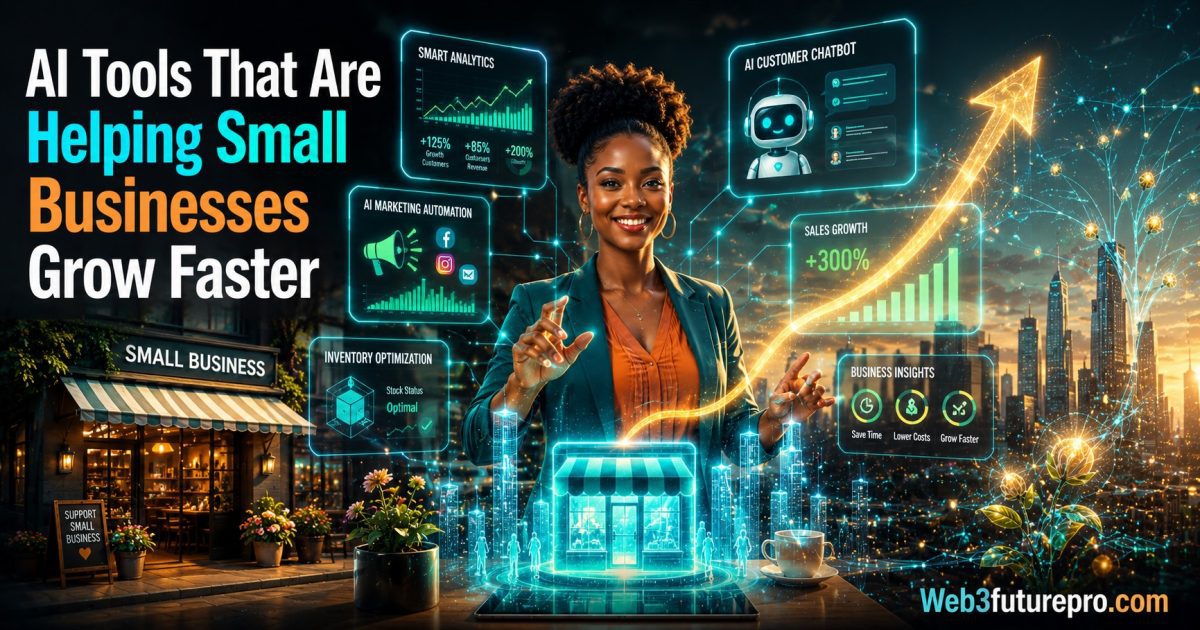
Artificial Intelligence is rapidly changing the way small businesses operate, compete, and grow in today’s digital economy. What was once considered advanced technology reserved for large corporations is now becoming an affordable and powerful solution for startups, entrepreneurs, and small business owners worldwide. From automating customer support and creating marketing content to managing finances and streamlining operations, AI tools are helping small businesses save time, reduce costs, and scale faster than ever before.
Modern AI platforms such as OpenAI’s ChatGPT, Canva AI, and HubSpot are transforming how entrepreneurs handle daily business tasks. These intelligent tools allow small teams to perform work that previously required entire departments, giving businesses the ability to improve productivity, enhance customer experiences, and compete with larger companies on a smaller budget. According to recent industry reports, small businesses using AI-powered tools are experiencing faster growth, improved efficiency, and increased revenue opportunities.
CHECK: Top AI Startups Revolutionizing Healthcare and Medical Research
As AI technology continues advancing in 2026, small businesses are increasingly adopting automation, AI-driven marketing, workflow optimization, and intelligent analytics to stay competitive in crowded markets. Business owners are no longer using AI only for experimentation — they are integrating it into core operations to simplify complex tasks, boost creativity, and make smarter decisions in real time. This growing adoption of artificial intelligence is reshaping the future of entrepreneurship and creating new opportunities for businesses to grow faster with fewer limitations.
Running a small business has always been hard. You wear multiple hats, work with limited budgets, and compete against much larger companies with bigger teams and deeper pockets. But in 2026, something has fundamentally changed: artificial intelligence has become the great equalizer.
Smart, affordable AI tools are now enabling small business owners to compete at a level that was unimaginable just a few years ago. From creating professional marketing campaigns in minutes to automating customer support, predicting cash flow, and personalizing offers at scale — AI is dramatically accelerating growth for businesses of all sizes.
Whether you run an e-commerce store, a local service business, a consulting firm, or a SaaS startup, the right AI tools can help you save dozens of hours per week, reduce costs, improve customer experience, and scale faster than ever before.
This ultimate guide reveals the best AI tools actually helping small businesses grow in 2026. I’ve organized them by business function, with practical recommendations, real-world impact examples, pricing insights, and implementation tips so you can start seeing results quickly.
The Best AI Tools Helping Entrepreneurs Scale Faster
1. Marketing & Content Creation: From Zero to Professional in Minutes
Small businesses often struggle most with consistent, high-quality marketing. AI has changed this completely.
Top Tools:
- Claude (Anthropic) and Grok Best for long-form content, strategy, and creative brainstorming. Claude excels at nuanced brand voice, while Grok is strong for bold, engaging copy.
- Jasper.ai and Anyword Still dominant for marketing copy, ad variations, email sequences, and social media content. They now include strong SEO optimization and performance prediction features.
- Midjourney, Leonardo.ai, and Flux Generate stunning product photos, social visuals, ad creatives, and even video clips. Small brands are creating entire visual identities without hiring photographers or designers.
- Descript and Runway ML Edit podcasts and videos using text. Create short promotional videos from scripts in minutes.
Real Impact: Many small e-commerce brands report 3–5x more content output with half the effort, leading to higher engagement and sales.
2. Sales & Lead Generation: Smarter, Not Harder
Top Tools:
- Apollo.io and Clay.com AI-powered sales intelligence platforms that find leads, enrich data, and personalize outreach at scale.
- HubSpot AI (Free CRM + AI features) Excellent for small businesses. AI scores leads, writes emails, suggests next best actions, and automates follow-ups.
- Instantly.ai and Smartlead Cold email automation with AI that writes, tests, and optimizes sequences while staying compliant.
- ElevenLabs and HeyGen Create personalized video messages and voiceovers for sales outreach that feel human and convert better.
Impact: Small sales teams are closing deals faster and at higher rates by combining human relationship skills with AI efficiency.
3. Customer Service & Support: 24/7 Without the Overhead
Top Tools:
- Intercom Fin and Zendesk AI Advanced AI agents that handle most routine inquiries, escalate complex issues, and learn from your knowledge base.
- Gorgias (for e-commerce) Excellent AI that integrates with Shopify and provides contextual answers based on order history.
- Tidio and Tars Affordable chatbots with strong AI capabilities perfect for small websites.
Impact: Many small businesses have reduced support ticket volume by 60–80% while maintaining or improving customer satisfaction scores.
4. Operations & Productivity: Running Leaner and Smarter
Top Tools:
- Notion AI and Coda AI Turn messy notes and processes into structured workflows, meeting summaries, project plans, and databases.
- Zapier Central and Make.com (with AI agents) No-code automation on steroids. Connect apps and create intelligent workflows that adapt and make decisions.
- ClickUp AI and Monday.com AI Project management with built-in AI for task generation, risk prediction, and resource allocation.
Impact: Small teams operate with the efficiency of much larger organizations.
5. Finance, Accounting & Cash Flow Management
Top Tools:
- QuickBooks AI and Xero AI Automated bookkeeping, invoice chasing, expense categorization, and cash flow forecasting.
- Pencil and Runway (financial modeling) AI-powered financial forecasting and scenario planning.
- DocuClipper and Nanets Intelligent receipt and document processing.
Impact: Small business owners spend far less time on admin and gain much better visibility into their financial health.
6. Analytics, Insights & Decision Making
Top Tools:
- Google Analytics 4 + Gemini Much smarter insights and recommendations than previous versions.
- Mixpanel and Amplitude with AI layers Behavioral analytics that surface actionable insights automatically.
- Glean and Elicit AI research tools that help small businesses stay on top of industry trends and competitor moves.
Case Pattern 1: E-commerce Store A fashion brand uses Midjourney for product imagery, Jasper + Claude for descriptions, Klaviyo AI for email flows, and Gorgias for support — achieving professional results with a team of 3–4 people.
Case Pattern 2: Local Service Business A plumbing company uses AI chatbots for booking, automated follow-up sequences, and predictive maintenance scheduling — increasing revenue while reducing owner workload.
Case Pattern 3: B2B Service Provider A marketing consultant uses Notion AI + Claude for proposals, Instantly.ai for outreach, and HubSpot AI for CRM management — scaling from solo to multiple clients efficiently.
Implementation Framework for Small Businesses
- Start Small — Pick one painful area (content, support, or sales) and implement one tool first.
- Focus on ROI — Choose tools with clear time or money savings.
- Maintain Human Oversight — AI is powerful but not perfect — always review important outputs.
- Train Your Team — Invest time in learning prompt engineering and tool capabilities.
- Integrate Gradually — Connect tools using Zapier or native integrations.
- Measure Results — Track metrics before and after implementation.
Challenges Small Businesses Still Face
- Tool overload and integration complexity.
- Cost management (many tools have usage-based pricing).
- Data privacy and security concerns.
- Over-reliance on AI leading to generic outputs.
- Learning curve for non-technical founders.
The Future Outlook for AI in Small Business
By 2028–2030, we will likely see:
- AI agents that can run significant portions of a small business autonomously.
- Deeper integration between tools (one AI “brain” managing multiple functions).
- More affordable, industry-specific AI solutions.
- Greater emphasis on ethical and transparent AI use.
Small businesses that embrace AI thoughtfully today will have an enormous competitive advantage in the coming years.
Your Competitive Edge
The biggest difference between small businesses that thrive and those that struggle in 2026 isn’t luck, location, or even capital — it’s how intelligently they use AI.
You don’t need to be a tech expert. You just need to start experimenting with the right tools, stay consistent, and always keep the human element (your unique brand voice, values, and customer relationships) at the center.
AI won’t replace small business owners — but small business owners who use AI effectively will replace those who don’t.
The tools are more powerful and accessible than ever. The only question left is: Which one will you implement first this week?
Start small. Think big. Grow faster.
AI tools are no longer optional for small businesses looking to compete in today’s fast-moving digital landscape. They have become essential growth engines that help entrepreneurs automate repetitive tasks, improve customer engagement, strengthen marketing strategies, and increase overall productivity without requiring massive budgets or large teams.
From AI writing assistants and design platforms to automation software and intelligent CRM systems, small businesses now have access to powerful technologies that simplify operations and accelerate growth. Tools like ChatGPT, Canva AI, Zapier, and HubSpot AI are helping business owners create content faster, manage workflows more efficiently, and deliver better customer experiences at scale.
As artificial intelligence continues evolving, the businesses that successfully embrace AI-driven innovation will likely gain a significant competitive advantage in the years ahead. The future of small business growth will depend heavily on smart automation, data-driven decision-making, and efficient digital strategies powered by AI. For entrepreneurs willing to adapt and integrate these technologies into their operations, AI presents an unprecedented opportunity to grow faster, work smarter, and build more sustainable businesses in the modern economy.