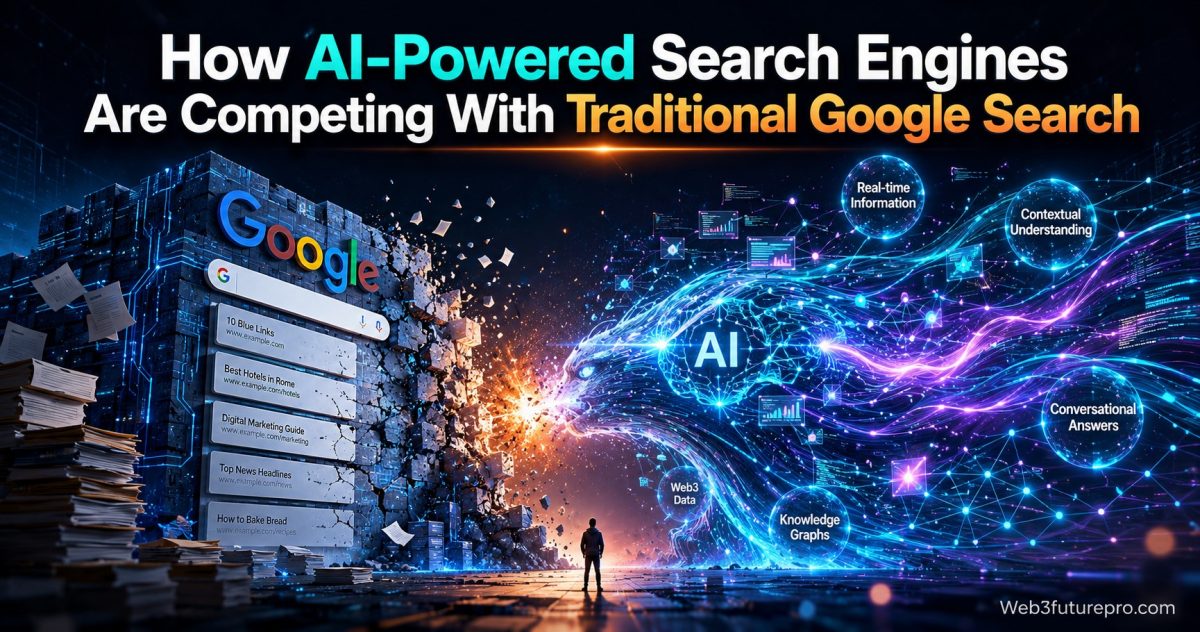
For more than two decades, Google has dominated the search engine industry, becoming the primary gateway to information for billions of users worldwide. However, the rise of artificial intelligence is reshaping the search landscape and creating a new generation of AI-powered search engines that promise faster, more conversational, and highly personalized ways to discover information online. As users increasingly seek direct answers rather than lists of links, AI-driven search platforms are emerging as serious competitors to traditional search models.
Modern AI search engines leverage large language models, natural language processing, and machine learning to understand user intent more effectively than conventional keyword-based systems. Instead of simply displaying relevant web pages, these platforms can summarize information, answer complex questions, compare products, generate insights, and even assist with research tasks in real time. Companies such as OpenAI, Perplexity AI, and Microsoft are leading the development of AI-enhanced search experiences that challenge the traditional way people interact with online information.
CHECK: Google, Microsoft, and Meta Tech Scholarships: Full Breakdown
As competition intensifies, the search industry is entering a transformative phase where artificial intelligence is becoming the central driver of innovation. While Google continues to integrate advanced AI features into its ecosystem, emerging AI-first search platforms are attracting users with conversational interfaces, source-backed answers, and improved research capabilities. This shift raises important questions about the future of online search, digital advertising, content discovery, and how information will be accessed in the years ahead.
For decades, Google Search was the undisputed king of the internet — the default starting point for almost every question. In 2026, that monopoly is under serious pressure. A new generation of AI-powered search engines is challenging Google not by copying its model, but by fundamentally reinventing how people find, understand, and act on information.
These AI search tools don’t just return lists of blue links. They understand questions in natural language, synthesize information from multiple sources, provide reasoned answers, and often complete tasks on behalf of the user. The shift is dramatic: users are increasingly starting their searches in tools like Perplexity, ChatGPT Search, Grok, Gemini, and Claude instead of typing directly into Google.
This comprehensive guide explores how AI-powered search engines are competing with traditional Google Search in 2026 — their strengths, weaknesses, market impact, technological differences, user behavior changes, effects on publishers and advertisers, and what the future of search might look like.
For the first time in more than two decades, Google is not the obvious answer to the question: “Where do I go to find something online?” That sentence would have been laughable in 2020. It would have been dismissed as wishful thinking by Google’s rivals as recently as 2022. But in 2026, it is a statement that the world’s most valuable advertising company is spending billions of dollars to make untrue — and not entirely succeeding.
The search engine, one of the most lucrative and entrenched technology products in human history, is undergoing its most significant structural disruption since Google itself dethroned Yahoo and AltaVista at the turn of the millennium. The instrument of this disruption is artificial intelligence — specifically, large language models capable of synthesizing information, reasoning across sources, and delivering direct, conversational answers instead of a ranked list of blue links.
The stakes could not be higher. Google’s search advertising business generates more than $175 billion in annual revenue. The companies competing with it — some well-funded startups, some established tech giants — are not chasing a small niche. They are aiming at the financial heart of the most profitable business model the internet has ever produced.
This is the story of how AI-powered search engines are challenging Google, what they are doing differently, where they are falling short, and what the outcome of this battle means for users, advertisers, publishers, and the open web.
The Anatomy of the Disruption: Why Now?
The Blue Link Problem
To understand why AI search is gaining traction, it helps to understand the specific frustrations with traditional search that have been building for years — frustrations that Google’s own dominance made it slow to address.
Traditional keyword-based search operates on a deceptively simple model: a user types a query, an algorithm scores billions of indexed web pages against that query, and a ranked list of links is returned. The user then clicks through to individual pages, reads them, navigates back, tries another link, and repeats.
This model was revolutionary in 1998. In 2026, it has accumulated significant friction. Modern search results pages are cluttered with paid advertisements that occupy the top of the page before any organic results appear. The organic results themselves are increasingly dominated by content that has been engineered to rank well — optimized for algorithmic signals rather than genuine informational value.
The original web of authentic human knowledge that PageRank was designed to surface has been partially buried under layers of SEO-optimized content farms, aggregator sites, and low-value listicles.
Users have noticed. Research tracking user satisfaction with search results has shown declining trust in search result quality over the past several years, with younger users in particular expressing frustration with the gap between what they ask and what they get.
The specific pain point that AI search is targeting is what researchers call “multi-step informational queries” — questions that require synthesizing information from multiple sources, understanding context and intent, and delivering a coherent, actionable answer. “What is the capital of France” is not a multi-step informational query. ”
What are the main differences between a Roth IRA and a traditional IRA, and which makes more sense for someone in their thirties earning $90,000 a year in the United States?” absolutely is.
For this second category of query — which represents a growing share of what people actually want from search — a ranked list of links is a genuinely inferior answer to a well-synthesized direct response.
The Rise of Conversational and Generative Search
The core difference is simple but revolutionary. Traditional Google Search is built on information retrieval — it finds and ranks existing web pages. AI-powered search is built on information synthesis — it reads, understands, reasons about, and generates coherent answers.
This shift has created two distinct experiences:
- Google-style search: “Here are the top 10 pages that might have what you’re looking for.”
- AI-powered search: “Here is a clear, reasoned answer to your question, with sources.”
In 2026, many users prefer the second approach for complex, research-oriented, or time-sensitive queries.
Major AI Search Players Competing with Google

1. Perplexity AI
Perplexity has become the poster child for AI search. It combines real-time web access with strong reasoning models to deliver cited, conversational answers.
Among the new generation of AI search products, Perplexity AI has attracted the most attention and the most user growth. Its model is conceptually simple: instead of returning links, it returns answers — synthesized from web sources in real time, with citations attached so users can verify the provenance of the information.
The user experience is meaningfully different from traditional search. A query on Perplexity feels more like consulting a well-read research assistant than querying a database. The system reads across multiple sources, reconciles conflicting information, and presents a coherent synthesis with the sources displayed alongside the answer. Follow-up questions are handled conversationally, with the system maintaining context across a session.
Perplexity has grown aggressively, reporting hundreds of millions of queries per month and attracting investment from prominent venture capital firms and technology investors who see it as a structural challenger to the search advertising model. Its monetization strategy — a subscription tier for advanced features alongside advertising — is a deliberate departure from Google’s pure advertising model, positioning it as a product that serves users rather than advertisers.
The criticism of Perplexity, and of AI search products generally, is that the synthesis quality is uneven. For well-documented topics with clear factual answers, the system performs impressively. For emerging topics, contested questions, or subjects that require genuine subject matter expertise to evaluate correctly, the confidence of the output can outrun its accuracy — presenting synthesized misinformation with the same authoritative tone as synthesized fact.
Strengths:
- Excellent source transparency and citations.
- Strong research and academic-style queries.
- Fast iteration and product development.
2026 Status: Significant user growth, especially among researchers, students, and professionals who value accuracy and speed.
2. ChatGPT Search (OpenAI)
OpenAI integrated deep search capabilities into ChatGPT, creating a powerful hybrid of conversational AI and real-time web access.
Advantages:
- Seamless memory across conversations.
- Strong reasoning and multi-step problem solving.
- Integration with other OpenAI tools and ecosystem.
3. Grok (xAI)
Grok emphasizes real-time knowledge, less censorship, and a more personality-driven interaction style while maintaining strong search capabilities.
4. Google Gemini & AI Overviews

Google has responded aggressively with AI Overviews (formerly SGE) and the Gemini model. While still primarily a traditional search engine, Google now provides AI-generated summaries at the top of many results.
Google’s Position: Still dominates overall market share, but user satisfaction for complex queries is increasingly challenged by pure AI search tools.
Microsoft Bing and Copilot Search
Microsoft’s integration of AI into its Bing search product — powered by its deep partnership with OpenAI — represents the most significant institutional challenge to Google’s search dominance. Microsoft had the resources, the distribution infrastructure, and the strategic motivation to move aggressively, and it did.
The results have been mixed but meaningful. Microsoft has gained search market share for the first time in years, primarily in markets where its AI-integrated Bing experience is most differentiated from traditional Google search. Copilot Search — the more deeply AI-integrated product that Microsoft has been evolving through 2025 and 2026 — represents a genuine rethinking of the search interface, blending conversational AI with web retrieval in a way that is more seamlessly integrated than Google’s initial AI Overview product.
Microsoft’s advantage is integration. For users who live inside the Microsoft ecosystem — Windows, Office 365, Teams, Edge — the AI search experience is embedded in tools they already use, reducing the switching friction that Google’s ubiquity otherwise creates.
You.com and the Personalization Thesis
You.com has pursued a differentiated strategy based on personalization and user control. Its model allows users to configure their search experience — choosing which sources to prioritize, which to exclude, and how much AI synthesis to blend with direct web results. This approach is designed to address one of the core criticisms of AI search: that it collapses the diversity of the web into a single synthesized perspective, removing the user’s ability to evaluate multiple sources and form their own judgment.
The personalization thesis resonates with a specific segment of sophisticated users who are uncomfortable with the opacity of fully automated synthesis but want more than a traditional link list. Whether it can scale to a mass market audience remains an open question.
Meta AI and the Social Search Pivot
Meta’s integration of AI search functionality into Instagram, Facebook, and WhatsApp represents a different vector of competition — not a standalone search engine, but AI-powered information retrieval embedded in platforms where hundreds of millions of people already spend significant time.
The strategic logic is compelling: a large proportion of the queries people would historically have taken to Google are now being handled inside social platforms. “Where should I eat in this neighborhood?” “What is this product I saw in a video?” “How do I fix this problem I’m having?” These are search behaviors, even if they don’t happen in a search box. Meta‘s AI integration is designed to capture this demand within its ecosystem rather than route it to Google.
In markets like India, Southeast Asia, and sub-Saharan Africa — where WhatsApp is the primary digital communication platform for hundreds of millions of people — this embedded AI search capability represents a genuinely significant alternative to traditional search engine behavior.
Key Advantages of AI-Powered Search Engines
1. Better Understanding of Intent AI models grasp nuance, context, and follow-up questions far better than traditional keyword-based search.
2. Synthesis Over Discovery Instead of forcing users to click through multiple links, AI search delivers synthesized, coherent answers.
3. Multi-Step Reasoning Complex queries (e.g., “Compare the best electric cars for city driving under $40k in 2026 considering range, charging speed, and total cost of ownership”) are handled elegantly.
4. Personalization With user permission and memory features, answers become increasingly tailored to individual preferences and history.
5. Speed and Convenience Users get direct answers instead of link lists, saving significant time.
Limitations and Challenges of AI Search
Despite the hype, AI search engines still face serious hurdles:
- Hallucinations and Accuracy Issues: Even top models occasionally invent facts or misinterpret sources.
- Monetization Difficulty: Providing free, high-quality answers at scale is expensive. Many are still figuring out sustainable business models.
- Source Attribution: Publishers worry about traffic loss as users get answers without visiting original sites.
- Freshness: Some tools lag on breaking news compared to Google’s real-time indexing.
- Bias and Transparency: Users want to know how answers are generated and what data influences them.
How Google Is Fighting Back

Google has not been passive. Its AI Overviews feature now appears on a large percentage of searches, blending traditional results with AI-generated summaries. The company is also heavily integrating Gemini across its products and investing billions in infrastructure to maintain its lead in speed and coverage.
Google’s advantage remains its unmatched index, brand trust, and advertising ecosystem. However, many users now use Google for simple navigational searches and AI tools for research and complex questions — a phenomenon known as “search fragmentation.”
Impact on Publishers, SEO, and the Web Economy
The rise of AI search is disrupting the traditional web economy:
- Traffic Shift: Many sites report declining referral traffic from search as users get answers directly from AI summaries.
- SEO Evolution: Traditional keyword optimization is losing importance. Success now depends on being cited as a high-quality source by AI models (often called “AEO” or Answer Engine Optimization).
- New Opportunities: Publishers that produce original, high-value research and data are sometimes rewarded with prominent citations.
This shift is forcing media companies to rethink distribution, monetization, and content strategy.
User Behavior Changes in 2026
Studies and usage data show:
- Simple factual or navigational queries still go to Google.
- Research, comparison, planning, and multi-step questions increasingly start in AI search tools.
- Many users maintain multiple search habits — using different tools for different needs.
- Trust in AI answers is growing but remains conditional on proper sourcing.
Future Outlook: 2026–2030
Several scenarios are possible:
Hybrid Future (Most Likely): Google maintains dominance for general search while specialized AI search tools carve out strong niches for research, shopping, and complex reasoning.
AI-First Future: Conversational AI search becomes the primary interface, with traditional link-based results becoming secondary.
Fragmented Future: Users regularly switch between multiple AI tools and Google depending on the query type.
Most experts expect a hybrid, multi-tool world for the next several years, with gradual consolidation as the best AI search experiences improve.
Practical Advice for Users, Businesses, and Creators
For Everyday Users:
- Use AI search for research and planning.
- Cross-check important facts with multiple sources.
- Experiment with different tools to find your preferred workflow.
For Businesses and Marketers:
- Optimize for both traditional SEO and AI citation.
- Create original, authoritative content that AI models are likely to reference.
- Build direct relationships with customers instead of relying solely on search traffic.
For Content Creators:
- Focus on depth, originality, and unique perspectives.
- Use AI tools to increase productivity while maintaining your authentic voice.
- Explore new formats that work well with AI-powered discovery.
The Search Revolution Is Here
AI-powered search engines are not merely competing with Google — they are redefining what search means in the first place. By moving from link lists to intelligent answers, they are making information more accessible, actionable, and personalized than ever before.
While Google remains enormously powerful and continues to innovate, the emergence of strong AI alternatives has created healthy competition that benefits users. The future of search will likely be plural — a mix of traditional and conversational tools working alongside each other.
For users, this means better, faster answers. For creators and businesses, it means adapting to new realities of discovery and distribution. For the web as a whole, it represents both risk and opportunity as the economics of attention continue to evolve.
The search revolution is well underway. The winners will be those who embrace the change thoughtfully — whether as users seeking better answers or as creators building for the new ways people find information.
In 2026 and beyond, search is no longer just about finding the web. It’s about understanding it.
AI-powered search engines are transforming the way people find and interact with information online. By combining advanced artificial intelligence with conversational interfaces, these platforms are moving beyond traditional keyword searches and delivering direct, context-aware answers that help users complete tasks more efficiently. This evolution is changing user expectations and pushing the entire search industry toward a more intelligent and interactive future.
While Google remains a dominant force with vast infrastructure, extensive indexing capabilities, and a global user base, emerging AI-first competitors are introducing innovative approaches that challenge conventional search experiences. Their ability to summarize information, answer complex questions, and provide deeper research assistance has created a new level of competition that is accelerating innovation across the industry.
The future of search is unlikely to be defined by a single winner. Instead, users may benefit from a diverse ecosystem where traditional search engines and AI-powered platforms coexist, each serving different needs and use cases. As artificial intelligence continues to evolve, the battle between AI search engines and traditional search models will play a critical role in shaping how knowledge is discovered, consumed, and shared across the digital world.