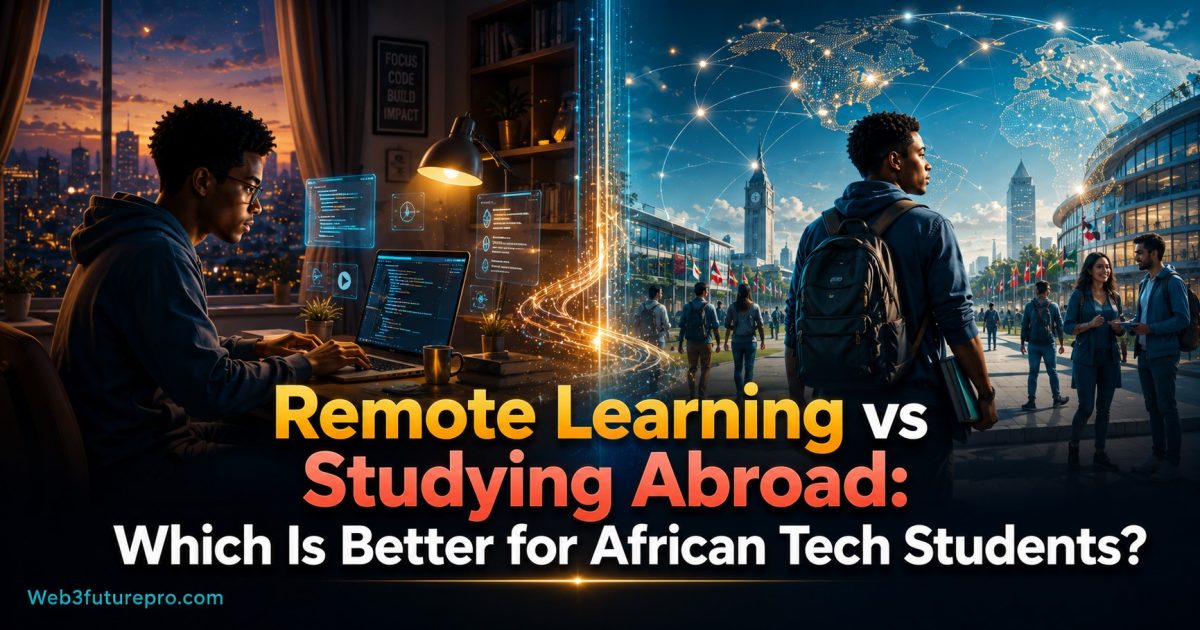
The technology industry is creating new opportunities for African students to build globally competitive careers without necessarily leaving the continent. At the same time, studying abroad remains an attractive pathway for students seeking international exposure, world-class universities, advanced research facilities, and global professional networks. This has created an important question for aspiring technology professionals: Remote Learning vs Studying Abroad: Which Is Better for African Tech Students?
Remote learning allows students to acquire technical and academic skills from their home countries through online universities, professional certification platforms, bootcamps, virtual internships, and international distance-learning programs. This approach can significantly reduce relocation and living expenses while giving students access to courses and instructors from institutions around the world. For example, current programs supporting African learners include technology-focused distance education and online degree opportunities.
Studying abroad, meanwhile, offers an immersive educational experience that can combine classroom learning with research, internships, cultural exchange, and face-to-face networking. For students who secure strong scholarships, the financial barrier can also be significantly reduced. Some African-focused programs now combine university funding with laptops, connectivity, mentorship, career preparation, and industry exposure.
CHECK: Undergraduate Scholarships vs Fellowship Programs: Which Supports Long-Term Growth Better?
Neither option is automatically better for everyone. Remote education can provide flexibility and lower relocation costs, but reliable internet, suitable devices, and self-discipline remain important considerations. Research involving international distance learners in sub-Saharan Africa has highlighted both the benefits of digital learning and challenges involving connectivity, technology access, and engagement.
Studying abroad can provide valuable international exposure and professional networking, but it may involve visa requirements, relocation expenses, cultural adjustment, and intense competition for scholarships. For tech students, the decision should therefore be based on the quality of the program, practical experience, affordability, career outcomes, and access to professional networks—not simply the location of the classroom.
In this comprehensive comparison, we’ll examine remote learning and studying abroad based on cost, flexibility, academic quality, technical skills, networking, internships, international exposure, career opportunities, and long-term return on investment. Whether you’re an undergraduate, graduate student, or aspiring African tech professional, this guide will help you determine which pathway best fits your career ambitions in 2026 and beyond.
For African students aiming at careers in software engineering, data science, cybersecurity, cloud computing, AI, and related fields, two broad pathways dominate the conversation in 2026: high-quality remote or online learning (including degrees, bootcamps, and structured certifications pursued from home) and traditional studying abroad. One keeps learners in their home countries while granting access to global curricula and remote job markets. The other involves physical relocation, international campuses, visas, and the full cultural and professional immersion of living overseas.
Neither path is universally superior. The better choice depends on finances, family situation, risk tolerance, target roles, and long-term goals. This comparison examines both options specifically for African tech students, covering structure, access, costs, outcomes, and practical strategy across the continent.
Program Overview: Remote Learning vs Studying Abroad

Remote learning encompasses fully online university degrees, hybrid programmes from African or international institutions, intensive coding bootcamps (local or global), professional certificate pathways (Google, AWS, Microsoft, Meta, and others), and self-directed or mentored online curricula. Learners remain in their home countries, study via internet-connected devices, and often combine learning with work or family responsibilities. Quality ranges from free world-class courses (such as Harvard’s CS50) to accredited online degrees and scholarship-supported bootcamps designed for African talent.
Studying abroad means enrolling in an on-campus or primarily in-person programme at a university outside Africa—commonly in Europe, North America, the UK, or increasingly Asia and the Middle East. Students relocate, obtain student visas, live in the host country, and experience campus life, local industry exposure, and post-study work opportunities where available. Many pursue computer science, data science, or related master’s or bachelor’s degrees, sometimes supported by scholarships.
| Aspect | Remote Learning | Studying Abroad |
|---|---|---|
| Location | Home country | Host country overseas |
| Primary Format | Online / hybrid | On-campus / in-person |
| Typical Duration | Months (bootcamps/certs) to 2–4 years (degrees) | 1–4 years |
| Key Advantage | Accessibility and lower cost | Immersion, networks, and credential prestige |
| Main Constraint | Self-discipline, connectivity, recognition variability | Cost, visas, and relocation challenges |
Remote learning prioritises reach and flexibility. Studying abroad prioritises immersion and traditional academic signalling.
Eligibility Requirements
Remote learning has the lowest formal barriers. Most online courses and many bootcamps require only basic digital literacy, reliable internet access, and the ability to complete assessments. Accredited online degrees may demand prior academic qualifications equivalent to local university entry standards. Scholarship-supported African programmes (for example certain software development scholarships) often prioritise motivation, aptitude tests, and sometimes financial need or gender balance. Nationality is rarely a barrier.
Studying abroad involves stricter and more complex requirements. Academic transcripts, language proficiency (IELTS, TOEFL, or equivalent), standardised tests in some cases, recommendation letters, and proof of funds or scholarship awards are standard. Visa eligibility adds layers: genuine student intent, financial capacity, health insurance, and sometimes ties to the home country. Certain destinations have heightened scrutiny or restrictions for applicants from specific African countries. Competitive scholarships impose additional merit and leadership criteria.
Remote pathways are accessible to a far wider pool of African learners. Study-abroad pathways filter more heavily on academic preparation, documentation, and financial or scholarship readiness.
Application Process
Remote learning applications are generally straightforward and fast. Students create accounts on platforms, submit basic information or aptitude assessments, and begin almost immediately for many courses and bootcamps. Online degree applications follow university admissions cycles but usually involve less paperwork than international mobility. Scholarship-funded remote programmes may include interviews or coding challenges.
Studying abroad requires a longer, multi-step process: university applications, scholarship applications (often separate and highly competitive), visa applications with supporting financial and academic evidence, and pre-departure logistics (housing, travel, insurance). Timelines frequently span 6–18 months from first application to arrival. Rejection at the visa stage remains a real risk even after academic admission.
The remote route rewards quick starts and iteration. The study-abroad route demands sustained organisation and contingency planning.
Benefits & Funding
Cost is the most striking difference.
Remote learning can be extremely low-cost or free. High-quality introductory and intermediate resources are widely available at no charge. Structured bootcamps and certificate programmes often range from a few hundred to a few thousand dollars (or local-currency equivalents), with many scholarship or sponsored options targeted at African talent. Living costs remain at home-country levels. Opportunity cost is low because many students continue earning while studying.
Studying abroad is expensive. Even in lower-tuition destinations (public universities in Germany or parts of Europe), living costs, flights, visas, insurance, and settling-in expenses add up quickly. Total annual costs commonly range from several thousand to tens of thousands of US dollars. Fully funded scholarships dramatically improve the equation but are scarce and competitive. Partial support still leaves significant gaps that many African families find difficult to close, especially amid currency volatility.
| Cost & Support Element | Remote Learning | Studying Abroad |
|---|---|---|
| Tuition / Programme Fees | Low to free (many options) | Moderate to very high |
| Living Costs | Home-country levels | Host-country levels (often much higher) |
| Travel & Visa | Minimal or none | Significant |
| Scholarship Availability | Growing (local + global online) | Competitive fully funded + partial options |
| Ability to Earn While Studying | High | Restricted by visa rules in many countries |
| Residual Financial Risk | Low | High without full funding |
Remote learning minimises financial risk and maximises accessibility. Studying abroad offers higher potential upside when fully funded but carries substantial downside risk when it is not.
Acceptance Rate
Remote programmes vary. Open online courses and many bootcamps have high or open enrolment. Selective scholarship bootcamps and competitive online degrees have lower acceptance rates, yet still far higher than top international scholarships.
Study-abroad places at desirable universities, combined with visas and funding, are significantly more selective. Fully funded international scholarships for African students often accept only a small percentage of applicants. Even self-funded routes face visa approval uncertainty in some destinations.
Remote options therefore offer more predictable access. Study-abroad success depends heavily on both academic competitiveness and external factors such as visa policy.
Global Opportunities
Remote learning grants direct access to global knowledge and, increasingly, global remote job markets. African developers, data professionals, and cybersecurity specialists already earn international salaries while living in Lagos, Nairobi, Accra, Johannesburg, or smaller cities. Platforms, freelance marketplaces, and remote-first companies actively hire across the continent. Skills in high demand—modern frontend and backend development, cloud, data engineering, AI-related tools, and strong written English—travel well without relocation.
Studying abroad provides physical presence in tech ecosystems, campus recruiting, local internships, alumni networks, and post-study work visas in countries that offer them. These can lead to higher local salaries in the host country and clearer pathways to longer-term skilled migration. The international credential and lived experience also carry signalling value with some employers and for certain advanced roles.
Remote pathways excel at global skill acquisition and remote income without leaving home. Study-abroad pathways excel at immersive networks and migration-linked opportunities.
Career Impact
Both routes can produce strong tech careers. Remote learners who build solid portfolios, contribute to projects, earn relevant certifications, and master in-demand tools frequently secure well-paying remote roles or strong local positions. The ability to start earning earlier compounds over time. Many African remote tech professionals report significant income advantages from dollar- or euro-denominated work while maintaining lower living costs.
Study-abroad graduates often benefit from stronger formal credentials, international professional networks, and exposure to different work cultures. In research-oriented, highly specialised, or immigration-dependent career paths, the overseas degree and experience can open doors that pure remote credentials reach more slowly. However, success is not automatic: graduates still need to perform in technical interviews and may face local job-market competition or the need to return home.
Recognition of online credentials remains uneven in some African and international contexts, though employer emphasis on skills and portfolios continues to grow. A strong remote portfolio plus demonstrable results often outweighs the formal label of the learning pathway.
Long-term, the highest earners and most resilient professionals on both routes share common traits: continuous learning, shipped projects, clear communication, and the ability to solve real problems.
Tips for Winning
For remote learning: Prioritise programmes and resources with strong outcomes data or clear industry alignment. Build a public portfolio of real projects early. Treat learning like a full-time job if possible. Master written communication in English. Pursue internships, open-source contributions, or freelance work while studying. Seek African-focused or scholarship-supported bootcamps that include career support. Address connectivity and power challenges with offline resources and backup plans where feasible.
For studying abroad: Target destinations and programmes with realistic visa pathways and post-study work options. Apply aggressively for fully funded scholarships while preparing a solid partial-funding or family-support backup. Strengthen the academic and leadership narrative. Prepare thoroughly for language tests and visa interviews. Research total cost of attendance carefully, including living expenses and currency risk. Have a clear plan for skills development and networking once on campus.
On both paths: Focus on demonstrable skills over credentials alone. Network intentionally. Stay current with tools and practices that employers actually use.
Remote learning is better for the majority of African tech students in 2026 when the goals are accessibility, speed to income, lower financial risk, and the ability to remain close to family and community. High-quality online resources, bootcamps, and remote-friendly credentials, combined with the expanding global remote job market, make it possible to build competitive tech careers without the cost, complexity, and uncertainty of relocation. For career switchers, those with limited capital, and students outside major urban centres, remote pathways offer the highest practical return.
Studying abroad is better when a student can secure substantial or full funding, has strong academic preparation, seeks immersive international networks, targets roles or immigration pathways that favour overseas credentials, or specifically wants the personal and professional growth that comes from living and studying in another country. When the financial and visa risks are managed, the upside in networks, experience, and certain career tracks can be significant.
The smartest approach for many is hybrid and sequential: use remote learning and local or online programmes to build foundational skills, a portfolio, and early income, then pursue targeted study-abroad opportunities (especially funded master’s programmes) later if deeper specialisation, research, or migration goals emerge. Skills, projects, and results remain the ultimate currency in tech. The pathway that best enables an African student to acquire and demonstrate those assets—given their specific constraints—is the better one.
Assess your finances, support system, risk tolerance, and five-year goals honestly. Then choose the route that maximises your ability to learn continuously and ship real work. In the current landscape, remote learning has dramatically expanded what is possible without leaving the continent, while studying abroad retains distinctive advantages for those who can access it on strong terms.
When comparing remote learning vs studying abroad for African tech students, there is no universal winner. Both pathways can lead to successful technology careers, but they provide different advantages depending on a student’s financial circumstances, academic goals, technical interests, and preferred career environment.
Remote learning can be the more practical choice for students who want to develop technology skills while remaining in their home country. It can eliminate many relocation expenses and allow learners to combine education with internships, freelance work, personal projects, or employment. Modern distance-learning programs can also connect African students with international universities, instructors, and peers without requiring physical relocation.
Studying abroad, however, can provide advantages that are difficult to reproduce entirely online. Students may gain access to advanced laboratories, research facilities, in-person mentorship, international classmates, career fairs, internships, and professional networks. These experiences can be particularly valuable for students pursuing advanced research, specialized engineering fields, or careers where international academic and professional connections are important.
For students with limited financial resources, high-quality remote learning can be an excellent starting point, particularly when combined with scholarships, industry certifications, practical projects, and remote internships. For students who can secure a fully funded study-abroad opportunity, international education may provide an exceptional combination of academic training, professional exposure, and networking. Some current African-focused scholarship programs even combine university education with career readiness, mentorship, technology resources, and industry pathways.
The smartest strategy may ultimately be to combine both approaches. An African student can begin with online courses and certifications, build practical technology projects, participate in remote internships, and then pursue a fully funded international degree or fellowship when the opportunity arises. This creates both technical competence and international exposure.
Ultimately, the best education is the one that produces valuable skills, meaningful experience, strong professional connections, and measurable career opportunities. Whether you learn from your home country or study at a university abroad, your ability to continuously learn, build real-world projects, develop a strong professional portfolio, and connect with the global technology community will play a major role in determining your success.