
In the world of business intelligence, technology innovation, and cryptocurrency investing, few figures have attracted as much attention as Michael Saylor. Best known as the co-founder and Executive Chairman of MicroStrategy, Saylor has evolved from a successful technology entrepreneur into one of the most influential advocates for Bitcoin adoption worldwide. His bold investment strategy and unwavering belief in Bitcoin as a superior store of value have made him a defining figure in the digital asset revolution.
Born in the United States and educated at one of the nation’s most prestigious institutions, Michael Saylor demonstrated exceptional academic and entrepreneurial talent from an early age. In 1989, he co-founded MicroStrategy, a company that would become a pioneer in business intelligence software and data analytics. Under his leadership, the company grew into a publicly traded enterprise serving organizations across various industries, earning Saylor recognition as one of the most successful technology executives of his generation.
However, it was his decision to make Bitcoin a core corporate treasury asset that propelled him to global prominence. Beginning in 2020, Saylor led MicroStrategy’s aggressive acquisition of Bitcoin, arguing that the cryptocurrency offered superior protection against inflation and currency devaluation. This strategy transformed both his public image and the company’s identity, positioning him as a leading voice in the cryptocurrency ecosystem. This biography explores Michael Saylor’s early life, education, entrepreneurial journey, the rise of MicroStrategy, Bitcoin advocacy, net worth, achievements, and his lasting influence on the future of digital finance.
He lost $6 billion in a single day. He rebuilt from near-zero. Then he bet an entire publicly traded company on one asset — and became one of the most polarizing, prophetic, and paradoxical figures in the history of modern finance.
Most people who suffer a catastrophic financial collapse quietly disappear into consulting roles or board seats. Michael Saylor did the opposite. He came back louder, bolder, and with a conviction so iron-clad that it transformed not just his own fortune, but the entire conversation around how corporations manage money.
Today, Strategy Inc. — the company he founded in 1989 under the name MicroStrategy — holds over 671,000 BTC, making it the largest corporate holder of Bitcoin in the world. Every week, sometimes every few days, Saylor announces another purchase. Another billion dollars converted from fiat currency into digital scarcity. Another bet, placed with the calm certainty of a man who believes he is not gambling but simply seeing clearly what others refuse to acknowledge.
But who is Michael Saylor before the Bitcoin maximalism? Before the memes, the conferences, the endlessly quoted predictions of $13 million Bitcoin? Who is the Nebraska-born military kid who taught himself to think in systems at MIT and built a software empire before he turned 25?
What if a former rocket scientist, once worth billions during the dot-com boom only to lose nearly everything, looked at the wreckage of traditional finance and decided the solution was a 21st-century digital asset most dismissed as speculative fiction? Michael Saylor didn’t just buy Bitcoin—he weaponized an entire public company around it, turning MicroStrategy (now Strategy) into the world’s largest corporate Bitcoin holder and a high-stakes proxy for the cryptocurrency itself. As of mid-2026, with Strategy holding over 843,000 BTC amid market volatility, Saylor’s unyielding maximalist vision has made him a polarizing figure: genius to some, reckless gambler to others.
His story is one of dramatic rises, crushing falls, and phoenix-like rebirths. From Air Force brat to MIT-trained engineer, dot-com billionaire to near-penniless survivor, and now a leading voice in the Bitcoin revolution, Saylor embodies the high-drama intersection of technology, finance, and conviction. In an era of economic uncertainty, his approach resonates strongly in the United States, where institutional adoption grows, as well as in Asia, the Middle East, and South Africa, where Bitcoin offers a hedge against inflation, currency volatility, and limited banking access. This biography dives deep into the man who bet his company—and reputation—on the idea that Bitcoin is the future of money.
Michael Saylor Biography: Executive Chairman of Strategy (MSTR), Bitcoin Advocate & Vision for Digital Capital

Early Life: Discipline Forged in Motion
Michael J. Saylor was born on February 4, 1965, in Lincoln, Nebraska, into a military family. His father served as a U.S. Air Force chief master sergeant, meaning young Michael’s childhood was defined by constant movement across bases worldwide. This nomadic existence built resilience, adaptability, and a global perspective that would later inform his borderless view of finance.
By his teenage years, the family settled near Wright-Patterson Air Force Base in Fairborn, Ohio—birthplace of aviation and home to the Wright brothers. The environment fueled Saylor’s fascination with technology, engineering, and big ideas. He excelled academically, graduating first in his high school class as valedictorian, class marshal, and voted “most likely to succeed.” These early achievements reflected a driven personality shaped by military discipline and intellectual curiosity.
Saylor’s upbringing emphasized structure, learning, and self-reliance. Exposure to aviation history and strategic thinking planted seeds for his later interests in systems, simulation, and long-term strategy—concepts he would apply to both business and Bitcoin advocacy. Unlike many tech founders from affluent Silicon Valley backgrounds, Saylor’s roots in a service family instilled a pragmatic, mission-oriented mindset.
Education: MIT and the Foundations of Systems Thinking
In 1983, Saylor enrolled at the Massachusetts Institute of Technology (MIT) on a full Air Force ROTC scholarship. He pursued a rigorous dual degree in aeronautics and astronautics, alongside science, technology, and society (history of science). He graduated with highest honors in 1987.
At MIT, Saylor thrived in an environment of innovation and complex problem-solving. He was involved in Theta Delta Chi fraternity, played guitar in a rock band, and learned to fly gliders. His thesis explored a mathematical model of a Renaissance Italian city-state, reflecting deep interest in system dynamics and large-scale simulations. A medical condition prevented him from becoming a pilot, redirecting his path to consulting.
This education equipped Saylor with analytical tools for modeling complex systems—skills he later used in business intelligence software and Bitcoin’s economic arguments. The blend of engineering precision and historical/societal context gave him a unique lens: technology as a force multiplier for human progress, a theme central to his Bitcoin maximalism.
For most people, a door slammed that hard would produce bitterness, paralysis, or a prolonged identity crisis. For Saylor, it produced a pivot. He turned the skills that would have made him an exceptional pilot — systems thinking, precision under pressure, comfort with high-stakes decision-making, the ability to process complex information rapidly — toward the emerging world of computer simulation and business technology.
After college, he became a consultant to companies such as DuPont, Dow, and Exxon, developing computer simulations to predict changes in key markets.
The pilot who couldn’t fly learned instead to model the trajectories of entire industries. The redirection was, in retrospect, the most consequential medical examination in tech history.
Meeting Sanju Bansal: The Partnership That Built an Empire
During his time at MIT, he met the co-founder of MicroStrategy, Sanju Bansal. This detail matters enormously. The relationship between Saylor and Bansal was not a chance coffee meeting at a startup event years later. It was forged in the crucible of MIT’s demanding environment — built on mutual respect between two serious people operating at a high level in a high-pressure place.
The trust required to co-found a company is not transactional. It is relational. And the relationship between Saylor and Bansal had years of foundation before either of them used the word “startup.”
Career Journey: From Consulting to Software Empire to Bitcoin Bet
After MIT, Saylor joined a consulting firm, The Federal Group, applying computer simulations to strategic decisions for corporations like DuPont and Exxon. This experience highlighted inefficiencies in data analysis and decision-making.
In 1989, at age 24, he founded MicroStrategy with a vision for enterprise intelligence. Starting as a small firm focused on data analytics and relational online analytical processing (ROLAP), the company grew steadily. It went public in 1998, riding the dot-com wave. Saylor’s leadership turned it into a pioneer in business intelligence tools.
The early 2000s brought challenges, but MicroStrategy survived and adapted. By 2020, facing a mature software market, Saylor made a pivotal shift: adopting Bitcoin as the primary treasury asset. This “Bitcoin standard” strategy transformed the company into a leveraged play on BTC. In 2022, he stepped down as CEO to become Executive Chairman, focusing on the Bitcoin treasury while the firm rebranded elements toward Strategy.
Saylor’s journey reflects relentless adaptation—from aerospace dreams to software innovation to becoming crypto’s most vocal corporate champion.
Founding MicroStrategy at Age 24
In 1989, at the age of 24, Mr. Saylor combined his passions for technology, business, and the use of computer simulations to launch MicroStrategy. The company was founded on his vision of helping enterprises deliver intelligence everywhere.
Twenty-four years old. No venture capital ecosystem the way it exists today. No accelerator programs or startup playbooks. Just a 24-year-old MIT graduate with a clear idea — that businesses were drowning in data they couldn’t interpret, and that the right software could transform that data into competitive intelligence.
In 1989, Saylor and Bansal co-founded MicroStrategy, focusing initially on data mining before expanding into business intelligence, mobile software, and cloud-based services.
The company grew steadily through the early 1990s — not with the explosive, venture-fuelled rocketship trajectory of a social media platform, but with the durable growth of a company solving a real problem for paying enterprise customers who needed what it built.
The 1998 IPO and the Dot-Com Billionaire
MicroStrategy grew steadily, going public in 1998 on NASDAQ under the ticker MSTR. The timing was extraordinary. The late 1990s tech boom was inflating valuations to levels that made rational analysis seem quaint. Software companies — especially those with enterprise customers and credible technology — were being rewarded with market capitalizations that bore only a passing relationship to their actual revenues.
MicroStrategy, with its genuine product and genuine customers, was swept up in the flood. Saylor became a dot-com billionaire. His personal wealth reportedly touched $7 billion. He was profiled in major publications as the face of a new kind of tech leadership — serious, intellectual, visionary.
He was also, it turned out, about to learn the hardest lesson of his career.
The Dark Year: 2000 and the Accounting Crisis
Then came March 20, 2000. A date Saylor will never forget.
In 2000, the U.S. Securities and Exchange Commission charged Saylor and two other MicroStrategy executives for inaccurate financial reporting. The company disclosed that it needed to restate its financial results for 1997, 1998, and 1999. The company reduced its 1999 reported revenue from $205.3 million to between approximately $150 million and $155 million, and its results of operations swung from reported net income to a significant loss.
The accounting issue centered on revenue recognition — specifically, how the company recorded income from large, complex contracts that bundled both software and services. MicroStrategy allegedly recognized revenues on software licensing agreements prior to those contracts being finalized or when they were subject to significant contingencies.
The market reaction was instantaneous and savage. MicroStrategy’s stock lost 62% of its value in a single trading session on March 20, 2000. Saylor’s personal net worth evaporated by approximately $6 billion in a single day — at the time, one of the largest single-day personal wealth destructions ever recorded.
On December 14, 2000, Saylor consented, without admitting or denying the allegations in the SEC’s complaint, to the entry of a judgment enjoining him from violating the antifraud and recordkeeping provisions of the federal securities laws. In December 2000, Saylor settled with the SEC without admitting wrongdoing, paying $350,000 in penalties and a personal disgorgement of $8.3 million.
What happened next is what defines Michael Saylor more than any single achievement.
He didn’t leave. He didn’t cash out his remaining shares and retire to a yacht. He stayed, rebuilt, and spent the next two decades quietly rebuilding MicroStrategy into a profitable, respected enterprise software company — without the dot-com hype, without the billions in paper valuation, just grinding.
That decade and a half of patient reconstruction is the context without which his Bitcoin pivot is impossible to fully understand.
Saylor’s Major Achievements: Pioneering Intelligence and Bitcoin Adoption

Saylor’s accomplishments span decades:
- Building MicroStrategy/Strategy: Founded and scaled a public company that pioneered business intelligence, helping enterprises harness data for competitive advantage. It survived multiple market cycles.
- Bitcoin Treasury Strategy: Starting in 2020, MicroStrategy began aggressively acquiring Bitcoin. As of mid-2026, Strategy holds approximately 843,706 BTC, representing a significant portion of total supply and making it the largest corporate holder. This approach has influenced other companies and institutions.
- Saylor Academy (formerly Saylor Foundation): Founded a nonprofit providing free online education to millions, democratizing learning globally—particularly impactful in emerging markets across Asia, Africa, and the Middle East.
- Thought Leadership: Authored The Mobile Wave, holds numerous patents, and delivers influential keynotes on Bitcoin, digital credit, and economic philosophy. His interviews and posts shape public discourse.
- Alarm.com: Early involvement in this security and smart home company, which went public successfully.
These feats established Saylor as both a software innovator and a Bitcoin evangelist who put substantial corporate capital behind his beliefs.
Michael Saylor Net Worth: Volatility of a Bitcoin Believer
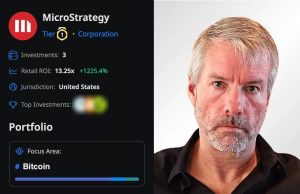
As of June 2026, Michael Saylor’s net worth is estimated around $3.8 billion to $4.7 billion according to Forbes and other trackers, largely tied to his equity in Strategy and personal Bitcoin holdings. He personally owns about 17,732 BTC, acquired earlier.
Strategy’s massive BTC treasury drives much of the company’s valuation as a Bitcoin proxy, leading to dramatic swings. Saylor’s wealth peaked during the dot-com era (around $7 billion) before crashing, then rebuilt through Bitcoin. Despite unrealized losses at times due to market dips, his long-term conviction remains. He has explored digital credit instruments and other innovations to sustain the strategy.
A Wealth Figure That Moves Like a Bitcoin Chart
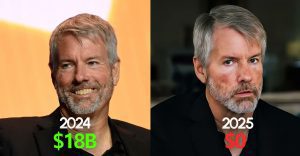
Michael Saylor’s net worth in early 2026 is estimated at approximately $4.7 billion, a figure that fluctuates wildly alongside Bitcoin’s price and Strategy Inc.’s valuation.
This is possibly the most volatile billionaire fortune in the world. The trajectory tells the full story:
- 2000 — Net worth briefly touched ~$7 billion during the dot-com peak, then collapsed to near zero after the accounting crisis and stock crash
- 2021 — Recovered significantly as Bitcoin surged and MSTR stock became a leveraged Bitcoin proxy
- 2025 (Peak) — Bloomberg and Forbes trackers estimated his wealth as high as $10.1 billion during late 2025’s bull market.
- 2026 (Current) — Forbes places his net worth at around $4.6 billion to $4.7 billion in early 2026, with a dramatic $5.4 billion contraction from his 2025 peaks.
This wealth profile highlights both the opportunities and risks of concentrated crypto bets, relevant to investors worldwide navigating inflation and asset preservation.
Companies & Projects: A Portfolio of Intelligence and Innovation
- Strategy (formerly MicroStrategy): The core vehicle, now a Bitcoin development and treasury company alongside its analytics software roots.
- Saylor Academy: Nonprofit offering free courses to over 2.8 million students, focusing on accessible education.
- Alarm.com: Co-founded or early backer of this IoT security platform.
- Hope.com and Bitcoin Advocacy: Platforms promoting the Bitcoin standard and economic education.
- Patents and Thought Leadership: Inventor on dozens of patents; author and speaker influencing tech and finance.
Saylor’s projects blend enterprise tools, education, and Bitcoin infrastructure, with growing emphasis on digital credit and yield-bearing Bitcoin products.
Controversies: Accounting Scandals, Taxes, and High-Stakes Bets
Saylor’s career includes notable challenges. In 2000, the SEC charged MicroStrategy with overstating revenues; Saylor settled without admitting wrongdoing, paying penalties, and the stock plummeted, erasing billions in personal wealth.
In 2022–2024, the District of Columbia sued him for alleged tax fraud involving residency claims. He settled in 2024 with a $40 million fine.
Critics question the sustainability of Strategy’s leveraged Bitcoin strategy, especially during drawdowns when the company has faced pressure and made minor sales (e.g., 32 BTC in 2026 for obligations). Debates rage over whether it’s brilliant treasury management or risky financial engineering. Saylor defends it vigorously, framing Bitcoin as superior capital.
These episodes underscore tensions between aggressive innovation and regulatory scrutiny.
Web3/AI Impact: Bitcoin as the Bedrock for Future Tech
Saylor is a Bitcoin maximalist, viewing it as pristine digital property superior to other assets. He has been less focused on broader Web3 experiments like DeFi or NFTs, prioritizing Bitcoin’s scarcity and security. However, his company explores Bitcoin-backed digital credit and yield products, potentially bridging traditional finance and crypto.
On AI, Saylor sees Bitcoin as enabling sound money for an AI-driven economy—providing a stable base amid technological disruption. His educational initiatives and advocacy support broader tech literacy. In regions like South Africa and Asia, Bitcoin offers inclusion where fiat systems falter; in the US and Middle East, it attracts institutional interest. Saylor’s influence accelerates corporate adoption and policy discussions around sound money.
Lessons & Quotes: Philosophy of Conviction and Capital

Saylor’s journey teaches:
- Long-term conviction over short-term noise: Bitcoin’s volatility tests resolve, but holding through cycles builds wealth.
- Adapt and pivot: From software to Bitcoin treasury when traditional models stagnate.
- Education as leverage: Democratizing knowledge empowers individuals globally.
- Bitcoin as property: Treat it as digital gold in an inflationary world.
Notable quotes:
- “Bitcoin is hope.” (Central to his advocacy)
- On strategy: “We’re not going to be selling; we’re going to be buying bitcoin… every quarter forever.”
- “The mobile wave” and systems thinking permeate his views on technology transforming society.
His philosophy blends engineering rigor with economic radicalism, inspiring entrepreneurs and investors.
The Legacy of a Digital Capital Architect
Michael Saylor’s arc—from military brat and MIT engineer to dot-com survivor and Bitcoin maximalist—captures the drama of technological disruption. By steering Strategy into the largest corporate Bitcoin position, he has not only rebuilt personal and corporate value but also catalyzed mainstream conversations about money, inflation, and sovereignty. His impact extends beyond balance sheets to education and economic philosophy, offering tools for individuals in volatile economies across the US, Asia, the Middle East, and South Africa.
As markets evolve and AI reshapes work, Saylor’s bet on Bitcoin as pristine capital remains a bold experiment. Whether history deems him a visionary or a cautionary tale, his story urges bold thinking about the future of value. In a world of fleeting trends, Saylor’s unwavering focus on first principles offers a compelling model for resilience and conviction.
Michael Saylor’s career is a remarkable story of innovation, strategic thinking, and conviction. From co-founding MicroStrategy and helping pioneer the business intelligence industry to becoming one of the world’s most prominent Bitcoin advocates, he has consistently positioned himself at the forefront of transformative technological movements. His ability to identify long-term opportunities and act decisively has earned him a unique place in both the technology and cryptocurrency sectors.
Through his leadership, MicroStrategy became more than a software company—it became one of the most recognized corporate supporters of Bitcoin. Saylor’s decision to allocate significant corporate resources to digital assets influenced countless investors, executives, and organizations to reconsider the role of cryptocurrency in modern finance. His public advocacy has helped educate businesses and individuals about Bitcoin’s potential as a store of value and a strategic financial asset.
As the digital economy continues to evolve, Michael Saylor’s influence is likely to remain significant. Whether remembered as a visionary entrepreneur, a business intelligence pioneer, or one of Bitcoin’s most passionate champions, his contributions have left a lasting mark on the worlds of technology, finance, and digital innovation. His journey serves as a compelling example of how bold leadership and long-term vision can reshape industries and inspire global change.
Quick Facts: Michael Saylor at a Glance
| Detail | Info |
|---|---|
| Full Name | Michael J. Saylor |
| Date of Birth | February 4, 1965 |
| Birthplace | Lincoln, Nebraska, USA |
| Nationality | American |
| Education | MIT (Dual BS: Aeronautics & Astronautics; Science, Technology & Society) — Highest Honors, 1987 |
| Co-founded | MicroStrategy / Strategy Inc. (1989) |
| Current Role | Executive Chairman, Strategy Inc. |
| Personal BTC Holdings | ~17,732 BTC |
| Strategy BTC Holdings | 843,706+ BTC (as of mid-2026) |
| Net Worth (2026) | ~$4.6–$4.7 billion (Forbes/Bloomberg) |
| Patents | 48+ |
| Based In | Miami, Florida |