Tokenized real-world assets (RWAs) are becoming one of the most important developments in the global blockchain and digital finance industry. In 2026, banks, asset managers, investment companies and financial technology startups are increasingly using blockchain technology to represent traditional financial assets as digital tokens. These assets include government bonds, money market funds, corporate debt, commodities, equities, private credit and investment fund shares.
The idea is straightforward but potentially transformative: instead of relying entirely on conventional financial infrastructure to issue, record and transfer investment products, institutions can use blockchain-based systems to represent ownership interests, process transactions and manage certain financial operations. Depending on the structure, tokenization can support faster settlement, improved transparency, fractional investment opportunities and access to financial products through digital platforms.
The market is growing rapidly. According to the International Organization of Securities Commissions (IOSCO), the global tokenized real-world asset market expanded from approximately $16 billion in July 2025 to $37 billion by June 30, 2026. By late September, distributed on-chain RWA value had exceeded $39 billion, according to RWA.xyz data cited by VanEck.
Tokenized Real-World Assets in 2026: What the Data Actually Shows

Tokenized real-world assets are now a tens-of-billions-of-dollars market, and the hype around them is finally colliding with hard numbers. On 6 November 2026, the analytics platform rwa.xyz counted about $39.4 billion in tokenized real-world assets circulating on public blockchains, excluding stablecoins. That is slightly more than double the figure a year earlier, according to a MERGE market guide built on rwa.xyz data.
The growth is real, but so are the caveats. In its November 2026 report, the International Organization of Securities Commissions (IOSCO) described tokenized markets as “transitional and fragmented” and called recent change incremental rather than disruptive. Headline forecasts range from roughly $2 trillion to more than $80 trillion, depending on who is counting and what they include.
CHECK: Stablecoin Regulation 2026: GENIUS Act, MiCA & Hong Kong
This guide cuts through that noise. You will learn what tokenized real-world assets (RWAs) are, how the tokenization process works, which funds and issuers lead the market, how regulators in the United States, Europe, Asia and Nigeria are responding, and where the real risks sit. Every figure is dated and sourced so you can verify it.
Key Takeaways
- Size: about $39.4 billion in distributed value on 6 November 2026, versus roughly $368 billion in “represented” value that is recorded on-chain but not freely transferable.
- Leader: tokenized US Treasury products, at about $14.3 billion, are the largest category. Real estate is only about 0.5% of the total.
- Regulation: the US SEC issued a five-year “Innovation Exemption” for on-chain trading of tokenized stocks on 17 September 2026, while Nigeria’s SEC has published draft rules that would create a dedicated RWA tokenisation platform category.
- Risk: a token is only as strong as the legal structure behind it, and secondary-market liquidity is thin. One analysis found that most large tokenized assets recorded no transfers in a single week of July 2026.
- Forecasts: treat trillion-dollar projections as scenarios, not predictions.
What Are Tokenized Real-World Assets (RWAs)?
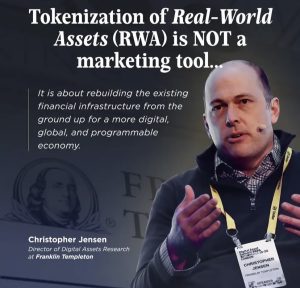
A tokenized real-world asset is a blockchain token that represents a claim on something of value that exists off-chain. That could be a government bond, a private loan, an ounce of gold, a share of stock or a building. The token is not the asset itself. It is a programmable record of who is entitled to what, backed by a legal structure that links the holder to the underlying value.
The Four Layers Behind Every RWA Token
Thinking in layers helps you judge any product you meet. The MERGE guide describes four, and the weakest layer usually decides how safe the whole product is.
1. The asset
The bond, loan, commodity or property that sits outside the blockchain. Good candidates have clear title, verifiable cash flows and an accepted way to value them.
2. The legal layer
A special-purpose vehicle (SPV), trust, regulated fund or registry entity that holds the asset and defines exactly what the token holder can claim. If this layer fails, the token may be worth little, however good the code is.
3. The token
The technical standard that encodes those rights and any restrictions. Simple instruments can use ERC-20, while regulated securities often use permissioned standards such as ERC-1400 or ERC-3643 that embed identity checks and transfer limits.
4. The protocol
The network where the token circulates and settles, such as Ethereum, Solana or Stellar. IOSCO’s 2026 report notes that institutions now use several public chains for different jobs rather than betting on one.
RWA Tokens vs Traditional Assets vs Crypto-Native Tokens
An RWA token sits between two worlds. It inherits the economic exposure and legal protections of a traditional security, while gaining the settlement speed and programmability of a crypto token. It also inherits the risks of both.
One principle from that guide is worth remembering: regulation follows the asset, not the technology. A share is still a share whether it sits on paper, in a book-entry system or on a blockchain.
How RWA Tokenization Works, Step by Step
Tokenization follows a repeatable lifecycle whatever the asset. Each step has an off-chain part and an on-chain part, and the weak link is usually the legal and operational plumbing rather than the code.
1. Identify and value the asset. Independent appraisers or auditors set a baseline value. For income-producing assets, a servicer confirms the cash flows the token will pass on to holders.
2. Build the legal structure. The issuer creates an SPV, trust or regulated fund, or issues directly on-chain where local law allows. The choice of jurisdiction shapes investor protection, tax and how enforceable the claim is.
3. Issue the token. The issuer picks a blockchain and a token standard, then encodes rights such as income distribution, voting and redemption in a smart contract.
4. Onboard investors. Know-your-customer (KYC) and anti-money-laundering (AML) checks happen before any allocation. The approved wallets are whitelisted at contract level, so a transfer only settles between verified parties.
5. Service the position. Oracles feed valuation and reference data on-chain, and smart contracts automate reporting and income payments.
How Big Is the Tokenized RWA Market in 2026?
The honest answer is “about $37 to $46 billion, depending on who counts and how.” Every credible tracker shows fast growth, but they disagree on the total because they define the market differently.
Market Size Estimates Compared
| Source | Figure | As of | What it measures |
|---|---|---|---|
| rwa.xyz via MERGE | About $39.4B | 6 Nov 2026 | Distributed value, excluding stablecoins |
| rwa.xyz via MERGE | About $368B | 6 Nov 2026 | Represented value, not freely transferable |
| IOSCO via Genfinity | $37B | 30 Jun 2026 | Public-chain RWAs, using rwa.xyz data |
| Chainalysis via Blockonomi | $36.07B | End of Q2 2026 | On-chain RWA market |
| Token Terminal via Crypto Briefing | $46.3B | Autumn 2026 | Broader count of tokenized RWAs |
| CoinGecko via Blockonomi | $19.32B | March 2026 | Market capitalization of RWA tokens |
Distributed vs Represented Value
The single most useful distinction is between two kinds of value that rwa.xyz tracks separately. Distributed value covers tokens that can move freely between wallets outside the issuer’s own platform. Represented value covers assets that use a blockchain only as a register and cannot be freely transferred. On 6 November 2026 those were roughly $39.4 billion and $368 billion. Before you quote any headline number, check which of the two it refers to.
Why the Numbers Disagree
Three things explain most of the gap.
- Scope. Some trackers count tokenized deposits, stablecoins or loans that only use a chain for record-keeping. Others exclude them.
- Timing. The market roughly doubled in a year, so a figure from March can be half of one from November.
- Method. Token Terminal’s count, for example, runs higher than rwa.xyz’s distributed figure of about $38 to $39 billion for September and October 2026, as Crypto Briefing reported.
Which Real-World Assets Are Actually Being Tokenized?
The market is concentrated. Government debt leads, private credit and gold follow, and real estate, the example most people imagine first, is the smallest major category.
| Asset class | Distributed value (6 Nov 2026) | Notes |
|---|---|---|
| US Treasury products | About $14.3B | Largest category, just over a third of the total |
| Private and corporate credit | About $8.2B | More than $42B if register-only loans are included |
| Commodities (mostly gold) | About $5.3B | XAUT and PAXG dominate |
| Tokenized stocks and ETFs | About $4.0B | Fast-growing, legally varied |
| Real estate | About $0.21B | Roughly 0.5% of the market |
Source: rwa.xyz data, 6 November 2026, as reported by MERGE. The remainder is alternative funds, corporate bonds and other debt.
Tokenized Treasuries and Government Debt
On-chain Treasuries became the default product for putting traditional finance on a blockchain. They offer dollar yield with a familiar credit profile, and they work as collateral in DeFi. IOSCO reports that tokenized US government debt on public blockchains rose from about $9 billion to nearly $15 billion between November 2025 and July 2026, while non-US government debt grew from roughly $900 million to $1.4 billion.
There is a structural reason for the demand. MERGE notes that both MiCA in Europe and the GENIUS Act in the United States bar stablecoin issuers from paying interest, so investors who live on-chain look for yield in tokenized funds. It estimates leading funds yielded roughly 3.5% to 3.8% a year in November 2026, tracking short-term government rates. A different tracker, Token Terminal, reports that Treasuries now make up less than one-third of its larger $46.3 billion total as credit and yield products grow (Crypto Briefing).
Tokenized Stocks
Tokenized equities are the newest class. IOSCO says tokenized equities and equity-linked products grew from $330 million to $1.7 billion in twelve months, with Ondo and xStocks running the two largest platforms. rwa.xyz’s broader stocks-and-ETFs category stood at about $4.0 billion in November. The figures differ because the definitions and dates differ.
Tokenized Real Estate
Tokenized property is only about $213 million, roughly 0.5% of distributed value, because in most countries land registries do not yet recognize on-chain claims. Most platforms therefore tokenize shares in a company that owns the property, not the property itself. Dubai is the notable exception, with tokenized title deeds issued through the Dubai Land Department’s Prypco Mint pilot since 2025. The cautionary tale is RealT, which the city of Detroit sued and which has been in voluntary liquidation since July 2026, a reminder of what happens when management of the physical asset fails.
Top Tokenized Funds and RWA Issuers
The leaderboard has become crowded. BlackRock’s BUIDL launched on Ethereum in March 2024 with Securitize as transfer agent and peaked above 40% of tokenized Treasuries in 2025. By 6 November 2026 it held about $1.9 billion, roughly 13% of the category, behind Ondo’s USDY and Circle’s USYC. MERGE reports that no single product now holds more than 17% of the market.
| Product or protocol | Type | Approx. size (6 Nov 2026) | Worth knowing |
|---|---|---|---|
| Franklin Templeton BENJI family | Government money fund | About $3.09B (whole family) | Longest track record; open to US retail |
| Ondo USDY | Tokenized Treasury note | About $2.40B | Ondo also reports more than $1B in tokenized stocks |
| Circle USYC | Tokenized money market fund | About $2.24B | Largest single fund in the category |
| BlackRock BUIDL | Tokenized money market fund | About $1.89B | $5M minimum, qualified purchasers only |
| Ondo OUSG | Tokenized Treasury bills | About $317M | Qualified investors only |
| Centrifuge | Private credit pools | About $770M | Real-world lending |
| Maple Finance | Institutional credit | About $4.8B reported | rwa.xyz counts about $960M on-chain |
Source: rwa.xyz figures as published in the MERGE RWA guide. Sizes move daily, so verify on the live dashboard before quoting.
This list is for education, not a recommendation to buy any product. Minimums, eligibility and fees differ, and many of these funds are restricted to qualified or non-US investors.
Institutional Adoption: DTCC, Nasdaq and the NYSE
The Depository Trust & Clearing Corporation (DTCC) launched a three-year tokenization pilot in October 2026. Participants can mint tokens that represent security entitlements held at The Depository Trust Company, which keeps the traditional books and tracks token movement off-chain. According to the IOSCO coverage, Nasdaq joined DTCC and other participants in July 2026 to tokenize live US trades, and the New York Stock Exchange has announced plans for a platform to trade and settle tokenized shares.
RWA Tokenization Regulation Around the World (November 2026)
Classification drives everything. The same token can be a security under one framework and a crypto-asset under another, so the first question for any product is which rulebook applies.
| Jurisdiction | Main framework | Status in late 2026 |
|---|---|---|
| United States | SEC rules, Project Crypto, Innovation Exemption | Five-year exemption for on-chain trading of tokenized stocks from 17 Sep 2026 |
| European Union | MiCA, MiFID II, DLT Pilot Regime | Tokenized funds mostly fall under MiFID II; pilot regime caps under reform |
| Singapore | MAS Project Guardian | Live tokenization pilots with banks |
| Hong Kong | HKMA and SFC | 24/7 settlement in tokenized central bank money (EnsembleTX), Nov 2026 |
| UAE | VARA and Dubai Land Department | Official tokenized real estate pilot since 2025 |
Sources: MERGE and the legal analyses linked below.
United States: From Enforcement to an Exemption
The key step came on 17 September 2026. The SEC issued two conditional exemptions, effective immediately and running until 17 September 2031, so that “Tokenized Securities Venues” using permissioned automated market makers can trade tokenized versions of listed US stocks without registering as an exchange (Mayer Brown; Cahill). Per Axios, the tokenized stocks covered are not derivatives and carry the same rights as the underlying shares, including dividends and voting.
The limits are as important as the headline. Law firm analyses note the exemption does not permit primary offerings, does not displace Securities Act registration (Greenberg Traurig). Skadden adds that trading is restricted by tight symbol and volume caps in two tiers (Skadden). Axios also reported it arrived days after a major crypto market-structure bill failed to advance in the Senate, so comprehensive legislation remains pending.
European Union: Two Regimes in Parallel
MiCA has applied to stablecoins since 30 June 2024 and to other crypto-assets and service providers since 30 December 2024, with the transition for existing providers ending on 1 July 2026. But most tokenized securities sit outside MiCA. Tokenized money market funds and Treasury products are financial instruments under MiFID II, so the tokenization is a technology wrapper, not a reclassification.
For trading and settling such instruments on distributed ledgers, the DLT Pilot Regime has applied since 23 March 2023, with caps of EUR 500 million for shares, EUR 1 billion for bonds and a EUR 6 billion ceiling per infrastructure. MERGE reports the European Commission proposed in December 2025 to lift that ceiling to EUR 100 billion, a reform still under negotiation.
Nigeria and Africa: Where RWA Tokenization Rules Stand
Nigeria is moving from a retail crypto hub toward institutional-style regulation, and tokenization sits at the center of that shift. The key point for builders and investors: the main rulebook is still a draft.
The Legal Base: Investments and Securities Act 2025
The Investments and Securities Act (ISA) 2025 came into force on 25 March 2025. Its definition of securities expressly includes virtual and digital assets, and it gives the Securities and Exchange Commission (SEC) Nigeria authority over digital-asset exchanges, service providers, custody and related services (CryptoSlate legal profile). In practice, a tokenized instrument offered to Nigerian investors is likely to be treated as a security.
The Draft Rules: A Dedicated RWA Tokenisation Category
On 20 August 2026, the SEC published proposed Rules on Digital and Virtual Assets Operations, Custody and Markets for public consultation (SEC Nigeria). Law-firm summaries say that if adopted, the rules would replace the 2022 digital-asset rules and add several new elements:
• a new platform category called the Real-World Asset Tokenisation Platform (RATOP) to govern how assets are structured, tokenised and offered;
• a four-tier classification of stablecoins based on reserves and collateral;
• coverage of operators in Nigeria, providers serving Nigerian residents, and entities that target Nigerian investors through digital channels.
These details come from the Aluko & Oyebode briefing, which stresses that the proposals are not yet law. Other reported details include proposed registration fees of N30 million for several operator categories, including RWA tokenisation platforms (Nairametrics), and a proposal under consideration to limit investors’ digital-asset exposure to N10 million (The Guardian Nigeria).
What This Means in Practice
- Investors: treat any tokenized product marketed in Nigeria as a securities product. Check that the issuer and platform are registered with the SEC before sending money.
- Builders and startups: plan for registration, capital requirements and custody rules now, because the draft shows the direction of travel. Data handling also falls under the Nigeria Data Protection Act, covered in our NDPA and GAID guide.
- Everyone: this section is general information, not legal advice. Confirm current status with a Nigerian securities lawyer.
The Real Risks of Tokenized Real-World Assets
A credible look at RWAs starts with risk, not yield. The same token can be safe in one structure and dangerous in another, so it helps to separate the risks.
Legal Wrapper and Counterparty Risk
The token is only as good as its legal wrapper. If the SPV becomes insolvent, the custodian defaults or a court will not enforce the holder’s claim, the on-chain balance may be worth little. Cross-border enforcement is a genuine open question, because a token can trade globally while the claim sits under one country’s courts. This is why IOSCO lists legal certainty over ownership and transfer as its first concern, and why auditing the underlying asset matters as much as auditing the smart contract.
Thin Secondary Liquidity
Liquidity is the gap between the pitch and the reality. MERGE cites a BeInCrypto analysis of rwa.xyz data from July 2026: 910 of the 1,289 tokenized assets worth more than $100,000, together about $32.9 billion, recorded no transfer at all in a single week. A fair caveat is that long-dated or buy-and-hold products may simply not trade often, so a quiet week is not always distress.
Even so, the same guide warns that in stressed markets tokens can trade at meaningful discounts to net asset value, and redemption terms often decide how liquid a token is in practice.
Smart Contract, Custody and Operational Risk
Code can contain vulnerabilities, upgrades can introduce errors, and bridges and oracles add dependencies. IOSCO adds that self-custody concentrates risk in private key management, where loss can be irreversible, and that public permissionless networks make it hard to assign accountability during a disruption.
Regulatory Reclassification Risk
Most RWA tokens are securities and can be reclassified, halted or forced into redemption. KYC whitelisting limits who can hold or transfer a token, which constrains the very liquidity tokenization promises. The SEC’s September 2026 exemption is explicitly temporary and permissioned, and Nigeria’s draft rules are not yet final, so the rulebook can change under holders’ feet.
Tokenization Forecasts Compared: Scenarios, Not Predictions
Forecasts for tokenized assets span a factor of more than forty. Treat them as scenarios built on different assumptions, not as a prediction of what will happen.
| Forecaster | Projection | Horizon | Notes |
|---|---|---|---|
| McKinsey | About $2T | 2030 | Base case, excluding stablecoins |
| Citi (Citi Institute) | $5.5T base; $2.7T bear; $8.2T bull | 2030 | Tokenized securities |
| BCG and ADDX (2022) | $16T, about 10% of global GDP | 2030 | Most-quoted headline figure |
| Ripple and BCG (2025) | $18.9T | 2033 | Raised from the 2022 estimate |
| Standard Chartered | $30T | 2034 | Cited by MERGE |
| BCG (cited by IOSCO) | $88.2T; lower scenario $46.2T | 2035 | From a $22B base in 2025 |
Sources: MERGE and Genfinity’s IOSCO report coverage.
A Quick Reality Check
Against today’s roughly $39.4 billion of distributed value, McKinsey’s $2 trillion implies about a 50-fold increase by 2030, and the $16 trillion headline implies roughly 400 times (my arithmetic from the figures above). Even the cautious scenarios need a large shift of traditional securities onto ledgers, which depends on the unsolved problems covered earlier: legal certainty, liquidity and interoperability. A fragmented regulatory landscape is exactly the scenario BCG’s lower bound assumes slows adoption.
How to Evaluate an RWA Product: A Due-Diligence Checklist
This checklist follows from the risks above. It is a learning framework, not financial advice.
Ten Questions to Ask Before You Touch Any RWA Token
1. What exactly do I own? Direct ownership, a fund share, a note or a contractual claim?
2. Who holds the underlying asset? Name the custodian, SPV or trust, and its jurisdiction.
3. Is the issuer regulated? Check registration with the relevant authority, such as the SEC in the US or Nigeria.
4. Who can buy it? Minimums and eligibility rules (qualified purchasers, non-US only) show who the product is designed for.
5. How do I get out? Redemption at net asset value, periodic windows, or only a secondary market?
6. Is there real secondary liquidity? Look at actual transfer activity, not just the headline market cap.
7. Where does the price come from? Identify the oracle or valuation agent and how often it updates.
8. Has the code been audited? Ask about smart contract audits, upgrade controls and who holds admin keys.
9. What is the yield source? Treasury bill interest is different from loan repayments or token emissions.
10. What happens if the issuer fails? Ask how on-chain holders are treated in insolvency.
Conclusion: Real Growth, Real Limits
Tokenized real-world assets have moved from pilot projects to a market of roughly $37 to $46 billion, led by Treasury funds from BlackRock, Franklin Templeton, Circle and Ondo, and backed by infrastructure moves at DTCC and Nasdaq. Regulators are responding, from the SEC’s five-year Innovation Exemption to Europe’s pilot regime and Nigeria’s draft RATOP category.
Yet the same regulators call the market fragmented, and the data shows thin secondary trading and a tiny real estate segment. The winners are likely to be products with strong legal wrappers, genuine redemption rights and clear regulation, not those with the loudest forecasts.
If you remember one rule, make it this: a token is only as strong as the legal structure and liquidity behind it. Verify the source, the date and the definition before you trust a number, and read our stablecoin regulation guide for the rules that sit beside tokenized funds.
This article is for information only and is not financial, legal or investment advice. Figures were gathered from the sources listed below and are accurate as of 22 November 2026; market data changes daily.
Frequently Asked Questions About Tokenized Real-World Assets
What are tokenized real-world assets?
They are blockchain tokens that represent claims on off-chain assets such as bonds, loans, gold, stocks or property. The token is a programmable record of entitlement, backed by a legal structure like an SPV, trust or regulated fund.
How big is the tokenized RWA market in 2026?
On 6 November 2026, rwa.xyz counted about $39.4 billion in distributed value, excluding stablecoins. IOSCO reported $37 billion at 30 June 2026. Other trackers range from about $36 billion to $46 billion, depending on scope.
Are tokenized real-world assets safe?
Not automatically. Risks include weak legal wrappers, thin liquidity, oracle errors, smart contract flaws and regulatory change. Safety depends on the issuer, structure, custody and redemption rights of each product.
Can anyone invest in tokenized Treasuries?
It depends on the product. BlackRock’s BUIDL requires a $5 million minimum and qualified purchaser status, while Franklin Templeton’s BENJI is open to US retail investors, according to MERGE.
What did the SEC’s Innovation Exemption do?
On 17 September 2026 the SEC issued two five-year, conditional exemptions letting permissioned venues trade tokenized versions of listed US stocks through automated market makers without registering as exchanges. It does not allow primary offerings.
Is RWA tokenization legal in Nigeria?
Nigeria’s Investments and Securities Act 2025 treats virtual and digital assets as securities under SEC oversight. The SEC’s August 2026 proposed rules would add an RWA tokenisation platform category, but they are still a draft. Confirm the current status with a Nigerian securities lawyer.
References and Sources
All pages below were retrieved on 22 November 2026, some as search extracts rather than full-page reads. Market figures change daily, so re-check them before republishing.
2. Genfinity (18 Nov 2026), IOSCO Tokenization Report Tracks Real-World Assets at $37 Billion and Flags Legal Gaps in Tokenized Stocks, summarizing the IOSCO 2026 tokenization report.
3. Crypto Briefing, Tokenized real-world asset market hits $46.3B as Treasuries lose their majority.
4. Blockonomi, Tokenized Real-World Assets Statistics 2026.
5. Mayer Brown (Sep 2026), SEC Innovation Exemption.
6. Cahill, via Columbia Law School Blue Sky Blog (7 Oct 2026), SEC’s Innovation Exemption for Tokenized Stock Trading.
7. Skadden (Sep 2026), SEC’s Innovation Exemption Establishes a New Framework for Trading Tokenized Stocks.
8. Greenberg Traurig (Sep 2026), SEC Issues Innovation Exemption for On-Chain Trading of Tokenized NMS Stocks.
9. Axios (17 Sep 2026), SEC opens door for crypto-style trading of U.S. stocks.
10. SEC Nigeria (20 Aug 2026), Proposed Rules: Digital and Virtual Assets Operations, Custody and Markets.
11. Aluko & Oyebode (Sep 2026), Nigeria’s Digital Asset Regulatory Reset.
12. CryptoSlate, Nigeria Investments and Securities Act 2025: Virtual/Digital Assets.
13. Nairametrics (20 Oct 2026), Senator Izunaso challenges SEC over delays in tokenisation regulations.
15. IOSCO, 2026 Tokenization Report (PD832), primary document linked from source 2; not opened directly.