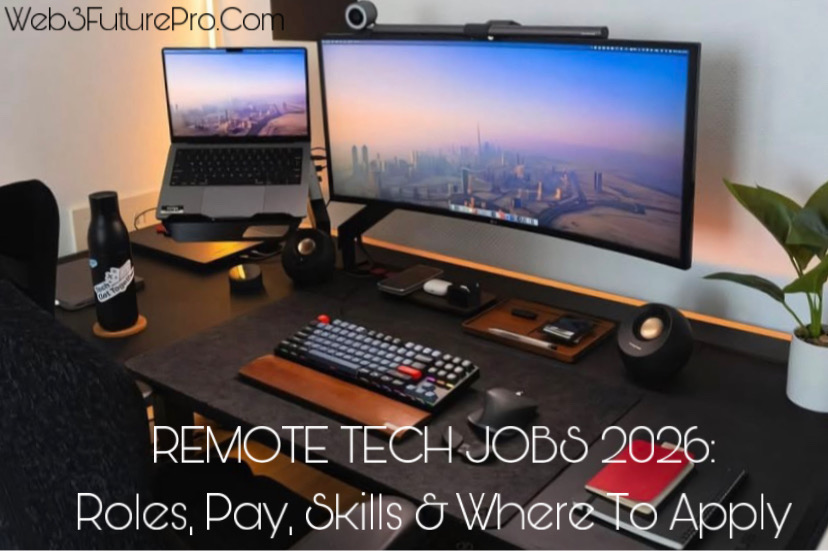
Remote tech jobs in 2026 offer opportunities for people who want to build careers in technology without commuting to a traditional office. From software development and cybersecurity to data analytics, artificial intelligence, cloud computing, and technical support, employers hire professionals to build digital products, manage systems, solve technical problems, and support customers from different locations.
For graduates, career changers, freelancers, and experienced professionals, remote technology work can provide access to international employers and projects beyond their local job markets.
However, finding a remote tech job requires more than having a laptop and an internet connection. Employers look for practical skills, relevant experience, strong communication, and the ability to work independently. Some positions require a computer science degree or several years of professional experience, while others place greater emphasis on demonstrable skills, certifications, personal projects, and a strong portfolio.
Entry-level candidates can explore roles such as IT support specialist, junior web developer, technical support analyst, software tester, and junior data analyst, depending on their existing knowledge and training.
If you read only the headlines, remote tech work is either dead (“return to office”) or booming (“AI hiring surge”). The data says something more useful and less dramatic: remote and hybrid postings have been flat for about a year, software hiring is recovering from a deep trough, and the roles are tilting heavily toward experienced people. For a senior engineer that is good news. For someone trying to land a first remote job, it changes the strategy.
This guide explains what the 2026 evidence actually shows, which remote tech roles exist and what they pay, what skills employers are asking for, where to look, how to avoid the scams that target remote job seekers, and how to build a realistic 90-day plan. It is written for beginners, career changers and working professionals, and it separates measured data from our own editorial judgment throughout.
How this guide was researched
We relied on primary and near-primary sources where we could: Indeed Hiring Lab’s research and its public remote tracker, the Federal Reserve Bank of New York, the U.S. Bureau of Labor Statistics (BLS), and Federal Trade Commission (FTC) data as reported by news outlets. Where a statistic reached us only through a secondary summary, we say so.
Three limits are important. First, most hard data here is U.S.-centric. Readers elsewhere face different markets, and we did not verify country-by-country figures beyond a brief UK reference. Second, we found no reliable, independently verified salary dataset for remote Web3 roles, so we do not publish Web3 salary figures; see your site’s own salary guide for that discussion and treat any such figures with caution. Third, job-posting data measures employer advertising, not actual hires, so it describes demand signals, not outcomes.
The 2026 remote tech jobs market in numbers

Remote work is a stable minority of postings, not a vanishing one. Indeed Hiring Lab’s remote tracker, which measures the share of postings that mention remote or hybrid work, showed 8.4% of U.S. postings on August 31, 2026, against 8.2% a year earlier, according to a summary of the tracker by Second Talent. The tracker’s methodology is public: it counts postings whose location is identified as remote, then searches the text for terms such as “remote work” and “hybrid role.” In the UK, Indeed’s mid-year report put the share of postings mentioning remote or hybrid at 16.9% at the end of June 2026, near its peak, and said employers cannot easily drop flexibility without narrowing their candidate pool.
Software development is among the more remote-friendly fields, but far less than at the peak. Indeed’s December 2023 analysis found 36% of software development postings advertised remote work, down from 43.7% earlier that year. The same summary of the 2026 tracker reports about 30.8% of software development postings mentioning remote or hybrid work, though that figure counts hybrid as well and comes from a secondary source, so do not compare the two numbers directly.
Software hiring is recovering from a trough. Summaries of Indeed Hiring Lab data via the St. Louis Fed’s FRED database show its U.S. software development postings index at about 78 in early October 2026, where February 2020 equals 100. That is roughly 21 to 22% below the pre-pandemic level but well above the low near 61 in May 2025, and it is about 21% higher than a year earlier.
CompTIA’s count of 625,633 active tech job postings in September 2026 is described as the highest in more than three years. We saw these through secondary sources, so verify them on FRED and CompTIA before quoting.
The long-run outlook is strong on paper. The BLS projects employment of software developers, quality assurance analysts and testers to grow 15% from 2024 to 2034, much faster than average, with about 129,200 openings a year. Across all computer and information technology occupations it projects about 317,700 openings a year. These are U.S. projections for all tech jobs, not remote jobs specifically.
AI skills are spreading into postings. Indeed’s UK report says postings mentioning AI or related tools reached 9.4% of all UK postings, the highest on record, with nearly half of data and analytics postings referencing AI. A summary of Indeed’s May 2026 U.S. data says over 47% of software development postings mentioned AI, compared with just over 5% of all U.S. postings; treat that as a secondary figure.
What it adds up to. Demand is returning, but it is concentrated in experienced roles, remote and hybrid postings are stable rather than growing, and AI fluency is becoming a normal expectation. That brings us to the issue that matters most for beginners.
The entry-level problem, and why it is bigger for remote roles
The most important number in this guide comes from Indeed Hiring Lab’s July 23, 2026 analysis. In the first quarter of 2026, only 4.5% of U.S. software development job postings were entry-level, the smallest share of any sector Indeed tracks, while senior-level roles made up 69.3%. Indeed’s seniority labels are assigned by an algorithm that reads the duties, experience and credentials in each posting, and it says manual checks found about 95% accuracy. By comparison, personal care and home health postings were 91.3% entry-level.
The broader trend is that senior-level postings rose 14.7% year over year as of May 2026, while entry-level postings have declined since their 2022 peak, down 7.5% year over year. Indeed notes that in tech, the 9-percentage-point growth in the senior share since 2019 came mainly at the expense of mid-level roles.
Why is this happening? Indeed lists several theories without choosing one: AI reducing demand for junior workers, the effect of remote work, interest-rate rises and a post-pandemic correction after over-hiring. A New York Fed analysis published June 1, 2026 by Natalia Emanuel, Emma Harrington and Amanda Pallais makes a pointed argument about the second.
It finds that youth unemployment and the prevalence of remote work have risen together, that remote work makes it harder for managers to train and mentor new employees, and it estimates that remote work can explain 64% of the recent rise in unemployment among young college graduates. The authors also say the timing suggests remote work, not generative AI, explains the bulk of that rise, while acknowledging AI may matter more in future.
This is one research team’s estimate, and other economists may disagree, but it fits what many hiring managers say: it is harder to train juniors you rarely see.
What this means in practice. If you are early in your career, a fully remote first job is the hardest version of the tech job hunt, because employers who hire remotely often want people who can work without close supervision. That is a reason to adjust your approach, not a reason to give up:
- Accept a hybrid, on-site or contract on-ramp if you can, then move to remote after one or two years of verifiable experience. This is our editorial advice, supported by the logic of the New York Fed findings.
- Show independence in your portfolio. Employers are screening for evidence that you can scope, build, document and ship without being managed.
- Look at adjacent entry points. Support engineering, quality assurance, technical writing, data analysis and developer relations often have more junior openings than core engineering, though we did not measure their entry-level shares.
- Be realistic about timelines. Indeed also notes that people who enter the labor market in weak hiring periods can see lower wages for up to a decade, which is a reason to build skills and experience steadily rather than to wait.
Remote tech roles compared
The table below is our editorial summary of the main remote-friendly paths. “Entry difficulty” is our judgment, informed by the entry-level data above, not a measured figure.
| Role | Typical work | Entry difficulty (editorial) | Key skills | Remote friendliness |
|---|---|---|---|---|
| Software engineer (web, backend, mobile) | Build and maintain applications | High for fully remote beginners | Programming, testing, version control, system design basics | High, with hybrid common |
| DevOps, cloud and site reliability | Deploy, monitor and secure infrastructure | High to medium | Linux, cloud platforms, automation, networking | High |
| Data analyst and data scientist | Analyze data, build reports and models | Medium to high | SQL, Python, statistics, communication | High |
| AI and machine learning engineer | Build and deploy models and AI features | High | Python, ML frameworks, data engineering, evaluation | High |
| Cybersecurity analyst and engineer | Detect, investigate and reduce risk | Medium to high | Networking, security tooling, scripting, incident response | Medium to high |
| UX and product designer | Research, design and test products | Medium to high | Research, prototyping, design tools, portfolio | High |
| Blockchain and smart contract developer | Build contracts and Web3 infrastructure | High; small market | Solidity or Rust, security, testing, protocol knowledge | High, often contract or token-paid |
| QA, support engineering, technical writing | Test, support and document products | Medium; often more junior openings (not measured) | Attention to detail, writing, tooling | High |
Your site already has comparison articles for many of these pairings, listed in the Related guides section below.
What remote tech roles pay

Salary data is where most career articles go wrong, so here is what is solid and what is not.
Solid anchors (U.S., all tech jobs, not remote-specific). The BLS reports a May 2024 median annual wage of $133,080 for software developers and $102,610 for software quality assurance analysts and testers, and $105,990 for the whole computer and information technology group, against a median of $49,500 for all U.S. occupations.
A secondary summary of BLS data lists information security analysts at about $124,910 and computer and information research scientists at about $140,910; verify these on the BLS site before quoting.
What these figures are and are not. They are medians for U.S. workers across all work arrangements, dated May 2024. They do not tell you what a remote role pays in Lagos, Manila, Warsaw or Toronto, what a first job pays, or what a Web3 company pays in tokens. Many remote employers also adjust pay by location, though we did not verify how common that is.
How to research your own number. Compare several posted ranges for your role and level, check whether the employer pays by location, and ask what share of compensation is cash versus equity or tokens. Pay-transparency rules in some places now require ranges in postings. Treat any single salary website’s average with caution, since they mix levels, locations and self-reported data.
A note on aggregated posting data. Some job-board analyses publish average posted pay by role. We found one that analyzes thousands of remote web developer postings, but its methodology is not independently verified, so we do not quote its salary figures.
Skills employers want in 2026

The evidence on skills is thinner than the evidence on hiring volume, so this section blends the data we have with editorial judgment, and labels which is which.
AI fluency is becoming a baseline. With AI mentioned in 9.4% of all UK postings and, per summaries of Indeed data, in nearly half of data and analytics postings and over 47% of U.S. software development postings, it is safe to say employers increasingly expect candidates to use AI tools well. In our judgment, this means using AI coding and research assistants productively while still understanding the code well enough to review, test and debug it. A portfolio that shows you can verify AI-assisted work is stronger than one that simply shows output.
Fundamentals still decide interviews. Programming fundamentals, data structures, version control, testing, databases and basic system design remain the core of most technical screens. This is editorial judgment, but it matches the logic of the market: when employers have many experienced applicants, they test for depth.
Written communication and async habits. Remote teams run on documents, tickets and pull requests. Clear writing, good status updates and the ability to unblock yourself are what the New York Fed research implicitly says is hard for junior workers to demonstrate at a distance. Showing these skills in your portfolio and application is a real differentiator.
Security hygiene. Remote employers worry about devices and credentials. Familiarity with multi-factor authentication, password managers, disk encryption and phishing awareness is increasingly assumed, and it is essential in Web3, where a single leaked key can be irreversible.
Domain depth. Generalists are competing with everyone. A specialty such as cloud infrastructure, data engineering, application security, smart contract security or machine learning evaluation makes you easier to place, though specialties also narrow your market.
Evidence over credentials. Certificates can help, but we did not verify any hiring data showing that they replace projects. Treat them as supplements.
Where to find legitimate remote tech jobs

We did not test job boards, so we do not rank them. Instead, here are the channels and how to use each safely.
Company career pages. Applying directly on a company’s official site avoids many fake listings. Build a list of 30 to 50 companies that hire remotely in your field and check their careers pages weekly.
General job boards. They have the volume, and also the most fake listings. Fortune’s reporting on FTC data notes that scammers post fake offers on legitimate job sites and impersonate recruiters. Verify the company independently before sharing personal information.
Niche boards. Boards focused on remote work, a specific language or Web3 can reduce noise. Check that listings link to real company pages and, for Web3 roles, that the project, team and funding are verifiable. Your site’s own guide to platforms for finding remote Web3 and AI jobs covers this topic; we did not review it for this article, so check its claims against current sources.
Freelance marketplaces. These can provide your first paid, verifiable work. See Fiverr vs Upwork for tech professionals and the section on freelancing below.
Open source and communities. Contributions to real projects are both portfolio evidence and a path to referrals. Many hires happen through people who have seen your work.
Referrals and direct outreach. A short, specific message to an engineer or hiring manager, referencing their product and a concrete way you could help, often beats a hundred anonymous applications. This is our editorial view, not a measured result.
How to apply and stand out
1. Target roles you can plausibly win. Given that only 4.5% of software postings are entry-level, apply to mid-level roles if you have relevant experience, and to junior, support, QA, data and contract roles if you do not.
2. Build a small portfolio with depth. Two or three well-documented projects with clear READMEs, tests, deployed demos and a short write-up of your decisions beat ten tutorial clones. See your site’s portfolio guide for remote blockchain careers for a Web3-specific angle.
3. Tailor your resume to each posting, matching real skills to the language of the description without padding.
4. Show remote readiness. Mention time-zone overlap, communication tools and examples of async work.
5. Prepare for take-home tests carefully. Time-box them, ask clarifying questions and document your assumptions. Be cautious about unusual instructions; see the scam section.
6. Understand the employment model. Remote employers may hire you as an employee, a contractor or through an employer-of-record service. Each has different tax, benefits and legal consequences, and international hires often face extra rules. Ask early, get terms in writing and consider professional tax or legal advice. This article is not legal or tax advice.
7. Negotiate with data. Use posted ranges and your own research, as described in the pay section, and ask about benefits, equipment budgets and how compensation is paid.
Remote job scams: how to spot and avoid them

Remote job seekers are prime targets, and the numbers are sobering. According to Fortune’s report on FTC data, reports of online job scams in the first half of 2025 rose 19% from the same period a year earlier and cost job seekers almost $300 million.
An earlier AP report on FTC data said reported losses to job scams more than tripled from 2020 to 2023, topped $220 million in the first half of 2024, and included about 20,000 reports of “task scams” in that half-year, up from 5,000 in all of 2023. The FTC and experts note that many victims never report, so true losses are likely higher.
Common red flags.
• An unsolicited text or WhatsApp message from a “recruiter,” which the FTC says is how task scams typically begin.
• Pay for “liking,” rating or clicking content, or completing simple online tasks for commissions.
• Little or no interview, immediate start and unusually high pay for little work.
• Requests to pay for equipment, training, software or background checks before you earn anything. The FTC’s advice is never to pay to get paid or to get a job.
• Early requests for your Social Security number, ID or bank details, before a verifiable offer.
• Links to “video interviews” that ask you to install software, which Fortune reports can be used to plant spyware.
• Messages that come from free email domains or messaging apps rather than a company address you can verify.
Extra caution for Web3 jobs. This is general security guidance, not drawn from our sources, but it is important:
• Never share a seed phrase or private key, and never sign a transaction as part of a hiring process.
• Do not run unfamiliar code from a recruiter on your main computer or on a machine that holds wallets or credentials. If a take-home test requires it, use a disposable virtual machine or a separate device with no keys.
• Verify the project and the recruiter through the company’s official website and known team members, not just through a chat message.
• Be wary of payment only in an unknown token, and understand how and when you will be paid before you work.
• Get a written contract that states the pay, currency, schedule and who the employer is.
If you suspect a scam, stop contact, do not send money, and report it to the relevant consumer protection authority in your country, such as the FTC in the United States.
Freelancing or full-time?
Neither is universally better. Your site’s comparison, Freelancing vs Full-Time Remote Tech Jobs, covers the topic for beginners; here is our own summary of the trade-offs, which is editorial rather than data-driven.
| Factor | Freelance or contract | Full-time employee |
|---|---|---|
| Income stability | Variable | More predictable |
| Entry barrier | Lower to start, hard to price | Higher in a tight market |
| Learning and mentoring | Self-directed | Often more structured, though remote mentoring is weaker, per the New York Fed research |
| Benefits | Usually your responsibility | Often included, depending on country |
| Portfolio building | Fast, varied | Deeper, slower |
| Admin and taxes | You handle them | Employer handles most |
A common route, which we describe as an option rather than a rule, is freelance or contract work to build verifiable experience, then a full-time role once you have a track record.
Working remotely well: setup, security and habits

Getting the job is half the challenge. Doing it comfortably and securely matters too.
Set up your workspace for your body. OSHA-derived guidance, as relayed by Purdue’s safety office, includes placing the top of the monitor at or slightly below eye level and taking short breaks regularly. An external monitor, a separate keyboard and mouse, and a supportive chair matter more than a faster processor for most remote workers.
Choose hardware that matches your work. For general remote work, a reliable laptop with enough memory is enough. Developers and AI engineers have heavier needs. We are preparing separate guides on laptops, developer hardware and AI computers, and we will link them once they are published rather than inventing URLs here.
Protect your devices and accounts. Use disk encryption, multi-factor authentication, a password manager, automatic updates and your employer’s security tools. Keep work and personal data apart.
Build habits that make you visible. Regular written updates, clear documentation and proactive communication help you stand out in a distributed team, particularly early in your career when mentoring happens through visible work.
A 90-day plan to land your first remote tech role
This plan is editorial, designed for someone with some skills who is not yet hired. Adjust it to your situation.
Days 1 to 30: foundation.
• Choose one target role from the comparison table and read ten real postings for it. List the repeated requirements.
• Close the biggest gaps with a structured course or project work.
• Set up a clean GitHub or portfolio site, a professional profile and a secure workspace.
• Learn the scam red flags above and set up multi-factor authentication on your accounts.
Days 31 to 60: proof.
• Build and publish two projects that match the postings you read, with documentation and tests.
• Contribute to one open-source project or complete a small paid contract.
• Write two short posts explaining decisions in your projects, which also demonstrates written communication.
• Make a list of 40 target companies and 10 people to contact.
Days 61 to 90: applications.
• Apply in batches, tailoring each application, and track results in a simple spreadsheet.
• Reach out to people at target companies with specific, short messages.
• Practice technical and behavioral interviews, and time-box take-home tests.
• Review what is and is not working weekly. If you get no interviews, change your resume or targets before sending more applications.
If, after this cycle, fully remote offers are not appearing, widen your search to hybrid, contract or adjacent roles. Given that only 4.5% of software postings are entry-level, that is a normal market signal, not a personal failure.
Frequently asked questions
Are remote tech jobs disappearing in 2026?
No. Indeed’s tracker shows the U.S. share of postings mentioning remote or hybrid work at 8.4% on August 31, 2026, roughly flat from 8.2% a year earlier, and the UK share is near its peak. The share is well below its pandemic-era high in software development, though.
Can a beginner get a fully remote tech job?
It is harder than it was. Only 4.5% of U.S. software development postings were entry-level in Q1 2026, and New York Fed research argues that remote work makes it harder for employers to train juniors. Many beginners do better by starting hybrid, contract, support, QA or data roles and moving to fully remote after building experience.
Which remote tech jobs are in demand?
Postings concentrate in experienced software, data, cloud and security roles, and AI fluency is spreading across them. The BLS projects 15% growth for software developers and QA roles from 2024 to 2034, though that covers all work arrangements.
How much do remote tech jobs pay?
It depends on role, level, employer and location. The BLS reports a May 2024 U.S. median of $133,080 for software developers and $105,990 across computer and IT occupations. We found no verified dataset specific to remote roles or Web3 pay, so verify ranges in actual postings.
Is AI taking entry-level tech jobs?
Economists disagree. Indeed lists AI as one of several possible causes of weak junior hiring, and the New York Fed team argues remote work explains most of the recent rise in youth unemployment, while noting AI may matter more later. The practical lesson is the same: build verifiable skills and learn to use AI tools well.
Do I need a degree for a remote tech job?
Indeed’s seniority methodology says entry-level software postings tend to require a bachelor’s degree, but a strong portfolio and experience matter, and requirements vary by employer. We did not verify how often employers waive degrees.
How do I spot a remote job scam?
Be suspicious of unsolicited recruiter messages, pay for simple online tasks, no interview, requests for upfront payment and early requests for sensitive personal information. The FTC’s advice is never to pay to get a job.
Are Web3 jobs a good way into remote work?
They can be, because many Web3 teams are distributed, but the market is smaller and more volatile, scams are common and pay may include tokens. We did not find verified Web3 hiring data, so research each employer carefully.
Is freelancing a good way to start?
For many people it is a way to build verifiable experience, but income is variable and you handle taxes and admin. See the comparison table above.
The remote tech job market in 2026 is neither dead nor booming. Remote and hybrid postings have held steady, software hiring is recovering from a deep trough, and AI skills are becoming a normal expectation. The harder truth is that the openings are tilted toward experienced workers, with entry-level roles at just 4.5% of software postings, and credible research suggests that fully remote arrangements make it even harder for employers to take on beginners.
That does not close the door. It means beginners should plan a route rather than a leap: build proof of independent work, take hybrid or contract steps when needed, aim at roles with more junior openings, protect themselves from scams and use AI tools to learn faster rather than to skip fundamentals. For experienced professionals, the picture is brighter, and the tools in this guide are about positioning and negotiating well.
Use the Related guides above to go deeper on specific careers, and check the sources below before you rely on any number.
Sources
URLs below were returned during our October 21, 2026 research. Secondary sources are labeled; verify their figures against the primary data before quoting.
1. The Labor Market Is Tilting Toward Seniority. Indeed Hiring Lab, July 23, 2026. Entry-level and senior shares, methodology, theories.
2. Remote Work Remains a Steady Presence in the Labor Market. Indeed Hiring Lab, December 12, 2023. Software development remote share then.
3. Indeed’s 2026 Mid-Year UK Jobs and Hiring Trends Report. Indeed Hiring Lab UK, August 3, 2026.
4. Indeed Remote Tracker. GitHub, Indeed Hiring Lab. Methodology for remote and hybrid posting shares.
5. Top 80+ Remote Work and Hiring Statistics 2026. Second Talent (secondary; relays Indeed tracker data to August 31, 2026).
6. Tech Hiring Statistics 2026. Copilot Interview (secondary; relays Indeed, FRED and CompTIA figures).
7. Entry-Level Software Engineer Job Market Statistics 2026. Rockstar Developer University (secondary).
8. Remote Work Leaves Younger Workers Sidelined. Emanuel, Harrington and Pallais, Federal Reserve Bank of New York Liberty Street Economics, June 1, 2026.
9. Software Developers, Quality Assurance Analysts, and Testers. U.S. Bureau of Labor Statistics, Occupational Outlook Handbook.
10. Computer and Information Technology Occupations. U.S. Bureau of Labor Statistics.
11. Software Engineer Job Outlook 2026: What the BLS Data Shows. Levelop (secondary; source of information security analyst and research scientist figures).
12. FTC data confirms job offer text scams are more common now. Fortune, November 17, 2025.
13. Beware of scams that promise good pay for completing easy online tasks. Associated Press via NY1, July 9, 2025.
14. Ergonomics. Purdue University (relays OSHA guidance).