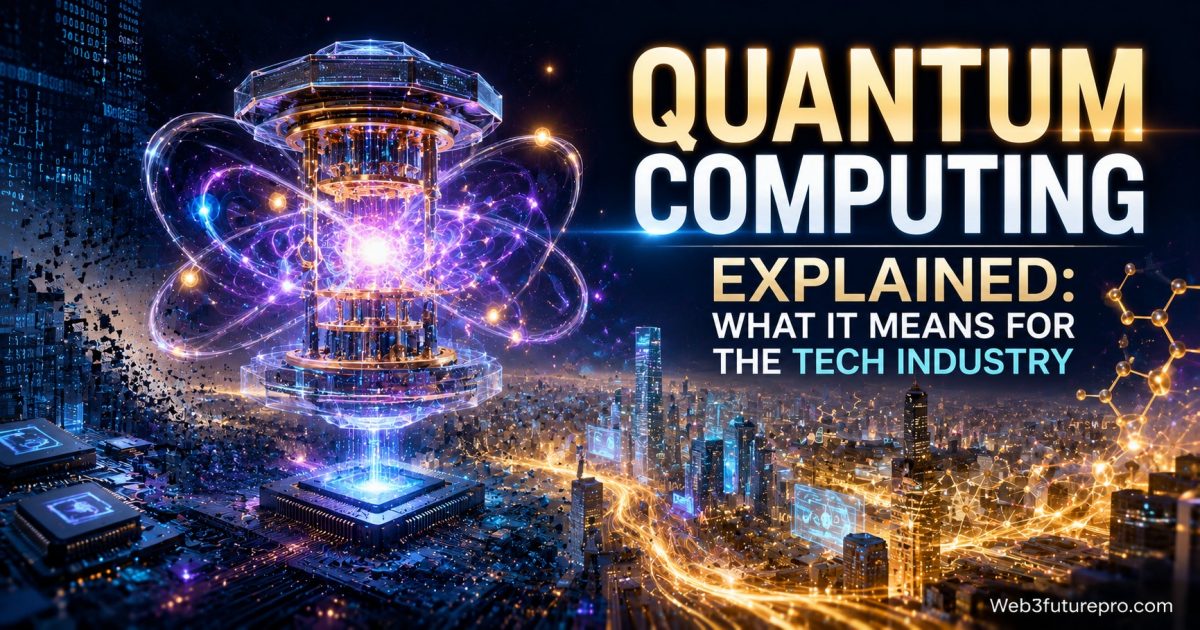
Quantum computing is widely regarded as one of the most revolutionary technologies of the 21st century, with the potential to transform industries, solve previously impossible problems, and redefine the future of computing. While traditional computers have powered the digital age for decades, quantum computers operate on fundamentally different principles that could enable them to process complex calculations at speeds far beyond the capabilities of even the most powerful supercomputers.
At the heart of quantum computing are concepts such as quantum bits (qubits), superposition, and entanglement. Unlike classical bits that exist as either 0 or 1, qubits can exist in multiple states simultaneously, allowing quantum systems to perform many calculations in parallel. This unique capability has attracted significant investment from technology giants, research institutions, and governments seeking to unlock breakthroughs in fields ranging from cybersecurity and artificial intelligence to pharmaceutical research and financial modeling.
As quantum technology continues to advance, its potential impact on the tech industry is becoming increasingly significant. Companies are exploring how quantum computing could accelerate scientific discovery, optimize complex business processes, improve machine learning models, and solve computational challenges that remain beyond the reach of conventional systems. Although practical, large-scale quantum computers are still under development, many experts believe the technology could become one of the most transformative innovations of the coming decades, reshaping the future of technology and global innovation.
CHECK: Can Artificial Intelligence Replace Software Developers in the Future?
There is a technology being built in laboratories across the United States, China, Europe, and Japan that operates on principles so counterintuitive they troubled even Albert Einstein. It processes information in ways that classical computers — every laptop, smartphone, and server in existence today — are physically incapable of replicating. And it is advancing fast enough that the world’s largest technology companies, most powerful governments, and most sophisticated investors are treating it not as a distant theoretical curiosity but as an imminent strategic priority.
That technology is quantum computing. And if the scientists and engineers working on it are even half right about its trajectory, it will be one of the most consequential technological developments of the twenty-first century.
But quantum computing is also one of the most misunderstood technologies in public discourse. It has been simultaneously over-hyped by breathless headlines and under-explained by the technical literature. The result is a widespread confusion in which many people have heard the term, absorbed a vague sense that it is important, and remain genuinely uncertain about what it actually is, what it can actually do, and why it should actually matter to anyone outside a physics laboratory.
What if computers could solve problems in minutes that would take the world’s fastest supercomputers billions of years? What if encryption systems that protect our banks, governments, and personal data could be broken in seconds? And what if we could simulate molecules with perfect accuracy to discover new medicines or revolutionary materials overnight?
This is the promise — and the looming reality — of quantum computing. In 2026, quantum technology has moved from pure scientific curiosity to a strategic priority for governments, tech giants, and forward-thinking investors. While still in its early commercial stages, the field is advancing faster than many expected, creating both enormous opportunities and serious risks for the entire technology industry.
This comprehensive guide explains what quantum computing actually is, how it works, where it stands in 2026, its potential to reshape entire industries, the major challenges ahead, and what it means for developers, companies, investors, and society at large.
Understanding Quantum Computing From the Ground Up
Why Classical Computers Have a Fundamental Limit
To understand quantum computing, it helps to first understand what classical computers do — and where they hit a wall.
Every classical computer, regardless of its size or processing power, stores and manipulates information as bits. A bit is the simplest possible unit of information: it is either a 0 or a 1. Everything a classical computer does — every calculation, every image rendered, every message sent — is ultimately a sequence of operations on bits arranged in patterns of zeros and ones.
Classical computers have become extraordinarily powerful by packing more and more transistors onto smaller and smaller chips, switching bits faster and faster. But this approach has a physical limit. Transistors are now so small that they are measured in nanometers — a few dozen atoms wide — and the laws of quantum mechanics begin to interfere with their reliable operation at this scale. The relentless miniaturization that drove five decades of computing performance improvements is approaching its physical boundary.
More fundamentally, there are entire categories of problems that classical computers cannot solve efficiently regardless of how fast they get. These are problems where the number of possible solutions grows exponentially with the size of the problem — so fast that even the most powerful supercomputer in existence would take longer than the age of the universe to find the answer by checking possibilities one at a time.
Quantum computing offers a fundamentally different approach to these problems.
What a Qubit Actually Is
The basic unit of quantum computing is the qubit — short for quantum bit. Like a classical bit, a qubit can represent a 0 or a 1. But unlike a classical bit, a qubit can also exist in a state called superposition — a condition in which it simultaneously represents both 0 and 1 until it is measured.
This is not a metaphor or a simplification. It is a literal description of how quantum mechanical systems behave, governed by the same physics that explains the behavior of electrons, photons, and atomic nuclei. When a quantum system is in superposition, it genuinely exists in multiple states at once. The act of measurement forces it to “choose” one state, at which point the superposition collapses and the qubit becomes a definite 0 or a definite 1.
The computational significance of superposition becomes clear when you consider a system of multiple qubits. Two classical bits can represent exactly one of four possible states at any given moment: 00, 01, 10, or 11. Two qubits in superposition can represent all four states simultaneously. Ten qubits can represent 1,024 states simultaneously. Three hundred qubits can represent more states simultaneously than there are atoms in the observable universe.
This exponential scaling of representational power is the foundation of quantum computing’s potential advantage over classical systems for certain classes of problems.
Entanglement: The Phenomenon Einstein Called “Spooky”
Superposition alone does not explain quantum computing’s power. The second critical quantum phenomenon is entanglement — a property by which two or more qubits become correlated in such a way that the state of one instantly influences the state of the others, regardless of the physical distance between them.
Einstein famously described this as “spooky action at a distance” and was deeply uncomfortable with its implications. He was right that it is deeply strange. But it is also real, experimentally verified beyond any reasonable scientific doubt, and enormously useful for quantum computation.
Entanglement allows quantum computers to create correlations between qubits that classical computers cannot efficiently simulate. When qubits are entangled, operations on one qubit can simultaneously affect all the qubits it is entangled with, enabling a kind of parallel computation that has no classical equivalent.
Quantum Interference: How Quantum Computers Find Answers
The third key quantum mechanical phenomenon in computing is interference — the ability of quantum states to combine in ways that amplify correct answers and cancel out incorrect ones.
This is, ultimately, how quantum algorithms work. A quantum computation is structured so that the quantum states corresponding to wrong answers interfere destructively — canceling each other out — while the states corresponding to correct answers interfere constructively, becoming more probable. When the system is finally measured, the answer that emerges is, with high probability, the correct one.
Designing quantum algorithms — the mathematical procedures that harness superposition, entanglement, and interference to solve specific problems — is one of the most demanding intellectual challenges in computer science. It requires simultaneously understanding quantum physics, advanced mathematics, and computational complexity theory. The small number of people who can do it well are among the most sought-after researchers in the technology industry.
The Current State of Quantum Hardware
Where the Technology Actually Stands in 2026
Understanding what quantum computers can do today requires setting aside both the hype and the skepticism and looking at the actual state of the hardware — which is genuinely impressive and genuinely limited in ways that matter.
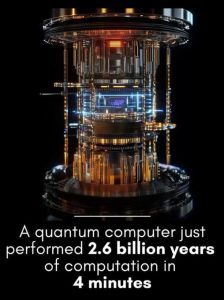
The leading quantum computing hardware platforms in 2026 include superconducting qubit systems (developed by companies including Google, IBM, and a cluster of well-funded startups), trapped-ion systems (developed by IonQ, Quantinuum, and others), photonic quantum systems, and neutral atom systems. Each approach has different tradeoffs in terms of qubit coherence times, gate fidelities, and scalability characteristics.
IBM has demonstrated systems with over a thousand physical qubits and is advancing aggressively toward larger systems with improved error rates. Google’s quantum computing division has published research demonstrating quantum advantage — the ability to perform specific computations faster than any classical supercomputer — for carefully chosen benchmark problems. Multiple other companies and national laboratories are achieving milestones that would have been considered years away just three years ago.
The Error Problem: The Core Engineering Challenge
Here is the honest caveat that every responsible account of quantum computing must include: today’s quantum computers are noisy.
In quantum computing terminology, “noise” refers to errors introduced by the interaction of qubits with their environment — temperature fluctuations, electromagnetic interference, vibrations, cosmic rays, and other physical disturbances that cause qubits to lose their quantum state prematurely. This loss of quantum state is called decoherence, and it is the central engineering challenge that quantum hardware developers are working to overcome.
Current quantum computers require qubits to remain coherent — to maintain their quantum state — for long enough to complete a meaningful calculation. The coherence times of the best current qubit implementations, while improving rapidly, are still short enough that only circuits of limited depth and complexity can be executed reliably before errors accumulate to the point of rendering the result meaningless.
The solution to this problem is quantum error correction — using multiple physical qubits to encode a single “logical qubit” that is protected against errors through redundancy. The challenge is that error correction is extraordinarily expensive in terms of physical qubit overhead. Current estimates suggest that a fully error-corrected logical qubit may require hundreds or even thousands of physical qubits, meaning that the path to a fault-tolerant quantum computer capable of solving commercially relevant problems at scale requires physical qubit counts in the millions.
No current system is close to this threshold. But the trajectory of improvement in qubit quality, error rates, and coherence times gives serious researchers confidence that fault-tolerant quantum computing is a matter of engineering progress rather than fundamental scientific obstacles.
The NISQ Era: What Is Possible Right Now
In the current era — which researchers call the Noisy Intermediate-Scale Quantum (NISQ) era — quantum computers are too error-prone for the applications that would generate the most dramatic practical value. But they are not useless.
NISQ devices are already being used for quantum chemistry simulations, optimization research, and the development and testing of quantum algorithms that will run more effectively on future, more capable hardware. They are also being used by research institutions and large enterprises to develop the internal expertise — the quantum-literate engineers, the workflow integrations, the software tooling — that will be needed when more capable hardware becomes available.
The companies and institutions that are investing in quantum capability now, during the NISQ era, are positioning themselves to move quickly when the fault-tolerant threshold is reached. The companies that wait for that threshold before engaging with quantum will face a steep learning curve at precisely the moment when competitive advantage is being established.
What Quantum Computing Can Actually Do
The Problems Quantum Computers Are Built to Solve

Quantum computers are not general-purpose replacements for classical computers. This is a common and important misconception to correct. For the vast majority of computational tasks that businesses and individuals perform daily — word processing, video streaming, database queries, web browsing, email — classical computers are perfectly adequate and quantum computers offer no meaningful advantage.
Quantum computers are specialized instruments designed to solve specific categories of problems that are intractable for classical systems. Understanding these categories is essential to understanding where the commercial value of quantum computing will actually appear.
Quantum chemistry and materials simulation. This is the application that many quantum computing researchers consider the most natural and the most certain to deliver transformative value. Simulating the quantum mechanical behavior of molecules and materials — understanding how electrons interact within complex chemical systems — is a problem that scales exponentially in difficulty as the system size grows, making it intractable for classical computers beyond a few dozen atoms. A fault-tolerant quantum computer could simulate the behavior of complex molecules with a precision that classical computers cannot approach, enabling the discovery of new drugs, new materials, new catalysts, and new battery chemistries with unprecedented efficiency.
Optimization problems. Many of the most economically significant computational problems in logistics, finance, manufacturing, and energy management are optimization problems — finding the best solution among an astronomically large number of possibilities. Routing problems, portfolio optimization, supply chain scheduling, traffic management, and energy grid optimization are all in this category. Quantum algorithms exist that offer theoretical speedups over the best known classical approaches for certain optimization problem structures.
Cryptography and code-breaking. This is the application that generates the most strategic and security concern. A sufficiently powerful quantum computer running an algorithm called Shor’s algorithm could break the public-key cryptographic systems — RSA, elliptic curve cryptography — that currently protect the vast majority of encrypted communications and digital transactions on the internet. This is not a future hypothetical; it is a known and mathematically proven vulnerability. The question is only one of timing: how long before quantum computers are powerful enough to run Shor’s algorithm at scale against real-world encryption key sizes.
Machine learning and AI. The relationship between quantum computing and artificial intelligence is complex and actively researched. Certain quantum machine learning algorithms offer theoretical speedups over classical equivalents for specific problem structures. Whether these theoretical advantages translate to practical speedups on real quantum hardware, for problems of real commercial interest, remains an active area of research with genuinely uncertain outcomes.
The Fundamental Difference: Classical vs Quantum Computing
To understand quantum computing, we first need to understand how today’s computers work.
Classical Computers (the ones we all use):
- Store and process information using bits — tiny switches that are either 0 or 1.
- Perform calculations sequentially or in parallel through massive numbers of transistors.
- Excellent at everyday tasks but struggle with certain complex problems (optimization, simulation of quantum systems, factoring large numbers).
Quantum Computers:
- Use qubits (quantum bits) that can exist in multiple states simultaneously thanks to quantum mechanics.
- Leverage two mind-bending properties: superposition and entanglement.
Superposition
A classical bit is either 0 or 1. A qubit can be in a combination of both 0 and 1 at the same time. With enough qubits, a quantum computer can explore an enormous number of possibilities simultaneously.
Entanglement
When qubits become entangled, the state of one instantly influences another, no matter how far apart they are. This creates powerful correlations that classical systems cannot replicate efficiently.
These properties allow quantum computers to tackle certain problems exponentially faster than classical machines.
How Quantum Computers Actually Work (Simplified)
A quantum computer typically consists of:
- Qubits — Physical implementations can use superconducting circuits (most common today), trapped ions, photons, or neutral atoms.
- Quantum Gates — Operations that manipulate qubits, similar to logic gates in classical computing.
- Measurement System — Collapses quantum states into classical 0s and 1s to extract results.
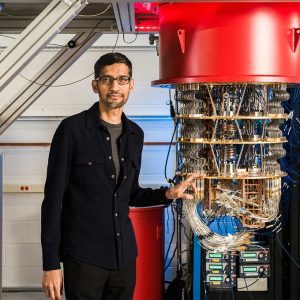
- Error Correction — Critical because qubits are extremely fragile and prone to “decoherence” (losing their quantum properties due to environmental noise).
Because of error rates, today’s quantum computers are often called Noisy Intermediate-Scale Quantum (NISQ) devices. They are powerful enough for specific tasks but not yet reliable for large-scale, practical applications.
The State of Quantum Computing in 2026
Progress has been impressive but uneven:
- Qubit Count: Leading systems now have hundreds of qubits (IBM, Google, Quantinuum, IonQ). Error-corrected logical qubits are still in the single to low double digits.
- Breakthroughs: Better error correction techniques, longer coherence times, and hybrid quantum-classical algorithms.
- Commercial Activity: Cloud access to quantum hardware is widely available. Companies are running real experiments and small-scale optimizations.
- Government Investment: Massive national programs in the US, China, EU, and others treat quantum as a strategic technology.
We are still in the pre-fault-tolerant era, but the path to useful quantum advantage is becoming clearer.
Major Applications That Could Transform Industries
1. Drug Discovery and Healthcare
Quantum computers can simulate molecular interactions with unprecedented accuracy. This could slash drug development timelines and costs dramatically.
Impact: Faster discovery of new medicines, better understanding of diseases, and personalized treatment design.
2. Materials Science and Chemistry
Designing new materials (batteries, superconductors, fertilizers, carbon capture materials) at the quantum level.
Potential: Revolutionary advances in clean energy, manufacturing, and sustainability.
3. Optimization and Logistics
Solving complex optimization problems (supply chains, traffic routing, financial portfolio optimization) that are practically impossible for classical computers.
4. Financial Modeling
Better risk assessment, option pricing, and fraud detection through quantum Monte Carlo methods and other algorithms.
5. Cryptography and Cybersecurity
Shor’s Algorithm could eventually break current public-key encryption (RSA, ECC). This creates both a massive risk (quantum decryption) and opportunity (development of post-quantum cryptography).
6. Artificial Intelligence and Machine Learning
Quantum machine learning algorithms could offer exponential speedups for certain training and inference tasks.
Leading Quantum Computing Companies in 2026
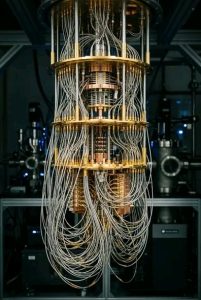
- IBM — Strong full-stack approach with extensive cloud access and research.
- Google Quantum AI — Focused on error correction and supremacy demonstrations.
- Quantinuum (Honeywell) — Leading trapped-ion systems with high fidelity.
- IonQ — Public company pushing trapped-ion technology.
- Rigetti — Superconducting systems with hybrid focus.
- PsiQuantum — Ambitious photonic approach aiming for million-qubit systems.
- Chinese efforts (Origin Quantum, etc.) — Significant state-backed progress.
Challenges That Remain Significant
Technical:
- Qubit stability and error rates.
- Scalability to millions of logical qubits.
- Need for extreme operating conditions (near absolute zero for many systems).
Economic:
- Extremely high cost of building and maintaining quantum hardware.
- Unclear timeline for broad commercial advantage.
Talent:
- Severe shortage of quantum engineers and researchers.
Security:
- The “harvest now, decrypt later” threat — adversaries collecting encrypted data today for future quantum decryption.
What This Means for the Tech Industry
Winners:
- Companies that integrate quantum capabilities early (pharma, chemicals, finance, logistics, cybersecurity).
- Hardware providers and cloud quantum services.
- Post-quantum cryptography developers.
- Talent in quantum-related fields.
Risks:
- Disruption of current encryption standards could create security crises.
- Massive capital requirements could concentrate power among well-funded players.
- Overhype cycles may lead to investment bubbles and disappointment.
Strategic Implications:
- Tech giants are heavily investing to avoid being left behind.
- Nations are treating quantum as a matter of technological sovereignty.
- Hybrid quantum-classical computing will likely dominate for the next decade.
Timeline Expectations
2026–2028: Continued progress in error correction. More specialized quantum advantage demonstrations. Early commercial pilots in optimization and chemistry.
2028–2032: Fault-tolerant systems with hundreds of logical qubits. Practical applications in specific industries.
2032+: Broader commercial viability. Potential for transformative breakthroughs in multiple sectors.
Practical Advice for Different Stakeholders
For Tech Companies:
- Begin quantum readiness assessments now.
- Invest in post-quantum cryptography migration.
- Explore hybrid quantum-classical solutions for specific problems.
- Build talent pipelines through partnerships with universities.
For Investors:
- Focus on companies with strong technical moats and clear use cases.
- Diversify across hardware, software, and application layers.
- Maintain realistic timelines — quantum is a marathon, not a sprint.
For Developers and Engineers:
- Learn quantum basics (Qiskit, Cirq, Q#).
- Develop hybrid skills combining classical and quantum computing.
- Specialize in high-demand areas like quantum algorithms, error correction, or applications.
For Everyone Else:
- Stay informed — quantum will affect cybersecurity, medicine, and many industries.
- Support education and research initiatives in this field.
A Transformative Technology on the Horizon
Quantum computing represents one of the most significant technological shifts since the invention of the transistor. While we are still in the early chapters of its development, the progress in 2026 suggests that the long-promised quantum revolution is beginning to materialize.
For the tech industry, this means both opportunity and urgency. Companies that prepare strategically — by investing in talent, exploring applications, and securing their systems — will be best positioned to thrive. Those that ignore it risk being disrupted when quantum advantage becomes commercially relevant.
The future will not be entirely quantum. It will be hybrid — classical systems handling most everyday tasks, with quantum computers accelerating the hardest, most valuable problems. This combination could unlock scientific and economic progress on a scale that reshapes civilization.
Quantum computing is not coming someday. The foundations are being built right now. The only question is who will be ready when it truly arrives.
Quantum computing represents a major leap forward in computational technology, offering the possibility of solving problems that are currently too complex for traditional computers. By harnessing the principles of quantum mechanics, these advanced systems have the potential to revolutionize fields such as artificial intelligence, cybersecurity, scientific research, logistics, and financial analysis. While the technology remains in its developmental stages, its long-term impact could rival or even surpass some of the most important technological breakthroughs in modern history.
For the tech industry, quantum computing presents both extraordinary opportunities and significant challenges. Organizations that invest early in quantum research, workforce development, and next-generation security solutions may gain a competitive advantage as the technology matures. At the same time, businesses must prepare for a future where existing encryption methods, computational models, and software architectures may need to evolve to accommodate quantum capabilities.
Although widespread commercial adoption may still be years away, the momentum behind quantum computing continues to grow. Governments, startups, and major technology companies are investing heavily in research and development, signaling strong confidence in the technology’s future potential. As breakthroughs continue to emerge, quantum computing is expected to play a crucial role in shaping the next era of technological innovation, unlocking possibilities that were once considered beyond the limits of modern computing.