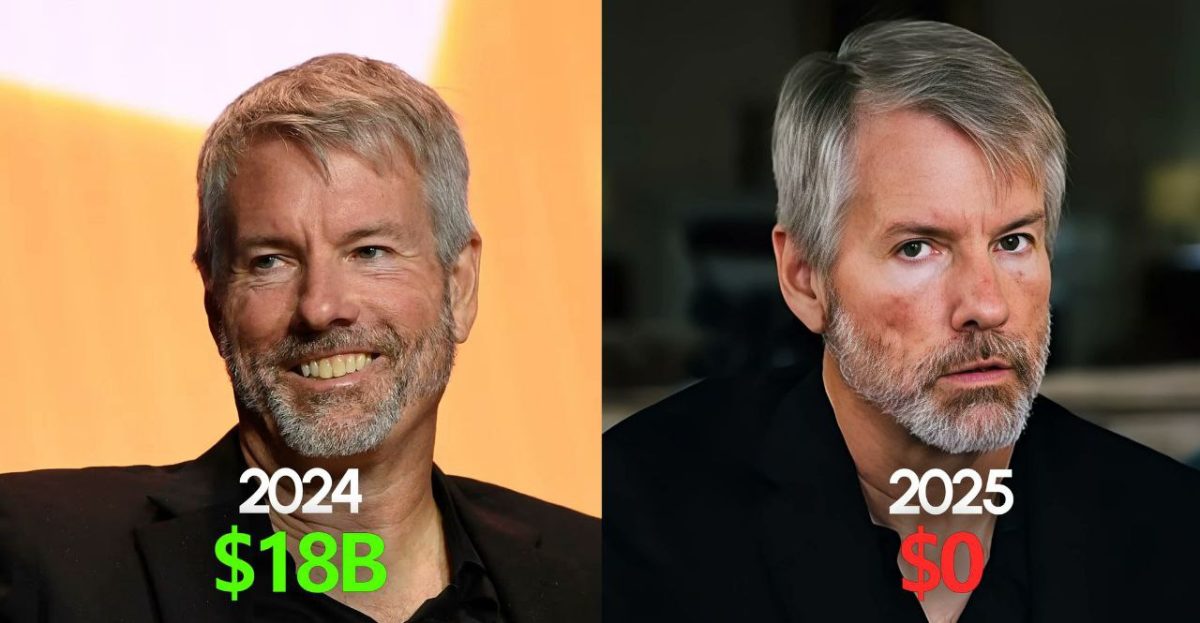
Michael Saylor Net Worth in 2026: Michael Saylor is one of the most recognizable figures in both the technology and cryptocurrency industries. As the co-founder and Executive Chairman of MicroStrategy (now known as Strategy), he built a successful software company before becoming one of the world’s most influential Bitcoin advocates. His bold decision to transform Strategy into a Bitcoin-focused corporate treasury company reshaped his public image and established him as a leading voice in the digital asset revolution.
Saylor first achieved billionaire status during the dot-com boom of the late 1990s before experiencing a dramatic decline in wealth following the technology market crash. However, his long-term belief in innovation and strategic investments helped him rebuild his fortune. Today, much of his wealth is tied to Strategy’s stock performance, his personal Bitcoin holdings, and his influence within the cryptocurrency ecosystem. According to Forbes, Michael Saylor’s net worth is estimated at approximately $3.7 billion as of June 2026, making him one of the wealthiest Bitcoin proponents in the world.
CHECK: Michael Saylor Biography: MicroStrategy Founder, Bitcoin Maximalist & Executive Chairman
This article explores Michael Saylor’s net worth in 2026, his career achievements, major income sources, investment strategy, assets, and lifestyle, offering insight into how he built and maintained his fortune through multiple technological revolutions.
Who Is Michael Saylor?

There are people who bet on Bitcoin. Then there is Michael Saylor — the man who turned a publicly traded software company into the world’s largest corporate Bitcoin treasury, and in doing so, invented an entirely new category of institutional finance.
You could describe Saylor as a tech entrepreneur. You could call him a Bitcoin maximalist, a financial provocateur, or a visionary who has staked his entire legacy on a single, uncompromising thesis: that Bitcoin is the most superior asset ever created, and that every dollar not invested in it represents a failure of judgment. He has said this in boardrooms and on Bloomberg television and at conferences in Miami and Prague. He has backed the claim by purchasing Bitcoin in amounts that still shock institutional investors — not once or twice but week after week, quarter after quarter, through bull runs and bear markets and every shade of regulatory uncertainty in between.
In 2026, Strategy Inc. — the company formerly known as MicroStrategy, which Saylor co-founded in 1989 and led for 33 years — holds over 818,000 Bitcoin. That is more Bitcoin than any other publicly traded company on Earth. It is more, reportedly, than BlackRock. It trails only the presumed holdings of Bitcoin’s anonymous creator, Satoshi Nakamoto. And Saylor’s personal stake in this extraordinary enterprise, combined with his own Bitcoin holdings, places his estimated net worth at approximately $4.2 to $4.7 billion in early to mid-2026 — a figure that has swung by more than $5 billion within a single year.
Saylor is not simply a crypto billionaire. He is one of the most consequential and most polarising figures in the history of corporate finance. His story is not a straight line to success. It is a career of extremes — of a man who lost more money in a single day than most people earn in a lifetime, rebuilt from nothing, and then placed the biggest corporate Bitcoin bet in history.
Quick Snapshot of Net Worth
| Metric | Detail |
|---|---|
| Full Name | Michael J. Saylor |
| Date of Birth | February 4, 1965 |
| Place of Birth | Lincoln, Nebraska, USA |
| Nationality | American |
| Current Residence | Miami Beach, Florida |
| Net Worth (Forbes, Early 2026) | ~$4.7 billion |
| Net Worth (Bloomberg, May 2025 Peak) | ~$7.37 billion |
| Net Worth (Post-Correction, Feb 2026) | ~$3.4 billion |
| Primary Wealth Source | ~8% equity stake in Strategy Inc. (MSTR) |
| Personal Bitcoin Holdings | ~17,732 BTC (~$1.37B at mid-2026 prices) |
| Strategy BTC Holdings (April 2026) | 818,334 BTC (largest corporate holder) |
| Key Role | Executive Chairman, Strategy Inc. (formerly MicroStrategy) |
Career Journey
Early Life and Education
Michael Jeffrey Saylor was born on February 4, 1965, in Lincoln, Nebraska. His father was a chief master sergeant in the United States Air Force — a profession that meant the Saylor family moved frequently, living on Air Force bases across the country and abroad, including postings in Japan and New Zealand. It was a childhood defined by adaptation, discipline, and exposure to the world beyond American borders.
In 1976, when Saylor was approximately eleven years old, the family settled in Fairborn, Ohio, near Wright-Patterson Air Force Base — one of the most significant military research centres in the U.S. Air Force’s history. The proximity to aeronautical engineering excellence was not lost on a boy with a powerful scientific mind. At Park High School in Fairborn, Saylor excelled academically, graduating as class valedictorian. His classmates voted him “most likely to succeed.”
In 1983, Saylor enrolled at the Massachusetts Institute of Technology on a full Air Force Reserve Officers’ Training Corps (ROTC) scholarship — one of the most prestigious academic and military accolades available to a high school graduate. At MIT, the institution that has produced more Nobel laureates and tech entrepreneurs per square foot than arguably anywhere else in the world, Saylor pursued a dual degree in Aeronautics and Astronautics alongside Science, Technology, and Society. He graduated with highest honours in 1987.
The choice of disciplines was revealing. Aeronautics gave him engineering rigour — the kind that demands precision, tolerates no ambiguity, and insists on testing every assumption against physical reality. Science, Technology, and Society gave him a macro lens — a way of asking not just how systems work, but what they mean and what they do to human civilisation over time. Both modes of thinking are visible in everything Saylor has built and argued.
His undergraduate thesis — a computer simulation modelling the social and economic dynamics of a Renaissance Italian city-state — now reads as almost eerily prophetic. It was systems thinking applied to the movement of money and power through a society. Bitcoin, as Saylor would later frame it, is the system that performs that function for the 21st century at global scale.
There was one ambition the Air Force scholarship was supposed to serve that did not work out. Saylor had aspired to become a military pilot. A medical issue during Air Force training ended that dream before it began, redirecting him into business and technology consulting. It was one of those redirections that, in retrospect, changed not just a career but the history of an industry.
At MIT, Saylor met Sanju Bansal — his future business partner, and the man who would co-found MicroStrategy with him a few years later. The meeting of those two minds in MIT’s corridors set in motion a company that would eventually hold more Bitcoin than any other public corporation in the world.
Entry Into the Tech Industry
After MIT, Saylor served briefly as a Second Lieutenant in the Air Force Reserve. He then moved into corporate consulting, developing computer simulations for industrial giants including DuPont and Exxon — a role that married his engineering precision with his interest in decision modelling. He was already, at 22, thinking about how large systems could be optimised through data and computation.
That thinking crystallised into a business idea in 1989. At just 24 years old, Saylor co-founded MicroStrategy with Sanju Bansal in Washington, D.C. The company’s original mission was data mining and business intelligence — helping large organisations extract meaningful patterns from datasets that were, by the standards of 1989, enormous. The concept was ahead of its time, but Saylor’s sales instincts were sharp. In 1992, MicroStrategy landed a $10 million contract with McDonald’s to build analytical tools for the fast food giant’s promotional strategy. That deal gave the company its credibility and its growth trajectory.
MicroStrategy went public on the NASDAQ in 1998 under the ticker MSTR. The timing was perfect — the dot-com bubble was inflating, enterprise software was a favourite of institutional investors, and MicroStrategy’s revenue was growing rapidly. Saylor became a darling of the tech press, appearing in the pages of The New Yorker and Newsweek, comparing himself to Caesar and Edison, and promising to “purge ignorance from the planet.” He announced plans to invest $100 million of his personal fortune in an online university.
Then came March 20, 2000 — a date Saylor has described as one he will never forget.
On that day, MicroStrategy was forced to issue a devastating financial restatement. The company’s accountants at PricewaterhouseCoopers had discovered that MicroStrategy had been improperly recognising revenue over the preceding three years — inflating its reported earnings by tens of millions of dollars. In a single trading session, MicroStrategy’s stock dropped from $260 per share to $86, before continuing to fall further in subsequent weeks. Saylor personally lost approximately $6 billion in a single day — a sum that remains one of the largest single-day personal wealth destructions in American business history.
The SEC charged Saylor and two other executives with accounting fraud. Without admitting or denying guilt, Saylor consented to a final judgment, paid approximately $8.28 million in disgorgements and a $350,000 civil penalty. MicroStrategy’s revenues were restated; the dot-com dream collapsed. Saylor did not resign. He rebuilt.
Major Achievements and Milestones
The years between 2000 and 2020 were ones of patient reconstruction. Under Saylor’s leadership, MicroStrategy pivoted from a speculative dot-com darling to a solid, if unspectacular, enterprise analytics software company. It rebuilt its balance sheet, retained its enterprise client base, and generated consistent cash flow. It was not glamorous work, but it was honest work — and it kept the company alive through a period when dozens of its contemporaries had disappeared entirely.
Then came August 11, 2020 — the second pivotal date in Saylor’s career.
On that date, MicroStrategy announced that it had purchased 21,454 Bitcoin for approximately $250 million — the company’s entire cash treasury — as a primary reserve asset. The decision was justified publicly in a remarkable letter from Saylor, in which he argued that the U.S. dollar was experiencing monetary debasement through Federal Reserve quantitative easing and that Bitcoin was the superior store of value. It was, at the time, one of the most radical financial decisions ever made by the board of a publicly traded American company.
The reaction was split. Many Wall Street analysts called the move reckless. Others viewed it as visionary. Bitcoin, at the time of the purchase, was trading near $11,700.
The Bitcoin purchases did not stop at $250 million. They accelerated. Through a series of equity issuances, convertible debt offerings, and what Saylor would later call the “21/21 Plan” — a structured programme of $21 billion in equity raises and $21 billion in debt issuances — Strategy accumulated Bitcoin at a pace and consistency that has no precedent in corporate financial history.
By April 2026, Strategy held 818,334 Bitcoin, acquired for a cumulative $27.3 billion at an average cost of approximately $45,400 per coin. At Bitcoin’s mid-2026 price of approximately $77,500, that position is worth roughly $63 billion — an unrealised gain of over $35 billion.
Saylor stepped down as CEO of MicroStrategy in August 2022, following a quarter in which the company reported a $917 million impairment loss on its Bitcoin holdings during the crypto winter. Phong Le became CEO, while Saylor retained the role of Executive Chairman — allowing him, as he stated publicly, to focus “more on Bitcoin acquisition strategy and related Bitcoin advocacy initiatives.” The company subsequently rebranded entirely as Strategy Inc. in 2025, formally acknowledging that Bitcoin accumulation — not business intelligence software — had become its defining corporate identity.
MicroStrategy was added to the Nasdaq 100 in December 2024, cementing its status as a legitimate component of America’s benchmark technology index. In early 2026, prediction markets give a 61% probability that Strategy will reach its stated goal of holding 1 million Bitcoin by the end of 2026.
Additional recognition came steadily. Forbes’ January 2025 cover story profiled Saylor as one of the defining financial figures of the Bitcoin era. He has spoken at the World Economic Forum, Bitcoin Miami, and BTC Prague — consistently delivering the same message with the evangelical intensity of a man who has staked everything on a single, unshakeable conviction.
Net Worth Breakdown
Estimated Michael Saylor Net Worth in 2026

Michael Saylor’s wealth is perhaps the most extreme example in global finance of a fortune that moves in lockstep with a single asset class. Almost every dollar of his net worth is ultimately anchored to Bitcoin — either through his equity stake in Strategy (whose value is determined primarily by its Bitcoin treasury) or through his personal Bitcoin holdings.
The result is a fortune that behaves like a leveraged Bitcoin position. When Bitcoin rises, Saylor’s wealth rises faster than BTC itself — because Strategy’s stock trades at a premium to its Bitcoin net asset value (historically between 1.5x and 3x). When Bitcoin falls, his wealth falls just as amplified.
The data tells this story clearly:
- November 2024: Strategy hit its all-time high share price of $543. Saylor’s net worth peaked at approximately $11.4 billion.
- May 2025 (Bloomberg entry): Saylor made his first appearance on the Bloomberg Billionaires Index with a net worth of $7.37 billion, ranking 491st globally.
- Early February 2026: Following a significant Bitcoin correction, Forbes placed his net worth at approximately $4.7 billion, ranking him #866 globally — a decline of approximately $5.4 billion from his 2025 peaks.
- Late February / March 2026: Further Bitcoin weakness pushed estimates lower, with some trackers placing his fortune closer to $3.4 billion.
- April 2026: Partial market recovery placed estimates back in the $4.2–$4.7 billion range.
The composition of Saylor’s wealth is straightforward by billionaire standards:
His primary asset is his approximately 8% equity stake in Strategy Inc., comprising approximately 19.6 million Class B shares and 382,000 Class A shares. This stake is worth approximately $3–6 billion depending on MSTR’s share price. Saylor’s voting power within Strategy significantly exceeds his economic ownership, giving him effective control of a company with an $80+ billion market capitalisation.
His secondary asset is his personal Bitcoin treasury — approximately 17,732 BTC held in his own name, separate from Strategy’s corporate holdings. At Bitcoin’s mid-2026 price of approximately $77,500, this personal stack is worth approximately $1.37 billion.
Bloomberg’s breakdown of his wealth during his peak period noted approximately $6.72 billion in Strategy equity and approximately $650 million in cash. Outside of these, Saylor’s diversification is minimal — by design.
Sources of Income
Tech Companies and Startups — Strategy Inc.
Strategy Inc. — the corporate entity Saylor co-founded in 1989 and still controls as Executive Chairman — is the financial engine of his wealth, though its economic character has changed entirely from its origins.
When Saylor founded MicroStrategy, it was a data mining and business intelligence company that earned revenue from enterprise software licences and consulting services. That business still exists. Strategy continues to sell analytics and business intelligence software to corporate clients. But this revenue stream — which was, for two decades, the company’s entire reason for existing — is now almost irrelevant to the company’s valuation. Strategy’s market capitalisation in early 2026 sits at approximately $80–100 billion. Its software business generates a fraction of that in annual revenue. The rest of the valuation is entirely a reflection of its Bitcoin holdings and the premium investors assign to the “Bitcoin treasury company” model.
That model works as follows: Strategy raises capital — through equity issuances at a premium to its Bitcoin NAV, through convertible notes, through preferred stock offerings — and deploys every dollar of that capital into purchasing more Bitcoin. The cycle is self-reinforcing as long as MSTR trades at a premium to its Bitcoin holdings: selling equity at a premium to NAV is, in effect, a mechanism for acquiring more Bitcoin per share of equity than the share price implies. Saylor has called this “Bitcoin yield,” and Strategy achieved a 9.6% Bitcoin yield in the first part of 2026 alone.
Between August 2024 and March 2026, Strategy raised an estimated $28.7 billion through at-the-money equity programmes, including the landmark “21/21 Plan” announced in October 2024, which authorised $21 billion in equity raises and was fully exhausted by approximately May 2025.
Investments
Beyond Strategy and his personal Bitcoin stack, Saylor’s investment portfolio is deliberately and conspicuously undiversified. He has stated on multiple public occasions that he does not own real estate for investment purposes, does not hold significant equity positions in other companies, and does not diversify into gold, bonds, or other traditional stores of value.
Bitcoin is, in his view, the only investment that matters. His thesis — articulated across thousands of public appearances, interviews, and social media posts — is that all other assets are depreciating against Bitcoin over time, and that holding any other asset represents an opportunity cost measured in Bitcoin terms.
This maximalism is not rhetorical. It is his actual investment posture. His personal BTC stack of 17,732 coins was acquired before Strategy’s corporate buying programme began, at average prices significantly below current levels. Even at mid-2026 prices, his unrealised gain on that personal stack is substantial.
Saylor also holds intellectual property in the form of 29 patents spanning security, automation, and business intelligence — assets with modest commercial value but significant historical interest as evidence of his technical breadth.
Endorsements and Partnerships
Saylor does not have a traditional sponsorship or endorsement portfolio. His brand is ideological, not commercial — and in that sense, it is more powerful than any conventional endorsement arrangement could be.
His public profile generates economic value for Strategy in ways that are difficult to quantify but impossible to overstate. Every appearance on Bloomberg, CNBC, or at a major Bitcoin conference is effectively a marketing event for MSTR stock. When Saylor speaks, Bitcoin markets react, institutional attention is directed toward Strategy’s thesis, and MSTR’s premium to NAV is sustained.
He has served as an informal strategic adviser to Bitcoin advocates globally — including meetings with politicians and policymakers who are designing sovereign Bitcoin reserve frameworks. The Trump administration’s pro-Bitcoin posture, which included discussions of a U.S. strategic Bitcoin reserve, is a policy environment Saylor has spent years actively advocating for. His speech at the White House Bitcoin summit in early 2025 was a moment of institutional validation that few could have predicted even three years earlier.
His media presence extends to his own content ecosystem — the “Saylor Series” interviews, Bitcoin fundamentals presentations, and a body of public writing about monetary theory that has been downloaded and shared millions of times. This intellectual content is not monetised through traditional channels, but it anchors his public credibility and sustains the narrative infrastructure that supports Strategy’s valuation.
Yearly Earnings Growth
| Year | Estimated Net Worth | Key Driver |
|---|---|---|
| 1999 (Peak) | ~$7 billion | MicroStrategy dot-com bubble peak |
| 2000 | Near zero | MicroStrategy restatement, $6B loss in one day |
| 2010–2019 | < $1 billion | MicroStrategy recovery; enterprise software |
| 2020 | ~$1–2 billion | First Bitcoin purchases announced |
| 2021 | ~$2–3 billion | Bitcoin bull market; MicroStrategy stock rally |
| 2022 | < $1 billion | Crypto winter; 90%+ MSTR drawdown |
| 2023 | ~$1–2 billion | Bitcoin stabilisation; market floor |
| 2024 (Peak Nov) | ~$11.4 billion | MSTR all-time high of $543/share |
| 2025 (Bloomberg entry) | ~$7.37 billion | Nasdaq 100 inclusion; Bitcoin super cycle |
| 2026 (Current) | ~$3.4B–$4.7B | Bitcoin correction; partial recovery |
Saylor’s wealth history is extraordinary in both directions. He has lost more than $6 billion in a single day — twice, if you count both March 2000 and the various Bitcoin drawdowns. He has also built multiple multi-billion-dollar fortunes from near-zero starting points. No other figure in American business history has experienced comparable wealth volatility at this scale.
Lifestyle and Assets
Real Estate Holdings
Michael Saylor’s real estate portfolio is one of the most famous in Washington, D.C. legal history — for reasons that have nothing to do with the properties themselves.
For years, Saylor maintained a penthouse suite at the Trigate building in Washington, D.C. — a lavish personal residence that DC tax authorities alleged was his primary domicile, regardless of where he claimed to be officially based. He also owned a luxury condominium in the Eden complex in Washington, D.C., and officially claimed residency in either Florida or Virginia, depending on the period in question.
The D.C. Attorney General’s office saw things differently. In 2022, AG Karl Racine sued Saylor for tax fraud, alleging he had lived in D.C. for more than a decade while declaring residency in lower-tax jurisdictions, thereby evading hundreds of millions of dollars in D.C. income taxes. The complaint cited Saylor’s own Facebook posts, corporate jet flight records, and the docking of what it described as “at least two of his luxury yachts” on the Georgetown waterfront as evidence of his perpetual presence in the capital.
In June 2024, Saylor agreed to settle the case for $40 million — the largest-ever income tax fraud recovery in Washington, D.C. history. He maintained that he had moved to Florida legitimately in 2012 and settled to avoid the continued burden of litigation on friends and family. The properties in question are not the headline. The $40 million settlement is.
His primary personal residence in 2026 is in Miami Beach, Florida — where he purchased Villa Vecchia, a historic 18,000-square-foot waterfront mansion on Allison Island with 13 bedrooms and 12 bathrooms. The property, acquired for approximately $13.1 million, has hosted some of Miami’s most extravagant tech and crypto industry parties — most notably the New Year’s Eve celebration marking Bitcoin’s first surge past $100,000, which became a cultural moment for the crypto community.
Cars, Luxury Items and Collectibles
Unlike many tech billionaires who keep their personal assets discreet, Saylor has historically displayed his lifestyle with a confidence that has occasionally attracted regulatory attention.
His yacht fleet is the most documented. Saylor owns multiple luxury yachts — Fleet Miami LLC, a yacht charter company he founded, offers nine vessels to clients and serves as a vehicle for managing and partly monetising his marine assets. The yachts have been a recurring feature of his personal brand: photographed in exotic locations, used for corporate entertainment, and referenced in more than one legal complaint. A 2014 shareholder revolt at MicroStrategy specifically cited photographs of Saylor’s yachts on his social media as evidence that company management was “not fully engaged in day-to-day operations.”
In terms of personal collectibles, Saylor’s most discussed asset is intellectual: his collection of Bitcoin, and his published framework for thinking about it. He has spoken repeatedly about Bitcoin being his primary personal “collectible” — a permanent, portable, sovereign store of value that he intends to never sell.
He holds 29 patents in security, automation, and business intelligence — intellectual assets that represent a career’s worth of technical innovation.
Philanthropy and Donations
Saylor’s most significant philanthropic legacy is unambiguous: Saylor Academy.
Founded in 2008, Saylor Academy is a nonprofit organisation that provides free online university-level education to anyone in the world with an internet connection. The platform offers over 100 accredited and credit-transferable courses in subjects including computer science, business, mathematics, history, and the natural sciences. Millions of students globally — particularly in Africa, South Asia, Southeast Asia, and Latin America — have accessed university-level education through Saylor Academy at zero cost.
The academy is, in many ways, the fulfilment of the promise Saylor made at the height of the dot-com bubble in 1999, when he announced plans to invest $100 million of his personal fortune in an online university. The dot-com crash destroyed those initial plans. Saylor rebuilt and delivered on the underlying commitment anyway — quietly, over years, through a nonprofit structure that does not carry his name in headlines but has had measurable impact on the educational access of hundreds of thousands of people in the developing world.
He has funded the Academy personally and substantially, though the exact lifetime total of his donations to it is not publicly disclosed. What is documented is the platform’s scope: more than 3 million registered learners, partnerships with universities on multiple continents, and a credit transfer programme that allows students to use Saylor Academy courses toward accredited degrees.
Saylor has not signed the Giving Pledge and has expressed philosophical scepticism about traditional philanthropy — arguing that creating economic value through Bitcoin adoption does more for humanity than redirecting wealth through charitable foundations. Whether or not that argument is persuasive, Saylor Academy represents a genuine and substantial philanthropic contribution, sustained over nearly two decades and delivered entirely through free access to educational resources.
Comparison and Influence
Net Worth Compared to Other Tech Entrepreneurs
| Name | Role | Estimated Net Worth (2026) |
|---|---|---|
| Changpeng Zhao (CZ) | Binance Founder | $50B – $110B |
| Brian Armstrong | Coinbase CEO | ~$8.9B – $9.4B |
| Michael Saylor | Strategy Exec. Chairman | ~$3.4B – $4.7B |
| Michael Novogratz | Galaxy Digital CEO | ~$6.2B |
| Cameron Winklevoss | Gemini Co-Founder | ~$1.9B |
| Tyler Winklevoss | Gemini Co-Founder | ~$1.9B |
| Sam Bankman-Fried | FTX Founder | Bankrupt / Imprisoned |
Saylor occupies a singular position in the crypto wealth hierarchy. He is not the richest crypto billionaire — CZ and Armstrong both have larger personal fortunes derived directly from exchange ownership. But Saylor has arguably done more than anyone else to bring institutional capital, public equity markets, and sovereign-level policy attention to Bitcoin.
His position among crypto-exposed billionaires is instructive when contrasted with Michael Novogratz of Galaxy Digital. Novogratz runs a more diversified institutional crypto firm — trading, asset management, banking services — while Saylor runs what is, in essence, a single-asset corporate fund. Galaxy’s diversification did not protect Novogratz from significant losses in the 2025–2026 correction, suggesting that the real differentiator in crypto wealth is conviction depth rather than portfolio breadth.
The comparison with the Winklevoss twins also illuminates something important. Cameron and Tyler Winklevoss founded Gemini as a regulated, compliance-first U.S. exchange — a strategy similar in orientation to Armstrong’s Coinbase approach. Yet their net worths have suffered more dramatically in the 2026 correction, falling from $8.2 billion each at the October 2025 peak to approximately $1.9 billion each. This contrast with Saylor’s relative resilience (even at $3.4–4.7 billion, still substantially above the Winklevoss twins individually) reflects both the premium MSTR stock commands and the structural difference between owning company equity versus holding the asset itself through corporate structure.
Influence in the Tech World
Michael Saylor’s influence in 2026 is disproportionate to his net worth ranking. Within crypto, he is arguably the most influential single voice on Bitcoin’s institutional adoption — more visible than any CEO of a crypto exchange, more consistently present in policy debates, and more cited in the arguments that sovereign wealth funds, pension managers, and national governments use when they consider Bitcoin allocation.
The corporate Bitcoin treasury model he created — the “Bitcoin Treasury Company” framework — has been replicated by dozens of publicly traded companies globally. Strategy’s influence on corporate capital allocation is now measurable: at least 40 publicly traded companies across the U.S., Asia, and Europe have adopted some version of the Bitcoin reserve model as of 2026, collectively holding tens of thousands of BTC. None of them existed without Saylor’s original 2020 decision as the template.
His prediction framework — most recently updated to forecast Bitcoin at $21 million per coin by 2046 — is one of the most shared and debated financial forecasts in the world. The figure may be extraordinary, but the structured argument behind it — Bitcoin as the world’s emerging neutral reserve asset in a multipolar monetary order — is taken seriously by a growing number of institutional economists and sovereign wealth managers.
At the White House Bitcoin Summit in early 2025, Saylor sat alongside the architects of U.S. digital asset policy. That image — of a man who had been charged with SEC fraud in 2000, had lost billions in the dot-com crash, and who spent the early 2020s being dismissed as a dangerous crank by mainstream finance — sitting at the table where American monetary policy is shaped — summarised the arc of his influence more vividly than any biography could.
Future Outlook
Upcoming Projects
Saylor’s agenda for 2026 and beyond is defined by a single, unwavering objective: accumulate more Bitcoin for Strategy.
The 1 million Bitcoin goal is the most concrete near-term milestone. Strategy held 818,334 BTC as of late April 2026. With prediction markets assigning a 61% probability of reaching 1 million BTC by year-end 2026, the target is plausible — provided capital markets cooperate and Bitcoin’s price remains above Strategy’s cost basis of approximately $45,400 per coin.
The funding engine that powers continued accumulation is Strategy’s leveraged treasury model — a combination of at-the-market equity issuance, convertible notes, and preferred stock offerings (including the new STRC preferred share product, which offers Bitcoin-pegged yield to investors). As long as MSTR trades at a premium to Bitcoin NAV, the machinery for accumulation continues to operate. Saylor has stated he intends to run this machine indefinitely.
Bitcoin advocacy and policy influence remain central to Saylor’s personal mission. Following the Trump administration’s embrace of a U.S. strategic Bitcoin reserve framework — a concept Saylor publicly championed for years before it entered policy discourse — he is now a recognised participant in the institutional infrastructure being built around sovereign Bitcoin adoption. Several states within the U.S. have also passed or are considering Bitcoin reserve legislation, a development Saylor described at BTC Prague 2025 as “something nobody guessed, no one conceived of a year ago.”
Saylor Academy continues its expansion as a global free education platform. While it does not generate revenue, it represents a long-term philanthropic investment in Saylor’s stated belief that open access to education is one of the highest-leverage interventions available to a wealthy individual.
The announcement of STRC — Strategy’s new Bitcoin-pegged preferred stock product — in early 2026 represents an expansion of the company’s capital market toolkit. STRC offers investors Bitcoin exposure through a preferred equity instrument, adding a new funding channel that broadens the investor base beyond common equity and convertible debt holders. It is a financial innovation that, if successful, could expand Strategy’s capacity to accumulate BTC significantly.
Potential Net Worth Growth
Saylor’s wealth trajectory from 2026 onward is, perhaps more than any other billionaire on Earth, a simple function of one variable: Bitcoin’s price.
If Bitcoin achieves Saylor’s long-held target of $150,000 by the end of 2025 (which it narrowly missed, reaching approximately $108,000 in late 2024 before correcting), his personal Bitcoin holdings alone would be worth approximately $2.66 billion, and Strategy’s BTC treasury would approach $120 billion in paper value. MSTR at a 2x NAV premium would imply a market cap of $240 billion — with Saylor’s 8% stake worth approximately $19 billion.
If Bitcoin reaches $1 million per coin — Saylor’s stated medium-term target — his personal BTC stack alone would be worth approximately $17.7 billion, and Strategy’s treasury would be worth approximately $818 billion. At that scenario, Saylor’s total wealth would be measured in the hundreds of billions.
If Bitcoin remains range-bound or falls significantly below current levels, the opposite dynamics apply. Strategy’s leveraged model — which depends on the company’s NAV premium being maintained — is fragile if Bitcoin trades persistently below its $45,400 average cost basis. In that scenario, the equity issuance machine stalls, debt obligations become pressing, and MSTR’s stock could face severe pressure.
The range of outcomes for Saylor’s net worth over the next five years is arguably wider than for any other billionaire of comparable current wealth. It spans from potential near-ruin to extraordinary, historic wealth — reflecting a life that has already traced both extremes once before.
Summary of Wealth and Legacy
Michael Saylor’s net worth in 2026 — somewhere between $3.4 billion and $4.7 billion depending on timing — understates the magnitude of what he has built and the scale of the bet he has placed.
The numbers in his personal fortune are significant, but they are not the story. The story is that Saylor took a dying enterprise software company, rebuilt it from zero after one of the most catastrophic financial crashes in tech history, and then transformed it into the world’s largest corporate Bitcoin treasury through a series of capital market innovations that Wall Street initially mocked and now studies as a template.
In doing so, he invented an entirely new corporate financial archetype: the Bitcoin Treasury Company. He created a model — now replicated across dozens of publicly traded firms globally — that allows ordinary investors to access Bitcoin exposure through a regulated equity structure. He brought the institutional language of capital allocation to bear on an asset that most of those institutions refused to hold directly. And he did all of this at full personal risk, with his own reputation and the fate of a company he had built over 30 years as the stakes.
His philanthropic contribution through Saylor Academy — millions of learners, hundreds of free courses, decades of sustained funding — is the quieter dimension of his legacy, but it is no less real than the Bitcoin treasury.
There is a Saylor who is easy to dismiss: the man who lost $6 billion in a day through accounting fraud, who settled a $40 million tax case, who makes Bitcoin price predictions that most mainstream economists regard as delusional. All of that is real, and none of it should be whitewashed.
But there is another Saylor who is harder to dismiss: the man who made a binary call on Bitcoin in 2020 when it traded near $11,000, who backed that call with $30+ billion of institutional capital over five years, who sat at the White House Bitcoin summit in 2025, and whose company now holds more Bitcoin than every sovereign nation except El Salvador.
Whatever Bitcoin’s long-term fate — whether it reaches $21 million per coin as Saylor predicts, or settles into a more modest role in global finance — the outcome will be inseparable from the decisions Michael Saylor made. He did not simply bet on Bitcoin. He bet the entire architecture of a publicly traded company on it, and in doing so, changed the conversation about what corporate treasuries are for and what money is worth.
That is a legacy that no market correction can fully erase.
Michael Saylor’s financial journey is a remarkable story of resilience, innovation, and conviction. After building MicroStrategy into a successful software company and experiencing the highs and lows of the technology sector, he reinvented himself as one of Bitcoin’s most prominent advocates. His decision to aggressively accumulate Bitcoin through Strategy transformed both the company and his personal fortune, making him a central figure in the cryptocurrency industry.
As of 2026, Forbes estimates Michael Saylor’s net worth at around $3.7 billion, with most of his wealth derived from his ownership stake in Strategy and his personal Bitcoin holdings. Forbes also notes that Saylor personally purchased 17,732 Bitcoin in 2020 and has benefited significantly from the appreciation of digital assets over time.
Beyond his wealth, Saylor’s influence extends to corporate finance and institutional cryptocurrency adoption. Under his leadership, Strategy accumulated more than 845,000 Bitcoin, making it the world’s largest corporate holder of the cryptocurrency. This bold strategy inspired countless companies and investors to consider Bitcoin as a treasury reserve asset.
Whether viewed as a visionary entrepreneur, a business intelligence pioneer, or one of Bitcoin’s most committed believers, Michael Saylor has left a lasting mark on the worlds of technology and finance. As digital assets continue to evolve, his legacy as a champion of Bitcoin and innovative financial thinking is likely to endure for many years to come.