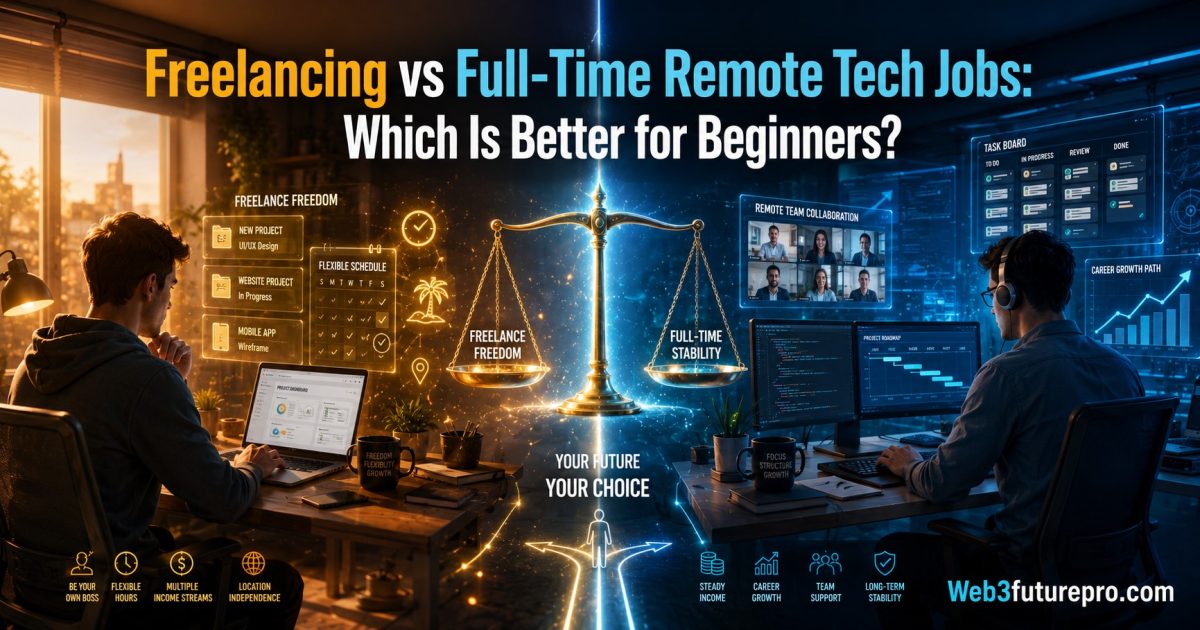
The rise of remote work has transformed the technology industry, giving aspiring professionals more career choices than ever before. Among the biggest decisions beginners face is whether to start as a freelancer or secure a full-time remote tech job. Both career paths offer flexibility, attractive income potential, and access to global opportunities, but they differ significantly in terms of job security, career growth, workload, and earning stability. This raises an important question: Freelancing vs Full-Time Remote Tech Jobs: Which Is Better for Beginners?
Freelancing allows individuals to work independently, choose their clients, set their own schedules, and potentially earn more as they gain experience. Full-time remote employment, on the other hand, provides a stable salary, employee benefits, structured career progression, and mentorship opportunities that can be especially valuable for those just entering the tech industry. Understanding the advantages and challenges of each option is essential before making a long-term career decision.
In 2026, companies around the world are hiring remote professionals in software development, cybersecurity, artificial intelligence, blockchain, cloud computing, UI/UX design, and data analytics. At the same time, freelance platforms continue to connect skilled tech professionals with businesses seeking flexible talent. As both markets expand, beginners have more opportunities than ever—but choosing the right starting point can significantly impact future success.
CHECK: Remote Web Development vs Cybersecurity Careers: Which Pays Better in 2026?
In this comprehensive guide, we’ll compare freelancing and full-time remote tech jobs based on earning potential, job stability, skill development, work-life balance, career advancement, and long-term opportunities. Whether you’re learning your first programming language or preparing to launch your tech career, this comparison will help you determine which path best fits your goals in 2026.
Freelancing vs full-time remote tech jobs for beginners in 2026
Every year thousands of people finish a coding bootcamp, complete an online curriculum, or teach themselves enough skills to start looking for paid work in tech. The question that follows is almost always the same: should I chase freelance gigs or hunt for a full-time remote position? In 2026 the answer is more nuanced than “whatever pays more.” For true beginners—those with limited professional experience, thin portfolios, and little client history—the two paths differ sharply in stability, learning curve, income reliability, and long-term career trajectory.
This comparison examines freelancing and full-time remote tech roles specifically through the lens of someone just starting out. It draws on 2026 market data, platform trends, salary benchmarks, and real hiring patterns across the United States, Asia, the Middle East, and South Africa. The goal is practical clarity rather than ideology. Both models can work. One is usually kinder to beginners.
Job Role Overview
Full-time remote tech jobs place you inside a company as an employee. You receive a regular salary, often benefits, and a defined set of responsibilities. Common entry-level or junior titles include junior software engineer, associate developer, junior data analyst, QA tester, technical support specialist, or implementation specialist. Work is typically organized around sprints, product roadmaps, and team goals. You report to a manager, collaborate with colleagues via Slack or similar tools, and receive structured feedback. The company provides the tools, the processes, and usually some form of onboarding or mentorship.
Freelance tech work means you operate as an independent contractor. You find clients, negotiate scope and price, deliver the work, invoice, and handle your own taxes and business administration. Beginners often start with smaller tasks: fixing bugs, building simple landing pages, writing basic scripts, performing data cleaning, or offering specialized micro-services on platforms. Projects can last from a few days to several months. You are responsible for finding the next engagement once the current one ends. There is no manager, no automatic benefits, and no guaranteed next paycheck.
The fundamental difference is employment relationship. Full-time remote work buys you stability and structure in exchange for less control over your schedule and projects. Freelancing buys you autonomy and potentially higher hourly rates in exchange for the full burden of running a small business and absorbing income volatility.
Skills Required
Both paths require technical competence, but the supporting skills diverge.
For full-time remote junior roles, the technical bar is usually a solid foundation in one or two languages or tools, basic version control with Git, an ability to read documentation, and a portfolio of personal or open-source projects that demonstrate you can ship working code. Soft skills that matter include clear written communication (critical for async teams), willingness to ask questions, reliability on deadlines, and the ability to work within an existing codebase and process. Many companies still value learning agility over deep specialization at the junior level.
Freelance beginners need the same technical foundation plus a heavier set of business and client-facing skills. You must estimate work accurately, write clear proposals, manage scope creep, communicate progress without a manager prompting you, handle revisions gracefully, and collect payment. Marketing yourself—whether through platform profiles, LinkedIn, or cold outreach—becomes part of the job. Time management and the discipline to treat non-billable hours (proposals, administration, learning) as necessary costs are essential. Beginners who treat freelancing purely as “coding for money” often struggle because the non-technical work consumes more energy than expected.
In short, full-time remote roles primarily test whether you can contribute to a team’s codebase and culture. Freelancing tests whether you can run a one-person service business while delivering technical results.
Salary Comparison
Raw numbers can mislead beginners. Freelance hourly rates often look higher, yet annual take-home and effective hourly earnings frequently favor stable full-time roles in the early years.
In the United States in 2026, entry-level or junior full-time remote software engineering roles commonly range from roughly $70,000 to $120,000 base, with some higher-end postings reaching into the low six figures depending on company and location benchmarking. Total compensation can include benefits, equity, and bonuses that add meaningful value. Data from remote job analyses show junior remote developers often landing in the $78,000–$112,000 range for base pay in strong markets.
Freelance rates for junior tech work are more fragmented. On major platforms, beginners frequently start in the $25–$50 per hour range for web development, data tasks, or similar work, climbing as reviews accumulate. Experienced mid-level freelancers commonly charge $50–$100+ per hour, and seniors command $100–$200 or more in specialized niches. However, beginners rarely bill 40 hours every week. Non-billable time for proposals, revisions, client communication, and platform fees commonly reduces effective earnings. After self-employment taxes, health insurance, software costs, and unpaid time off, a beginner freelancing full-time often nets less than a comparable junior full-time salary in the first one to two years.
In Asia, local full-time junior salaries remain lower than U.S. figures, but remote international full-time contracts can close much of the gap. Freelance rates for beginners in India, the Philippines, or Vietnam start lower still, though strong English and solid portfolios enable access to higher-paying international clients over time. In the Middle East and South Africa, full-time remote roles with international companies frequently offer more predictable and higher effective compensation for newcomers than pure local freelancing, while still providing the lifestyle benefits of remote work. Geographic arbitrage works better once a freelancer has reviews and a track record; pure beginners usually find the stability of a salary more advantageous.
The hidden costs of freelancing—taxes, benefits, equipment, downtime between projects—mean that a $60–$80 hourly rate does not automatically translate into higher annual income than a $90,000 full-time salary for someone still building momentum.
Remote Work Opportunities
Both models are inherently remote-friendly, yet the volume and accessibility of opportunities differ for beginners.
Full-time remote tech openings remain abundant in 2026. Many companies continue to hire distributed junior talent, especially for roles that can be onboarded asynchronously. Entry-level remote postings exist in software engineering, QA, data, support, and implementation tracks. Competition is real—junior roles attract many applicants—but structured hiring processes, clear job descriptions, and the possibility of referrals or bootcamp partnerships create accessible pathways. Time-zone preferences exist, yet global-friendly companies hire across regions when skills and communication are strong.
Freelance opportunities are also plentiful on platforms, but the barrier to consistent paid work is higher for beginners. Platforms are flooded with proposals. New accounts without reviews face steep competition. Success often requires underbidding initially, specializing in less saturated micro-niches, or leveraging personal networks. Once a freelancer accumulates positive feedback and a portfolio of delivered projects, opportunities expand significantly and can become more flexible than most full-time roles. For pure beginners, the pipeline of steady work is less reliable than a full-time salary.
In practical terms, full-time remote roles currently offer more accessible paid opportunities for people with limited professional history. Freelancing rewards those who already have proof of delivery or the patience and marketing skill to build that proof quickly.
Best Platforms to Apply
For full-time remote tech jobs, beginners should prioritize boards that surface junior or entry-level listings and companies open to less experienced talent. LinkedIn remains essential for both applications and networking. We Work Remotely, Remote OK, Wellfound, Himalayas, and FlexJobs (for vetted listings) consistently carry remote tech roles. Company career pages, especially at startups and mid-size remote-first firms, often post junior openings before they appear widely. Bootcamp career services and alumni networks can also provide warm introductions.
CHECK: Best Platforms for Finding Remote Web3 and AI Jobs in 2026
For freelancing, Upwork and Fiverr are the most common starting points for beginners because they allow rapid profile creation and proposal submission. Freelancer.com and similar marketplaces offer additional volume. Niche platforms focused on specific skills (design, writing, or certain development stacks) can reduce competition. Contra and other lower-fee or fee-free platforms appeal to those building a personal brand. Direct outreach via LinkedIn or personal websites becomes more effective once a few successful projects exist. Beginners should treat platform work as a portfolio-building phase rather than a permanent high-income strategy.
In both cases, a strong, specific portfolio and clear communication outperform generic applications or proposals.
Career Growth Potential
Full-time remote roles generally provide clearer early-career growth for beginners. Structured feedback, code reviews, exposure to larger systems, mentorship from senior engineers, and internal mobility create a learning environment that accelerates skill development. Many juniors progress to mid-level within two to three years through consistent performance. Equity and promotion paths can compound long-term earnings.
Freelancing growth is more self-directed. Early years often involve low-rate work to gather reviews. Over time, successful freelancers raise rates, specialize, move to direct clients, or productize services. Some eventually build agencies or product businesses. The ceiling can be higher for those who master both technical delivery and business development, but the path is less linear and requires deliberate skill-building outside pure coding. Many successful freelancers first spent years in full-time roles to gain depth and confidence before going independent.
A common and effective pattern in 2026 is to begin with a full-time remote position, develop skills and savings, then transition to freelancing or a hybrid model once a stronger foundation exists.
Pros and Cons
Full-Time Remote Pros for Beginners Predictable income and benefits reduce financial stress. Structured learning through mentorship, code reviews, and real production systems. Clearer path to mid-level and senior roles. Less administrative overhead. Easier to build professional references and network inside a company.
Full-Time Remote Cons for Beginners Less control over projects and schedule. Potential for slower income growth compared with successful freelancing later. Dependence on company performance and management quality. Some roles still carry residual return-to-office pressure or time-zone constraints.
Freelancing Pros for Beginners High autonomy over schedule and project selection once established. Potential for higher effective hourly rates after the initial period. Direct relationship between skill improvement and income. Flexibility to work across multiple clients and industries. Strong portfolio of varied work.
Freelancing Cons for Beginners Income volatility and feast-or-famine cycles. Difficulty landing first clients without reviews. Responsibility for taxes, insurance, retirement, and unpaid time off. Significant non-billable work. Higher risk of scope issues or difficult clients when experience is limited. Steeper self-management requirements.
Beginner Friendliness
Full-time remote tech jobs are generally more beginner-friendly. Companies expect juniors to learn on the job. Hiring processes evaluate potential, cultural fit, and foundational skills more than an extensive client history. A solid portfolio of personal projects, contributions to open source, or bootcamp capstones can open doors. Once hired, the environment supplies the structure many beginners need.
Freelancing is less forgiving at the start. Platforms reward proven delivery. Beginners often face dozens of competing proposals, pressure to lower rates, and the challenge of translating technical ability into client-ready communication. Those who succeed early usually combine strong technical demos with persistent outreach, niche positioning, or existing personal networks. It is possible, but it demands more self-direction and emotional resilience than most full-time junior roles.
For candidates in Asia, the Middle East, or South Africa, full-time remote roles with international companies frequently provide better entry points and more reliable income than pure freelancing against global competition. Once experience and reviews exist, freelancing becomes a stronger option for geographic arbitrage.
Industry Demand
Demand for both models remains healthy in 2026. Companies continue to hire full-time remote talent across software engineering, data, DevOps, QA, and related fields. Junior openings exist, though competition is higher than at mid and senior levels. The overall tech employment outlook supports steady hiring.
Freelance demand is also robust, particularly for specialized or project-based needs. Businesses of all sizes hire contractors for defined scopes, overflow work, or skills they lack in-house. AI-related, full-stack, and niche technical services see consistent platform activity. However, the supply of freelancers is large, which intensifies competition at the beginner end.
The practical result for newcomers is that full-time remote roles currently present a larger volume of accessible paid opportunities with lower variance. Freelancing offers abundant project volume but filters more aggressively for proven reliability.
For most beginners in 2026, a full-time remote tech job is the better starting point. It provides income stability, structured learning, benefits, professional references, and a clearer runway to mid-level competence. These advantages compound. Once a solid foundation of skills, savings, and professional credibility exists, transitioning to freelancing—or running a hybrid model—becomes far more viable and potentially more lucrative.
Freelancing can work for highly self-directed beginners with strong portfolios, existing networks, or specialized micro-skills that face less competition. It rewards entrepreneurship and can produce higher earnings later. Yet the early months or years often involve inconsistent income and steep non-technical learning that many new tech workers underestimate.
The optimal sequence for the majority is clear: secure a full-time remote role, grow rapidly inside a supportive environment, then decide whether independence, higher upside, or continued employment best matches your goals and risk tolerance. Both paths remain open and valuable. Starting with stability simply gives most beginners a stronger platform from which to choose.
Both freelancing and full-time remote tech jobs offer rewarding opportunities for beginners, but the better choice depends on your experience level, financial goals, and preferred work style. Freelancing provides unmatched flexibility, independence, and the potential to increase your income by working with multiple clients. However, it also requires strong self-discipline, client acquisition skills, and the ability to manage inconsistent workloads and income.
For most beginners, a full-time remote tech job is often the stronger starting point. It offers steady income, mentorship, structured training, employee benefits, and the chance to build real-world experience while developing technical and professional skills. Once you’ve established a solid portfolio, expanded your network, and gained confidence, transitioning into freelancing—or combining both career paths—can open even greater earning opportunities.
Ultimately, there is no one-size-fits-all answer. The most successful tech professionals continuously learn new skills, build impressive portfolios, and adapt to industry trends regardless of their employment model. Whether you choose freelancing or full-time remote work, investing in your expertise and maintaining a strong online presence will position you for long-term success in the rapidly evolving global tech industry.