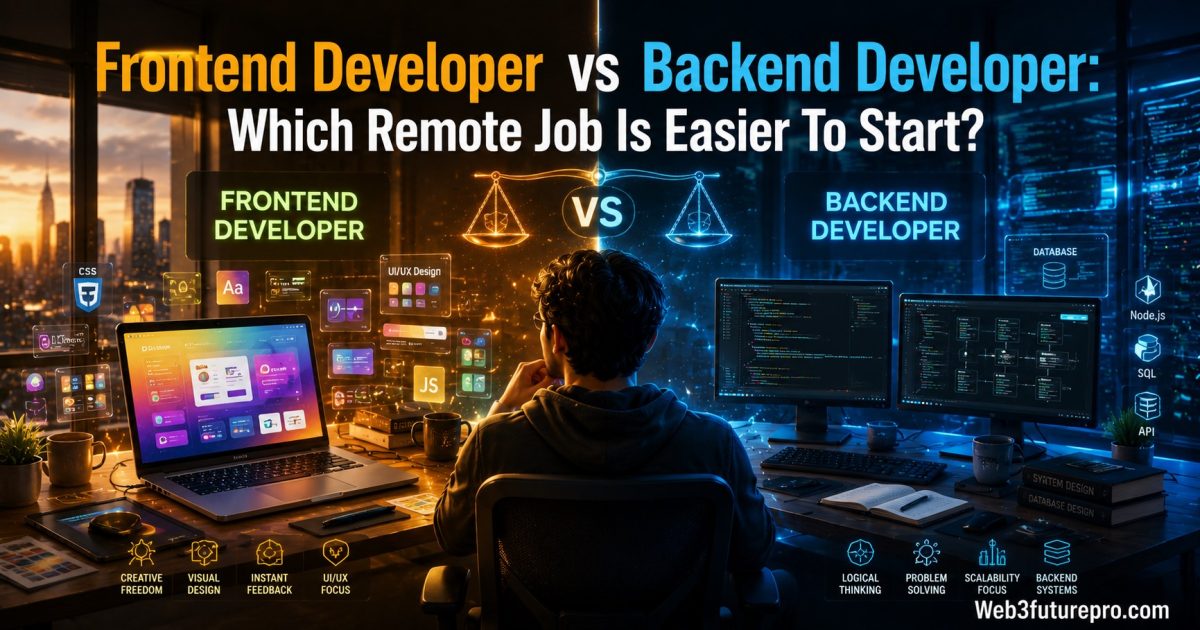
The demand for remote software developers continues to grow in 2026, creating exciting opportunities for aspiring tech professionals worldwide. Among the most popular career paths are frontend development and backend development, both of which play critical roles in building modern websites and web applications. While these specializations often work together on the same projects, they require different technical skills, responsibilities, and learning paths. For beginners looking to enter the remote workforce, one important question stands out: Frontend Developer vs Backend Developer: Which Remote Job Is Easier to Start?
Frontend developers focus on creating the visual and interactive elements users see and interact with, using technologies such as HTML, CSS, JavaScript, and modern frameworks like React, Vue, and Angular. Backend developers, in contrast, build the server-side logic, databases, APIs, authentication systems, and application infrastructure that power websites behind the scenes. Both careers offer competitive salaries, excellent job security, and abundant remote work opportunities, but they differ in terms of learning difficulty, portfolio requirements, and entry-level hiring trends.
CHECK: Blockchain Developer vs AI Engineer: Which Remote Career Has More Opportunities?
Frontend vs backend developer remote jobs for beginners in 2026/2027
As companies continue to embrace remote work, organizations are actively seeking skilled developers who can collaborate effectively from anywhere in the world. Whether you’re changing careers, learning to code through online courses, or pursuing self-taught development, choosing the right specialization can significantly influence how quickly you land your first remote tech job.
In this comprehensive comparison, we’ll examine frontend and backend development based on learning curve, required programming languages, salary expectations, job demand, portfolio requirements, career growth, and remote hiring opportunities. By the end of this guide, you’ll have a clear understanding of which path is easier to start and which aligns best with your interests and long-term career goals in 2026.
If you are deciding where to begin a remote tech career in 2026, the frontend-versus-backend question comes up almost immediately. One path deals with everything users see and interact with in the browser. The other powers the logic, data, and servers that make those interfaces work. Both are fully remote-friendly. Both pay solid junior salaries. Yet for someone with little or no professional experience, one route consistently offers a smoother on-ramp.
This article examines the practical differences for beginners. It covers learning curves, portfolio building, entry-level remote openings, salaries across the United States, Asia, the Middle East, and South Africa, and the day-to-day realities of each role. The goal is not to declare a universal winner but to show which path is easier to enter right now and why.
Job Role Overview
A remote frontend developer builds the client-facing side of web and web-adjacent applications. That includes layout, styling, interactivity, performance in the browser, accessibility, and the connection points to backend APIs. Modern frontend work centers on JavaScript or TypeScript, HTML, CSS, and frameworks such as React, Next.js, Vue, or similar tools. Developers spend their time translating designs into responsive interfaces, managing state, handling user events, optimizing load times, and ensuring the experience works across devices and browsers.
A remote backend developer builds and maintains the server-side systems. Responsibilities include designing APIs, working with databases, implementing business logic, handling authentication and authorization, managing data integrity, scaling services, and ensuring security and reliability. Common stacks involve Node.js, Python, Java, Go, or similar languages paired with relational or NoSQL databases, caching layers, and cloud services. The work is less visual; success is measured by correct data flow, uptime, performance under load, and clean interfaces for other systems.
Both roles collaborate closely in most product teams. Frontend developers consume the APIs that backend developers create. In smaller companies or startups the lines blur, and many early-career developers eventually learn both. Pure junior openings, however, still tend to specialize.
Skills Required
Frontend beginners need a solid grasp of HTML structure, CSS layout and responsive design, and core JavaScript. From there the focus shifts to a modern framework (React dominates postings), component thinking, basic state management, consuming REST or GraphQL APIs, version control with Git, and browser developer tools. Soft skills include attention to visual detail, understanding of user experience basics, and clear communication with designers. A public portfolio of interactive projects is the primary proof of ability.
Backend beginners require stronger foundations in programming logic, data structures, and how the web works under the hood (HTTP, request-response cycles). They need proficiency in at least one backend language, database fundamentals (SQL is essential), basic API design, authentication concepts, and error handling. Familiarity with a framework (Express, Django, Spring, or equivalents), environment configuration, and simple deployment helps. Soft skills lean toward systematic problem-solving, careful attention to edge cases, and documentation. Demonstrating ability usually requires projects that show working APIs, data models, and perhaps simple authentication flows—harder to showcase visually than a polished frontend.
Frontend offers faster visible progress. Changing a style or adding a button produces immediate browser feedback. Backend progress is more abstract; results appear in logs, database queries, or network responses. That difference shapes motivation and the speed at which beginners can assemble a portfolio.
Salary Comparison
At the junior remote level in 2026 the two paths are close in cash compensation, especially in the United States. Junior frontend and backend roles commonly fall in overlapping ranges. U.S. remote junior frontend averages often sit near $80,000–$95,000, with broader reported figures from the high $60,000s to low six figures depending on company and exact title. Junior backend roles show similar bands, frequently $75,000–$100,000 or slightly higher at the upper end for stronger candidates.
Global remote averages for frontend developers hover around $70,000, reflecting the mix of locations. In South Africa junior frontend salaries average roughly R20,000–R30,000 per month locally, with remote international contracts paying substantially more. In Asia (particularly India) entry-level local ranges start lower (often ₹6–15 LPA for frontend), while remote contracts for capable juniors improve the picture. Middle Eastern markets show competitive local packages for both specializations when tied to digital transformation projects. Backend juniors in many of these regions sometimes command a modest premium once they demonstrate database and API competence, but the gap is not dramatic at the true entry level.
Senior compensation often tilts toward backend or specialized systems roles because of scarcity around reliability, security, and scale. For pure beginners the starting salaries are comparable enough that ease of entry and learning speed matter more than the first paycheck difference.
Remote Work Opportunities
Both specializations support fully remote work. Frontend roles appear frequently on general remote boards and company career pages. Backend roles show a slightly higher percentage of fully remote listings in some datasets, partly because server-side work depends less on design collaboration tools or real-time visual reviews.
Entry-level volume favors frontend. Analyses of job postings consistently show more junior or associate frontend openings than pure junior backend positions. Backend teams often prefer candidates who already understand systems, data, and failure modes; companies are more willing to train juniors on the visual and interactive side. Full-stack junior roles exist and can serve as a bridge, but pure frontend still offers the largest number of accessible first remote jobs for people with limited experience.
Time-zone flexibility is good for both, though some product teams prefer overlapping hours for frontend work that involves designers or product managers. Backend roles focused on infrastructure or internal services sometimes allow greater schedule independence.
Best Platforms to Apply
Junior remote frontend developers find volume on LinkedIn (with careful filtering), We Work Remotely, Remote OK, Wellfound, Himalayas, and Arc. Company career pages at product startups and mid-size SaaS firms regularly list associate or junior frontend positions. Portfolio sites and GitHub remain essential supplements.
Junior backend seekers use the same boards but face fewer pure entry-level listings. Targeting companies that explicitly mention junior, associate, or “early career” backend or API roles helps. Full-stack junior postings that emphasize backend learning can also serve as entry points. Specialized platforms and direct outreach to smaller teams that need API support occasionally yield results.
In both cases a focused portfolio outperforms generic applications. Frontend candidates benefit from live demos; backend candidates benefit from clear README documentation of API endpoints, database schemas, and deployment notes.
Career Growth Potential
Frontend growth paths lead toward senior UI engineering, design-system ownership, performance specialization, accessibility leadership, or frontend architecture. Many move into full-stack or product-engineering hybrid roles. The visual nature of the work makes impact easy to demonstrate early.
Backend growth often moves into systems design, distributed services, data engineering, platform engineering, security, or technical leadership. The skills compound strongly; deep backend experience remains scarce relative to demand at senior levels. Some data suggest backend seniors hold a compensation edge in certain markets because of the operational criticality of their work.
Both paths support long-term remote careers. Developers who start in one area frequently expand into the other. Starting on the easier-entry side does not lock anyone into a permanent specialization.
Pros and Cons
Frontend Pros for Beginners Immediate visual feedback keeps motivation high. Easier to build a shareable public portfolio. Larger volume of junior remote openings. Many free learning resources and bootcamp curricula focus here. Clear connection between code and user experience.
Frontend Cons for Beginners Framework and tooling churn can feel constant. Advanced topics (complex state, performance, accessibility, cross-browser quirks) become demanding. Competition for junior roles is high because the path is popular. Some markets show softer demand signals for pure frontend in 2026 as AI tools assist routine UI work.
Backend Pros for Beginners Skills tend to be more stable over time. Strong long-term demand around data, reliability, and systems. Clear path to high-impact senior roles. Often slightly higher remote percentage and sometimes better senior compensation.
Backend Cons for Beginners Steeper early learning curve and more abstract feedback. Fewer pure junior openings. Harder to showcase work publicly without a product context. Debugging can feel opaque at the start (logs, traces, database states).
Beginner Friendliness
Frontend is easier to start for most beginners. The feedback loop is fast and concrete: change code, refresh the browser, see the result. Building a portfolio of interactive pages, small apps, or polished components is straightforward and publicly demonstrable. Many structured curricula and free resources target this path. Entry-level remote postings are more numerous, giving candidates more chances to land a first role.
Backend is learnable but requires more patience with abstract concepts before anything tangible appears. Databases, HTTP mechanics, authentication flows, and server configuration introduce complexity earlier. Portfolio projects need more explanation to convey value. Companies hire fewer pure juniors into backend roles because mistakes can affect data integrity or security. Beginners who already enjoy systems thinking, logic puzzles, or data modeling adapt faster.
Self-taught learners and career switchers without prior computer-science backgrounds usually find the frontend ramp gentler. Those with strong analytical backgrounds or prior scripting experience may prefer starting on the backend.
Industry Demand
Both specializations remain in demand in 2026. Software development overall continues to grow faster than average occupations. Frontend postings are numerous, though some regional data show increased competition and pressure from AI-assisted tooling on routine tasks. Backend demand is robust, particularly around reliable services, data handling, and integration with AI systems.
Entry-level opportunities still tilt toward frontend. Backend junior roles exist but form a smaller share of total openings. Full-stack junior positions that lean frontend or provide backend mentorship offer additional doors. Across the United States, Asia, the Middle East, and South Africa, remote-friendly companies continue to hire both, with frontend providing the broader set of first-job targets for newcomers.
For most beginners seeking a remote tech job in 2026, frontend development is easier to start. The combination of faster visual feedback, simpler early portfolio creation, and a higher volume of junior openings creates a more accessible entry point. Backend development is equally valuable and often leads to strong long-term opportunities, but it presents a steeper initial climb and fewer pure entry-level remote roles.
The practical recommendation is clear: if you have no strong preference, begin with frontend. Build real projects, land a first remote junior role, gain professional experience and confidence, then expand into backend skills or full-stack work if that direction appeals. Many successful backend and full-stack engineers started exactly this way.
Choose based on genuine interest when possible. People who love visual problem-solving and user interaction will progress faster on the frontend path. People who prefer systems, data, and invisible reliability will eventually thrive on the backend. For pure ease of getting started and securing that first remote paycheck, frontend currently holds the advantage.
When comparing Frontend Developer vs Backend Developer, both career paths offer excellent remote opportunities, strong earning potential, and long-term career growth. However, for most beginners, frontend development is generally easier to start because it has a more accessible learning curve, provides instant visual feedback, and allows newcomers to build an impressive portfolio of websites and applications with relatively basic tools. This makes it easier to showcase practical skills to potential employers and freelance clients.
Backend development, while equally rewarding, often requires a deeper understanding of programming concepts, databases, server architecture, APIs, authentication, cloud services, and system security. Although the learning journey can be more challenging, backend developers are highly valued for building scalable, secure, and reliable applications, leading to excellent career prospects and competitive salaries.
Ultimately, the best choice depends on your interests and strengths. If you enjoy creating beautiful user interfaces and enhancing user experiences, frontend development may be the ideal starting point. If you prefer solving complex technical problems, working with data, and building application logic, backend development could be the better fit. Regardless of the path you choose, continuously improving your coding skills, building real-world projects, contributing to open-source initiatives, and maintaining a strong portfolio will greatly improve your chances of securing a high-paying remote developer job in 2026 and beyond.