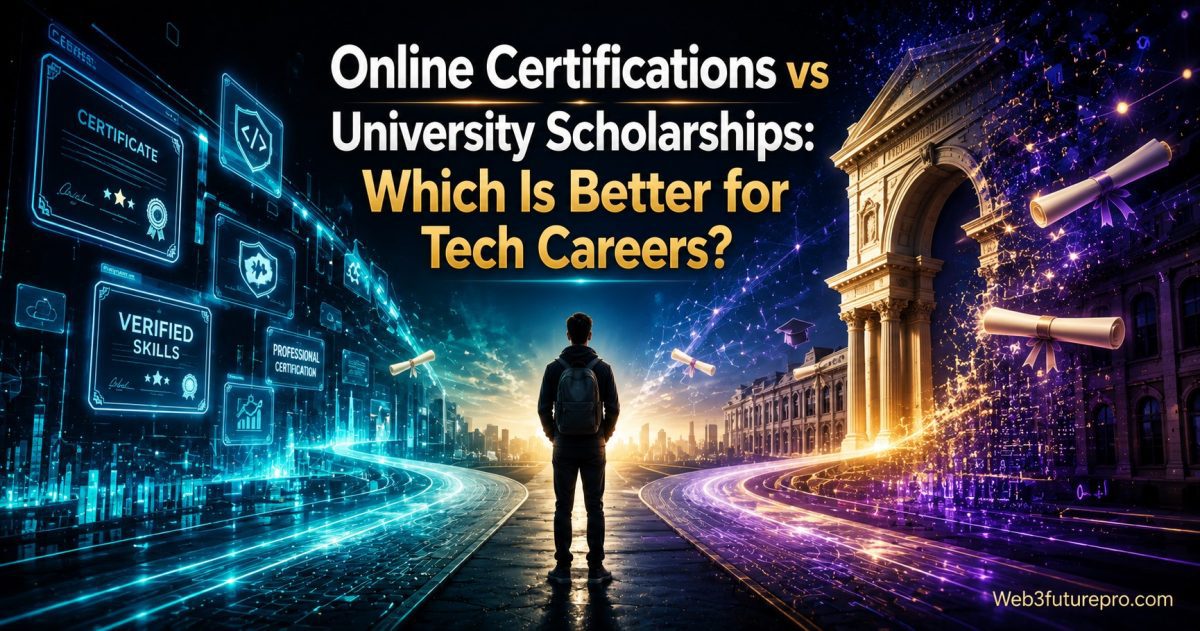
Online Certifications vs University Scholarships: The technology industry has evolved rapidly over the past decade, creating multiple pathways to build a successful career. While a traditional university education remains valuable, the growing popularity of online learning platforms and industry-recognized certifications has given aspiring professionals more options than ever before. This has sparked an important debate among students and career changers: Online Certifications vs University Scholarships: Which Is Better for Tech Careers?
Online certifications from leading technology companies and educational platforms enable learners to develop practical, job-ready skills in areas such as artificial intelligence, cloud computing, cybersecurity, software development, data science, blockchain, and digital marketing. These programs are often affordable, flexible, and designed to help learners enter the workforce quickly. On the other hand, university scholarships provide access to bachelor’s, master’s, and doctoral degree programs at world-class institutions, offering comprehensive academic training, research opportunities, networking, and internationally recognized qualifications with reduced or fully covered tuition costs.
CHECK: Chevening Scholarship vs Fulbright Program: Which Scholarship Is Better for International Students?
In 2026, employers increasingly value demonstrable skills alongside formal education. Many global technology companies now hire professionals based on technical ability, project portfolios, certifications, and real-world experience rather than academic credentials alone. At the same time, university graduates continue to benefit from structured learning, faculty mentorship, research experience, and extensive professional networks that can accelerate long-term career growth.
In this comprehensive comparison, we’ll examine online certifications and university scholarships based on cost, learning flexibility, industry recognition, hiring potential, salary prospects, career advancement, return on investment, and long-term value. Whether you’re starting your first tech career or planning to upskill for better opportunities, this guide will help you determine which path offers the greatest advantage in 2026.
In 2026 the tech job market no longer treats a university degree as the only legitimate entry ticket. Employers increasingly hire on demonstrated skills, portfolios, and targeted credentials. At the same time, fully or partially funded university programmes—especially those backed by scholarships—continue to deliver depth, networks, and long-term career ceilings that short-form credentials rarely match on their own.
This comparison examines online professional certifications (Google Career Certificates, AWS, Microsoft Azure, CompTIA, Google Cloud, AI-specific credentials, and similar industry programmes) against university scholarships that fund bachelor’s, master’s, or specialised tech degrees. It is written for a global audience, with particular relevance for learners in the United States, Asia, the Middle East, and South Africa who are deciding how to invest limited time and money in a tech career.
Online Certifications vs University Scholarships: Program Overview

Online certifications are short, skills-focused programmes offered by technology companies, professional bodies, or platforms such as Coursera, edX, and vendor academies. Typical examples include Google Data Analytics or Cybersecurity Professional Certificates, AWS Certified Solutions Architect, Microsoft Azure Administrator, CompTIA Security+, and newer AI practitioner credentials. Most can be completed in weeks to a few months, often entirely online and at low direct cost (exam fees frequently range from under $100 to a few hundred dollars; full certificate pathways may cost a few thousand). They validate practical, job-ready competencies that employers can immediately recognise.
University scholarships fund formal academic study at accredited institutions. These range from fully funded master’s programmes (Chevening-style leadership awards, DAAD, Erasmus Mundus, national government scholarships, or university-specific merit awards) to partial tuition waivers and research assistantships for bachelor’s or postgraduate tech degrees. The outcome is a recognised academic credential—often a bachelor’s or master’s in computer science, data science, cybersecurity, or related fields—earned over one to four years. Scholarships reduce or eliminate tuition and may include stipends, travel, and living support.
| Aspect | Online Certifications | University Scholarships (Degree Programmes) |
|---|---|---|
| Typical Duration | Weeks to 6–12 months | 1–4 years |
| Primary Focus | Job-specific technical skills | Broader academic foundation + specialised knowledge |
| Credential Type | Industry certificate / digital badge | Academic degree (BSc, MSc, etc.) |
| Delivery | Mostly self-paced or structured online | Campus, online, or hybrid; structured curriculum |
| Cost to Learner (typical) | Low ($0–few thousand) | Low to zero if fully funded; otherwise high |
| Main Provider | Tech vendors, platforms, professional bodies | Universities + government/foundation sponsors |
Certifications prioritise speed and immediate applicability. Scholarships prioritise depth, formal recognition, and structured academic development.
Eligibility Requirements
Online certifications generally have minimal formal barriers. Most require only basic literacy, internet access, and the ability to complete coursework and pass an exam. Some advanced certifications recommend or assume prior experience (for example, AWS Solutions Architect Professional expects familiarity with cloud concepts). Age, nationality, and prior degrees are rarely restrictions. Payment of exam or programme fees is the main practical requirement.
University scholarships are more selective. Common requirements include a strong academic record (GPA or equivalent), proof of English proficiency (IELTS/TOEFL or medium-of-instruction evidence), letters of recommendation, a statement of purpose or research proposal, and sometimes relevant work experience. Fully funded international scholarships often add nationality or residency criteria, leadership or impact potential, and a commitment to return home or contribute to development goals. Age limits and field-of-study restrictions appear in many programmes.
| Criterion | Online Certifications | University Scholarships |
|---|---|---|
| Prior Degree | Rarely required | Usually required for master’s; variable for bachelor’s |
| Academic Performance | Not formally assessed | Strong GPA / transcripts typically expected |
| Work Experience | Helpful for advanced certs | Often preferred or required |
| Language Proficiency | Functional English usually sufficient | Formal test scores commonly required |
| Nationality / Residency | Open almost globally | Frequently restricted by programme rules |
| Leadership / Impact Evidence | Not required | Frequently weighted in selection |
Certifications are far more accessible at the entry point. Scholarships demand stronger academic and personal narratives.
Application Process
Applying for online certifications is straightforward. Learners create an account on the provider platform, enrol in the course or exam preparation pathway, complete modules (often self-paced), and schedule the proctored exam. Some programmes issue certificates upon course completion; others require a separate paid exam. Turnaround from start to credential can be measured in weeks.
University scholarship applications are multi-stage and competitive. Applicants typically submit academic transcripts, CV, personal statement or research proposal, recommendation letters, language scores, and sometimes a portfolio or interview. Deadlines are fixed (often months in advance of the academic year). Selection committees evaluate academic merit, fit with the programme, and potential impact. Successful candidates then complete university admission processes alongside or after the scholarship decision.
The certification route rewards consistent study and exam performance. The scholarship route rewards long-term preparation, strong writing, and institutional endorsement.
Benefits & Funding
The financial and practical differences are substantial.
Online certifications cost little. Exam fees for major cloud and security credentials often sit between $100 and $400. Full professional certificate pathways (for example Google Career Certificates) may cost a few hundred dollars or be available via financial aid. Time investment is low, allowing continued employment. The main “funding” is the learner’s own time and modest fees. Return on investment can appear quickly through salary premiums or faster hiring in targeted roles.
University scholarships, when fully funded, cover tuition, provide a living stipend, and may include travel, insurance, and research allowances. The total value of a one- or two-year funded master’s can reach tens of thousands of dollars (or the local equivalent). Partial scholarships reduce tuition significantly. The trade-off is opportunity cost: years spent studying rather than earning, plus the intensity of academic work.
| Benefit Dimension | Online Certifications | University Scholarships |
|---|---|---|
| Direct Cost | Very low | Low/zero if fully funded |
| Time to Credential | Fast (weeks–months) | Slow (1–4 years) |
| Living Support | None (self-funded) | Stipend common in full awards |
| Depth of Learning | Narrow, applied | Broad + specialised |
| Networking | Platform communities, limited | University alumni, faculty, peers |
| Formal Recognition | Industry-recognised | Academically recognised globally |
Certifications minimise financial risk and maximise speed. Scholarships minimise (or eliminate) tuition cost while delivering a higher-status credential and structured support.
Acceptance Rate
Online certifications have effectively open enrolment for the learning phase; the only filter is passing the exam. Pass rates vary by credential and preparation quality, but the barrier is performance rather than selection. Anyone who can pay the fee (or obtain aid) and study can attempt most entry- and mid-level certifications.
University scholarships are highly selective. Acceptance rates for prestigious fully funded programmes commonly fall in the single digits to low teens (exact figures depend on the award and applicant pool). Even partial merit scholarships at competitive universities involve ranking against strong academic cohorts. The process itself functions as a filter.
In practical terms, certifications are attainable for motivated self-learners. Scholarships remain scarce relative to demand.
Global Opportunities
Both pathways travel well, but differently.
Major online certifications (AWS, Azure, Google Cloud, CompTIA, Google Career Certificates) are recognised by employers worldwide. A candidate in Lagos, Jakarta, Dubai, or Johannesburg holding an AWS Solutions Architect or Google Data Analytics certificate can apply to remote roles or local tech firms that list those credentials. The barrier is internet access, English proficiency, and the ability to demonstrate skills in interviews or portfolios.
University scholarships open physical and academic mobility. A funded place at a strong university in Europe, North America, Asia, or elsewhere provides a recognised degree, local networks, post-study work rights in many countries, and alumni channels that persist for decades. For students from Asia, the Middle East, and South Africa, these awards frequently serve as a primary route to high-quality international education that would otherwise be unaffordable.
Certifications democratise access to skills signals. Scholarships democratise access to elite academic environments and geographic mobility.
Career Impact
Evidence from 2025–2026 hiring trends shows a clear shift toward skills-based evaluation in tech. Many large employers have reduced or removed degree requirements for a range of roles. Certifications in cloud, security, data, and AI frequently appear in job descriptions and can produce measurable salary premiums. Certified professionals often report faster interviews for targeted positions and mid-single-digit to low-double-digit percentage pay advantages in relevant roles.
Degrees (especially those earned with scholarship support that signals merit) retain advantages in several areas: entry into research-oriented or highly theoretical roles, leadership pipelines, regulated or government-adjacent positions, and long-term salary trajectories. A master’s or strong bachelor’s still correlates with higher lifetime earnings in many analyses, partly because it supports progression into architecture, management, and specialised research positions. University networks and career services also provide structured recruiting channels that pure certification holders must build independently.
In practice, the highest-performing tech professionals often combine both: an academic foundation (degree or strong equivalent experience) plus current, high-value certifications that demonstrate up-to-date platform skills. Pure certification paths work well for rapid entry or career switches into cloud operations, support, cybersecurity analysis, and many applied roles. Pure degree paths (especially funded ones) work well for those targeting deeper technical leadership, research, or employers that still weight formal education heavily.
Tips for Winning
For online certifications: Choose credentials that appear repeatedly in job postings for your target roles (AWS, Azure, Google Cloud, Security+, relevant AI certificates). Treat preparation seriously—use official practice exams and hands-on labs. Build a portfolio of projects that prove you can apply the knowledge. List certifications clearly on LinkedIn and your CV, and be ready to discuss them in technical interviews. Stack complementary credentials rather than collecting low-value ones.
For university scholarships: Start early. Maintain strong academic performance. Develop a clear narrative that links your background, the target programme, and your future contribution. Secure detailed recommendation letters from people who know your work. Tailor every application to the specific scholarship’s priorities (leadership, research potential, development impact, etc.). Apply to multiple programmes with overlapping timelines. Prepare thoroughly for interviews.
In both cases, continuous learning and demonstrable output matter more than any single credential. Document projects, contribute to open source where relevant, and quantify impact whenever possible.
Neither path is universally superior. The better choice depends on your starting point, timeline, financial situation, and career target.
Online certifications are generally better when you need speed, low cost, and immediate applicability. They excel for career switchers, working professionals upskilling, and candidates targeting roles where employers explicitly list platform or vendor credentials. In 2026 they offer one of the highest-ROI routes into many applied tech positions, especially in cloud, security, data, and emerging AI operations.
University scholarships are generally better when you seek depth, formal academic recognition, stronger long-term advancement potential, and the networks that come with a degree from a reputable institution. A funded degree remains one of the highest-leverage investments available, particularly for those who can secure full support and who aim at roles requiring theoretical foundations, research capability, or leadership trajectories.
For most people building a tech career in 2026, the optimal strategy is sequential or hybrid: use targeted certifications to enter or advance quickly, then pursue a funded degree or advanced study if and when greater depth or a higher ceiling becomes the constraint. Skills remain the ultimate currency; both certifications and scholarships are simply different instruments for acquiring and signalling them.
Choose the instrument that matches your current constraints and next career milestone. Then execute with focus. The market rewards capability far more than the particular badge you hold.
When comparing Online Certifications vs University Scholarships, both pathways offer significant benefits, but the better choice depends on your career objectives, financial situation, learning preferences, and the specific technology field you want to enter.
Online certifications are ideal for learners who want to acquire practical, in-demand skills quickly and begin working in the technology industry without spending several years earning a degree. Certifications in cloud computing, cybersecurity, artificial intelligence, software engineering, project management, and data analytics can strengthen your resume, demonstrate current technical expertise, and help you qualify for entry-level and mid-level roles. They are especially valuable in a fast-changing industry where continuous learning is essential.
University scholarships, however, provide a broader educational experience by combining theoretical knowledge, research opportunities, professional networking, leadership development, internships, and internationally recognized academic qualifications. For careers in advanced research, academia, engineering leadership, and highly specialized technical roles, a university degree supported by a scholarship often provides stronger long-term advantages.
For most aspiring tech professionals in 2026, the most effective strategy is not choosing one over the other—but combining both. A scholarship-funded university degree establishes a solid academic foundation, while industry-recognized online certifications demonstrate that your skills remain current with emerging technologies. This combination makes you more competitive in the global job market and better prepared for evolving employer expectations.
Ultimately, success in technology depends less on the learning path you choose and more on your ability to continuously improve your skills, build a strong portfolio, gain practical experience, and adapt to new innovations. Whether you pursue online certifications, a university scholarship, or both, investing in lifelong learning will position you for a rewarding, future-proof career in the global tech industry.