In 2026, the “fun-first” mandate has officially conquered the Web3 gaming space. No longer defined by clunky interfaces or unsustainable tokenomics, the leading Web3 gaming ecosystems are now indistinguishable from traditional AAA titles in terms of graphics and gameplay. Ecosystems like Immutable zkEVM and Polygon have become the preferred foundations for studios using Unreal Engine 5 to build immersive worlds where assets are truly owned by the players. This 2026 guide explores how the “Invisible Web3” approach—where blockchain exists entirely in the background—is onboarding millions of traditional gamers who simply want to trade their hard-earned skins and items on a global, open market.
This deep dive examines the rise of ERC-6551 (Token-Bound Accounts), a 2026 standard that allows NFTs to own other NFTs, transforming game characters into “smart wallets” that carry their own inventory across different titles. We profile the breakout hits of the year—from open-world RPGs to competitive shooters—that have successfully integrated Chain Abstraction, allowing players to jump into the action without ever seeing a seed phrase or a gas fee.
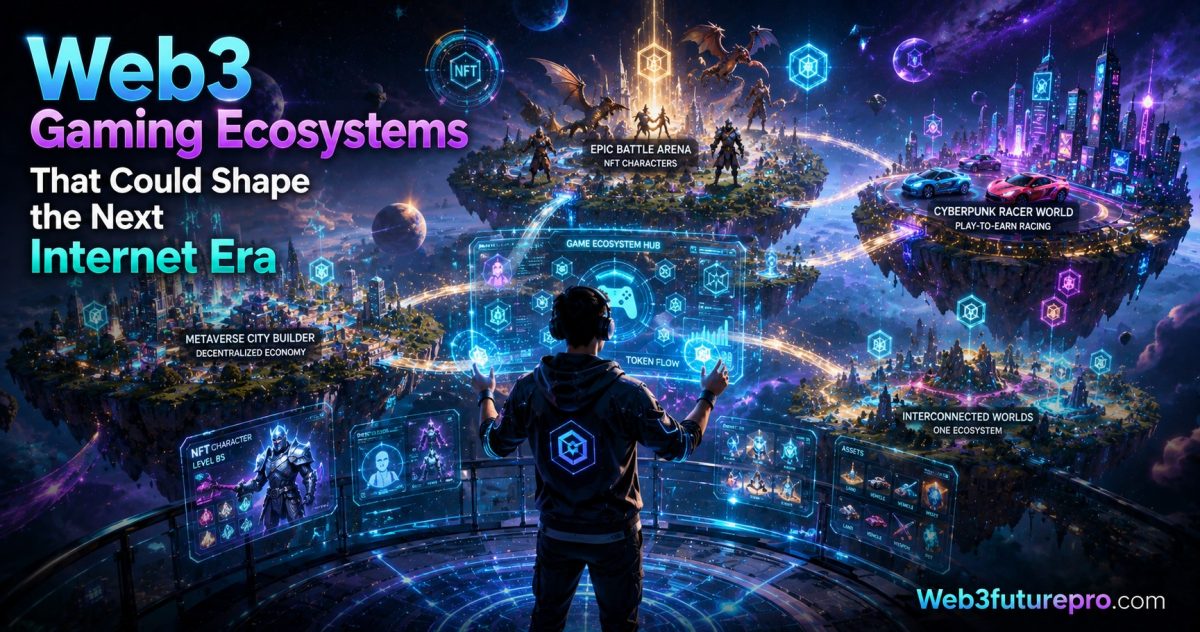
Imagine owning your in-game items, characters, and land as true digital property — tradable across different games and platforms, with real economic value that you control. Picture earning meaningful rewards for skillful play while contributing to vibrant, player-owned worlds. This is no longer a distant dream. In 2026, Web3 gaming ecosystems are maturing rapidly and positioning themselves as foundational building blocks for the next phase of the internet: an ownership-driven, creator-powered, interoperable digital economy.
CHECK: Top Blockchain Startups Building the Future of Decentralized Finance
Web3 gaming has evolved far beyond the early “play-to-earn” hype that crashed in 2022. Today, it combines high-quality gameplay, sustainable tokenomics, seamless user experiences, and true asset ownership. Leading ecosystems are attracting traditional game studios, millions of players, and serious institutional interest. The sector is no longer just about crypto speculation — it is becoming a proving ground for decentralized social experiences, digital property rights, and new creative economies.
This comprehensive guide explores the most promising Web3 gaming ecosystems in 2026, why they matter for the future of the internet, their unique strengths, current traction, challenges, and how they could reshape online interaction, creativity, and commerce for the next decade.
Why Web3 Gaming Matters for the Next Internet Era
Web3 gaming represents more than better video games. It introduces core primitives that could define the next internet:
- True Digital Ownership — Players own assets via NFTs and wallets, not platform accounts.
- Interoperability — Skins, characters, and items usable across multiple games and metaverses.
- Player-Owned Economies — Governance through DAOs and value flowing back to players and creators.
- Creator Empowerment — Anyone can build, monetize, and distribute content with reduced platform gatekeeping.
- New Social Layers — Games as persistent, decentralized social networks.
These elements address many frustrations with today’s centralized platforms: arbitrary bans, lack of asset portability, and extractive business models. Web3 gaming is quietly building the infrastructure for a more open, user-sovereign internet.
Key Trends Shaping Web3 Gaming in 2026
- Shift from Play-to-Earn to Play-and-Own and Play-to-Contribute models.
- Rise of AAA-quality titles from traditional studios entering Web3.
- Integration of AI for dynamic worlds, NPCs, and personalized experiences.
- Focus on sustainable tokenomics and long-term player retention.
- Modular blockchain infrastructure optimized for gaming (high throughput, low fees, account abstraction).
- Growing emphasis on community governance and player-driven content.
Top Web3 Gaming Ecosystems Leading the Charge
Here are the standout ecosystems poised to influence the broader internet:
1. Immutable (Immutable zkEVM)
Immutable has emerged as one of the strongest gaming-focused Layer-2 solutions on Ethereum.
- Strengths: Gas-free minting, battle-tested technology, strong partnerships with traditional game studios.
- Notable Games: Guild of Guardians, Gods Unchained (already a veteran), and several upcoming AAA titles.
- 2026 Momentum: Significant developer adoption and institutional backing. Positioned as the “go-to” infrastructure for high-quality card, strategy, and RPG games.
2. Ronin (Axie Infinity Ecosystem)
Ronin, originally built for Axie Infinity, has successfully evolved into a broader gaming hub.
- Key Features: Extremely low fees, fast transactions, and a massive existing player base.
- Evolution: Expanded beyond Axie into multiple game categories while maintaining strong community loyalty.
- Advantage: Proven ability to onboard millions of users in emerging markets.
3. Avalanche Gaming Hub
Avalanche offers high speed and low costs with its subnet architecture, allowing custom blockchains optimized for specific games.
- Strengths: Sub-second finality and excellent developer flexibility.
- Growth Areas: Multiple indie and mid-tier games building dedicated subnets.
4. Solana Gaming Ecosystem
Solana’s high throughput and mobile-friendly infrastructure make it ideal for casual and hyper-casual games.
- Highlights: Strong mobile gaming push, fast-paced titles, and integration with popular wallet ecosystems.
- 2026 Outlook: Expected to dominate casual and social gaming categories.
5. Beam (Confidential Gaming)
Beam stands out for its focus on privacy-preserving gaming using confidential computing technology. This appeals to players who want ownership without full on-chain transparency of their assets and strategies.
6. Other Notable Ecosystems
- Polygon — Strong for mass-market and social gaming.
- Carnival (by Zynga) — Traditional giant testing Web3 models.
- Mythical Games — Focus on player ownership and blockchain infrastructure.
- Parallel — High-production TCG with strong community.
How These Ecosystems Are Building the Next Internet
Digital Property Rights Web3 games are proving that players can truly own valuable digital items. This precedent could extend to social media content, virtual real estate, and personal data.
Creator Economies Players and creators earn sustainable income through play, content creation, and governance participation — creating new middle classes in the digital economy.
Interoperable Worlds Standards for cross-game asset usage are developing. A sword earned in one game could eventually be usable in another, creating a true metaverse fabric.
Social and Governance Innovation DAOs allow players to influence game direction, item economics, and ecosystem rules — a model that could influence future online communities and platforms.
Financial Inclusion Many successful Web3 games have strong adoption in emerging markets, providing earning opportunities where traditional jobs are limited.
Challenges Still Facing Web3 Gaming
- User Retention and Fun-First Design — Many early projects failed because gameplay was secondary to earning.
- Tokenomics Sustainability — Poorly designed incentives lead to boom-bust cycles.
- Regulatory Uncertainty — Classification of NFTs and tokens remains complex in many jurisdictions.
- Onboarding Friction — Wallet setup and blockchain concepts still intimidate mainstream players.
- Quality Gap — Many Web3 titles still lag behind traditional AAA production values (though this gap is closing fast).
The most successful ecosystems in 2026 are those that prioritize great gameplay first, with blockchain as an invisible ownership and economic layer.
Investment and Participation Opportunities
For Players:
- Focus on games with strong fundamentals, active communities, and sustainable economies.
- Treat assets as long-term holdings rather than quick flips.
- Participate in governance where possible.
For Developers and Entrepreneurs:
- Build on established gaming L2s rather than launching new chains.
- Prioritize fun, retention, and clear value propositions.
- Explore hybrid models that combine free-to-play with optional ownership layers.
For Investors:
- Look for teams with traditional gaming experience.
- Favor ecosystems with strong infrastructure and user growth metrics.
- Diversify across multiple promising chains and genres.
The Bigger Vision: Web3 Gaming as Internet Infrastructure
The most ambitious Web3 gaming projects are not just building games — they are building the foundational layers for the next internet:
- Persistent, player-owned virtual worlds.
- Portable digital identities and reputations.
- Creator tools that rival or surpass centralized platforms.
- Economic systems where value flows to participants rather than just platform owners.
If successful, these ecosystems could influence how we interact socially, create content, work, and own digital property far beyond gaming.
The Dawn of a New Gaming — and Internet — Era
In 2026, Web3 gaming stands at an inflection point. The technology is ready, infrastructure is scalable, and user experience is approaching mainstream standards. The projects and ecosystems that combine excellent gameplay with meaningful ownership will define not just the future of gaming, but key building blocks for the next internet.
The transition from Web2’s centralized, extractive model to Web3’s ownership-based paradigm is happening in real time within these virtual worlds. Every battle won, item crafted, or community decision made in these games is stress-testing ideas that could reshape how we live, work, and create online.
For players, creators, developers, and investors, the message is clear: Web3 gaming is no longer a sideshow. It is becoming one of the most important frontiers for innovation in the digital age.
The next internet is being built one game, one ecosystem, and one player-owned asset at a time. The question is not whether it will happen — but which ecosystems will lead the way.
By mid-2026, the distinction between “Gaming” and “Web3 Gaming” is beginning to blur. The successful ecosystems of this era have proven that Digital Ownership is not just a financial incentive, but a fundamental improvement to the player experience. Whether it is a trillion-satoshis asset in a Bitcoin L2 game or a legendary skin on a ZK-Rollup, the player’s agency is now the core mechanic.
As we look toward the 2030s, the “Next Internet Era” will be defined by these interoperable gaming identities. Our progress, achievements, and assets will no longer be locked in “walled gardens,” but will travel with us across a unified metaverse. In 2026, we aren’t just playing games; we are building the sovereign infrastructure of our future digital lives.