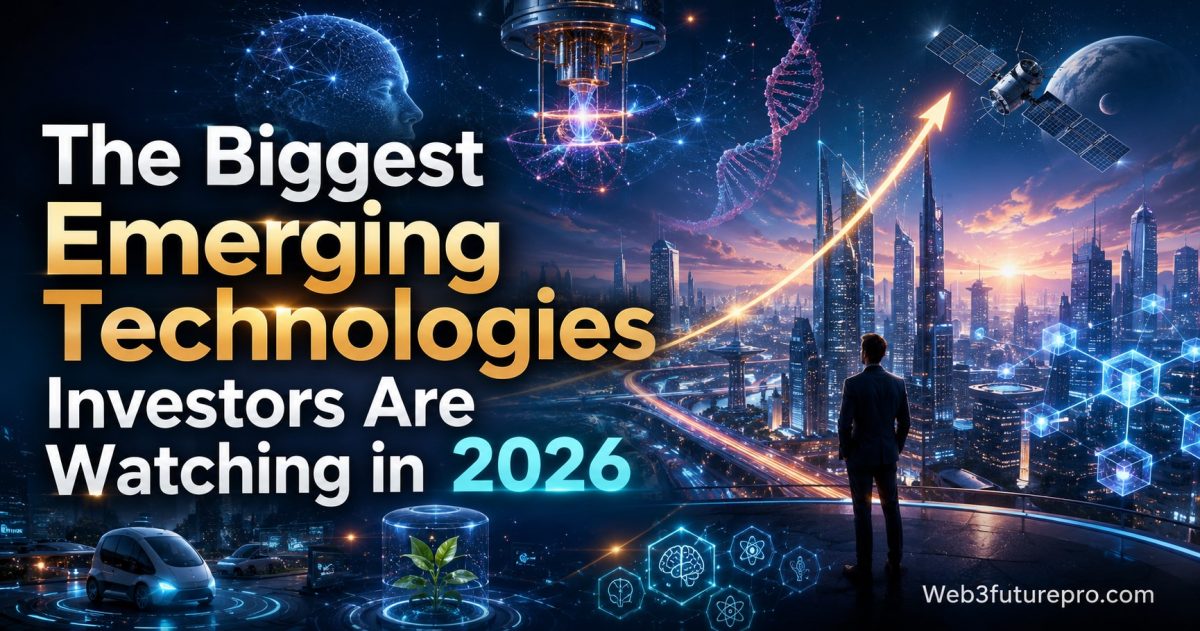
The biggest emerging technologies of 2026 represent far more than temporary trends—they are laying the foundation for the next generation of economic growth, industrial transformation, and scientific progress. From artificial intelligence and quantum computing to biotechnology, robotics, blockchain infrastructure, and clean energy solutions, these innovations are redefining how businesses operate and how societies solve increasingly complex challenges.
The technology landscape is evolving at an unprecedented pace, and 2026 is shaping up to be a pivotal year for innovation-driven investment opportunities. As artificial intelligence, robotics, biotechnology, and next-generation computing continue advancing, investors around the world are closely monitoring emerging technologies that have the potential to disrupt industries, create new markets, and generate significant long-term returns. From venture capital firms to institutional investors, the race to identify the next transformative breakthrough is more competitive than ever.
Several emerging technologies are attracting substantial attention due to their ability to solve complex global challenges and unlock new economic opportunities. Artificial intelligence remains at the forefront of investor interest, while sectors such as quantum computing, humanoid robotics, blockchain infrastructure, clean energy technology, biotechnology, and spatial computing are rapidly gaining momentum. These innovations are not only reshaping traditional industries but are also creating entirely new ecosystems for businesses, consumers, and governments.
As global investment continues flowing into high-growth technology sectors, understanding the trends driving investor confidence has become increasingly important. The technologies attracting the most capital in 2026 are those positioned to improve productivity, accelerate scientific discovery, enhance digital experiences, and address major societal challenges. For entrepreneurs, investors, and technology enthusiasts, staying informed about these emerging innovations offers valuable insight into where the future of business and technological advancement may be headed.
CHECK: Top 10 Emerging Technologies Revolutionizing the World by 2030
The last time technology transformed the global economy this profoundly, it was the mid-1990s. The internet was young, the browser had barely been invented, and a handful of far-sighted investors who bet on this strange new medium became some of the wealthiest people in human history.
We are living through that moment again — except this time, there are at least six of them happening simultaneously.
In 2026, investors are not merely tracking innovation. They are racing to position themselves ahead of technological shifts that experts are comparing to the invention of electricity, the birth of the semiconductor, and the rise of the internet — all at once. The capital flows are staggering. The timelines are compressing. And the technologies that were theoretical just three years ago are now generating revenue, attracting enterprise contracts, and quietly reshaping entire industries.
This is not a list of speculative concepts or moonshot ideas. Every technology featured in this article is already deployed at scale, attracting serious institutional capital, or both. What follows is a deep-dive into the emerging technologies that sophisticated investors — from sovereign wealth funds in the Middle East to venture capitalists in Silicon Valley and Bengaluru — are watching most closely in 2026.
Key Opportunities and Risks in Emerging Technologies
1. Artificial General Intelligence: The Race Beyond AI Tools
Why the Frontier Has Shifted
In 2023, the conversation about artificial intelligence centered on chatbots, writing assistants, and image generators. By 2026, that conversation has fundamentally changed. The world’s leading AI laboratories — Anthropic, OpenAI, Google DeepMind, and a growing cluster of well-funded challengers in China and Europe — are no longer building tools that respond to prompts. They are building systems capable of reasoning, planning across multiple steps, and executing complex multi-stage tasks with minimal human guidance.
This is the shift investors are watching with the most intensity. The question is no longer “will AI be useful?” The question is “which company will capture the value when AI becomes an autonomous economic agent?”
What Investors Are Tracking
The most capital-efficient AI companies in 2026 are those that have solved what researchers call “agentic reliability” — the ability of an AI system to complete long-horizon tasks without hallucinating, stalling, or making costly errors. Enterprise adoption is the proving ground. When a large bank in Singapore or a logistics firm in the UAE deploys an AI system to manage procurement, regulatory compliance, or customer service pipelines end-to-end, the results are measured in dollars and time — not demos.
Institutional investors are also watching the infrastructure layer. The demand for AI compute — the chips, the data centers, the cooling systems, the energy infrastructure — shows no signs of slowing. Semiconductor companies that supply the hardware backbone for AI training and inference have become some of the most closely watched stocks in global markets.
Geographic Focus
The United States retains its lead in foundation model development, but the gap is narrowing. China’s AI sector, despite regulatory friction, is producing increasingly competitive models. The Middle East — particularly the UAE and Saudi Arabia — has made sovereign AI development a strategic national priority, with multi-billion dollar commitments to data center infrastructure and homegrown large language model research. For investors with a global lens, the AI infrastructure plays in the Gulf Cooperation Council (GCC) represent one of the more underappreciated opportunities in the sector.
2. Quantum Computing: From Laboratory Curiosity to Commercial Reality
The Threshold Moment
For years, quantum computing existed at the awkward intersection of genuine scientific promise and chronic overhyping. Investors who bet on quantum timelines in 2019 or 2020 learned an expensive lesson. But 2026 is different — and the investors who ignored quantum after those early disappointments may be the ones making the expensive mistake now.
Several major quantum hardware companies have demonstrated systems that can perform specific, commercially relevant calculations faster than any classical supercomputer in existence. The technical term is “quantum advantage.” The commercial implication is that certain categories of problems — drug discovery, materials science, financial portfolio optimization, logistics routing, cryptographic modeling — can now be approached in fundamentally new ways.
Where the Money Is Moving
The investment thesis for quantum in 2026 has matured considerably. Early-stage investors are less focused on raw qubit counts and more focused on error correction and practical coherence times — the engineering challenges that determine whether a quantum processor can do useful work in the real world, not just in a physics paper.
The sector is broadly segmented into hardware companies (the fewest but the most capital-intensive), software and algorithm companies (which monetize quantum without needing to build the underlying hardware), and quantum networking companies (which are building the foundations of what some researchers call the “quantum internet”).
Pharmaceutical companies have been among the earliest enterprise adopters, using quantum simulation to model molecular interactions that would take classical computers years to compute. In the financial sector, major banks in Hong Kong, London, and New York have established dedicated quantum research divisions. In South Africa, research partnerships between universities and mining companies are exploring quantum optimization for ore extraction logistics — a use case that could have significant economic impact for the region.
3. Advanced Energy Storage: The Hidden Backbone of the Energy Transition
Beyond Lithium-Ion
Every major clean energy transition strategy in the world — from the United States Inflation Reduction Act to the European Green Deal to the vision documents of NEOM in Saudi Arabia — runs directly into the same technical constraint: you cannot run a modern economy on renewable energy alone without the ability to store that energy cheaply and reliably at grid scale.
Lithium-ion batteries, which power everything from smartphones to electric vehicles, are not sufficient for this challenge. They degrade. They use materials with difficult supply chains. They pose fire risks at large scale. And their energy density, while impressive in a consumer device, is inadequate for storing days or weeks of grid-level power.
This is why advanced energy storage — solid-state batteries, iron-air batteries, sodium-ion cells, compressed air storage, and gravitational storage systems — has become one of the most heavily funded sectors in energy technology.
Investment Landscape
The numbers are compelling. Analysts tracking the global energy storage market estimate it could represent trillions of dollars of cumulative investment opportunity through 2040. The key investment questions in 2026 center on which chemistries will win at scale, which companies have manufacturing cost curves that can compete with existing technologies, and which regions will develop the supply chains needed to support next-generation battery production.
For investors in Southeast Asia and the Middle East, the energy storage opportunity intersects directly with two major trends: the aggressive buildout of solar generation capacity and the growing concern about energy independence. Countries that can secure access to advanced storage technology early will have a significant economic advantage in a world where energy costs are increasingly tied to renewable generation and storage economics rather than fossil fuel prices.
4. Biotechnology and Synthetic Biology: Programming Life Itself
The New Industrial Revolution in Biology
If you had told a biologist in 2000 that by 2026 scientists would be routinely programming bacteria to produce pharmaceutical compounds, engineering crops to resist drought without pesticides, and using AI-designed proteins to target specific cancer cells with nanometer precision, they would have described a science fiction scenario.
It is not fiction. It is the current state of biotechnology and synthetic biology — and the investment opportunity it represents may be the single largest in human history.
The convergence of cheap DNA sequencing, advanced gene editing tools, machine learning-powered protein modeling, and industrial-scale bioreactors has created a moment where biology is becoming an engineering discipline. The implications extend far beyond healthcare. Industrial chemicals, materials, fuels, food ingredients, and agricultural inputs are all candidates for biological manufacturing — a process that is often cheaper, cleaner, and more sustainable than conventional chemical production.
Sectors Attracting the Most Capital
In healthcare, the dominant investment themes of 2026 center on cell and gene therapies (treatments that modify a patient’s own biology to cure disease rather than manage symptoms), mRNA platform technologies (which proved their value dramatically in the COVID-19 vaccine rollout and are now being applied to cancer, HIV, and rare genetic diseases), and AI-designed therapeutics (where machine learning systems design drug molecules from scratch, dramatically compressing the time and cost of drug discovery).
Outside healthcare, investors are increasingly focused on precision fermentation — using microorganisms to produce food ingredients like fats, proteins, and flavor compounds — and agricultural biotechnology, where gene-edited crops are reaching commercial scale in the United States, Brazil, and parts of Asia.
South Africa’s biotechnology sector is notable in this context. The country has significant agricultural research capacity, a growing bioeconomy, and a regulatory environment that is increasingly hospitable to advanced biological manufacturing. Investors with regional exposure to sub-Saharan Africa are watching South African biotech hubs with growing interest.
5. Autonomous Systems: When Machines Move Through the World
Beyond Self-Driving Cars
The public conversation about autonomous systems has been dominated for years by self-driving cars. That conversation, while important, misses the larger picture. The commercialization of autonomous systems in 2026 encompasses a far broader range of applications: autonomous maritime vessels, agricultural robots, warehouse automation systems, last-mile delivery drones, autonomous mining vehicles, and surgical robotics.
The common thread is the maturation of a set of enabling technologies — computer vision, sensor fusion, edge computing, and real-time AI inference — that have reached the reliability thresholds required for commercial deployment in demanding physical environments.
Where Autonomous Systems Are Already Changing Industries
In agriculture, autonomous tractors and harvesting robots are reducing labor costs and improving yield precision on large-scale farms in the United States, Australia, and Brazil. In logistics, automated guided vehicles and robotic picking systems have become standard in the large fulfillment centers of e-commerce companies globally.
In mining — a sector of particular relevance to investors with exposure to South Africa, Australia, and parts of Asia — autonomous haul trucks and drilling systems are being deployed at scale in open-pit mining operations. The safety and efficiency gains are significant enough that adoption is accelerating even in jurisdictions with strong labor protections.
The investment opportunity in autonomous systems is highly fragmented. The hardware companies that build the sensors and compute modules, the software companies that develop the autonomy stacks, and the systems integrators that deploy and maintain autonomous platforms across industries all represent distinct investment categories with different risk and return profiles.
6. Space Technology: The Commercialization of the Final Frontier
From Government Monopoly to Private Market
For the first six decades of the space age, access to space was the exclusive domain of national governments. This is no longer true. The commercialization of launch — driven primarily by reusable rocket technology developed by private companies — has reduced the cost of putting a kilogram of payload into orbit by more than 90% over the past fifteen years.
The downstream effects of cheap launch are only beginning to be felt. Satellite internet constellations are extending broadband connectivity to rural and remote regions across Africa, South Asia, and Southeast Asia — markets where fixed-line infrastructure is inadequate and mobile networks are strained. Earth observation constellations are providing near-real-time imagery and data products that are transforming agriculture, insurance, defense intelligence, and environmental monitoring. In-space manufacturing is moving from concept to pilot programs.
Investment Themes for 2026
The most sophisticated space investors in 2026 are focused less on launch — where the competitive dynamics are now well understood — and more on the applications layer: the companies that use satellite infrastructure to deliver services that were previously impossible or prohibitively expensive.
Satellite-based precision agriculture services, which use remote sensing data to give farmers field-level crop health monitoring and yield forecasting, represent a compelling commercial opportunity in regions like sub-Saharan Africa, South Asia, and Southeast Asia where smallholder agriculture is economically significant but traditional advisory services are scarce.
In the Middle East, the UAE’s ambitious space program — which successfully sent an orbiter to Mars and has ambitious plans for lunar exploration — reflects a broader regional understanding that space technology capability is both a prestige asset and a platform for economic diversification.
7. The Infrastructure of Trust: Cybersecurity and Digital Identity
Why Security Has Become a Technology Investment Thesis
In the hierarchy of technology investment themes, cybersecurity rarely generates the same excitement as artificial intelligence or quantum computing. This is a mistake. As the global economy becomes increasingly digital — and as the technologies described above create new attack surfaces, new vulnerabilities, and new categories of critical infrastructure — the demand for robust cybersecurity and digital identity solutions is compounding annually.
The specific investment themes that analysts are watching closely in 2026 include AI-native security platforms (which use machine learning to detect and respond to threats faster than human analysts can), post-quantum cryptography (the development of encryption standards that can resist attacks from quantum computers), and decentralized identity systems (which give individuals and organizations control over their digital credentials without relying on centralized authorities that can be compromised).
The post-quantum cryptography opportunity deserves particular attention. National standards bodies in the United States and Europe have now finalized the first wave of post-quantum cryptographic standards. The migration of global digital infrastructure — banking systems, government networks, critical industrial control systems — to these new standards will take years and represent a significant enterprise software opportunity.
What Sophisticated Investors Are Doing Differently in 2026
The investors generating the most alpha in emerging technology in 2026 share several characteristics that distinguish them from the retail speculation and hype-driven capital allocation that characterized earlier technology cycles.
They are investing in infrastructure, not just applications. The companies that build the foundational layers — the chips, the energy systems, the data pipelines, the security frameworks — tend to capture value across multiple application categories regardless of which specific applications ultimately win.
They are paying attention to geography. The technology investment universe is no longer a US-centric story. The Middle East’s sovereign wealth and infrastructure ambitions, Southeast Asia’s digital economy growth, India’s engineering talent and domestic market scale, and South Africa’s position as a gateway to African growth markets all represent genuine alpha opportunities for investors willing to look beyond traditional technology hubs.
They are thinking in systems, not individual companies. The most transformative technologies of 2026 do not succeed in isolation. Quantum computing depends on advanced semiconductor manufacturing. AI depends on energy infrastructure. Biotechnology depends on computational power. The investors who understand these interdependencies are better positioned to identify which companies sit at the convergence points where value creation will be most concentrated.
The technologies described in this article are not theoretical future possibilities. They are real, they are here, and they are attracting the most serious capital in global markets. The investors who succeed in this environment will be those who develop genuine technical literacy, think geographically, and resist the temptation to chase narratives rather than fundamentals.
The next decade of technology investment will reward patience, rigor, and a willingness to look where others are not looking. The opportunities are global, the timelines are accelerating, and the potential rewards — for investors, for companies, and for the societies these technologies will transform — are genuinely historic.
The question is not whether these technologies will reshape the global economy. They already are. The question is whether you are positioned accordingly.
Investors are paying close attention to technologies with the potential to create long-term value, improve efficiency, and open entirely new markets. Companies leading innovation in these sectors are attracting significant funding because they offer solutions that can reshape industries ranging from healthcare and finance to manufacturing and transportation. As technological breakthroughs continue accelerating, early identification of promising trends may provide substantial advantages for both investors and entrepreneurs.
While emerging technologies often come with uncertainty and risk, they also present some of the most exciting opportunities of the decade. The innovations gaining momentum in 2026 are likely to influence global markets, consumer behavior, and business strategies for years to come. For anyone seeking to understand the future of technology and investment, keeping a close watch on these transformative sectors will be essential as the next wave of innovation unfolds.