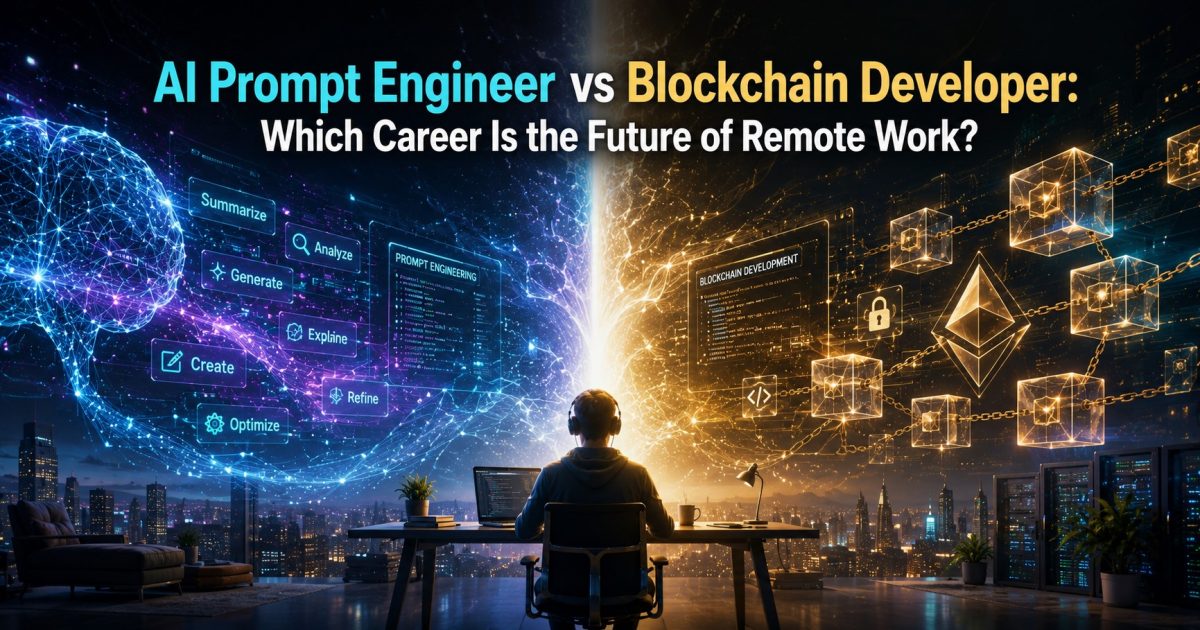
The global remote work market is evolving faster than ever, and two of the hottest tech careers in 2026 are AI Prompt Engineering and Blockchain Development. As artificial intelligence becomes embedded in business operations and Web3 technologies continue to reshape digital ownership, professionals are increasingly asking: AI Prompt Engineer vs Blockchain Developer: Which career is the future of remote work?
AI prompt engineers specialize in designing effective prompts, workflows, and automation systems for large language models such as ChatGPT, Claude, Gemini, and other generative AI platforms. Their work helps companies improve productivity, customer support, content generation, coding assistance, research, and AI-powered decision-making. Because these tasks can be performed entirely online, prompt engineering has quickly emerged as one of the most accessible remote tech careers.
Blockchain developers, on the other hand, build decentralized applications (dApps), smart contracts, DeFi protocols, NFT infrastructure, and enterprise blockchain solutions. Their expertise is critical for industries such as finance, gaming, supply chain, healthcare, digital identity, and tokenized assets. Like AI roles, blockchain development is highly compatible with remote collaboration and global hiring.
CHECK: Remote Web Development vs Cybersecurity Careers: Which Pays Better in 2026?
Both careers offer impressive salaries, international opportunities, and strong growth potential. However, they differ significantly in job availability, technical barriers, long-term stability, and future scalability. AI is expanding across virtually every industry, while blockchain remains a powerful but more specialized niche.
In this in-depth comparison, we’ll analyze salary potential, remote job demand, required skills, learning curve, automation risk, career longevity, and future industry trends to determine which path is most likely to dominate the next decade of remote work.
AI Prompt Engineer vs Blockchain Developer remote careers in 2026
In 2026 two specialized technical paths stand out for people seeking fully remote careers with strong earning potential. One sits at the center of the generative AI wave: the AI Prompt Engineer who designs, tests, and optimizes the instructions that make large language models useful, reliable, and aligned with business goals. The other lives in the decentralized world: the Blockchain Developer who builds smart contracts, protocols, and applications on distributed ledgers. Both roles are remote-friendly by nature. Both attract global talent. Yet when the question turns to which better represents the future of remote work—breadth of demand, resilience, accessibility, and long-term growth trajectory—the comparison becomes sharper.
This article examines the 2026 market for remote AI Prompt Engineer and Blockchain Developer careers across the United States, Asia, the Middle East, and South Africa. It covers role definitions, required skills, realistic compensation, remote patterns, application channels, growth potential, and which path currently shows stronger alignment with the evolving remote economy.
Job Role Overview
An AI Prompt Engineer focuses on the interface between humans and large language models. The work involves crafting precise prompts, designing evaluation frameworks, iterating on outputs for accuracy and safety, building prompt libraries or chains, integrating models via APIs, and measuring performance against business metrics. In many organizations the role has matured beyond simple chat interactions into systematic evaluation, red-teaming, RAG (retrieval-augmented generation) pipelines, and agent orchestration. Some positions remain closer to content or product operations; others sit inside AI research or engineering teams and require deeper technical collaboration.
A Blockchain Developer designs and implements software that runs on blockchain networks. Core activities include writing and auditing smart contracts (often in Solidity for EVM chains or Rust for others), building decentralized applications, integrating wallets and oracles, optimizing for gas costs and security, and participating in protocol development or Layer-2 solutions. The role demands careful attention to immutability, economic incentives, and adversarial conditions—bugs can be extremely costly. Many positions now sit at the intersection of blockchain and traditional finance, supply chain, or identity systems as institutional adoption grows.
The two roles rarely overlap in day-to-day tools, yet both reward clear thinking, iterative testing, and an understanding of systems that behave non-deterministically or adversarially.
Skills Required
AI Prompt Engineering prioritizes linguistic precision, logical structure, domain knowledge, and systematic evaluation. Strong practitioners understand how models interpret instructions, how to reduce hallucinations, how to design few-shot or chain-of-thought prompts, and how to measure outputs quantitatively. Technical depth varies: some roles require only excellent written communication and tool fluency (ChatGPT, Claude, API playgrounds); others expect Python scripting, basic API integration, evaluation frameworks, and familiarity with vector databases or agent frameworks. Soft skills—curiosity, iterative experimentation, and the ability to translate business needs into model behavior—are critical. A portfolio of documented prompt experiments, evaluation results, or production prompt systems is highly valued.
Blockchain Development demands stronger traditional engineering foundations. Core skills include proficiency in smart-contract languages (Solidity remains dominant; Rust is important for certain ecosystems), understanding of blockchain architecture, cryptography basics, security best practices, and testing tools. Experience with development frameworks, local networks, and audit processes is expected. Soft skills include careful risk assessment, clear documentation of on-chain logic, and collaboration with security researchers. Public repositories of audited or production contracts, contributions to open-source protocols, and demonstrated security awareness strengthen applications.
Both roles benefit from continuous learning. Prompt engineers must track rapid model updates and new techniques. Blockchain developers must follow protocol upgrades, emerging standards, and security incidents.
Salary Comparison
Compensation in 2026 reflects both scarcity and market cycles.
In the United States, AI Prompt Engineer average or median figures commonly fall in the $126,000–$136,000 range, with broader reported bands from roughly $90,000–$200,000 depending on seniority and company. Entry-level or less technical roles can start lower; positions at frontier labs or highly specialized evaluation roles reach significantly higher total compensation, sometimes including substantial equity. Remote roles are common and often pay close to on-site rates at AI-native companies.
Blockchain Developer median base salaries in the U.S. sit near $140,000 in several 2026 reports, with typical ranges of $110,000–$185,000 and seniors in smart-contract or protocol roles frequently clearing $175,000–$230,000 base. Total compensation at token- or equity-heavy employers can push substantially higher. Remote senior seats often command competitive figures.
Outside the United States the absolute numbers drop, yet relative attractiveness holds. In Asia, remote international contracts for both roles can multiply local market rates. Middle Eastern markets, particularly those investing in AI strategies and digital assets, offer competitive packages. South African professionals working remotely for global AI or Web3 companies achieve strong local purchasing power. In both fields, location-agnostic or remote-first employers compress geographic gaps for strong candidates.
Freelance rates follow similar patterns: specialized prompt work and smart-contract development both support high hourly or project pricing when portfolios demonstrate results.
Remote Work Opportunities
Both careers rank among the more remote-friendly technical paths. Prompt engineering work is almost entirely digital—model interaction, evaluation, and documentation require no physical presence. Many AI companies and enterprises hire prompt and AI-operations talent fully remotely. Blockchain development is similarly distributed; the Web3 ecosystem has long operated globally and asynchronously, with a high percentage of roles listed as remote.
Time-zone preferences appear in collaborative roles, yet fully asynchronous arrangements exist in both fields. Candidates based in Asia, the Middle East, and South Africa successfully land remote positions when they demonstrate clear output, reliable communication, and relevant portfolios. AI roles currently show broader industry distribution (enterprise, product, content, research), while blockchain roles cluster more tightly around crypto-native, fintech, and specialized infrastructure companies.
Best Platforms to Apply
Remote opportunities appear on LinkedIn, specialized AI job boards, Web3-focused boards (such as those aggregating blockchain roles), We Work Remotely, Wellfound, and company career pages at AI labs, product companies, and crypto protocols. For Prompt Engineers, portfolios of tested prompts, evaluation frameworks, or production use-cases matter more than formal credentials. For Blockchain Developers, GitHub repositories with verified contracts, audit reports, and contributions to open protocols carry weight.
Networking through AI communities, Discord servers, research forums, and Web3 developer groups often surfaces opportunities before they reach broad boards. Direct applications to AI product teams and protocol foundations remain effective.
Career Growth Potential
AI Prompt Engineering sits inside a rapidly expanding ecosystem. The standalone title has matured and, in some analyses, narrowed as the skill becomes expected across many AI-related roles. Growth paths lead into AI product roles, evaluation and safety engineering, LLM operations, agent development, or broader AI engineering. The underlying skill—making models reliable and useful—transfers widely as AI adoption spreads across industries. Long-term demand appears tied to the continued integration of generative AI into products and workflows.
Blockchain Development offers growth into senior smart-contract engineering, protocol design, security auditing, Layer-2 or infrastructure roles, or technical leadership in Web3 organizations. Institutional adoption, real-world asset tokenization, and continued DeFi and infrastructure development support ongoing need. The market remains more cyclical than pure AI roles, yet specialized security and protocol talent stays scarce. Paths into traditional finance technology or hybrid AI-plus-blockchain systems are emerging.
Both support independent consulting and high-value freelance work at senior levels. Hybrid profiles that combine strong prompt or AI systems skills with blockchain knowledge currently sit in interesting niche demand.
Pros and Cons
AI Prompt Engineer Pros Explosive recent demand growth. Highly remote-native. Accessible entry for strong communicators and systematic thinkers, including those without deep coding backgrounds. Broad industry applicability as AI spreads. Rapid skill evolution keeps work interesting. Strong compensation at specialized and lab-level roles.
AI Prompt Engineer Cons Title and role definition still variable—some positions are closer to advanced content operations than engineering. Risk that the pure “prompt engineer” title continues to evolve or fold into broader AI roles. Competition has increased as more people acquire basic skills. Requires continuous adaptation to new models and techniques.
Blockchain Developer Pros High compensation, especially with tokens or equity. Strong remote culture in the ecosystem. Clear technical craft with measurable outcomes (deployed contracts, security). Specialized scarcity for senior and security-focused talent. Growing institutional and real-world use cases.
Blockchain Developer Cons Higher technical barrier and steeper learning curve. Market cyclicality tied to crypto sentiment and funding. Security responsibility is intense—errors carry high stakes. Narrower industry distribution compared with general AI skills. Fewer pure junior openings relative to the skill requirements.
Beginner Friendliness
AI Prompt Engineering is generally more accessible to beginners and career switchers. Strong writing, logical thinking, domain expertise, and systematic experimentation can produce early results and portfolio pieces without advanced programming. Many entry paths exist through AI tool fluency, evaluation projects, and demonstration of improved model outputs. Coding helps for more technical roles but is not always required.
Blockchain Development has a higher barrier. Learners typically need solid programming foundations, then specialized knowledge of smart-contract languages, blockchain mechanics, and security practices. Public testnets, open-source contributions, and audited practice contracts form the practical portfolio. Pure junior roles exist but often prefer candidates with demonstrable on-chain work or prior software engineering experience.
A practical route for many is to develop foundational software or analytical skills first, then specialize according to interest—prompt systems for those drawn to language and model behavior, or smart contracts for those drawn to distributed systems and economic design.
Industry Demand
AI-related skills show broader and faster expansion in 2026. Demand for prompt engineering skills grew dramatically in recent periods, and AI capabilities appear in a rising share of tech job postings overall. The skill is becoming expected across product, research, operations, and content functions. While the exact “Prompt Engineer” title may continue to evolve, the underlying capability remains in high demand.
Blockchain and Web3 demand remains solid, supported by institutional interest, infrastructure development, and specialized security needs. Remote listings are plentiful within the ecosystem, and senior smart-contract and audit talent stays scarce. Overall volume is smaller than the broad AI category, and sentiment can fluctuate with market cycles, yet core engineering needs persist.
Across the United States, Asia, the Middle East (with national AI and digital-asset strategies), and South Africa, both profiles appear in remote postings. AI skills currently offer wider industry coverage and higher growth velocity; blockchain skills offer specialized, high-compensation niches with strong remote norms.
In 2026, AI Prompt Engineering—and more broadly the ability to make generative AI systems reliable and useful—aligns more closely with the long-term future of remote work for most people. The demand growth has been steeper, the applicability across industries is wider, the remote-native nature is clear, and the skill continues to spread even as specific job titles evolve. Compensation is competitive, and entry is relatively accessible for systematic, communicative professionals.
Blockchain Development remains a strong, well-compensated remote career with durable specialized demand, especially for security-conscious smart-contract and protocol engineers. It suits those who enjoy distributed systems, economic design, and high-stakes technical craft. Its long-term trajectory is positive but more concentrated and more sensitive to crypto-market cycles than the broader AI wave.
The highest-value remote careers will increasingly combine elements of both worlds—AI systems that interact with on-chain logic, verifiable computation, or decentralized infrastructure. For pure choice today, the AI prompt and systems path offers broader runway and closer alignment with the expanding remote economy. Choose the work whose problems you find more compelling, then build demonstrable results. Both paths reward clear thinking, rigorous testing, and continuous learning in a market that continues to value specialized remote talent.
When comparing AI Prompt Engineer vs Blockchain Developer, both careers are positioned for strong growth, but they represent different parts of the future technology landscape.
AI Prompt Engineering currently has the broader momentum. Businesses in marketing, customer service, software development, education, healthcare, finance, and operations are adopting generative AI at an unprecedented pace. This creates a large volume of remote opportunities, including freelance, contract, and full-time roles. The entry barrier is also relatively low, allowing beginners to start with prompt design, AI automation, workflow optimization, and no-code AI tools before moving into more advanced AI engineering roles.
Blockchain Development, however, remains one of the most technically valuable and difficult-to-replace skills in the Web3 ecosystem. Skilled blockchain developers who can build secure smart contracts, scalable dApps, and decentralized infrastructure are consistently in demand, particularly in DeFi, tokenization, gaming, digital identity, and enterprise blockchain projects. While the number of openings may be smaller than AI-related roles, the specialization often leads to higher compensation and stronger technical defensibility.
For remote work specifically, AI currently offers the largest number of opportunities, while blockchain offers deeper specialization and potentially higher long-term earning power for experienced developers.
A practical way to think about it is:
- Choose AI Prompt Engineering if: you want faster entry into remote work, broader industry demand, lower startup costs, and opportunities in both technical and non-technical roles.
- Choose Blockchain Development if: you enjoy programming, cryptography, decentralized systems, and want a highly specialized career with strong long-term value in the Web3 economy.
The strongest position may ultimately be combining both skills. Companies are increasingly looking for professionals who can build AI-powered decentralized applications, automate smart-contract workflows, create AI agents for Web3 platforms, and integrate generative AI into blockchain products.
In 2026 and beyond, AI is shaping the immediate future of remote work, while blockchain is building the infrastructure for the next generation of the internet. Professionals who understand both technologies will likely have the greatest advantage in the global remote tech economy.